
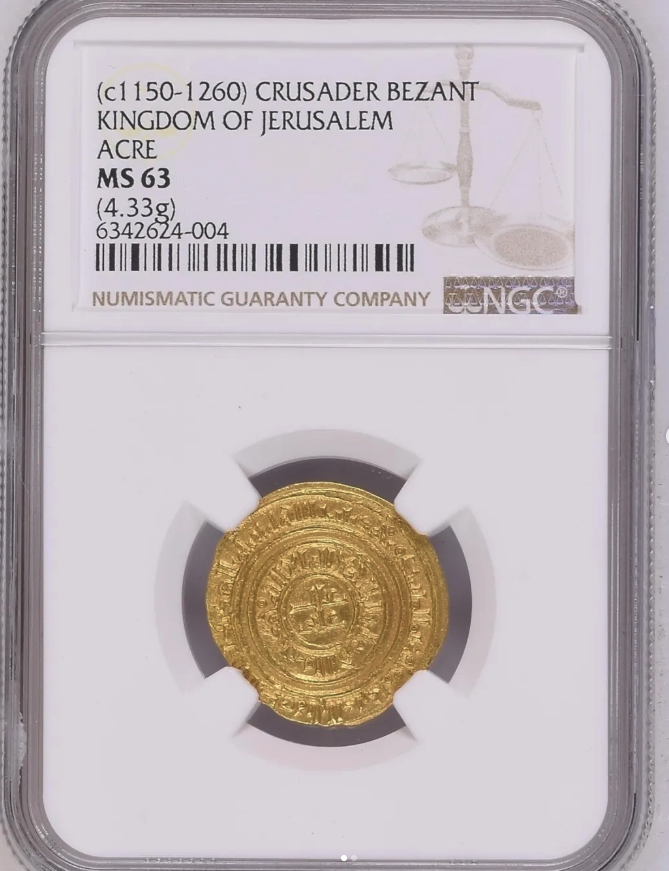
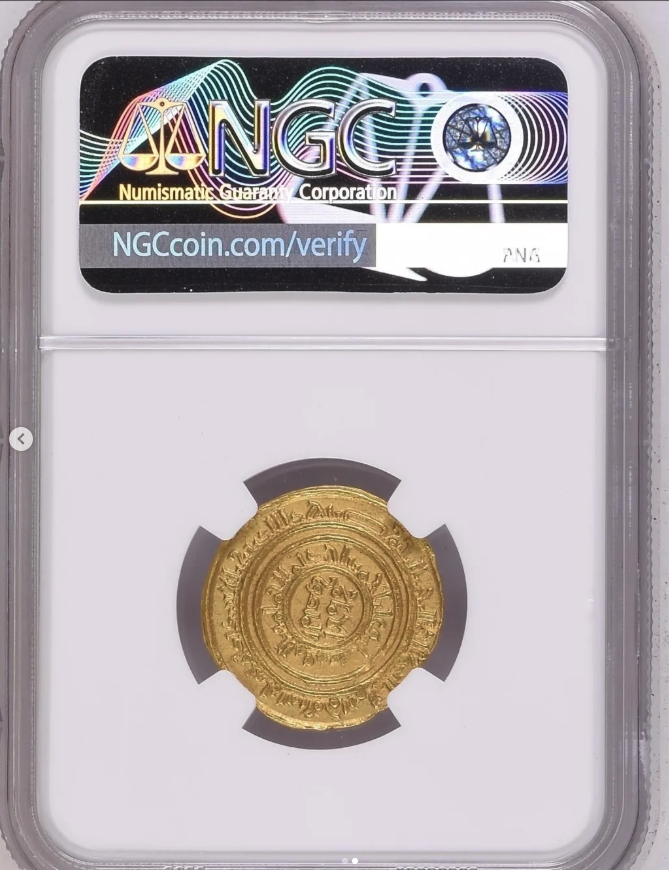
c. 1148-1187 AV Bezant (4.33g)
Crusader gold bezant struck at Acre in imitation of a Fatimid dinar - economic warfare against Saladin in the form of a debased gold coin with deliberately barely-legible Arabic.
- Metal
- Gold
- Grade
- NGC MS 63
- Cert #
- 6342624-004
Full attribution & era
The history behind the coin.
After the catastrophic failure of the Second Crusade in 1148, the Latin Kingdom of Jerusalem found itself increasingly squeezed between the rising power of Nur ad-Din in Syria and, soon after, his lieutenant and successor in Egypt, Saladin - the Ayyubid sultan who would unify Egypt and Syria around the Crusader states and, in 1187, retake Jerusalem itself at the battle of Hattin.
One of the more sophisticated forms of resistance the Crusaders mounted was monetary. The international gold coinage of the eastern Mediterranean in the 12th century was the Fatimid gold dinar, struck at Cairo and Alexandria from very pure metal. The Crusader mints at Tripoli and Acre responded by striking their own gold coins - the so-called "Saracenic" or imitation bezants - that copied the design and Arabic legends of Fatimid dinars (and later Ayyubid dinars), but in a slightly debased gold alloy. The intention was a form of economic warfare: if Frankish bezants were circulating widely under the same general appearance as Islamic dinars but at a lower fineness, merchants would begin to discount all gold dinars by weight and assay rather than tale, hurting Ayyubid finances and partially insulating the Latin kingdom from the bullion advantage of its enemies.
The pious side-effect, from a modern collector's standpoint, is that the Latin Patriarch and the church authorities in Acre eventually intervened. They were horrified to discover that the official mint of a Christian crusader kingdom was happily striking gold coins covered in the Islamic shahada (the profession of faith) - and forced the mint to add small Christian symbols (a cross, the letter B, etc.) and gradually to replace the Arabic script with Crusader-Latin legends. Coins like this one belong to the earlier "Arabic" series, where Crusader die-cutters who knew no Arabic copied Fatimid dinars more or less from memory. The result is exactly what one would expect when a Frankish engraver who has never read Arabic tries to copy an Arabic die: the formal layout - three concentric circular legends around a central inscription - is preserved, but the actual letters are crude, garbled, and only barely identifiable to a literate Arab eye. That is, in the most literal sense, what a 12th-century Crusader counterfeit Islamic gold coin looks like.
This piece is a mint-state Acre bezant, 4.33 g, imitating a Fatimid gold dinar (the type derived from issues of al-Mansur / al-Mustansir). NGC has graded it MS 63 - sharply struck on a full broad flan with full original yellow gold luster and the typical irregular wire-rim characteristic of an authentic struck-not-cast Crusader bezant. The three concentric Arabic-style legends, the central tiered inscription on the obverse, and the matching central legend on the reverse are all complete and as clear as the Crusader die-cutter ever managed. As a single physical object it is the religious, military, and economic crisis of 12th-century Outremer in your hand: a Christian gold coin, struck by Frankish knights inside a fortified Mediterranean port, pretending to be Muslim money in order to wage financial warfare on Saladin in the years immediately before he took Jerusalem back.
- Metcalf, D. M. - Coinage of the Crusades and the Latin East (Royal Numismatic Society Special Publication).
- Malloy/Preston/Seltman - Coins of the Crusader States (Acre and Tripoli imitative bezants).
- CCS (Crusader Coinage in the Holy Land) - Acre 'Saracenic' gold bezant series.
- NGC Cert 6342624-004 - MS 63.