
The best of the best.
A rotating gallery of the most extraordinary coins I've graded, owned, or had the privilege to handle. Each one represents a peak of preservation, rarity, or historical importance.
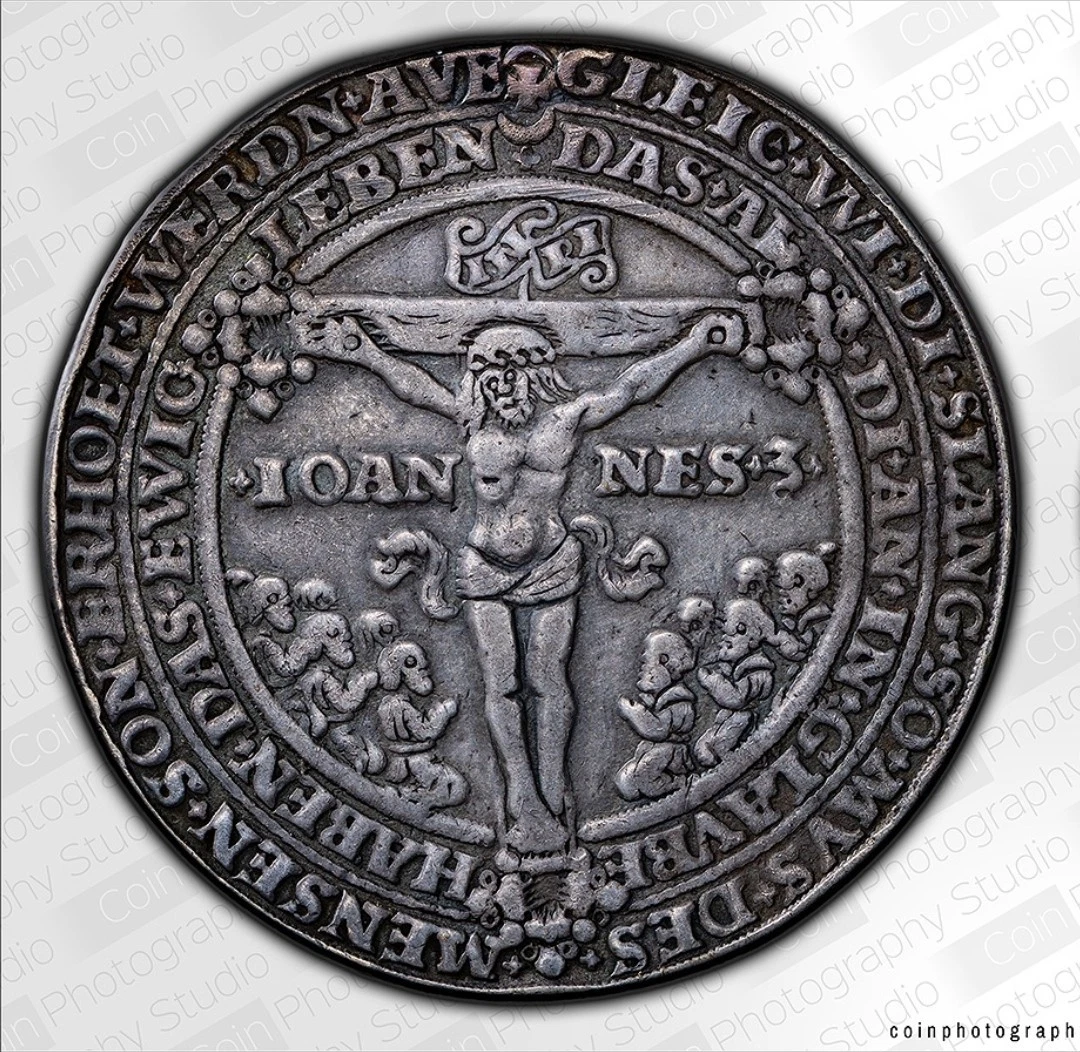
The Joachimsthal 'Pesttaler' or Snake Thaler - a devotional plague medal pairing the Crucifixion with the Brazen Serpent of Moses (Numbers 21), the great Reformation typology of Christ as the cure for a dying world. Struck in the Bohemian valley that gave the world the word 'Dollar.'
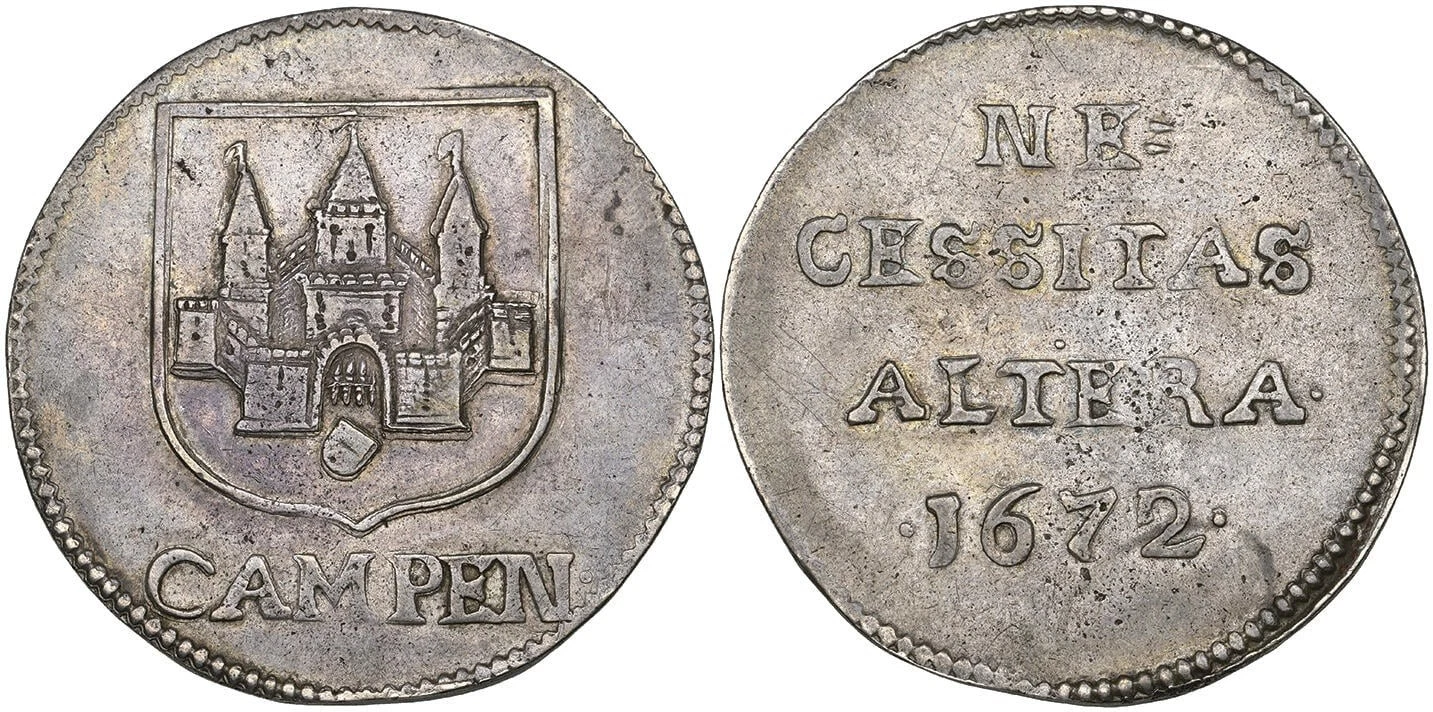
Struck inside besieged Kampen during the Dutch "Disaster Year" of 1672, with the defiant legend NE CESSIAS ALTERA - and an Archer Huntington pedigree.
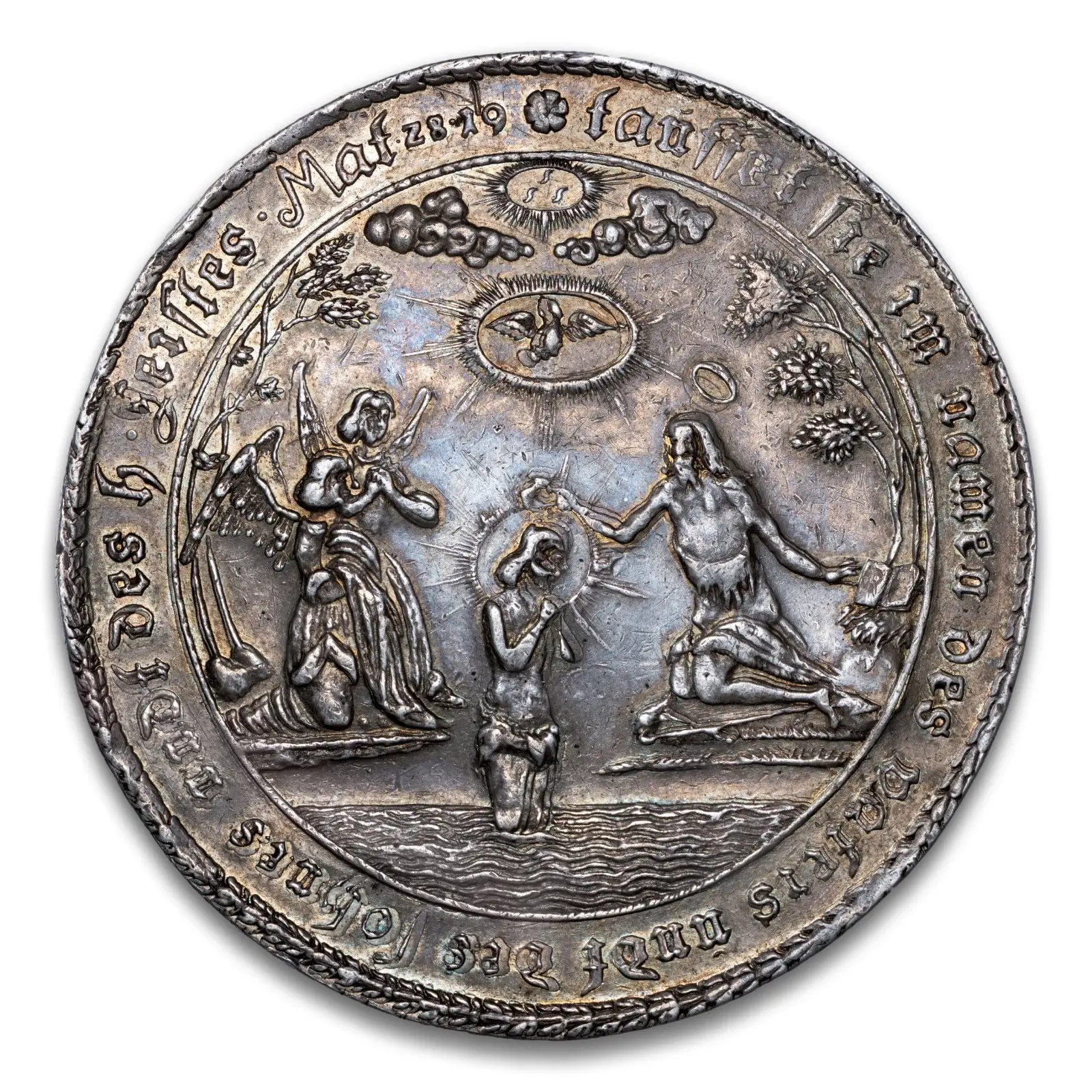
A double thaler in Harz silver showing Christ's baptism in the Jordan, the reverse filled edge to edge with German devotional verse.
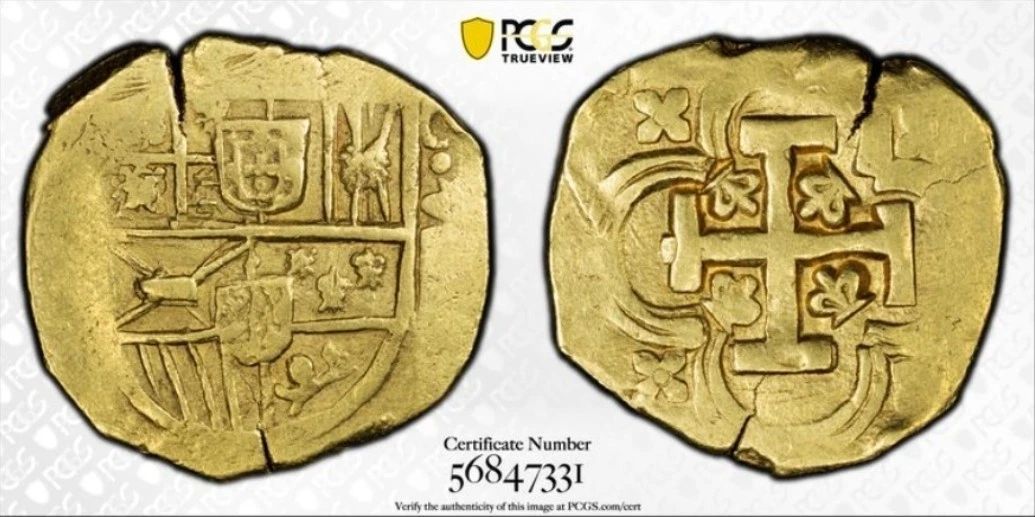
A full gold onza of Charles II - the eight-escudo cob, the largest regular gold coin of the Spanish Empire and the true "doubloon" of the treasure fleets.
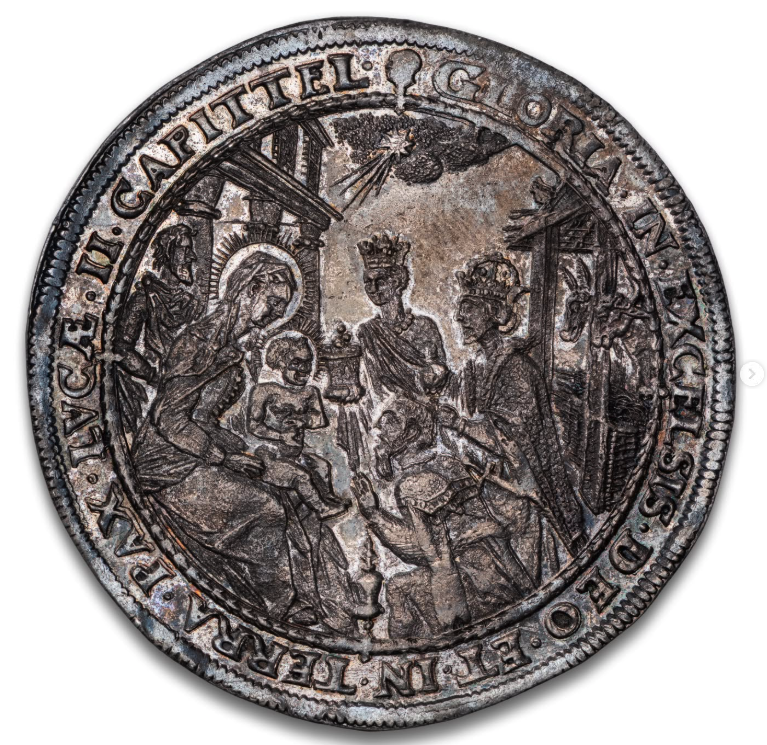
A double-thaler Christmas Thaler of Hamburg, and one of the finest-engraved nativity dies of the series - the Adoration of the Magi on one side, the Nativity on the other.
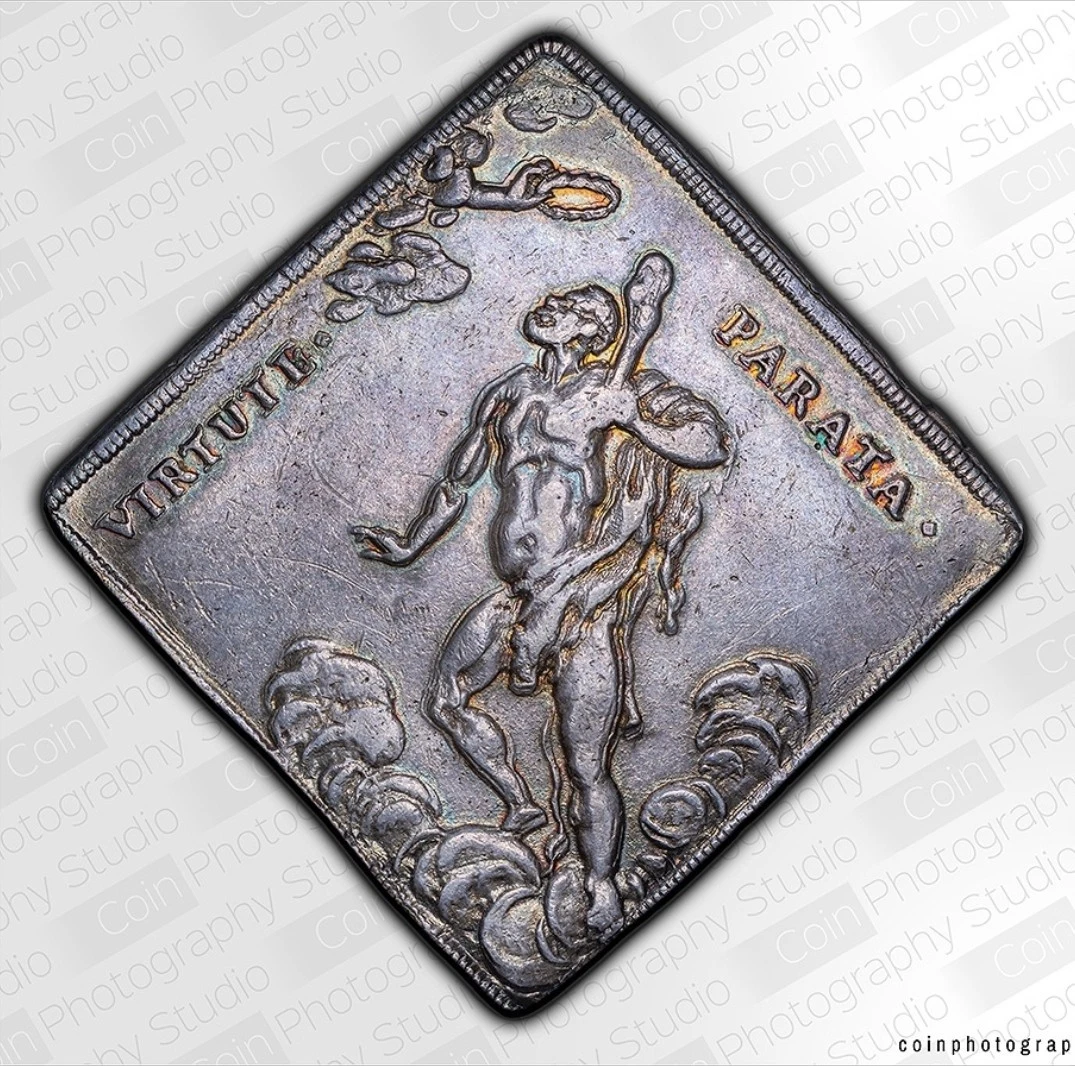
A square klippe thaler struck for the Peace of Nijmegen, with Fortuna above the clouds on one side and a laurel wreath prayer for peace on the other - blanketed in cabinet toning.
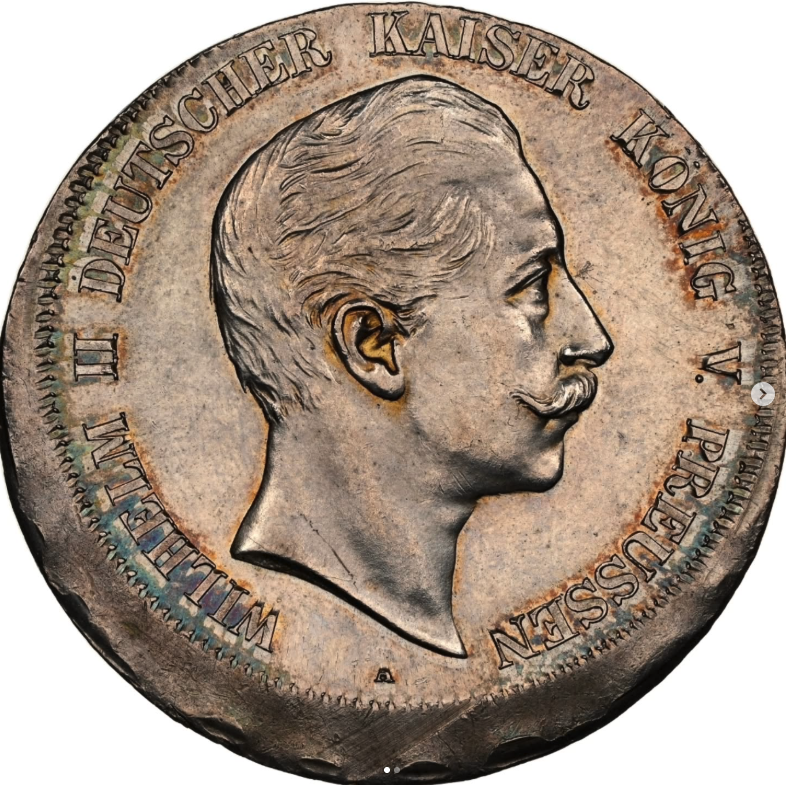
A crown-size imperial 5 Mark that escaped Berlin struck 10% off center in Mint State - an error type that almost never survives on German silver.
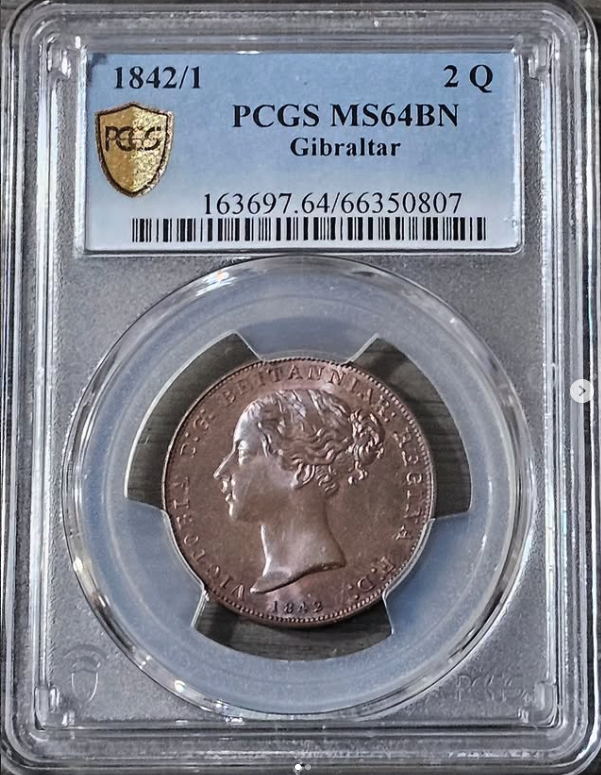
A near-gem overdated 2 Quarts from Gibraltar's first and only local coinage - the Moorish castle of the Rock in full mint brown.
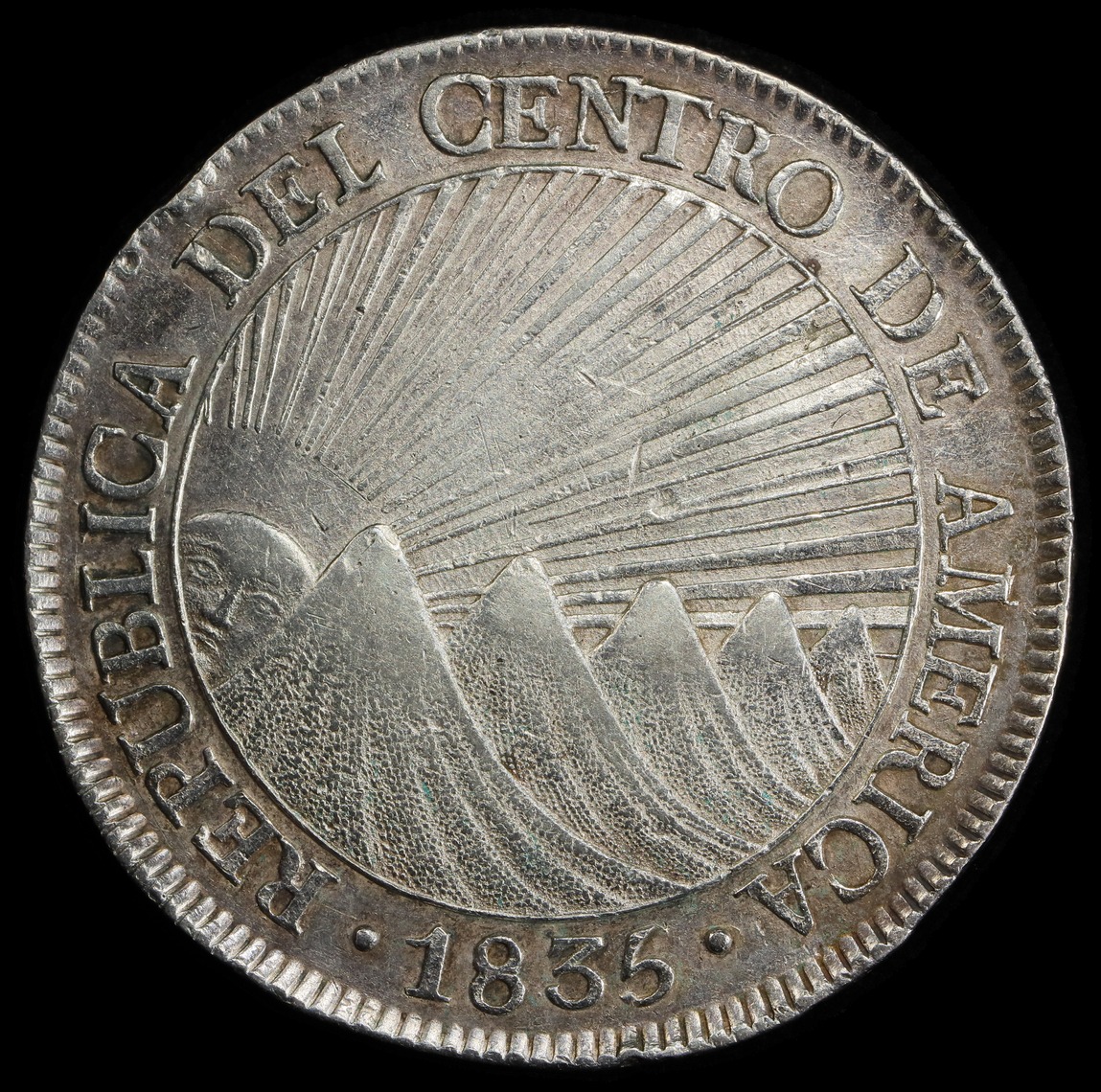
The crown of a country that no longer exists - the federal 8 Reales of the Central American Republic, struck at Nueva Guatemala as the union tore itself apart.
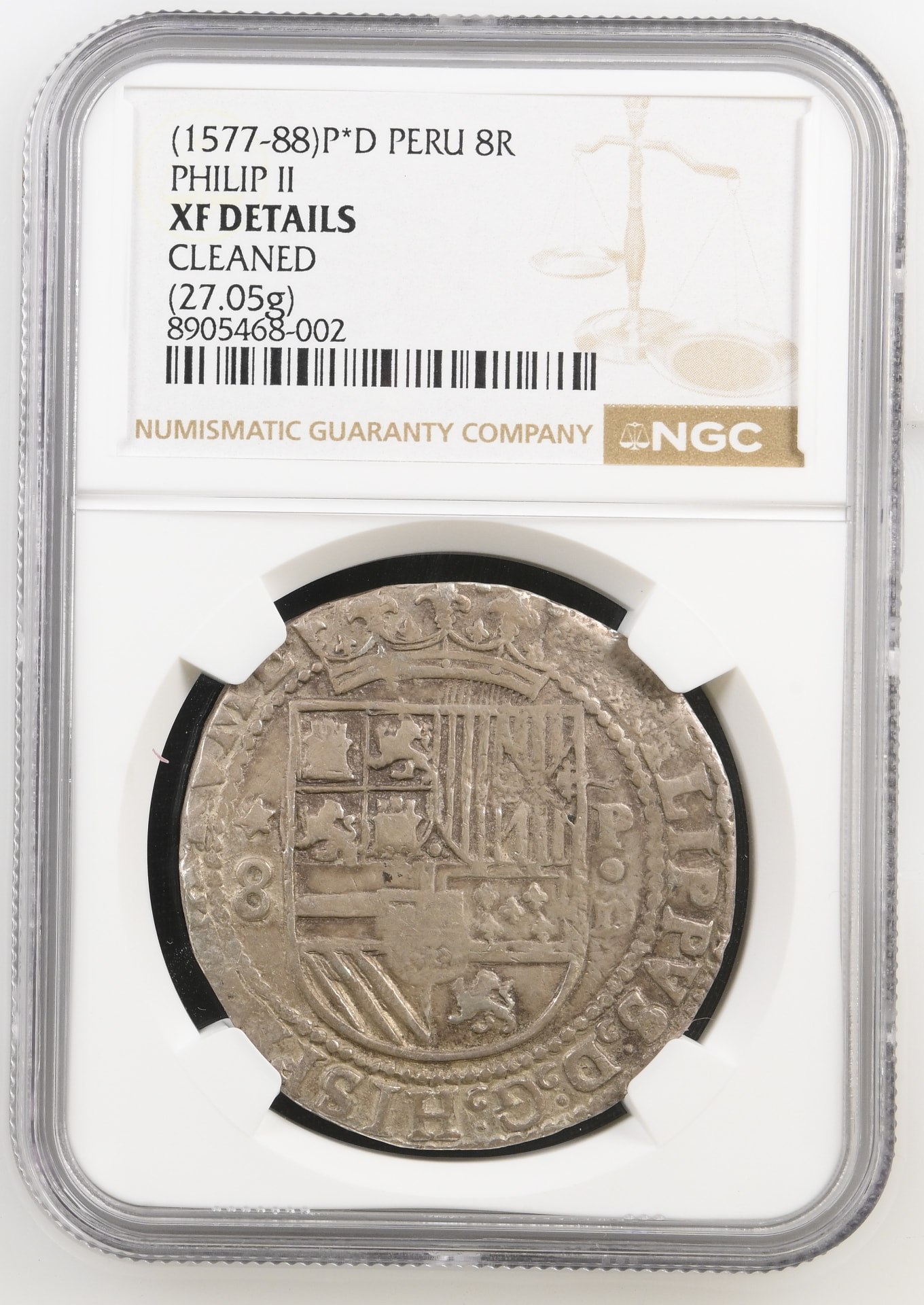
A full-weight Philip II shield-type eight reales from Potosí - the coin that carried the silver of Cerro Rico into the world economy.
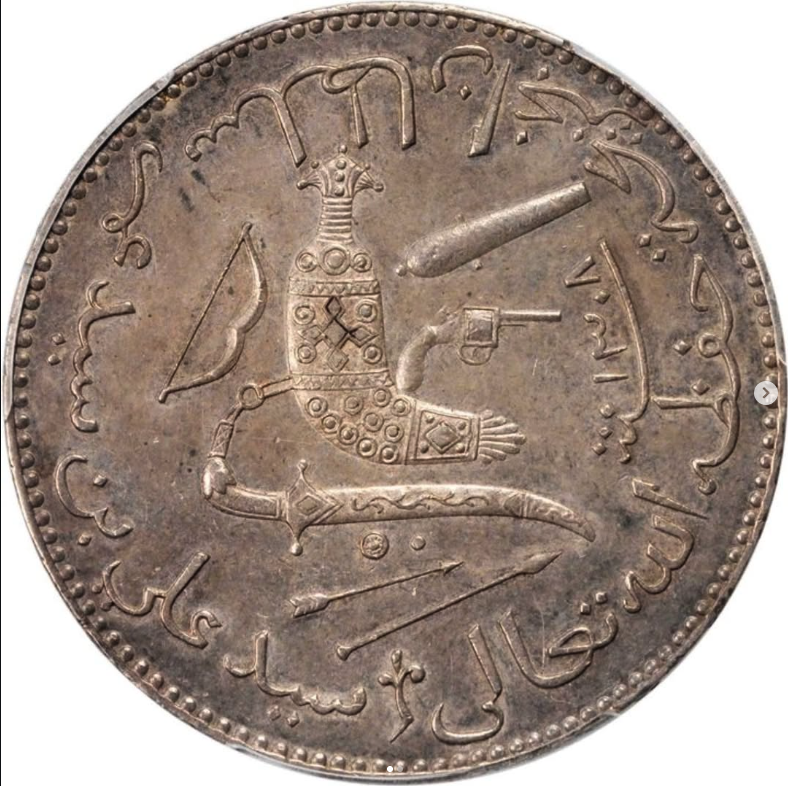
The sole silver crown of the Comoros - struck in Paris for Sultan Said Ali just as France absorbed his islands, then almost entirely withdrawn and melted.
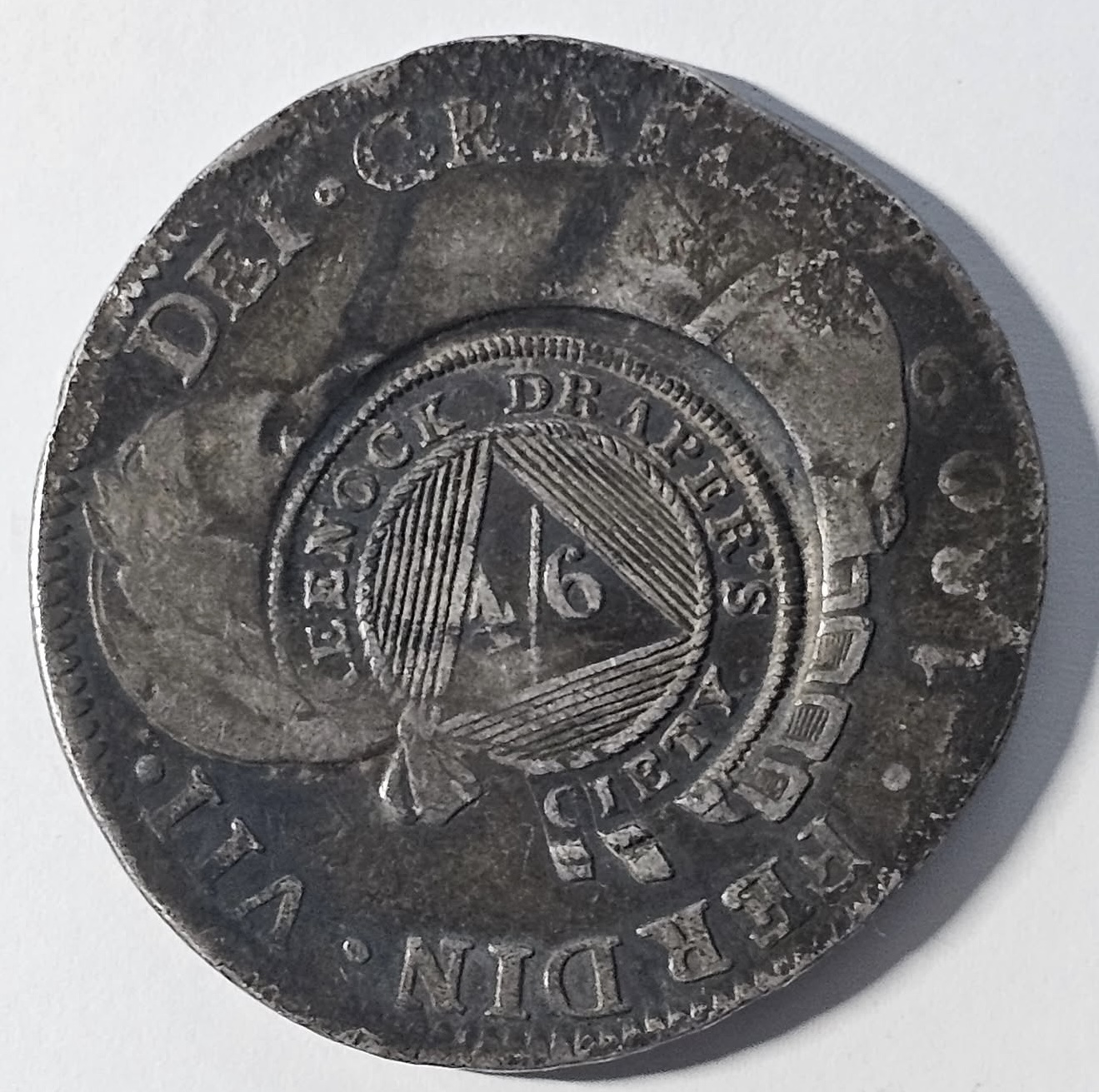
The Greenock Drapers' Society "4/6" countermark on a Spanish colonial 8 Reales - one of only four recorded, with two impounded in museums and the Cokayne piece lost since the 1950s.
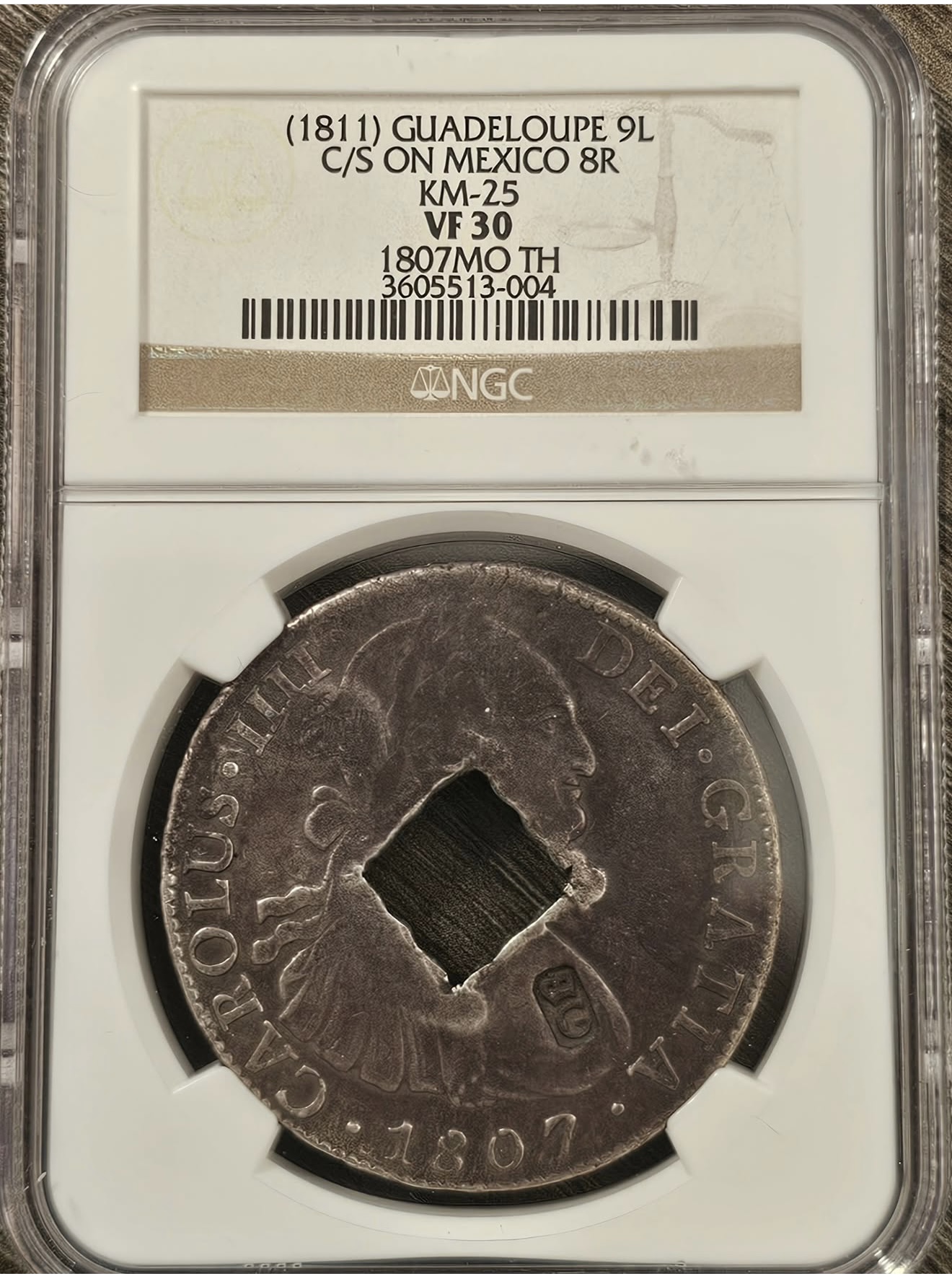
Guadeloupe 9 Livres of the British occupation - a crowned "G" countermarked and lozenge-holed 1807 Mo TH Mexico 8 Reales, certified NGC VF-30 (KM-25).
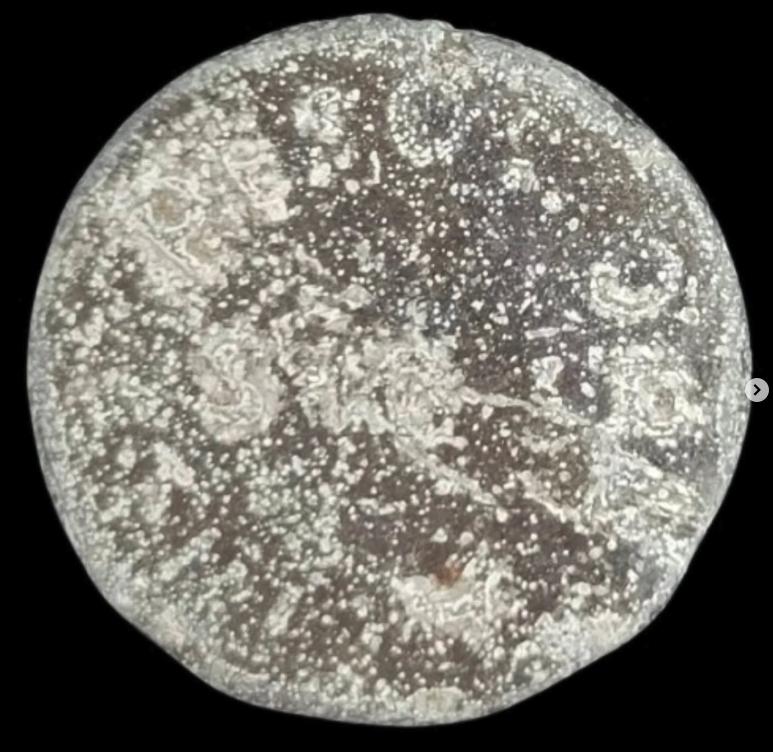
Cast lead 10 Pesos Oro struck by Augusto Sandino's rebels from a looted water pipe at the San Albino gold mine - fewer than seven known.
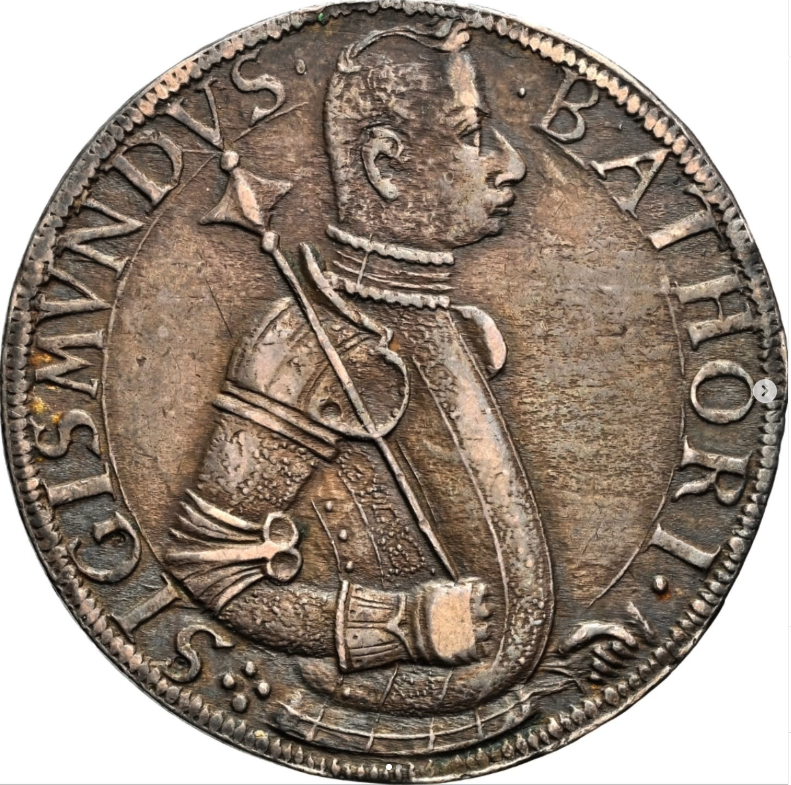
Thaler of Sigismund Báthory, Prince of Transylvania, struck during the lead-up to the Long Turkish War.
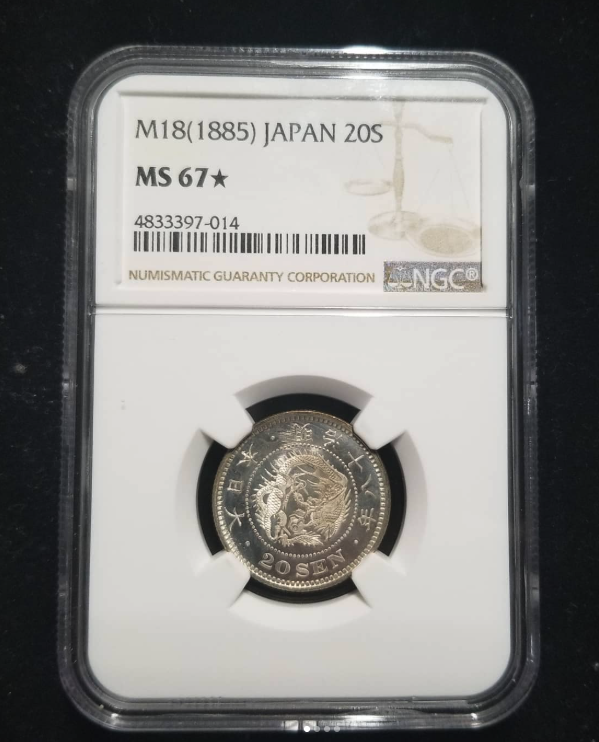
Meiji 18 (1885) 20 Sen with a flawless Deep Mirror Proof-Like obverse and strong cameo contrast - NGC MS-67★.
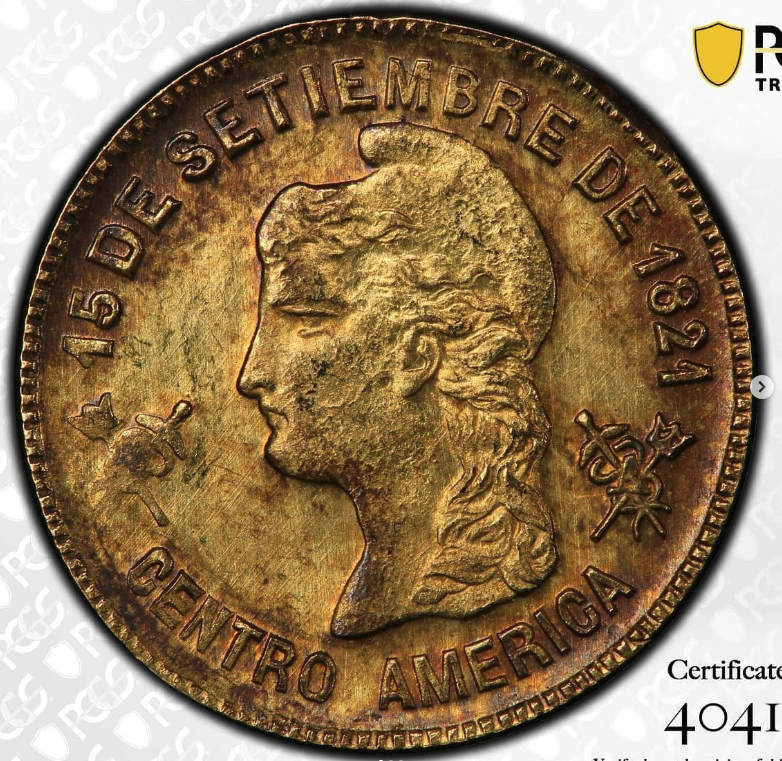
Only 5 minted - just 3 certified (1 PCGS, 2 NGC). In hand the coin presents at MS-61.
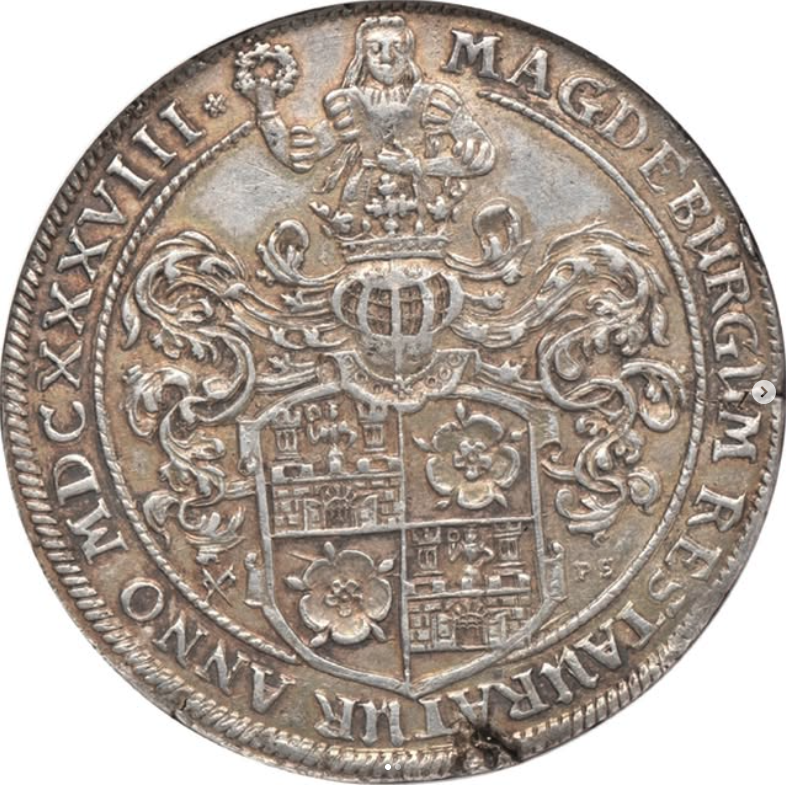
Extremely rare Thaler commemorating the rebuilding of Magdeburg after the 1631 sack that killed 20,000 of its 25,000 inhabitants.
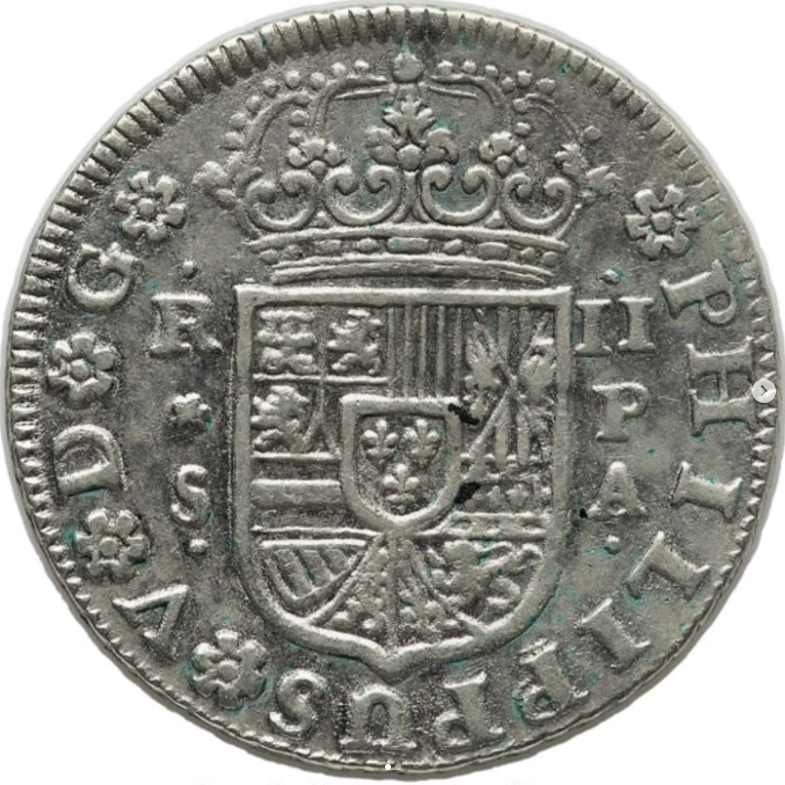
1 of only 3 coins known from the Invencible - the 1741 Fleet capitana destroyed by lightning in Havana harbor.
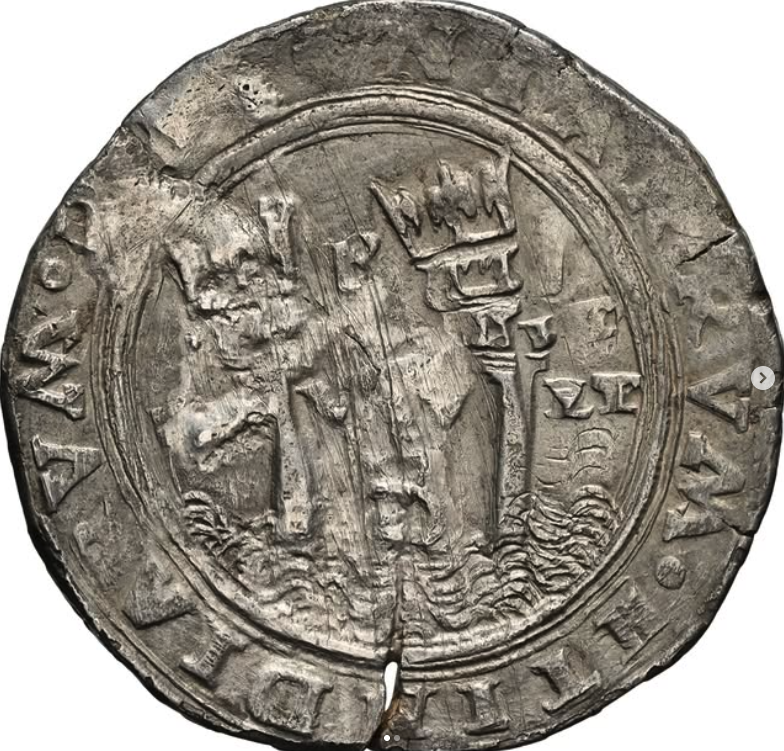
An extreme rarity - the FIRST dollar-size coins ever minted in South America. Estimated 9-12 known in any grade.
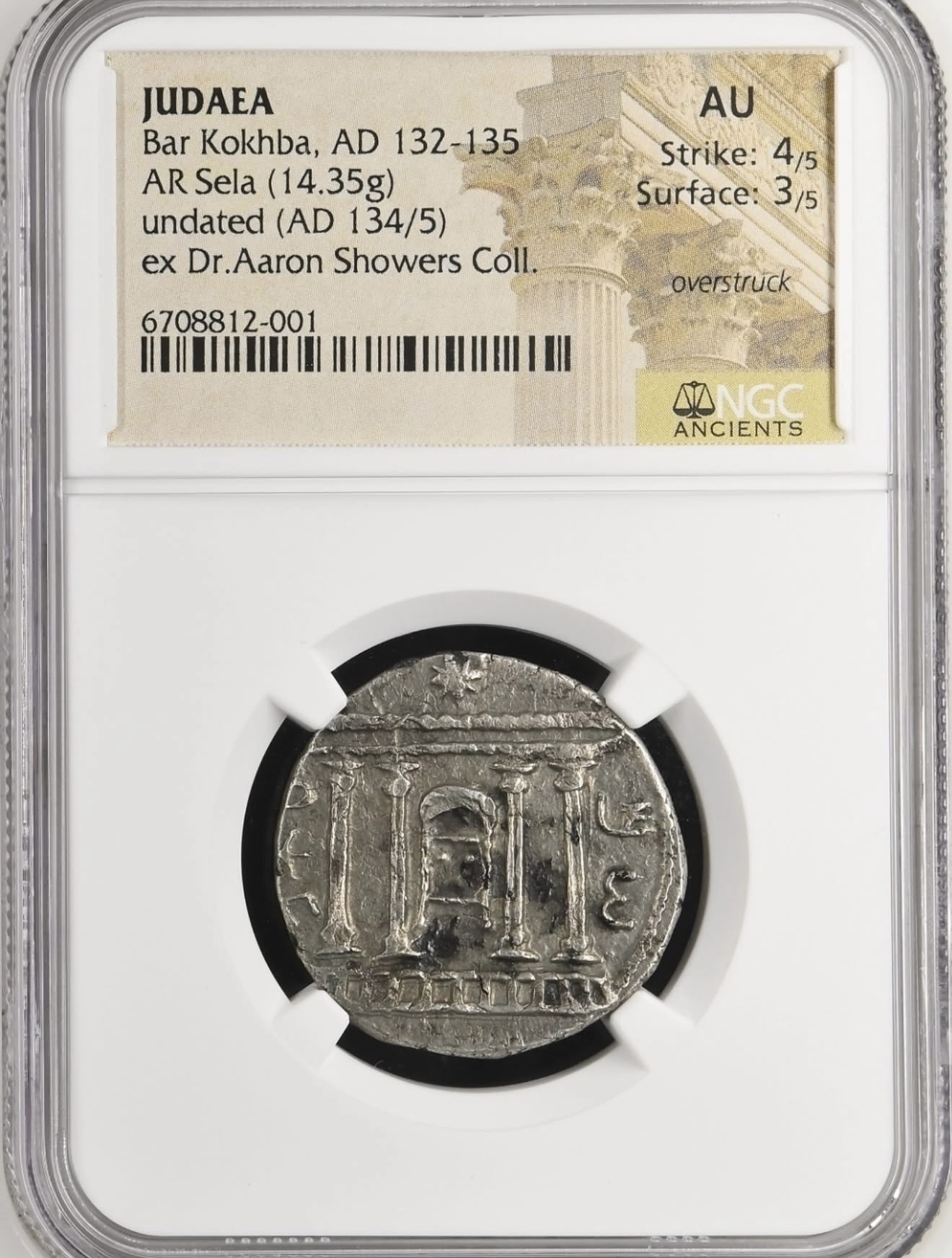
Struck during the 3rd Jewish War - overstruck on a Roman denarius and depicting the Second Temple façade.
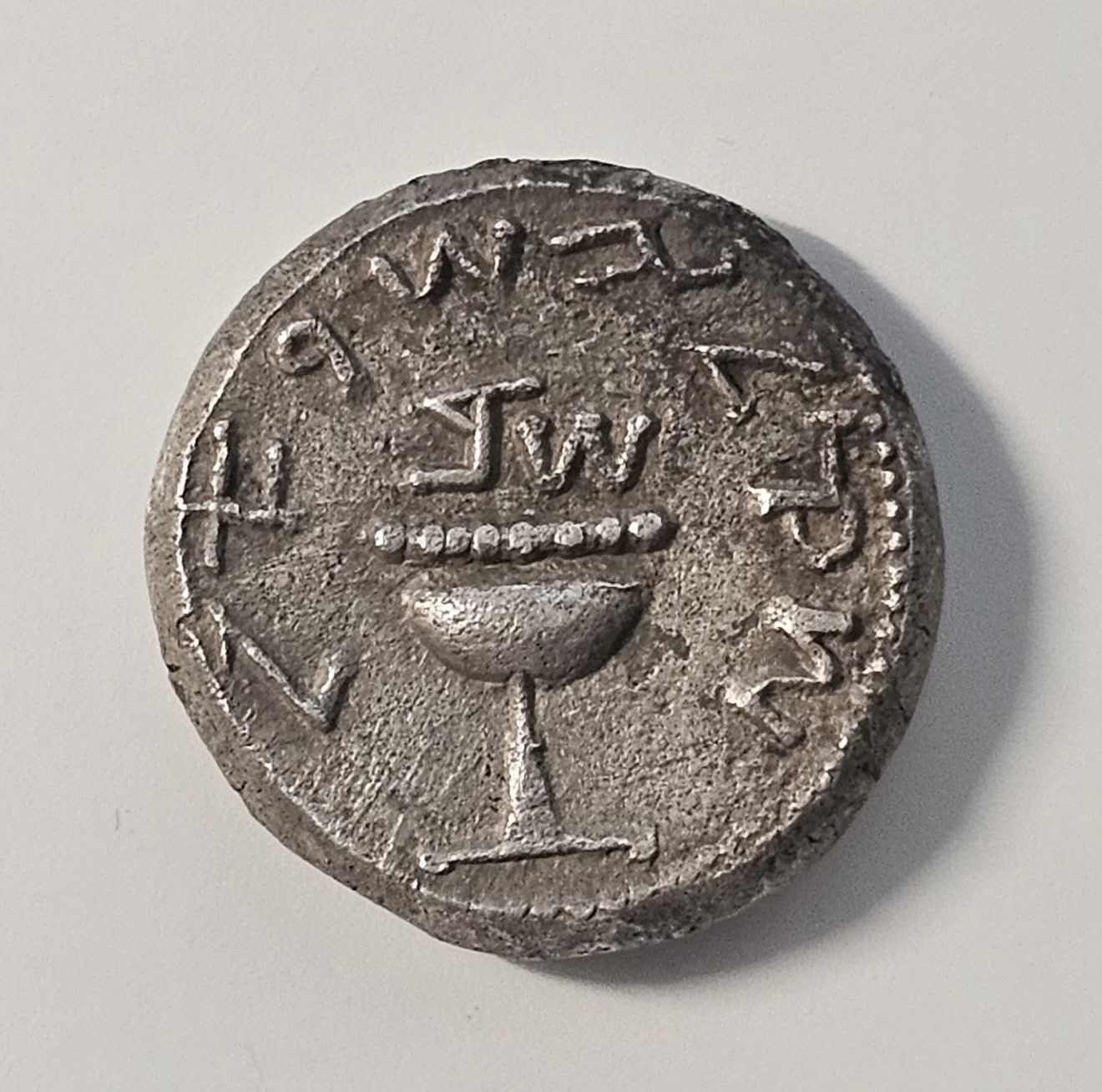
Struck by Judean rebels during the war that ended in the destruction of the Second Temple - chalice obverse, three pomegranates reverse.
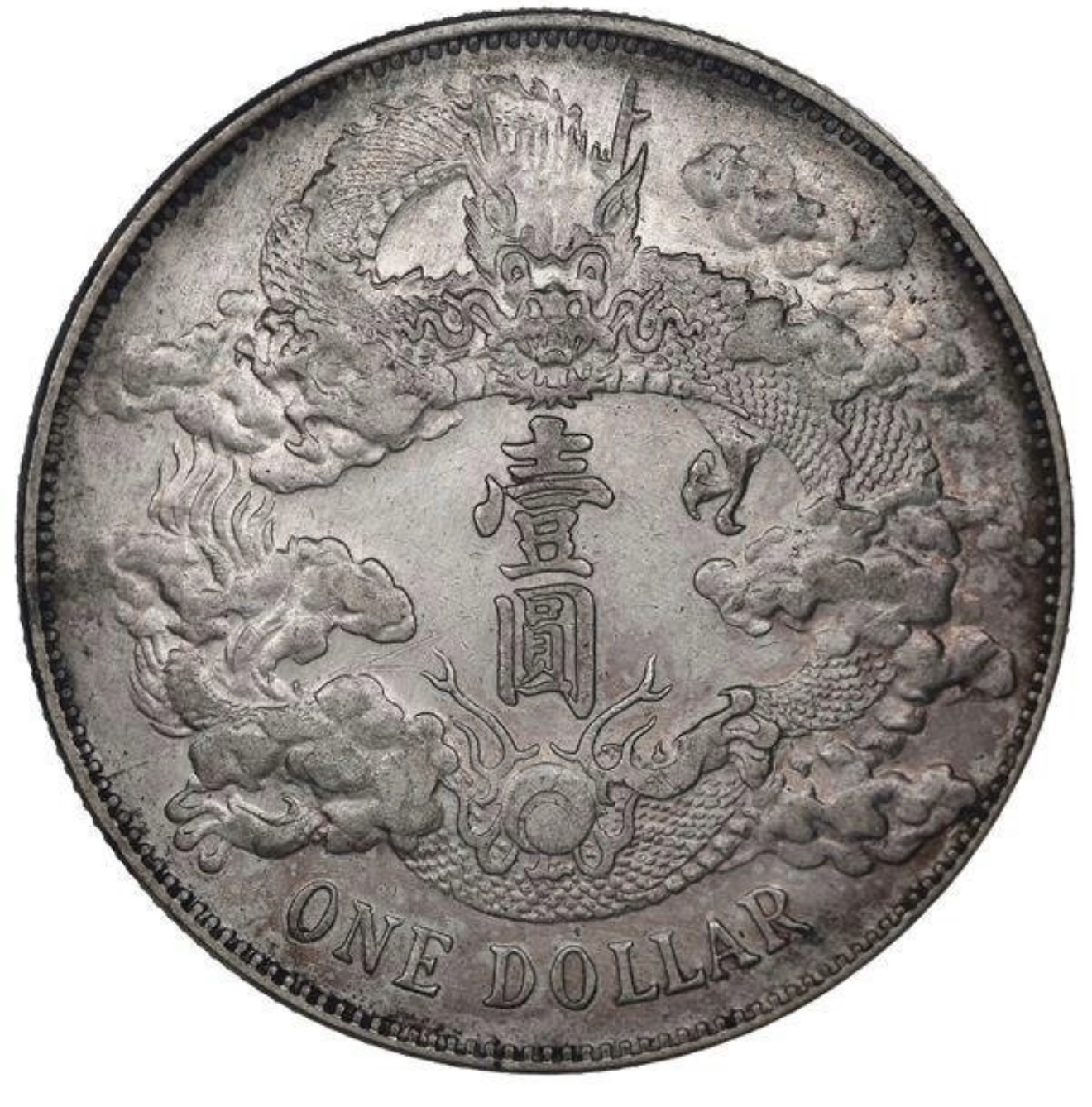
Recovered from the WWII wreck of the Tomiura Maru off Rabaul - pedigreed to the Smithsonian's curator of underwater archaeology.
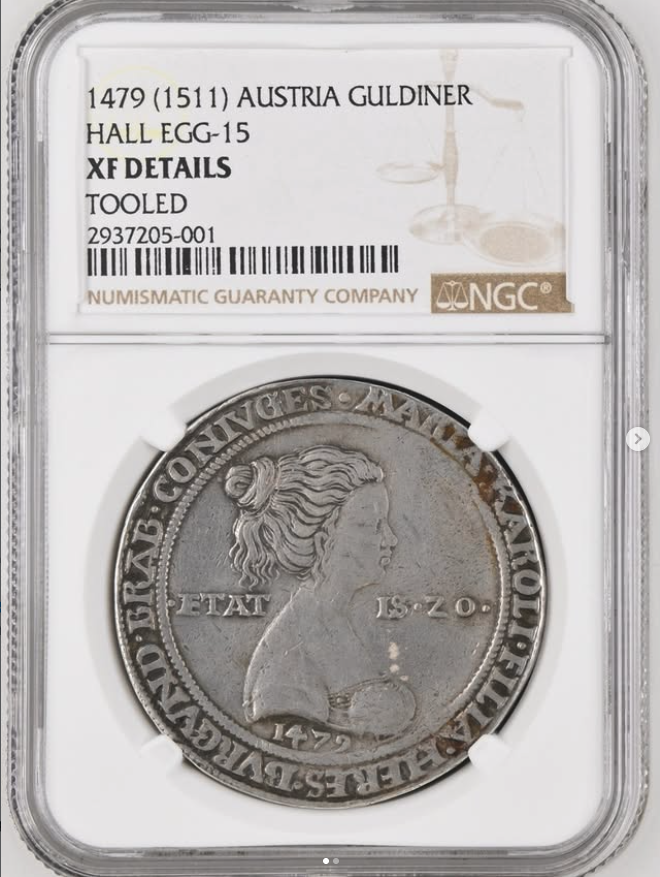
Renaissance commemorative of the 1479 Habsburg-Burgundy wedding - struck 1511 at Hall in Tyrol by Ulrich Ursentaler.
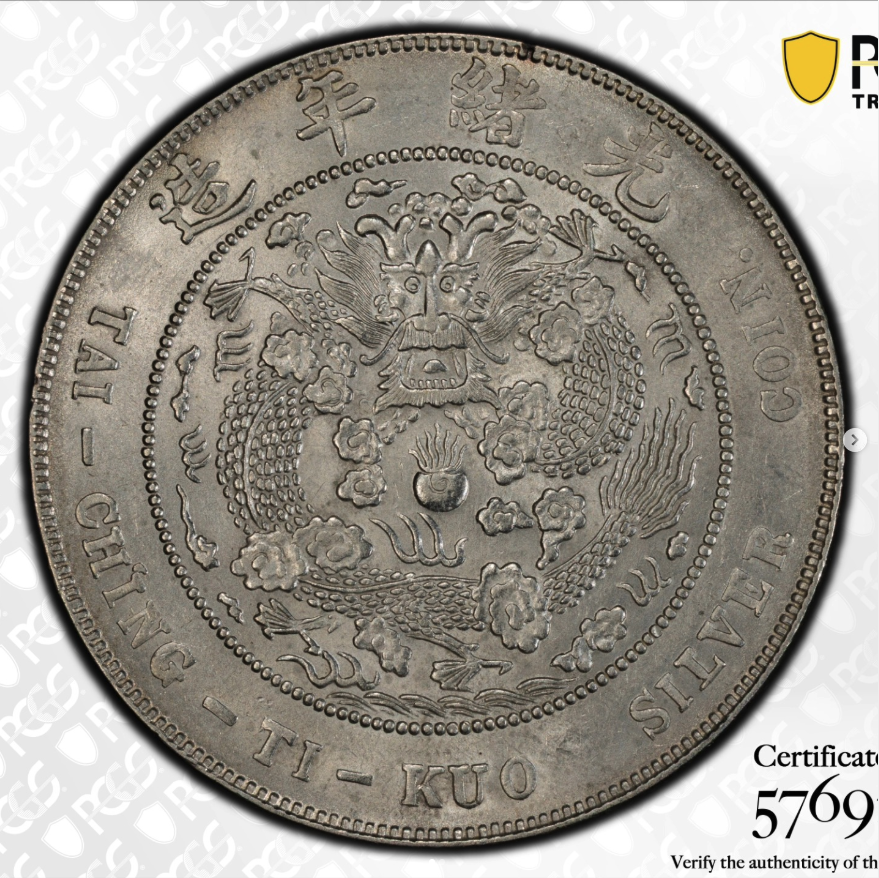
Final pattern dollar of the Guangxu reign - the iconic "Parade" Dragon design, struck at the Tientsin Central Mint.
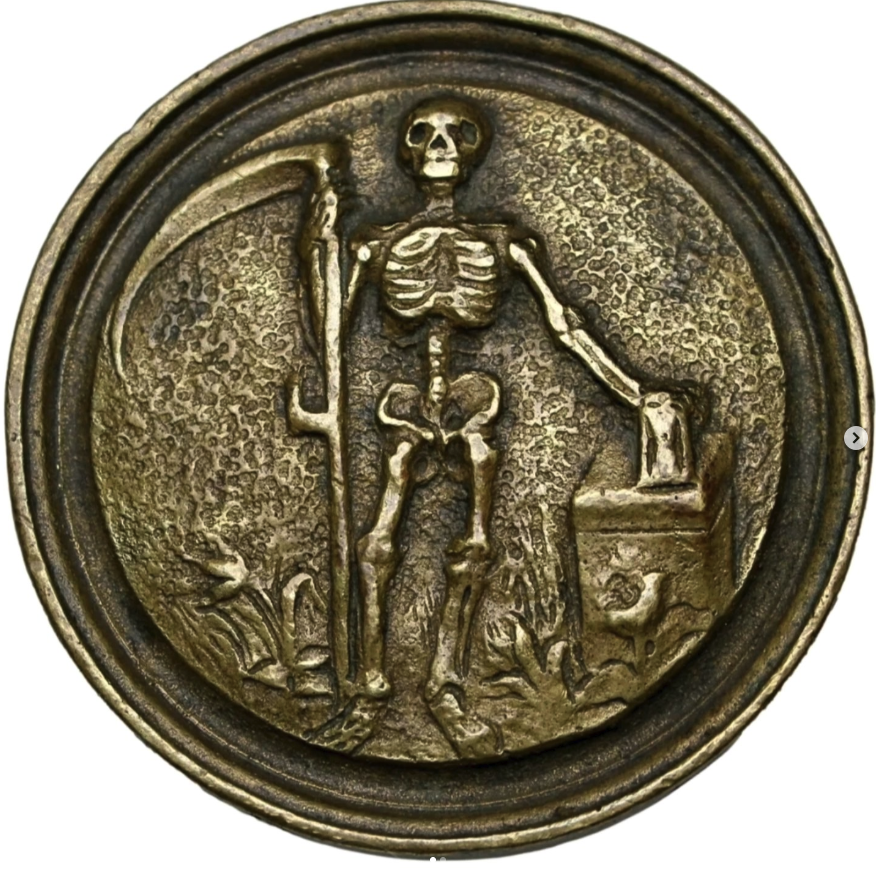
Memento mori admission token to the Amsterdam Surgeons' Guild and its medicinal garden - personally engraved to Willem Evers in 1766.
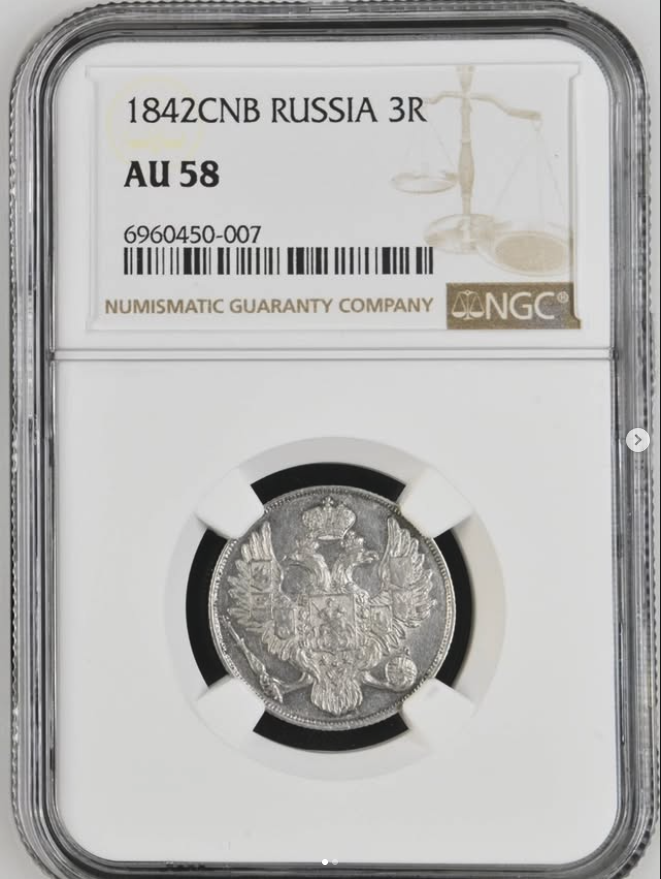
Platinum 3 Rouble of Nicholas I - the world's only circulating platinum coinage, struck from native Ural ore.
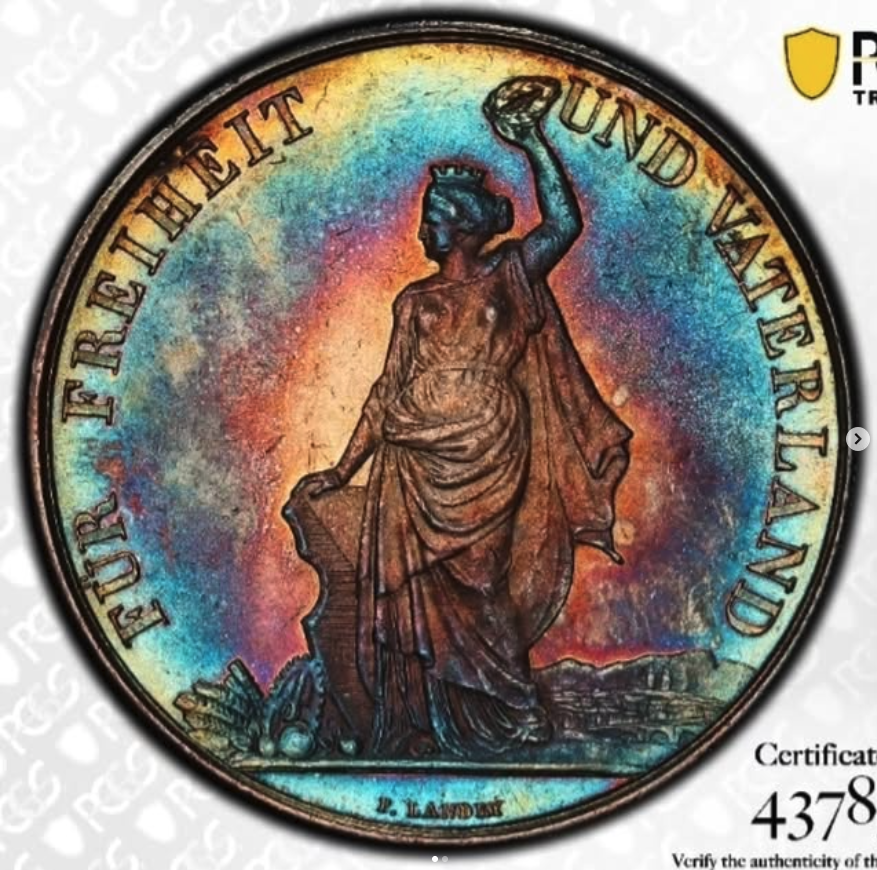
Federal shooting festival 5 Francs from Zürich - bold Helvetia obverse by Landry, vivid rainbow toning.
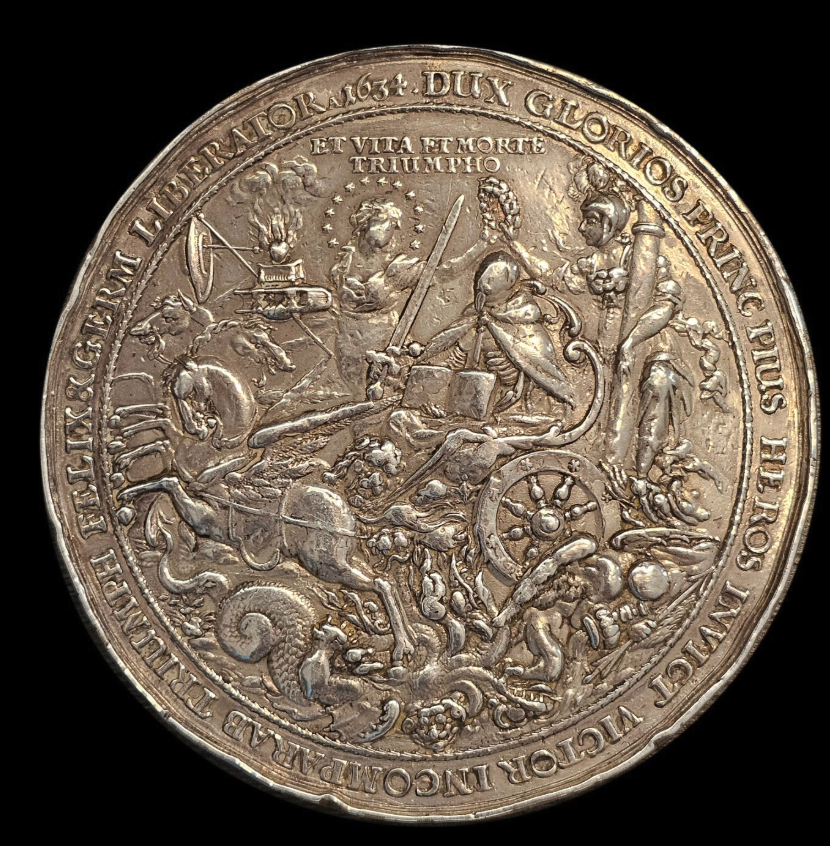
Massive funerary 5 Thaler struck at Wolgast for the funeral procession of King Gustavus Adolphus - silver reportedly repurposed from Queen Eleonora's sink and water jug.
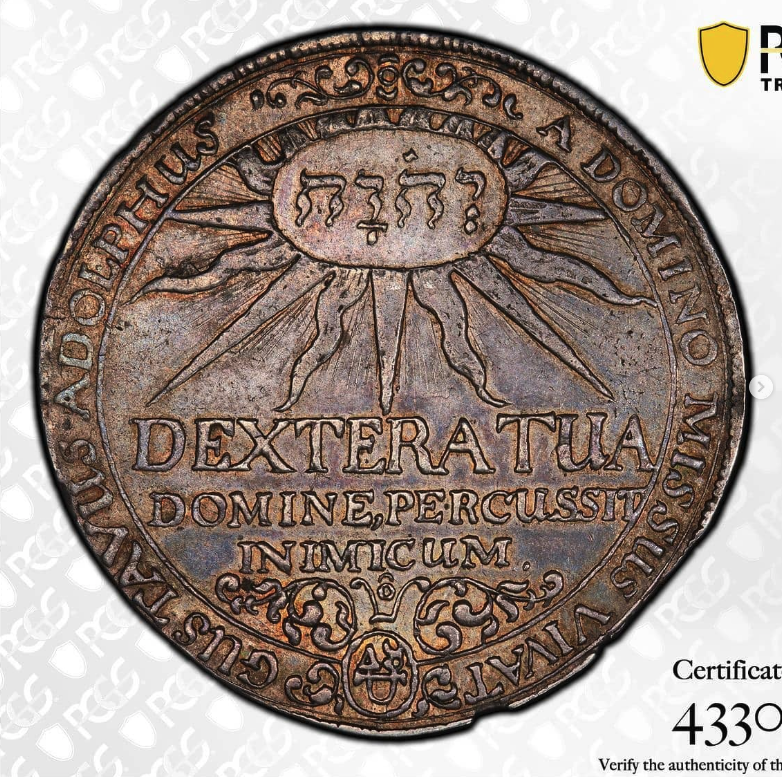
Struck to commemorate Gustavus Adolphus's victory at Breitenfeld on 7 September 1631 - which fell on Purim and earned the festival the name 'Purim of the Evangelicals.'
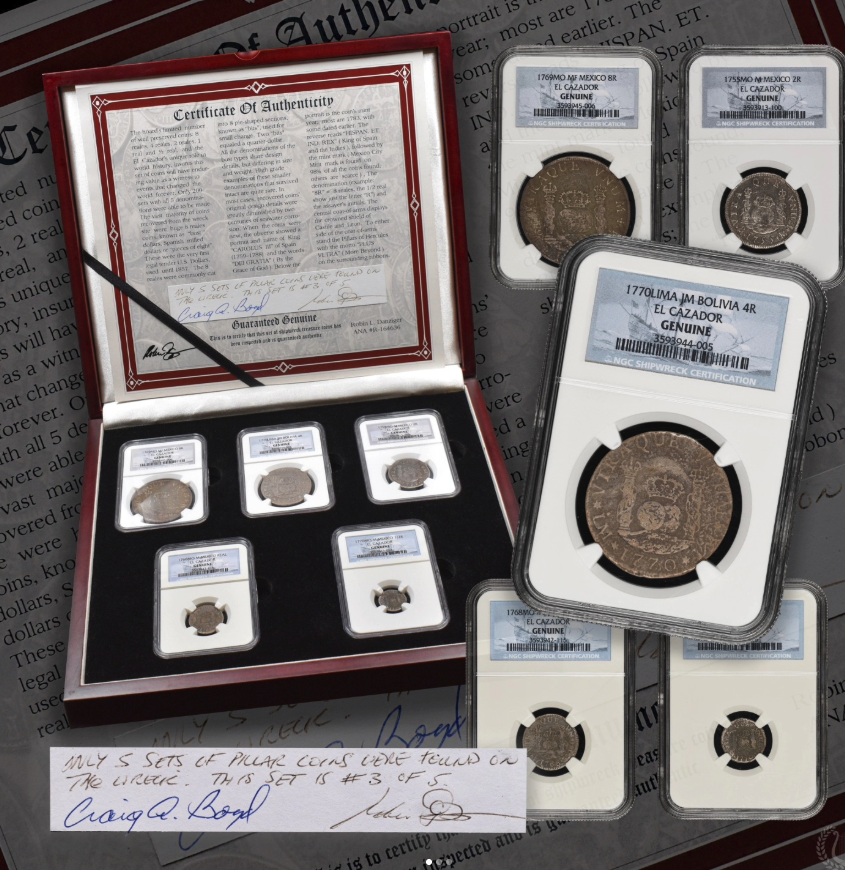
One of only 5 complete Pillar denomination sets recovered from the El Cazador - 8R, 4R, 2R, 1R, and 1/2R, including a rare Lima 4R.
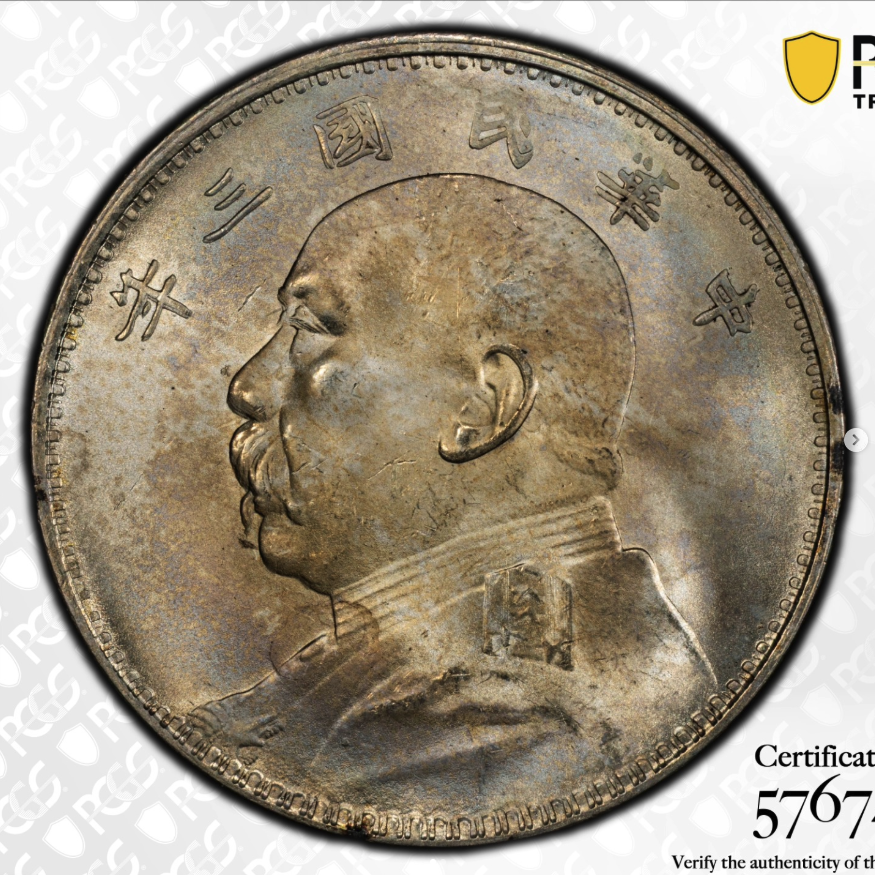
Year 3 Fatman Dollar with the dramatic Double Die Eyelid variety - a sharp MS-64 example of China's first unified Republic silver dollar.
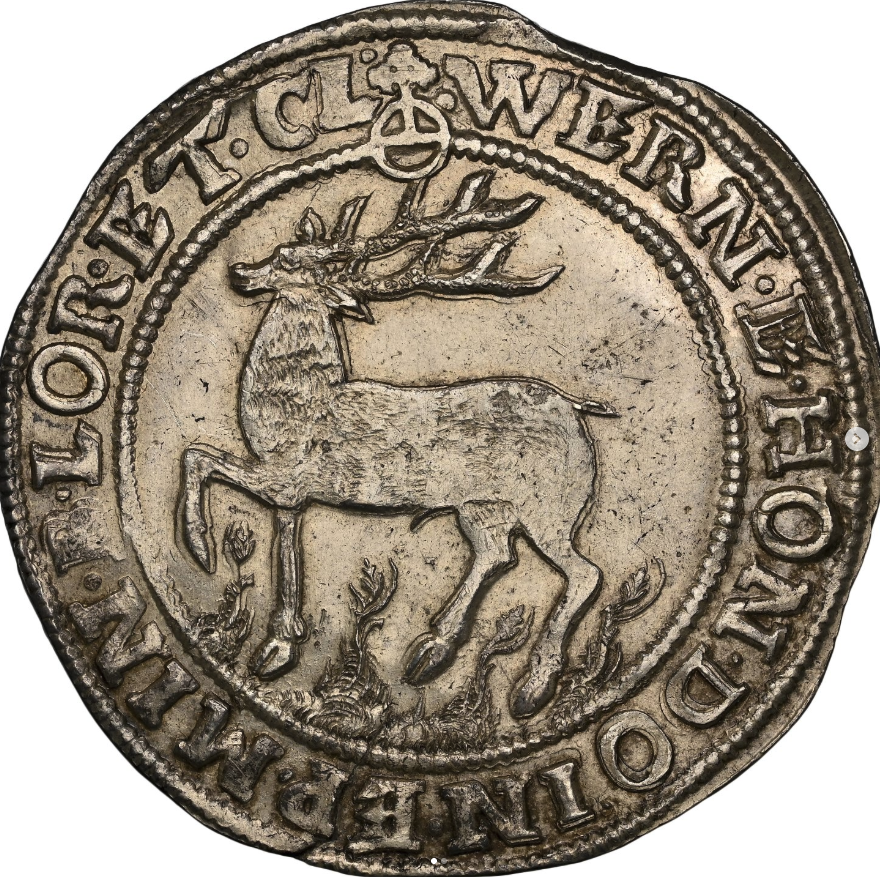
A choice Mint State thaler of Wolfgang Georg of Stolberg struck in the depths of the Thirty Years' War, with the famous Stolberg stag obverse.
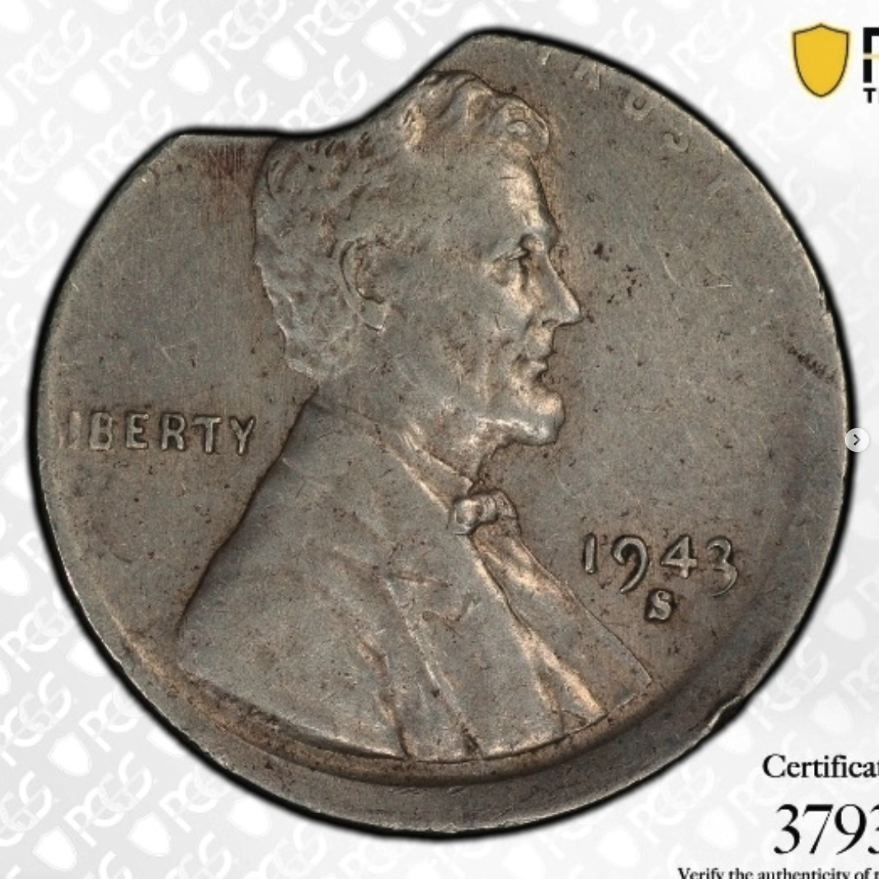
A 1943-S Wheat cent struck on a leftover silver Mercury dime planchet, 5% off-center - one of the most dramatic wrong-planchet errors of the WWII era.
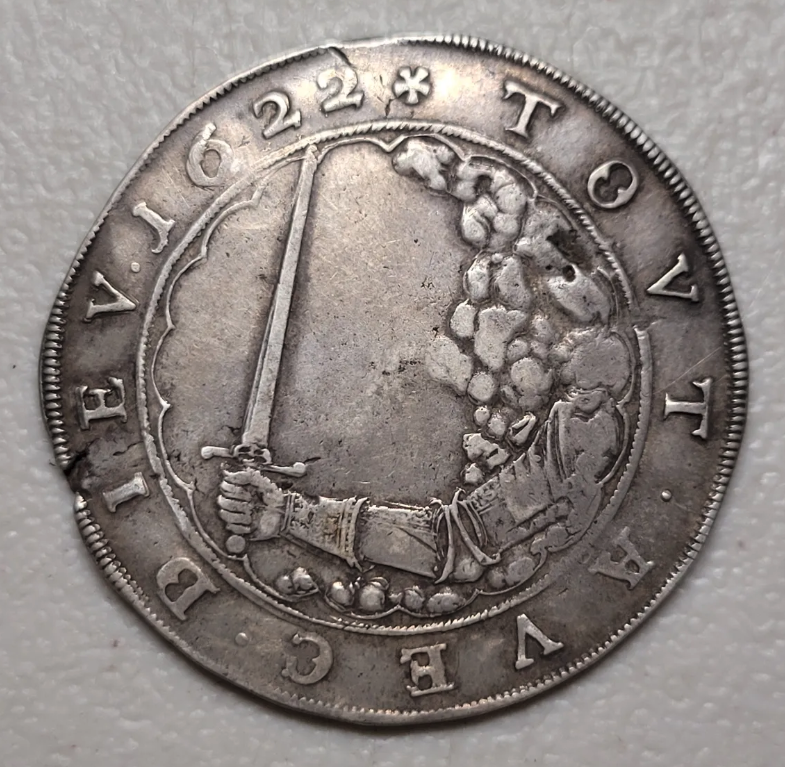
Struck from the melted Holy Libori Shrine after Christian 'the Mad' looted Paderborn to pay his mercenaries - one of the most inflammatory anti-Catholic thalers ever issued.
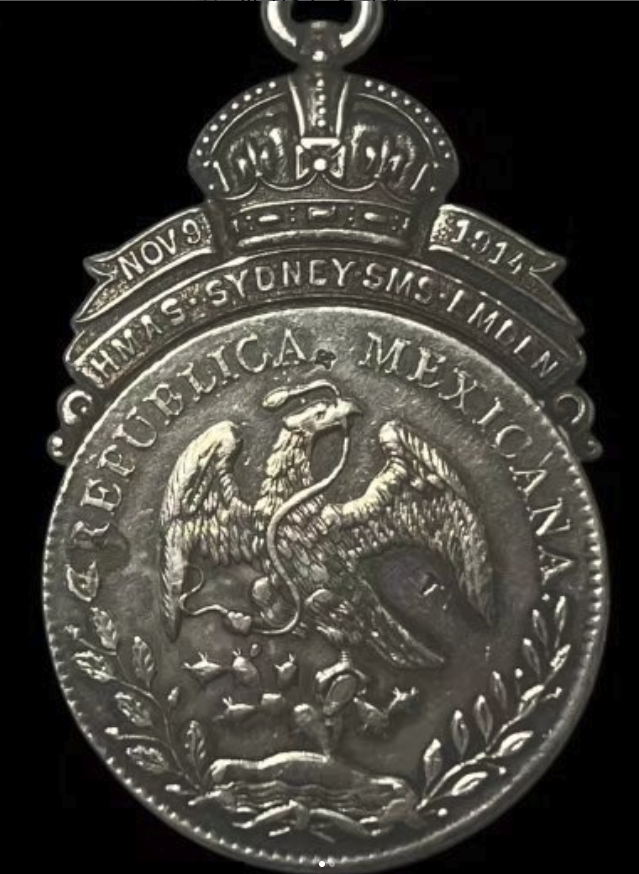
An 1888 Mexican 8 Reales recovered from the wreck of SMS Emden, mounted by W. Kerr of Sydney with a crowned 'HMAS SYDNEY · SMS EMDEN · NOV 9 1914' suspender.
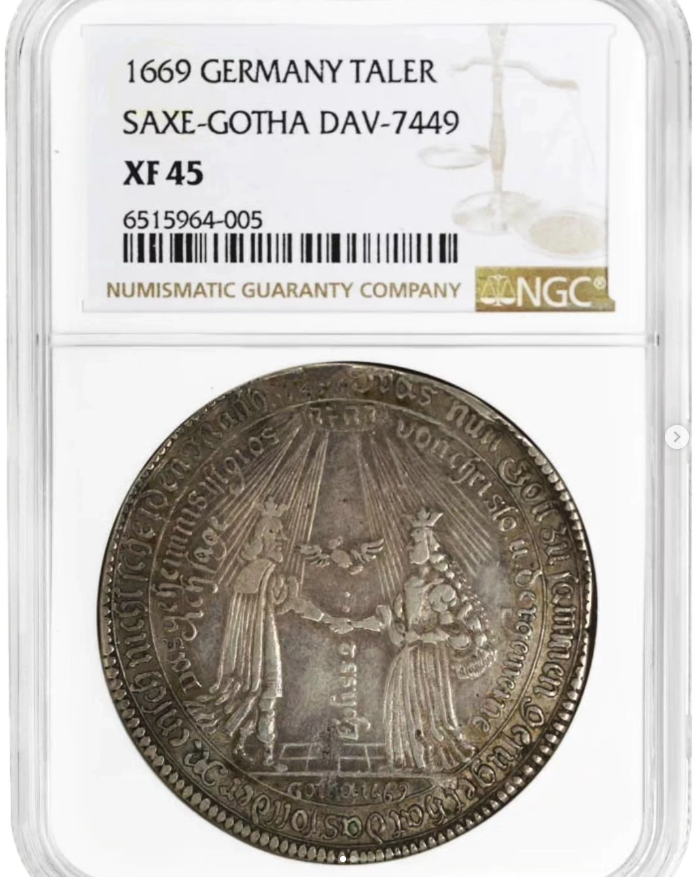
Struck for the marriage of Duke Friedrich I of Saxe-Gotha to Magdalena Sibylle of Saxe-Weissenfels - reported mintage of just 747 pieces.
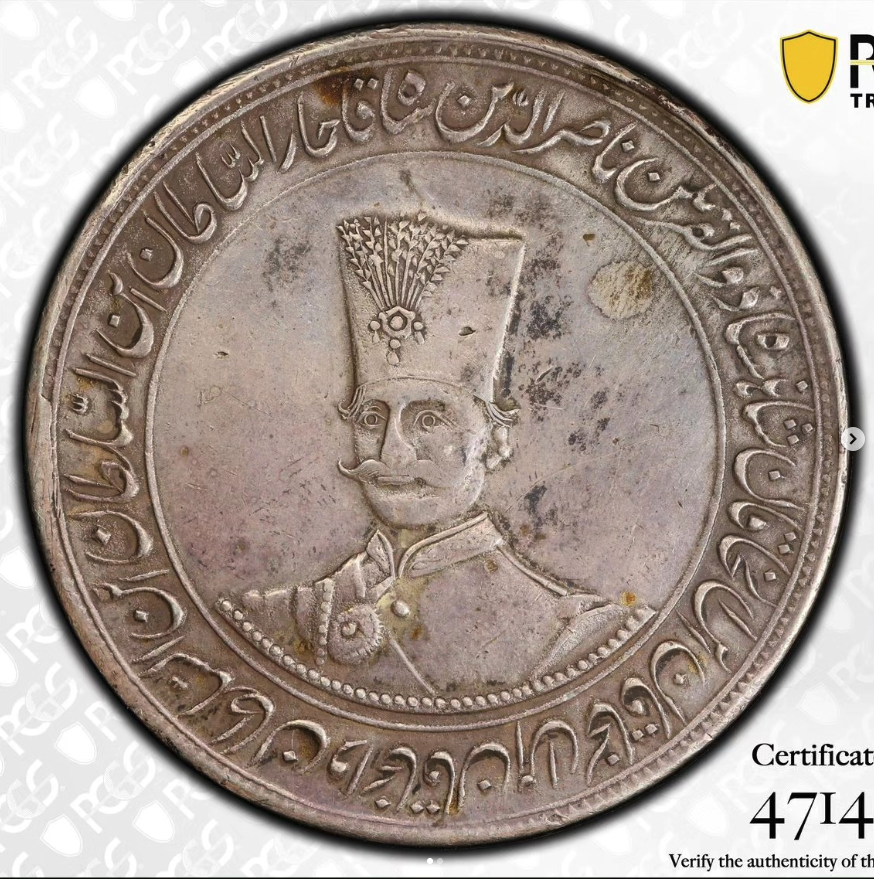
A massive 60mm jubilee toman struck only weeks before the Shah's assassination - this example a Belli Bank restrike from the 1930s.
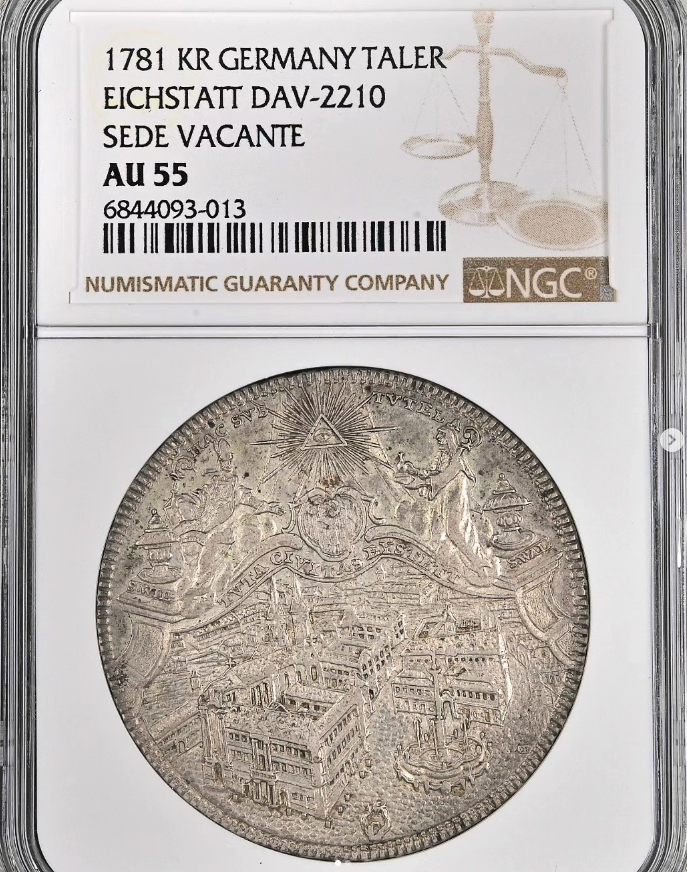
Struck by the cathedral chapter during the vacancy of the see after Bishop Raymund Anton's death - the famous bird's-eye city view obverse.
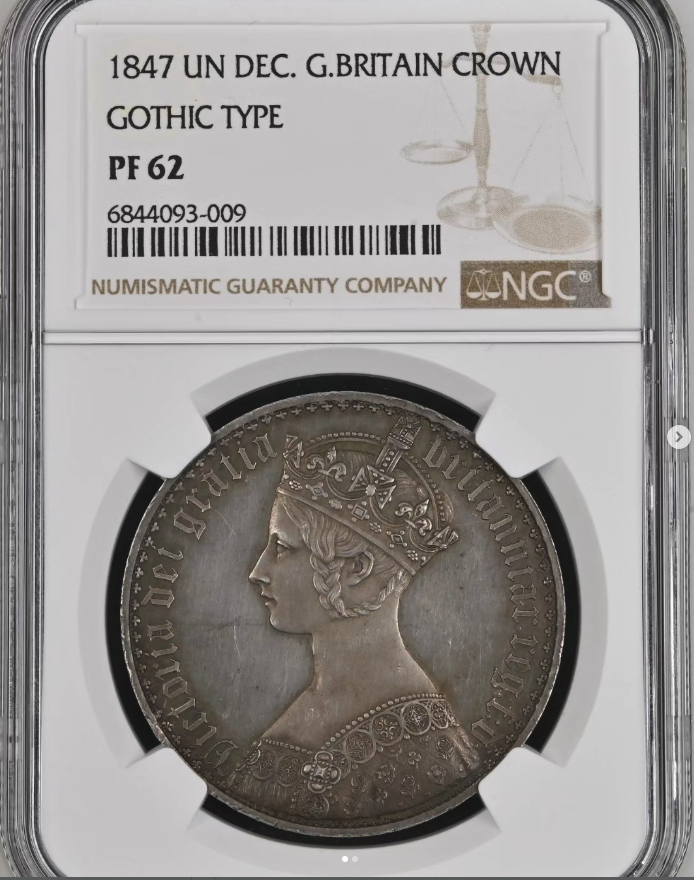
William Wyon's masterpiece - widely considered the most beautiful British coin ever struck. Mintage of just 8,000 silver proofs.
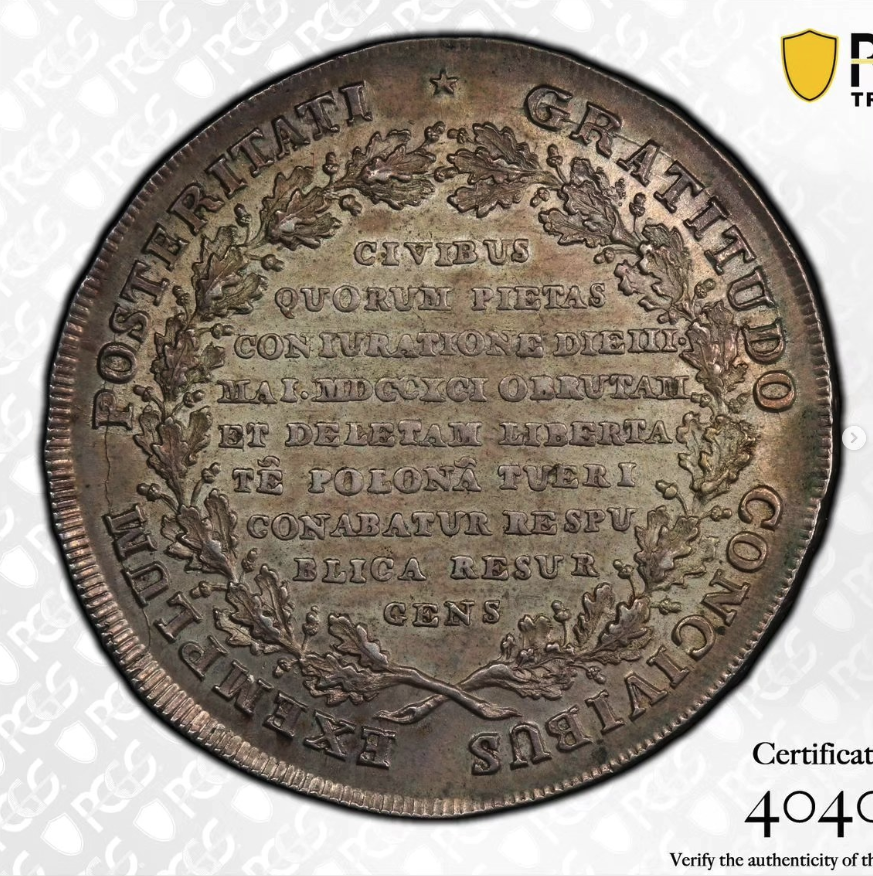
A deeply political thaler of the Russian-backed Targowica Confederation, struck in a tiny issue of about 1,699 pieces during the final dismemberment of Poland.
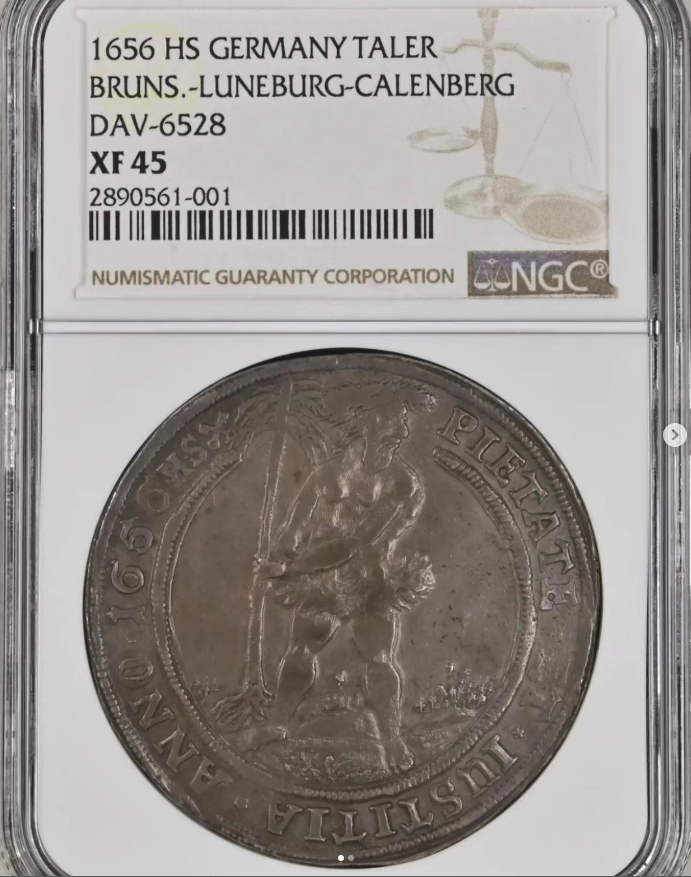
A classic Harz-silver Wildman thaler of Duke Christian Ludwig, with the legends PIETATE ET IUSTITIA - 'by piety and justice' - dated 1656.
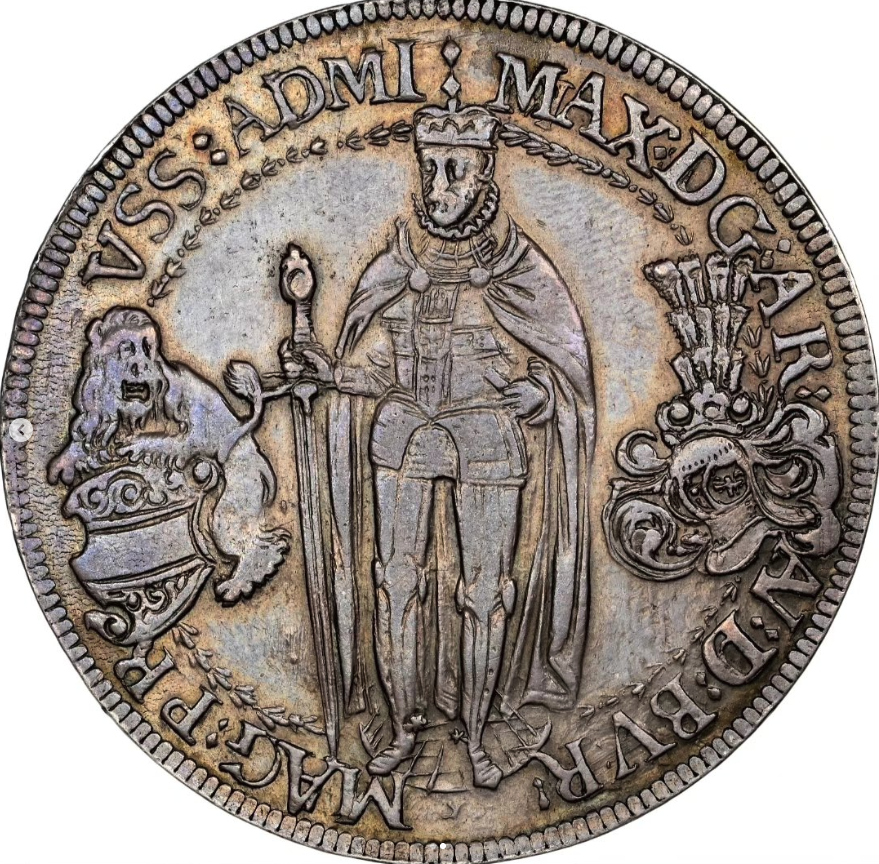
An overdated 1613/2 thaler of Archduke Maximilian III as Hochmeister of the Teutonic Order, struck at Hall in Tirol and later validated with a small '1' counterstamp.
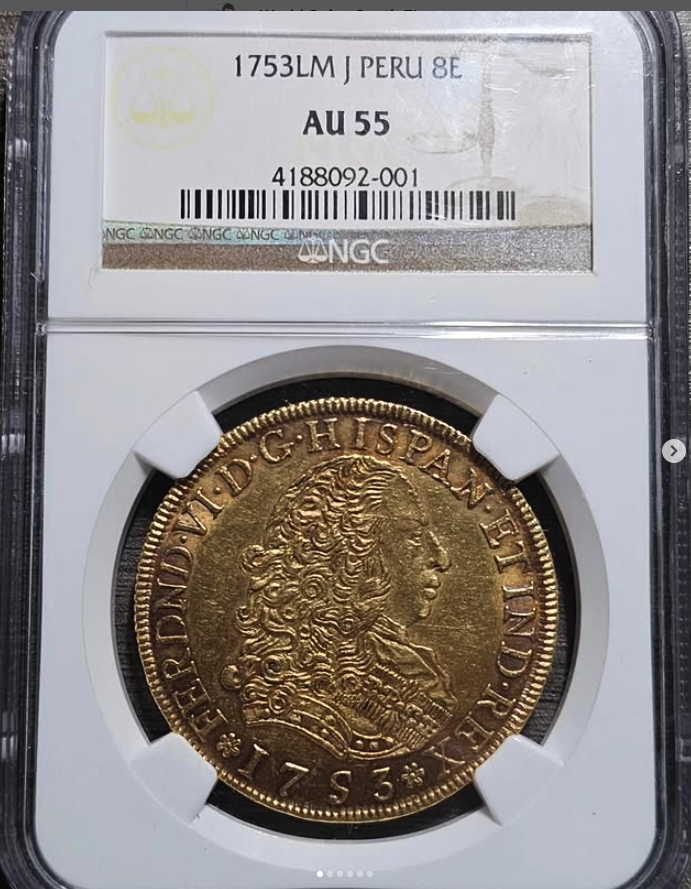
A Lima-mint 8 escudos of Ferdinand VI with the bust of the king and the crowned Bourbon arms - a classic 'onza' of Spanish colonial gold, here with attractive rose-and-purple cabinet toning.
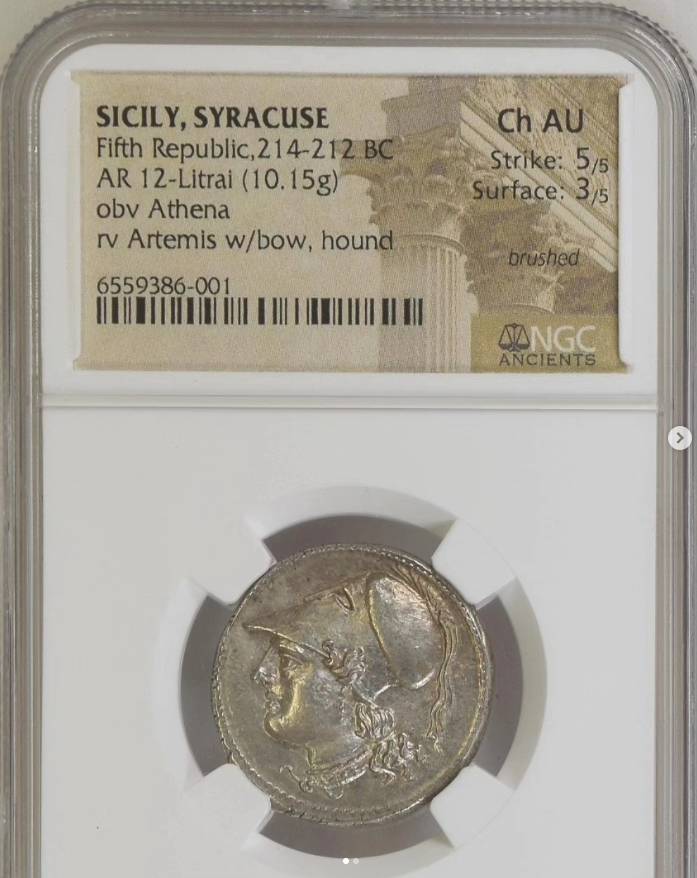
A large silver 12 litrai of the short-lived Fifth Republic of Syracuse, struck during the Roman siege immortalized by Archimedes' war machines.
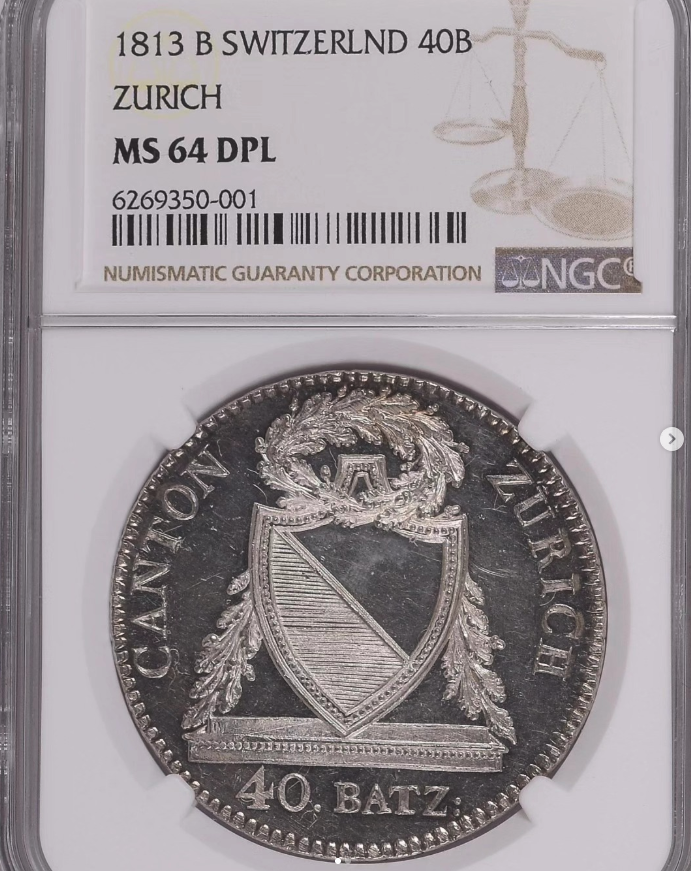
An exceptional Deep Mirror Proof-Like Zurich 40 Batzen, almost certainly an early strike from a freshly polished die set aside for a 19th-century cabinet collector. One of only 2 graded DPL by NGC, with only a handful more graded PL.
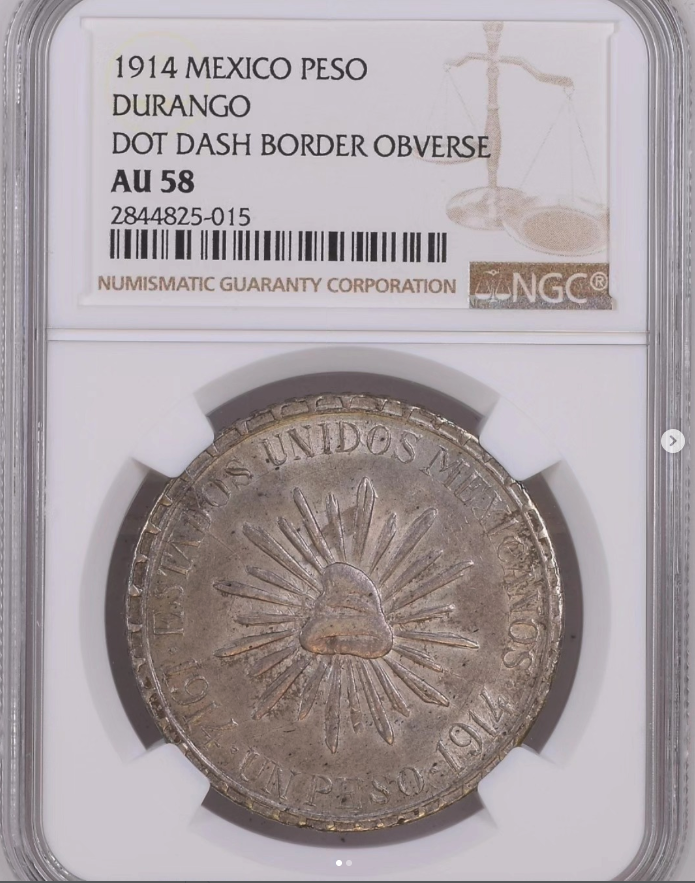
The famous 'Death to Huerta' peso of Pancho Villa's División del Norte - a defiant Revolutionary war coin so hated by Huerta that mere possession was reportedly a capital offense.
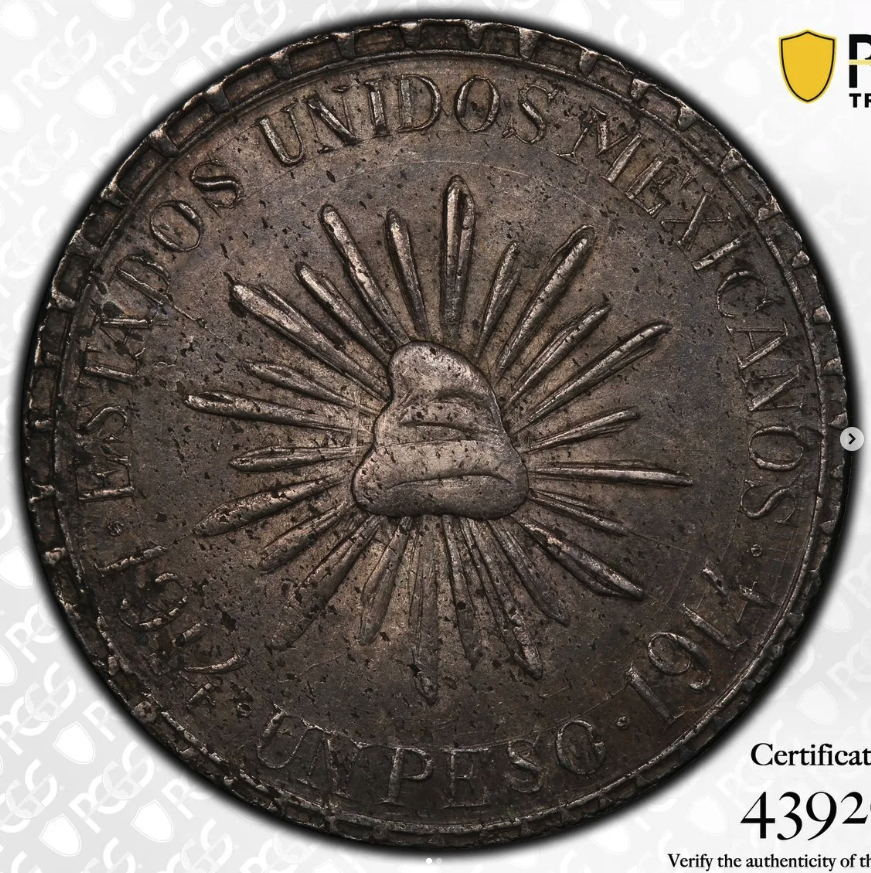
A second example of Pancho Villa's 'Death to Huerta' peso - PCGS AU-58, the silver pay-coin of the División del Norte that Huerta reportedly made a capital offense to carry.
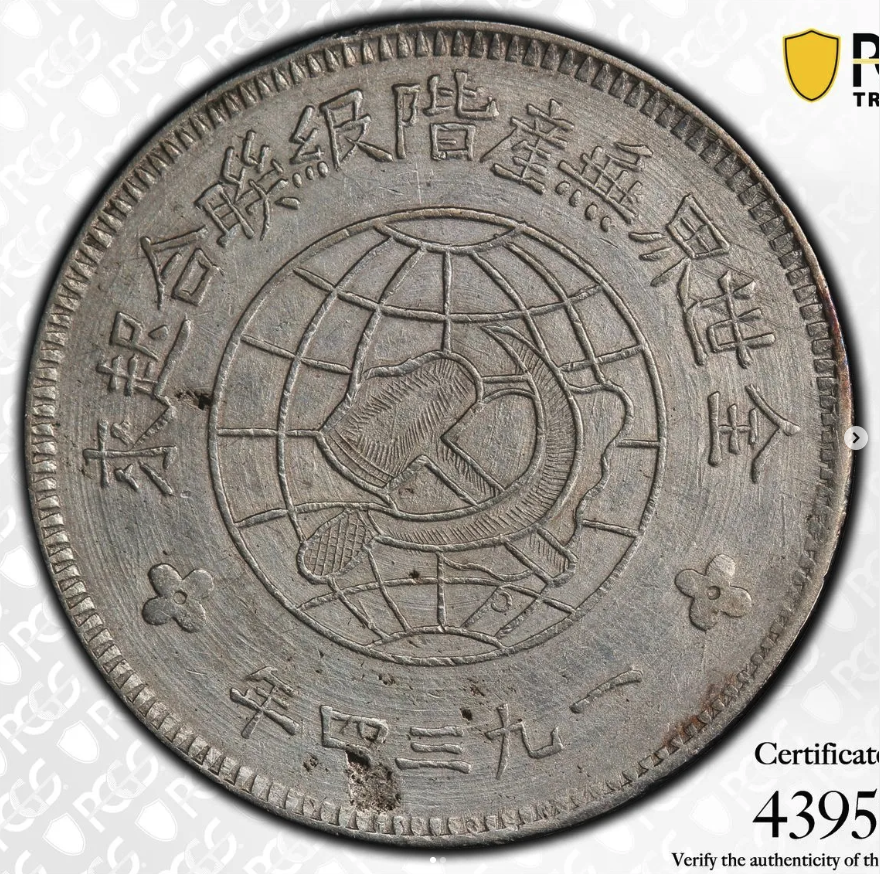
A propaganda dollar struck in hand-cut dies by the Red Army during the Long March - banned on pain of death by the KMT, sold for $33,600 at Stack's Bowers Hong Kong.
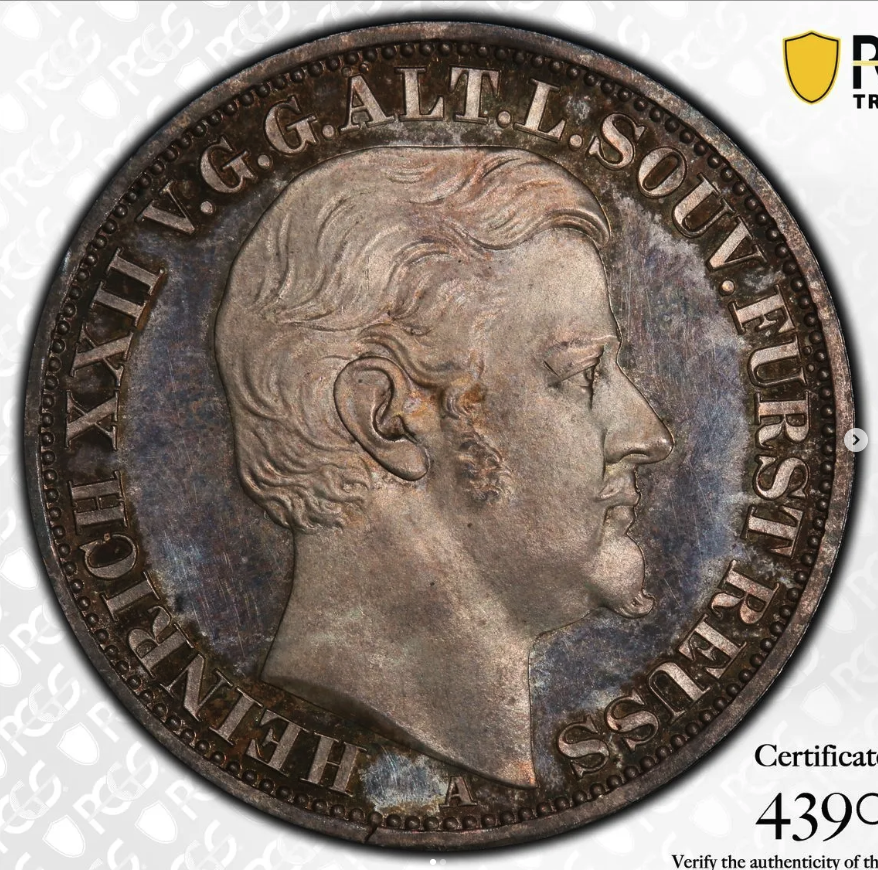
Finest-certified PCGS MS-66 PL of a tiny-state Vereinsthaler - and a textbook case of the proof vs. prooflike debate that haunts pre-unification German coinage.
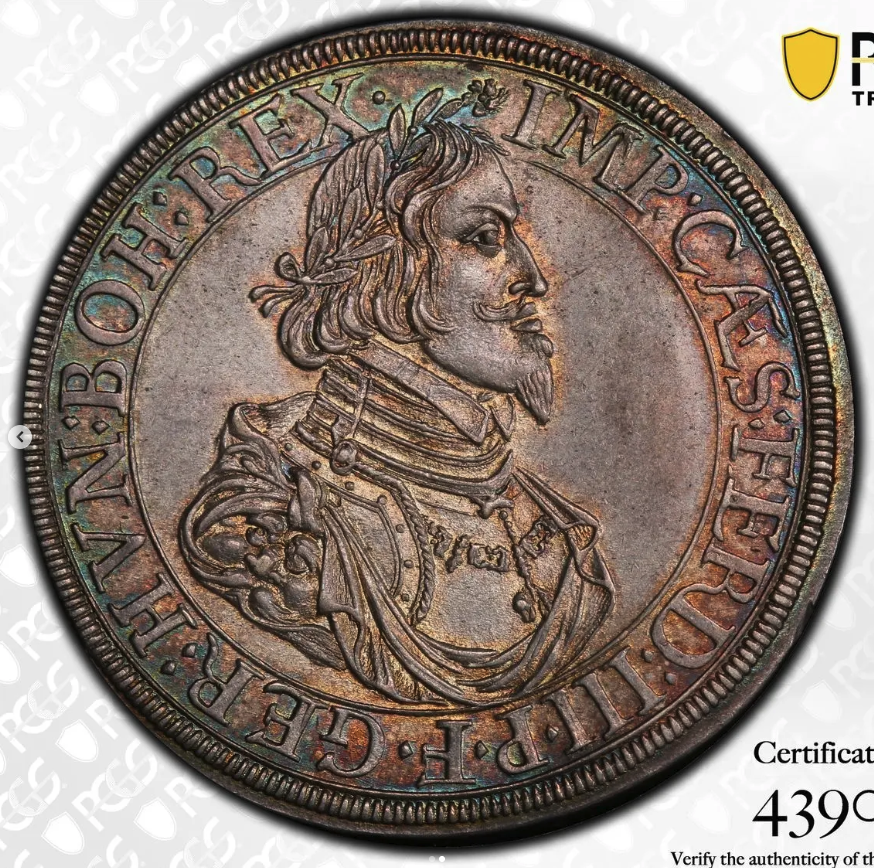
The famous Augsburg city-view thaler with bird's-eye panorama of the city's spires and the imperial pinecone (Pyr) - PCGS MS-65, finest certified for the Davenport-5039 type.
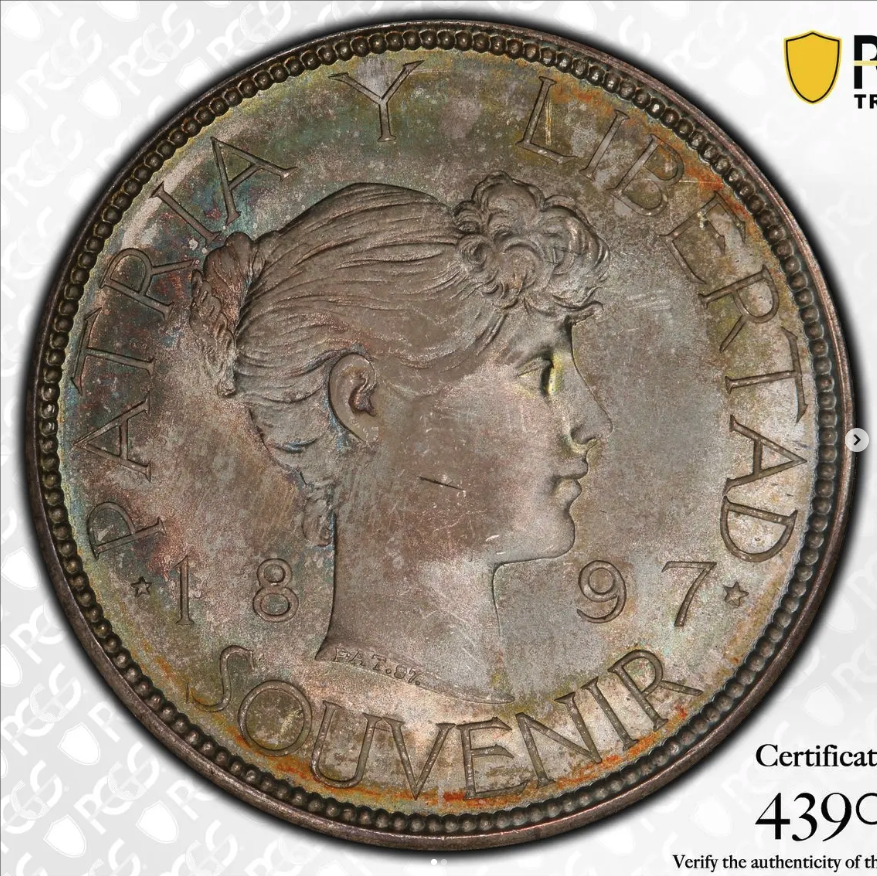
A fundraising 'fantasy' peso struck in Philadelphia by the Cuban Junta a year before the Spanish-American War - mintage of 828 net of destroyed pieces, PCGS MS-66 finest certified for Type I.
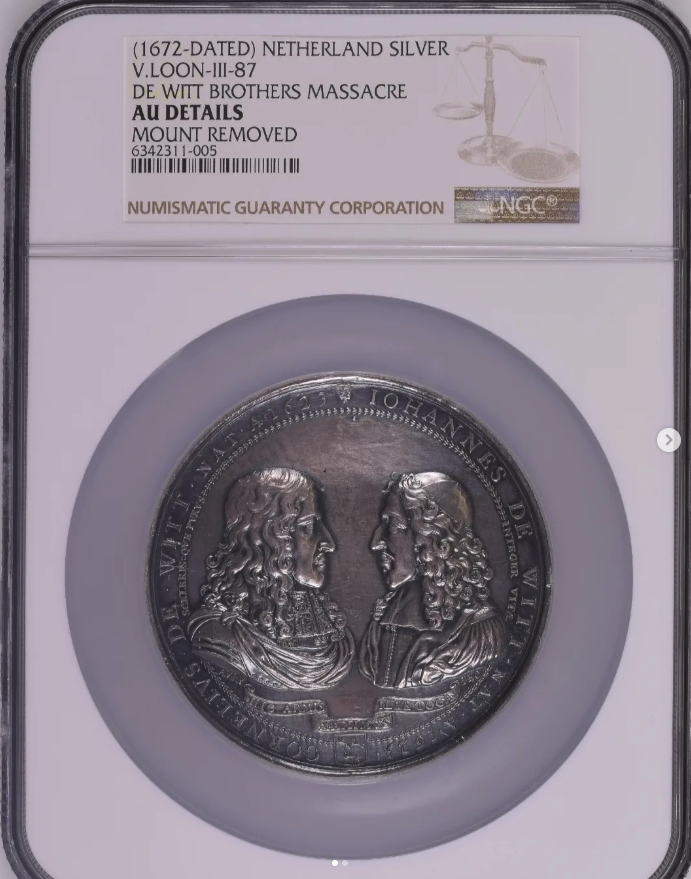
A massive 72mm silver medal struck in the year of the Rampjaar - the lynching, mutilation, and ritual cannibalism of the De Witt brothers by an Orangist mob in The Hague.
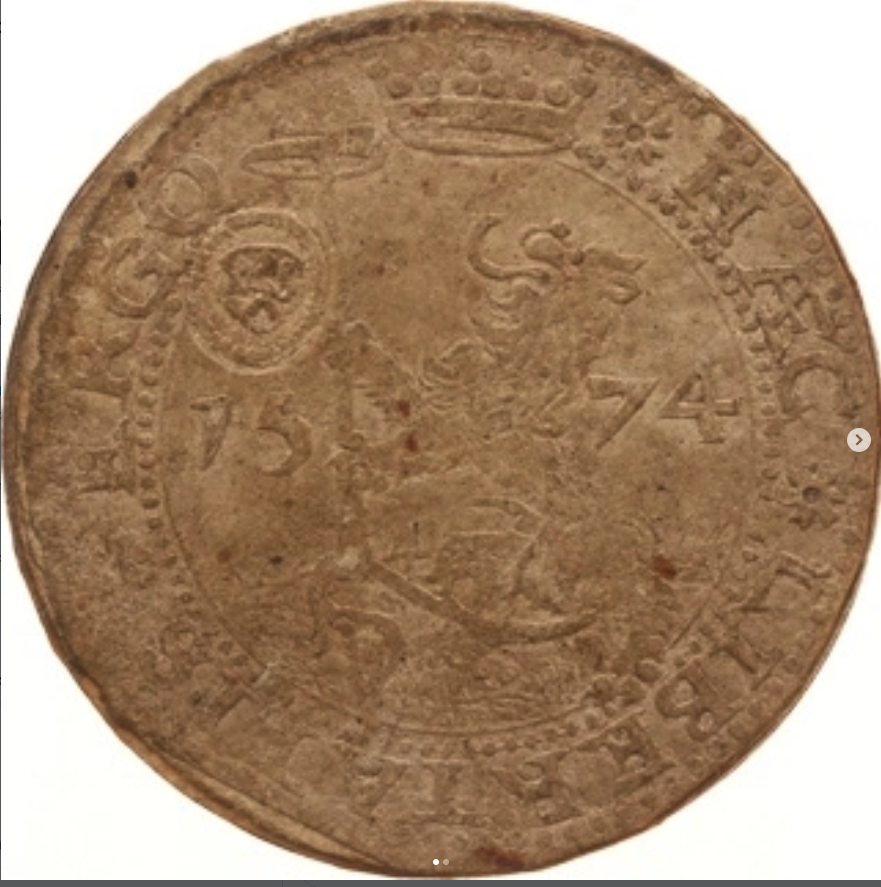
One of the earliest paper coins in European history - struck from cut-up Catholic missal pages inside a starving city, then counterstamped to mark it as genuine after counterfeits flooded Leyden.
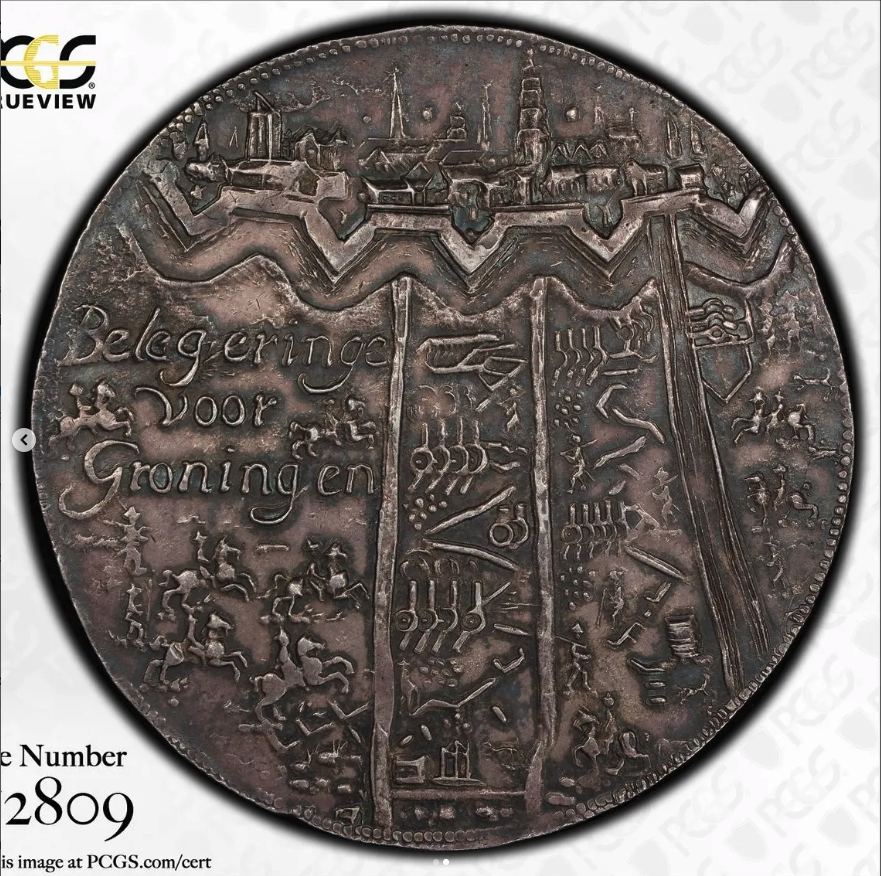
A magnificent narrative siege medal showing Groningen ringed by trenches, the Münster cavalry on the field, and the recapture of Coevorden - struck immediately after the city's deliverance on Groninger Ontzet (27 August 1672).
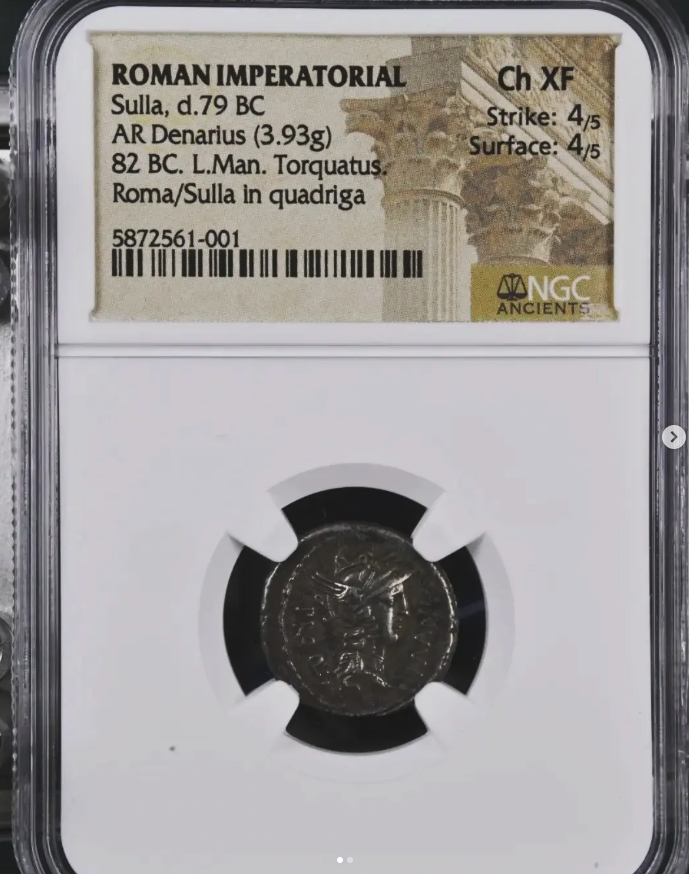
An imperatorial denarius struck in Sulla's military mint as he marched on Rome - the first Roman coin to depict a living general in his triumphal chariot, the prototype for Caesar's coinage.
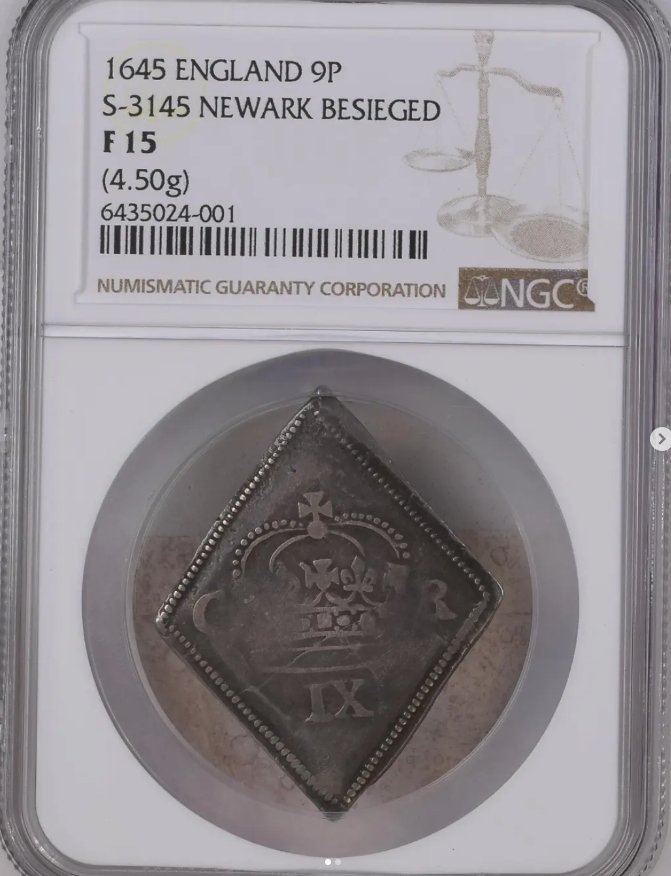
A diamond-shaped emergency coin hammered out of the king's own silver plate inside a starving Royalist garrison - one of the last coins struck in Charles I's name before he was forced to surrender to the Scots and, eventually, to the executioner's block.
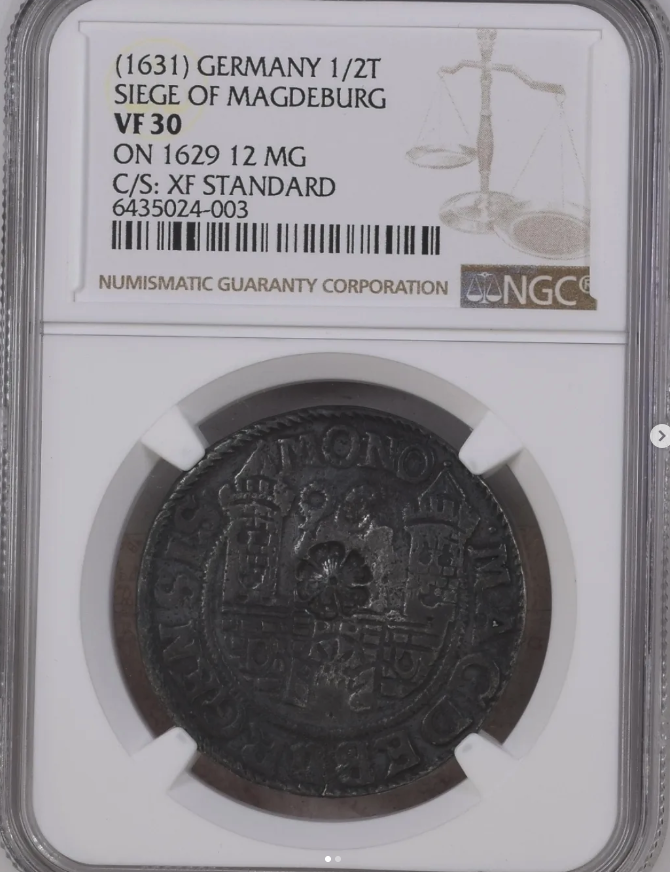
An emergency revaluation counterstamped onto an older Magdeburg coin during the siege - silver from a city that, weeks later, was annihilated. Of 25,000 inhabitants, only 5,000 survived.
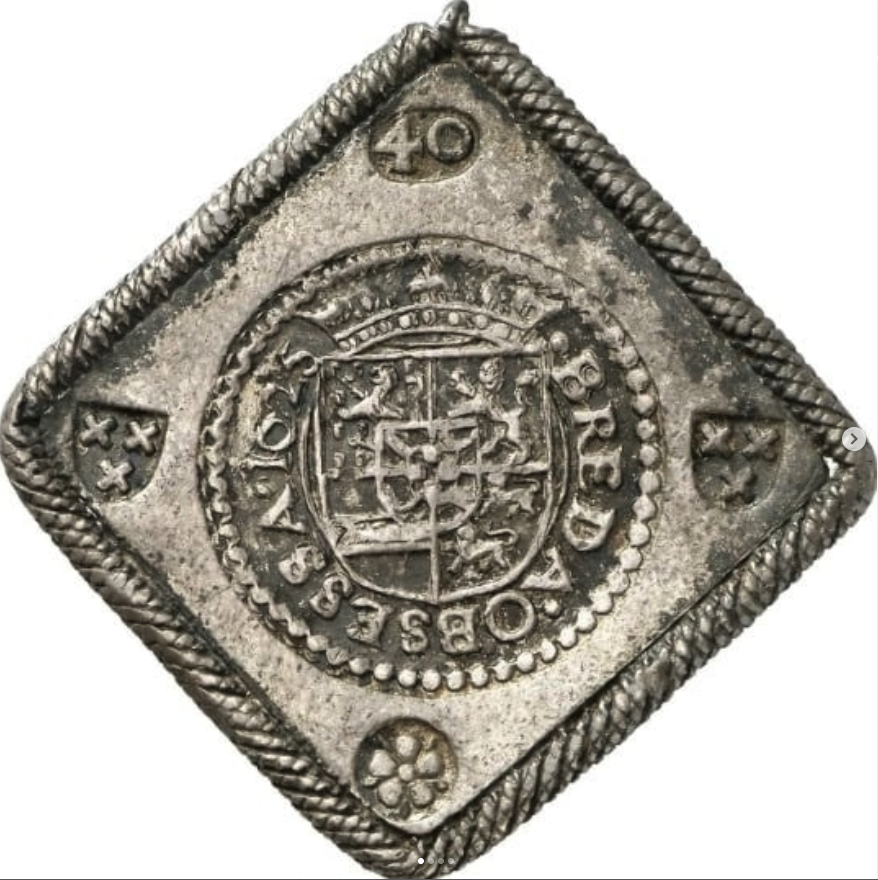
A klippe siege piece struck from melted church plate inside starving Breda, captured by Spanish soldiers at the surrender and mounted in a contemporary bezel as a battlefield trophy. Pedigreed to the Archer Huntington Collection (no. 9356) and Dr. Lawrence Korochnak.
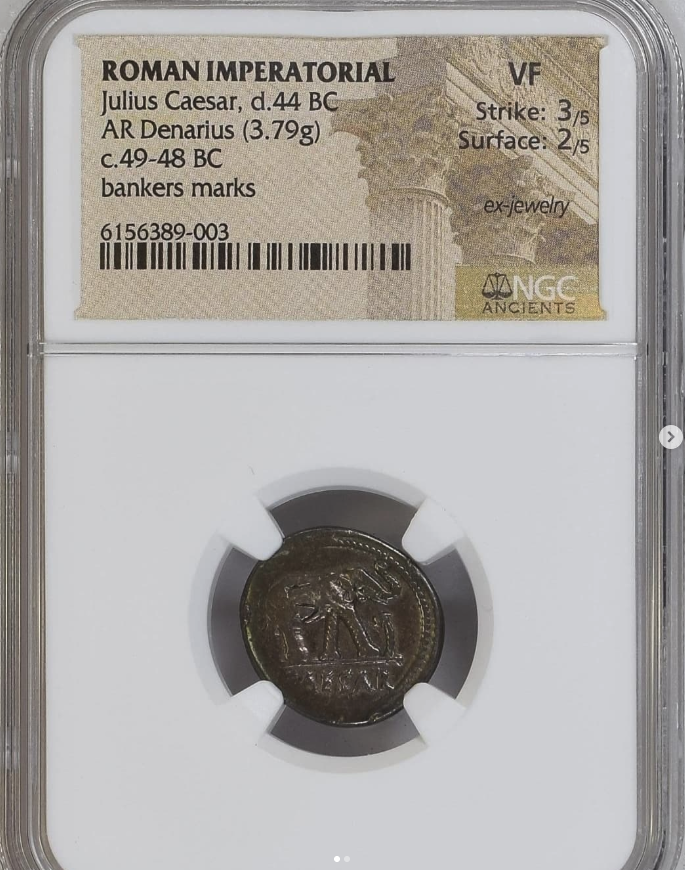
The most famous coin of the Roman Republic - struck by Caesar himself to pay the legions that crossed the Rubicon. The first Roman coin to put a living general's name on the obverse instead of the gods. An honest, well-circulated battlefield example with bankers' marks proving it passed through the hands of Roman moneychangers, later mounted as jewelry by an unknown owner who knew exactly what it was.
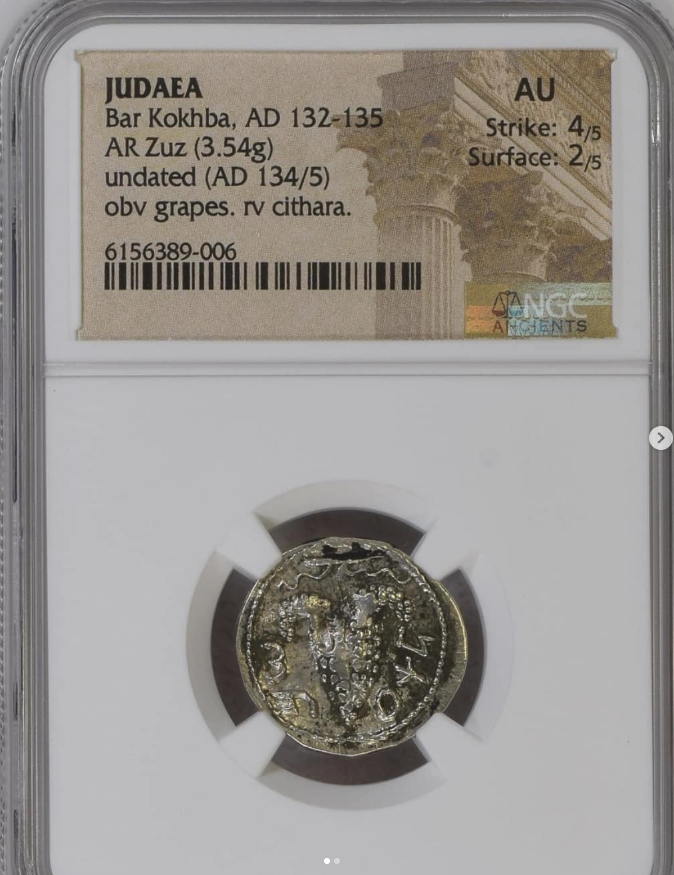
A silver zuz of Bar Kokhba - struck over a Roman denarius whose emperor's portrait the rebels deliberately defaced. The coins of a three-year independent Jewish state that bore the legend 'For the Freedom of Jerusalem' and named Bar Kokhba 'Prince of Israel' before Hadrian wiped Judaea from the map.
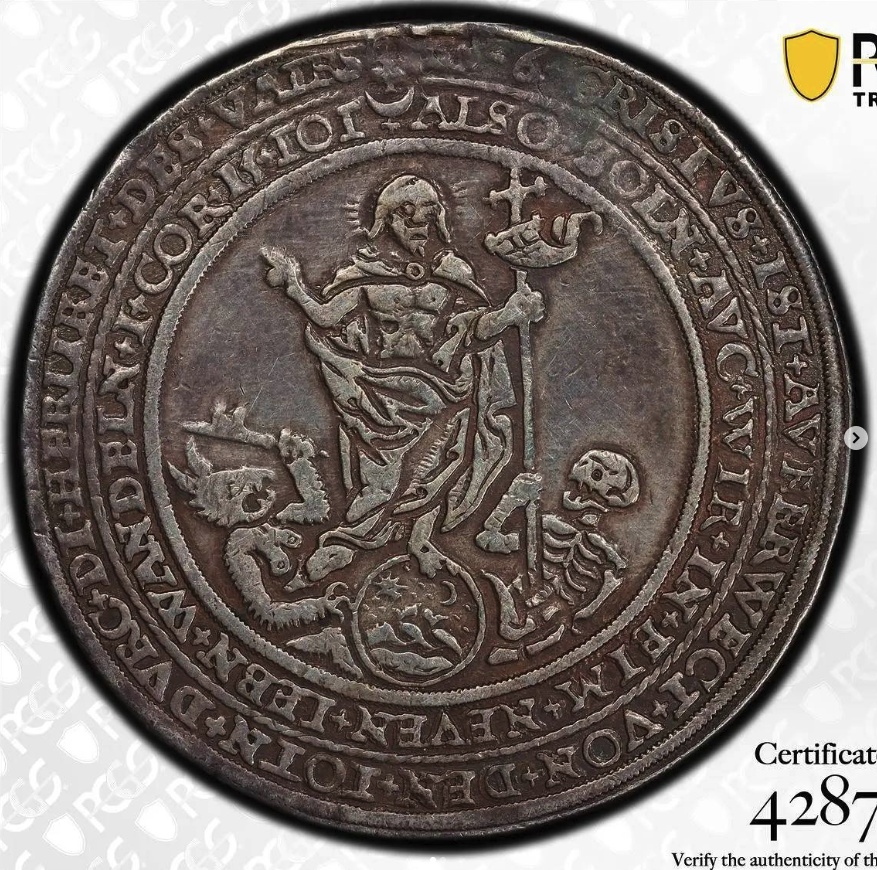
An early Joachimsthaler-style religious medallic Thaler from the Bohemian valley whose silver gave the world the word 'Dollar' - Christ trampling Death and the Devil on the obverse, the typological prefiguration of the Resurrection (Jonah cast into the sea) on the reverse.
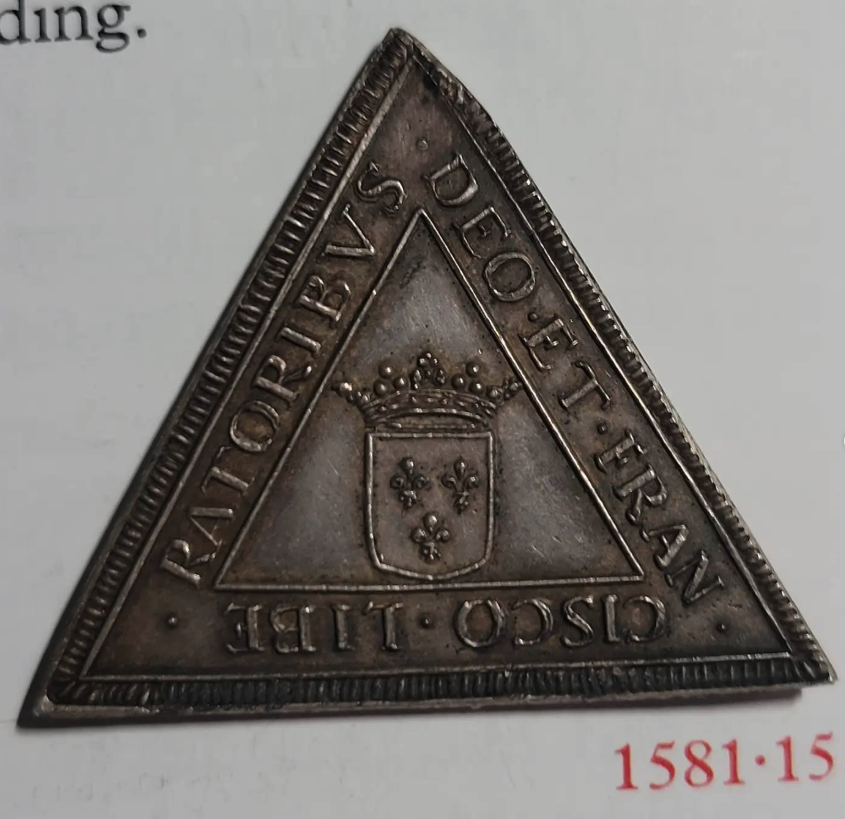
An extraordinarily rare triangular silver largesse medal physically thrown to the crowd of Cambrai on 18 August 1581 to celebrate the lifting of the Spanish siege. Pedigreed to Dr. Lawrence Korochnak (author of 'Siege Coins of the World 1453-1902') and accompanied by its original 1800s collector's tag. Comparable examples have made $12,000 at CNG and €5,000 at Künker.
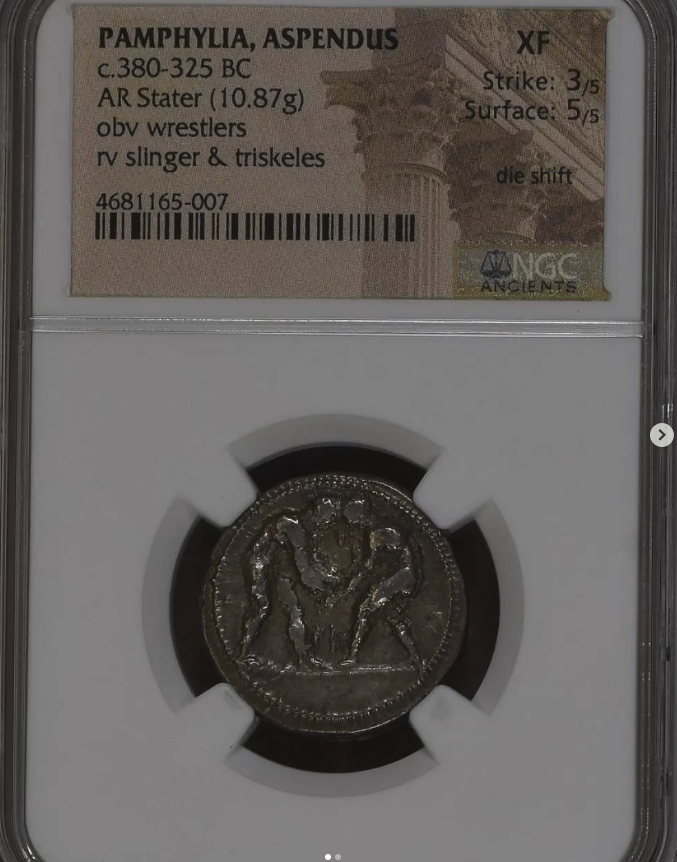
One of the most iconic Greek silver coins ever struck - two wrestlers locked in a hold on the obverse, a slinger in mid-throw on the reverse, both alluding to the city's two great public spectacles. Surface 5/5 is exceptional for the type.
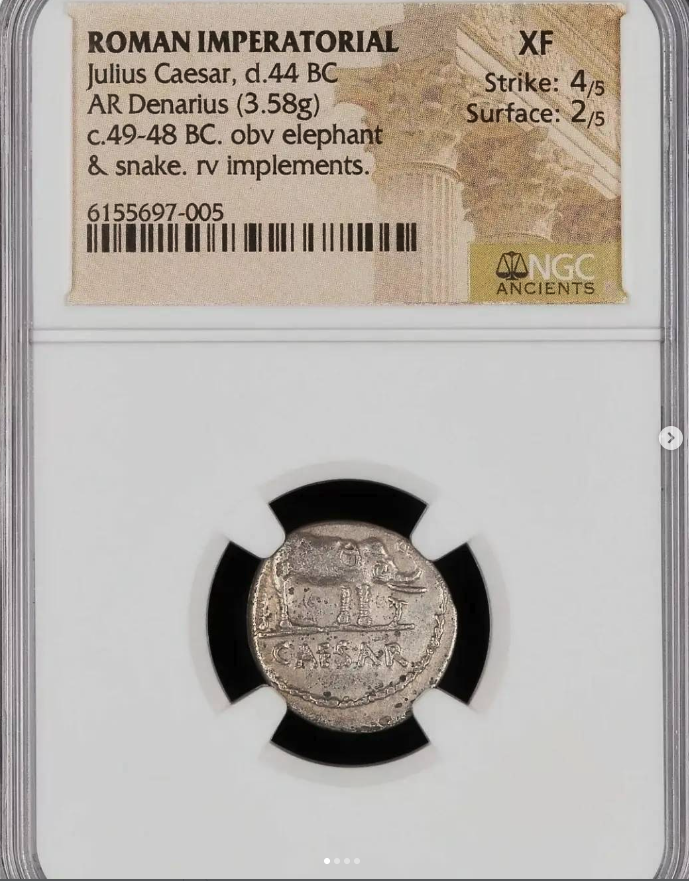
The most famous coin of the Roman Republic - struck by Caesar himself to pay the legions that crossed the Rubicon. The first Roman coin to put a living general's name on the obverse instead of the gods. A high-grade XF example with a sharp Strike 4/5.
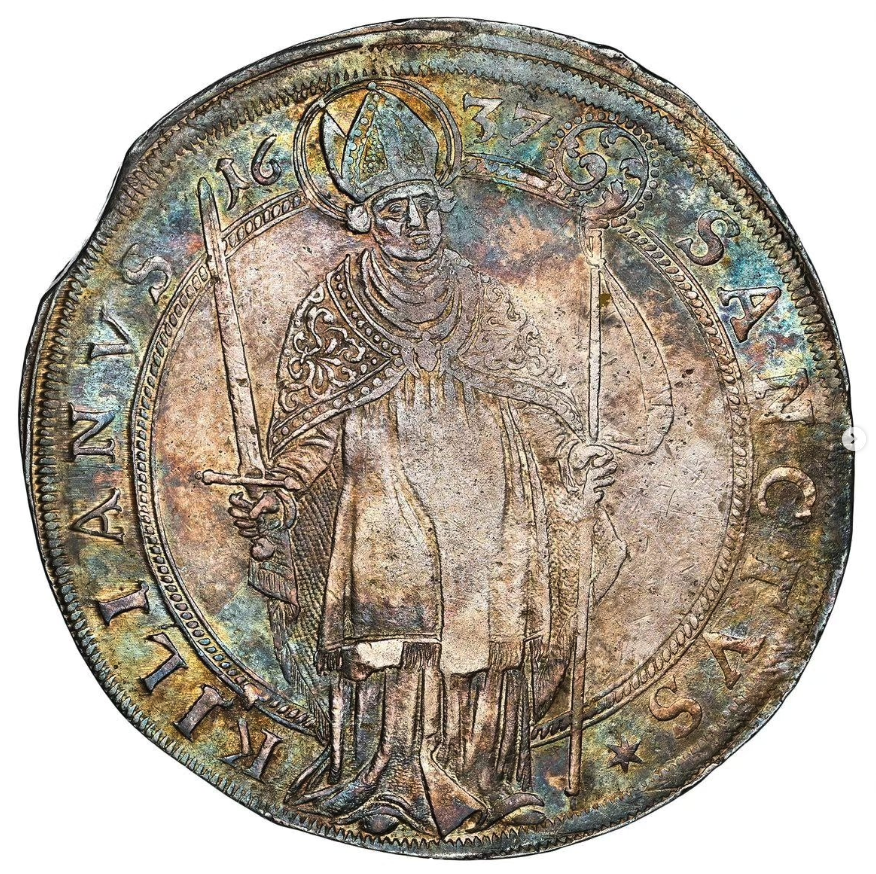
A magnificent St. Kilian thaler of Prince-Bishop Franz von Hatzfeld, struck in the depths of the Thirty Years' War and wrapped in deep rainbow cabinet toning.
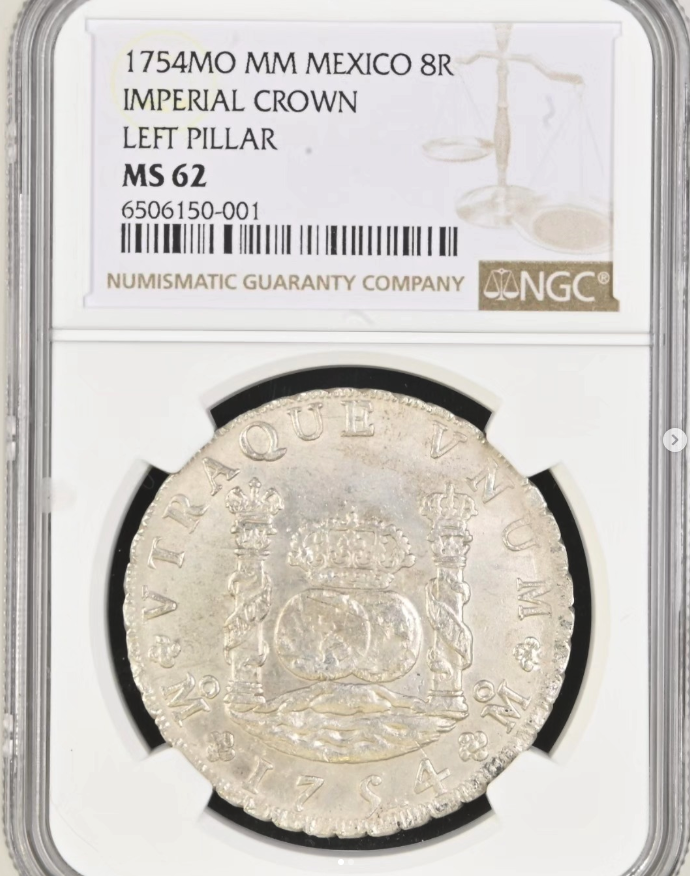
A fully Mint State Pillar Dollar of Ferdinand VI, struck at Mexico City with the recognized Imperial Crown / Left Pillar die variety - the original 'Spanish Milled Dollar' of world commerce.
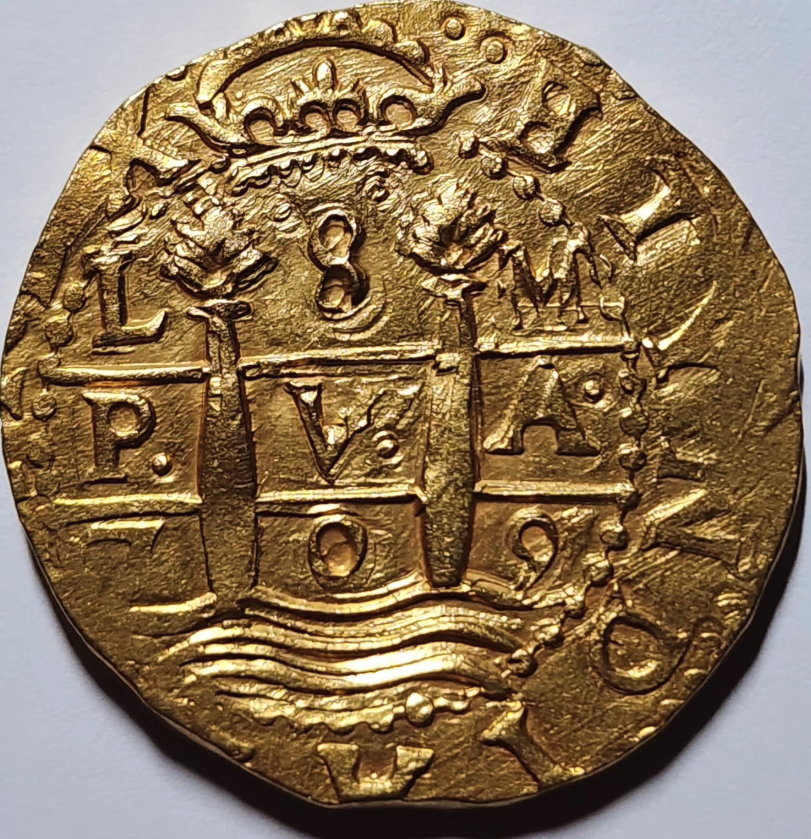
A Lima cob 8 escudos of Philip V recovered from the 1715 Plate Fleet - one of the great Spanish treasure-fleet disasters and the wrecks that gave Florida's 'Treasure Coast' its name.
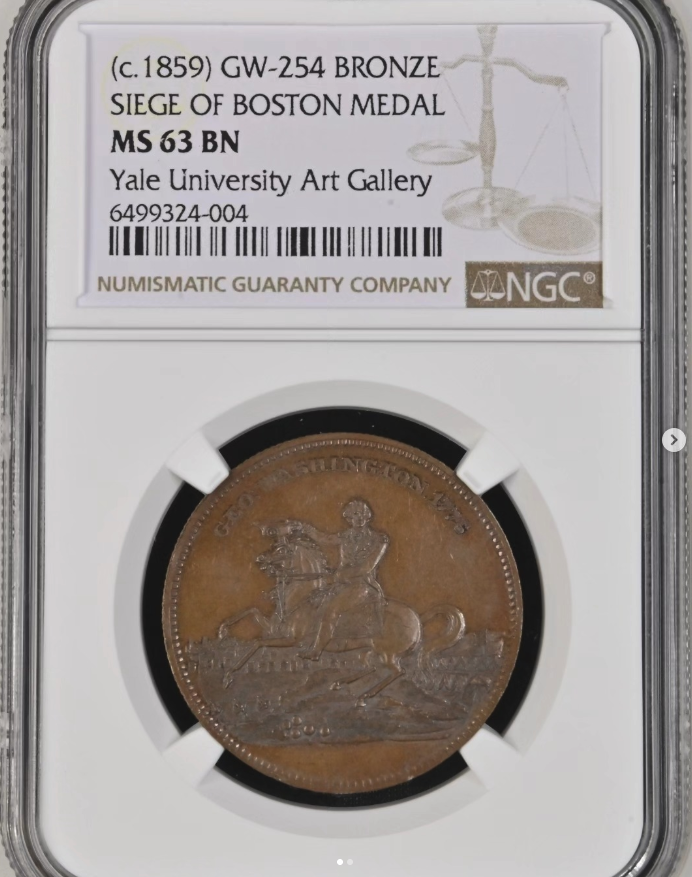
A Yale-pedigreed Washingtoniana medal commemorating the Siege of Boston (1775-1776), Washington's first great victory as Commander-in-Chief of the Continental Army.
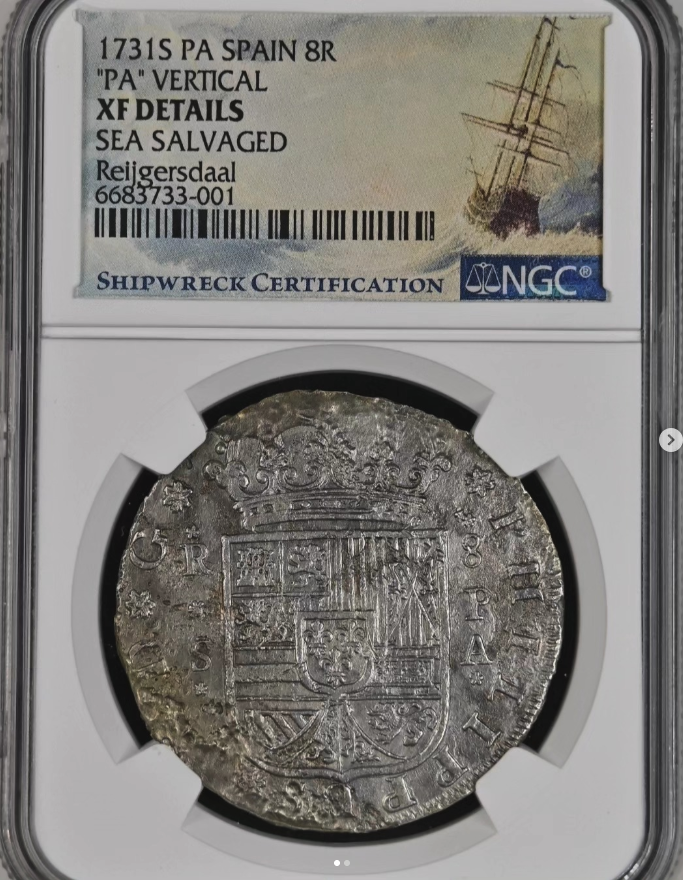
A rare mainland-Spain milled 8 reales recovered from the Dutch East India Company ship Reijgersdaal, whose 1747 wreck off South Africa yielded one of the great shipwreck hoards of 18th-century silver.
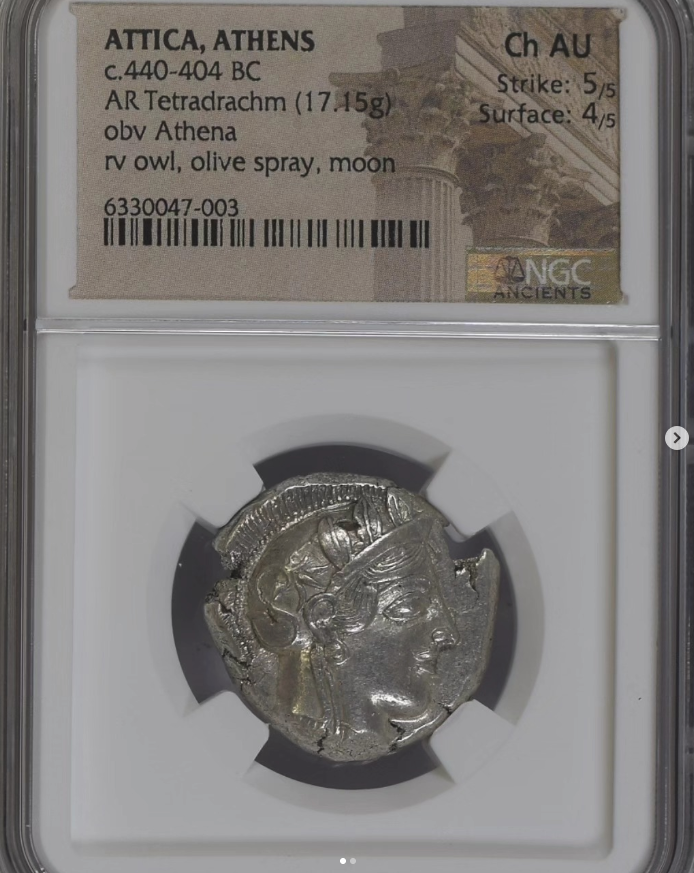
The 'owl' of Athens - the first true international trade coin, struck from the silver of Laurion at the height of the Athenian Empire.
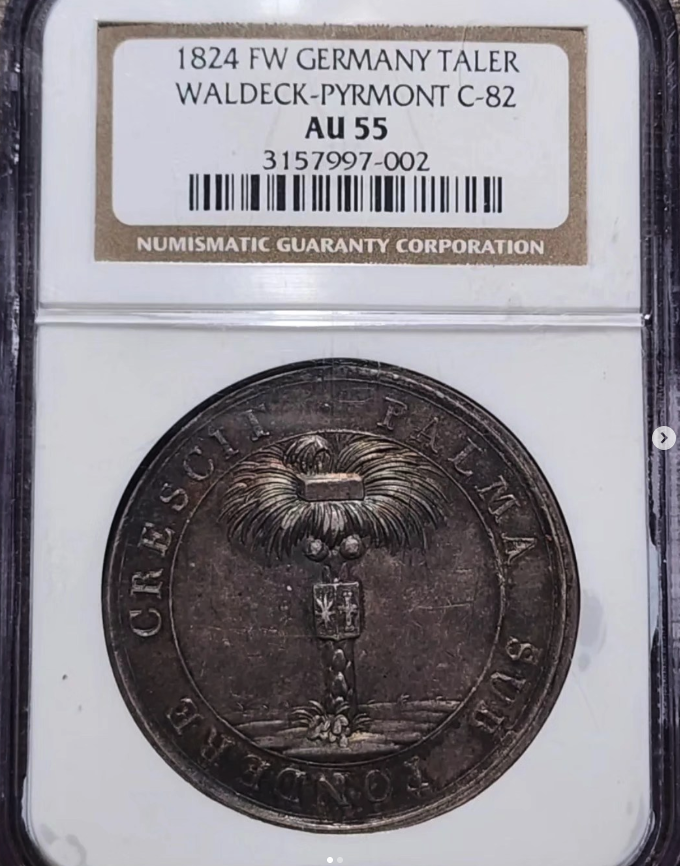
A scarce one-year-type Kronenthaler of the tiny Principality of Waldeck-Pyrmont, struck under Prince Georg Heinrich with the famous palm-tree motto CRESCITE PALMA SUB PONDERE - 'grow, palm, under burden.'
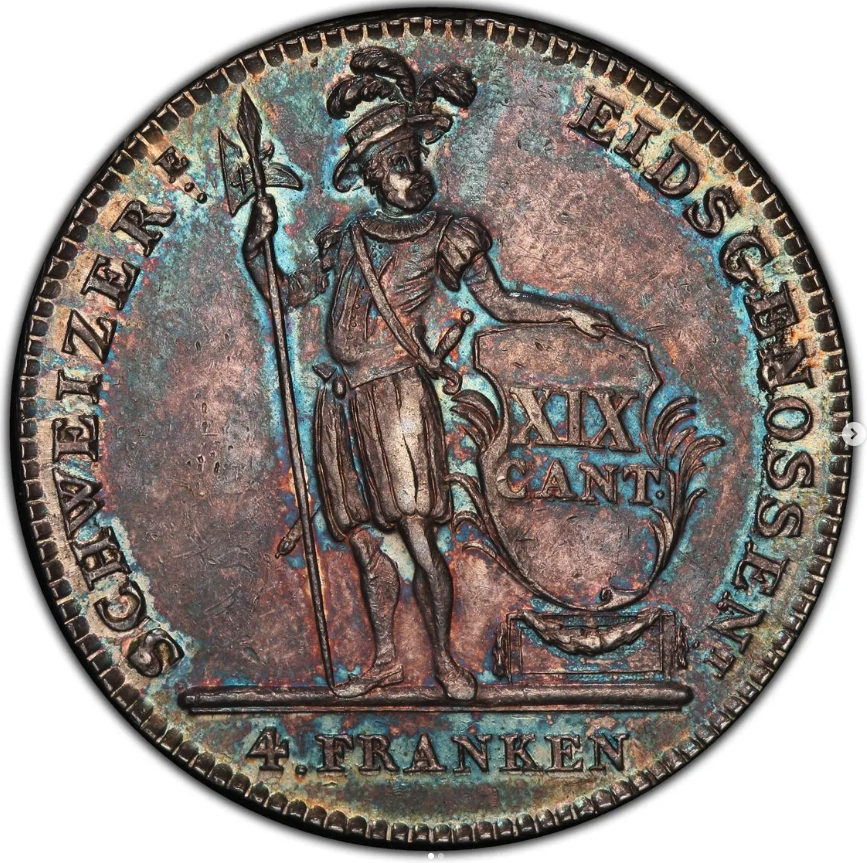
A scarce post-Napoleonic Cantonal 4 Franken of Luzern, struck for the restored Swiss Confederation of XIX Cantons - here with extraordinary rainbow cabinet toning.
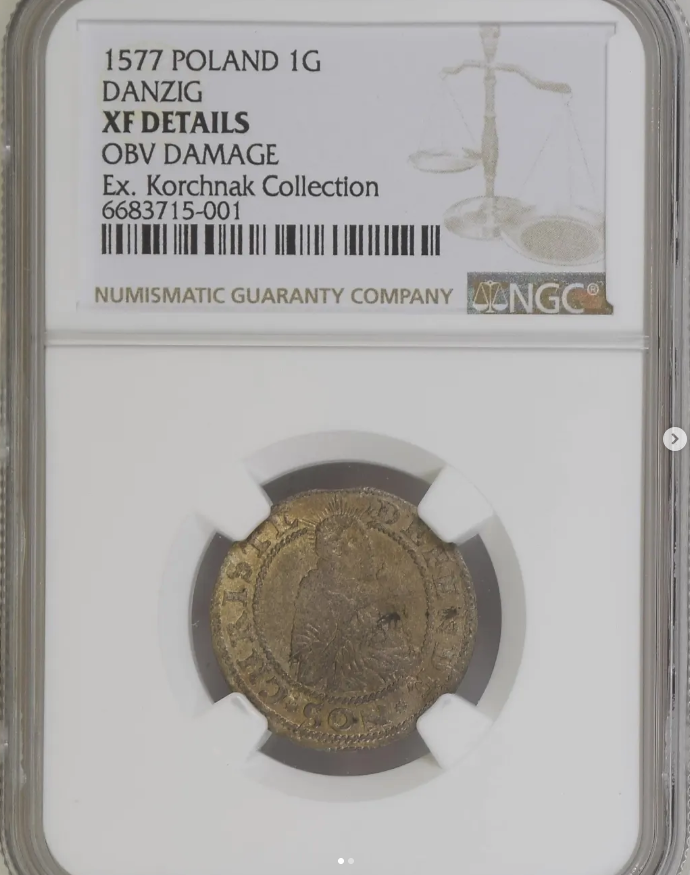
A genuine emergency siege groschen struck inside Danzig during the 1577 siege - bearing the image of Christ to pay Scottish mercenaries - from the cabinet of Dr. Lawrence Korchnak, the standard author on world siege coinage.
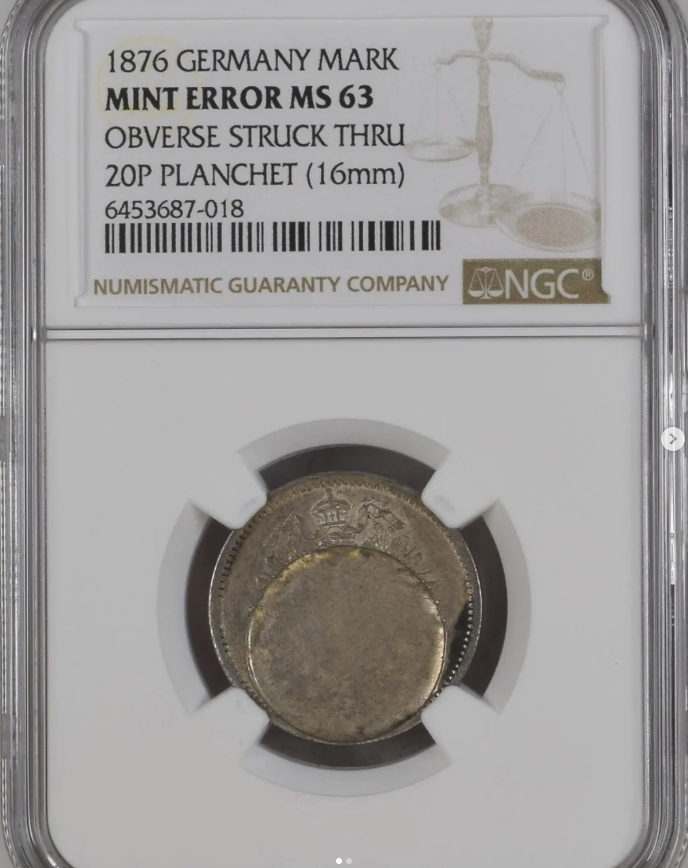
A spectacular and historically improbable mint error: an 1876 German Empire 1 Mark struck through a 20 Pfennig planchet, leaving a perfect 16mm blank circle across the obverse - in choice Mint State.
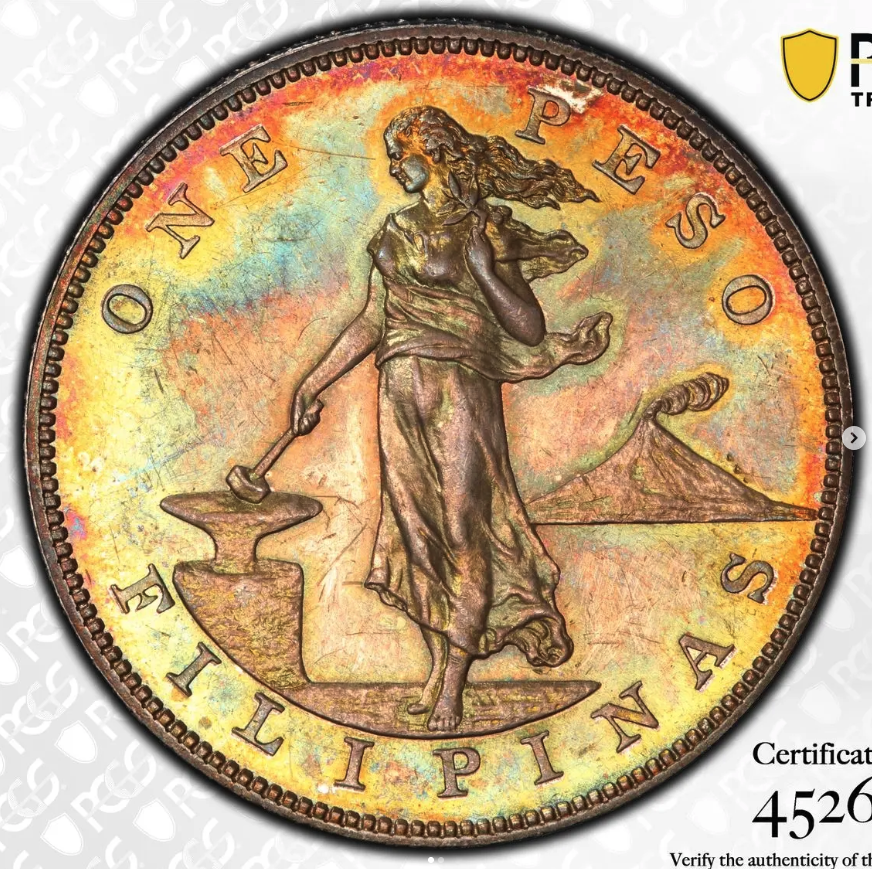
A choice rainbow-toned Proof Peso from the tiny early-Insular mintage of just 2,558 pieces - the elegant Allegorical Filipina type by Melecio Figueroa.
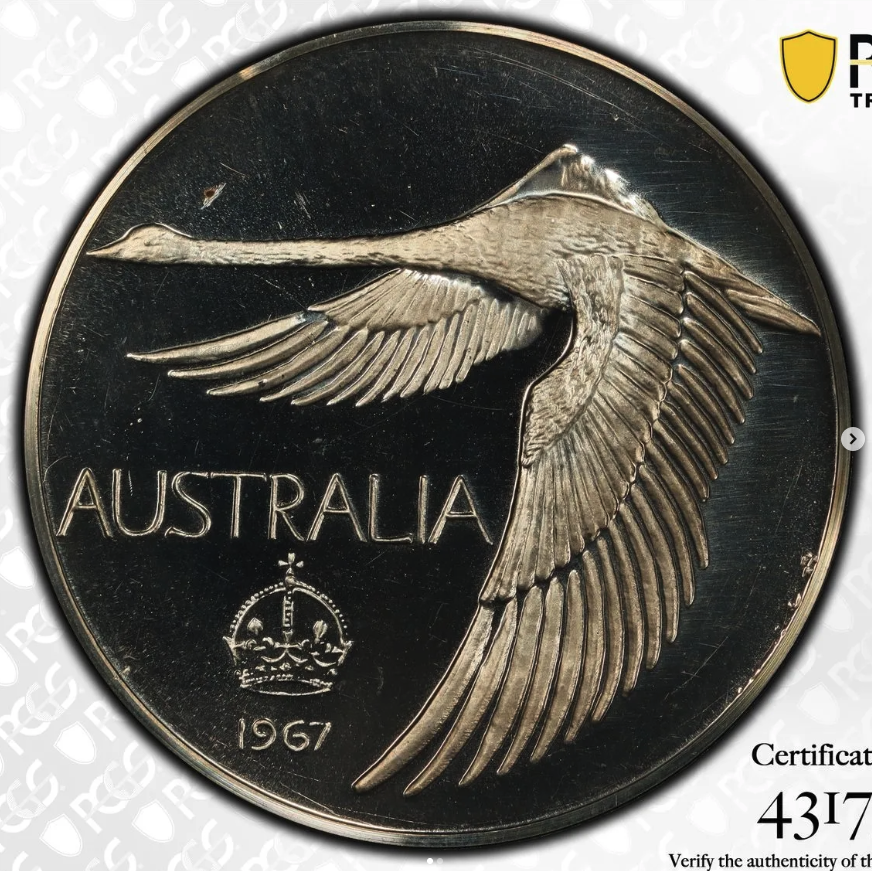
A deep-cameo Proof example of the famous 1967 Mészáros 'flying swan' pattern dollar - struck by John Pinches of London in just 750 plain-edge proof pieces.
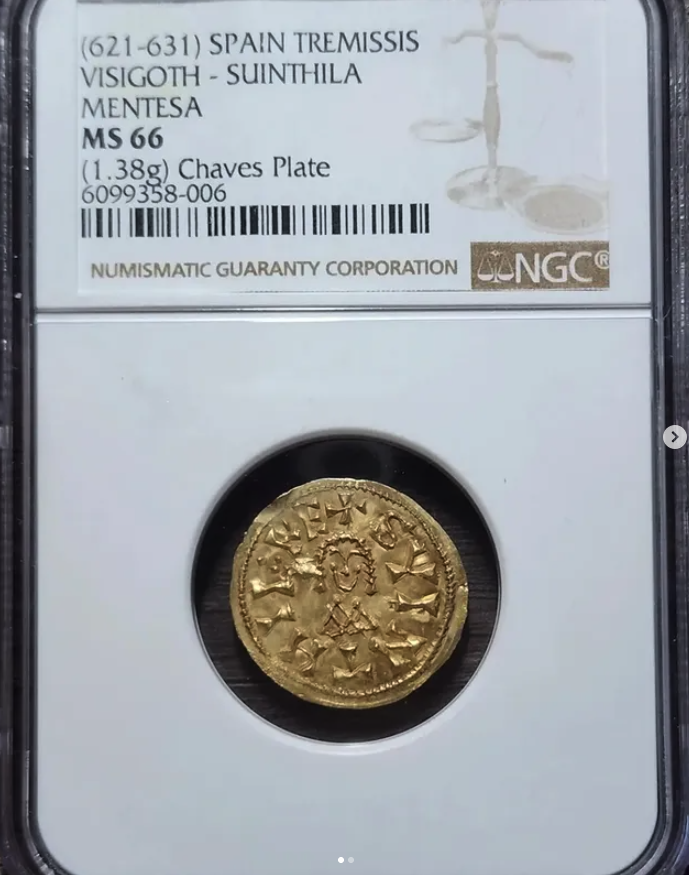
A spectacular gold tremissis of the Visigothic king Suinthila from the rare Mentesa mint - graded NGC MS 66 and published as the plate coin in the Chaves reference. The kind of survival that simply does not happen.
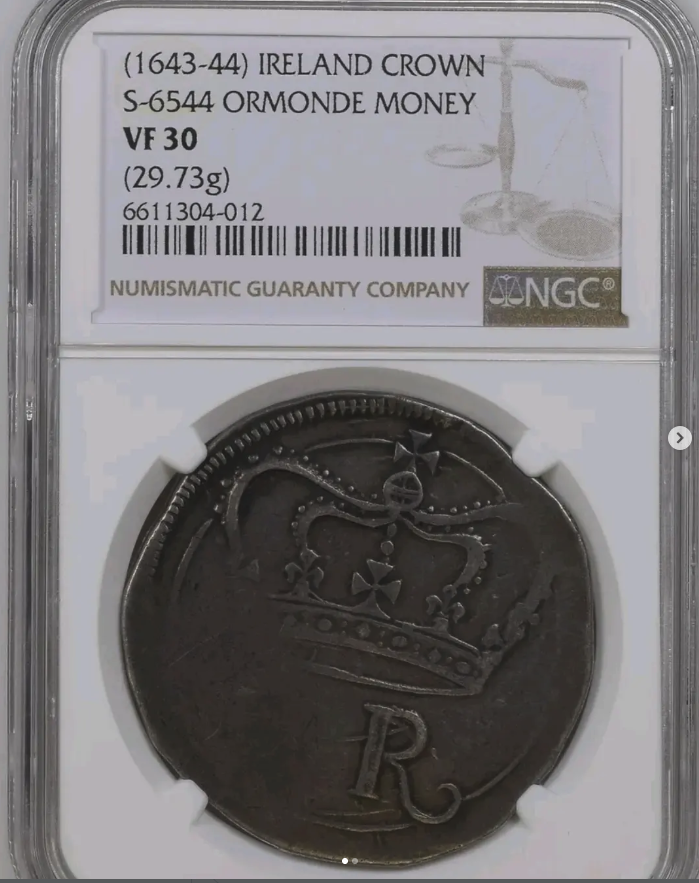
Crude, heavy emergency silver crown struck in Dublin under the Marquis of Ormonde during the 1643 Cessation - one of the great Royalist Civil War issues of Ireland.
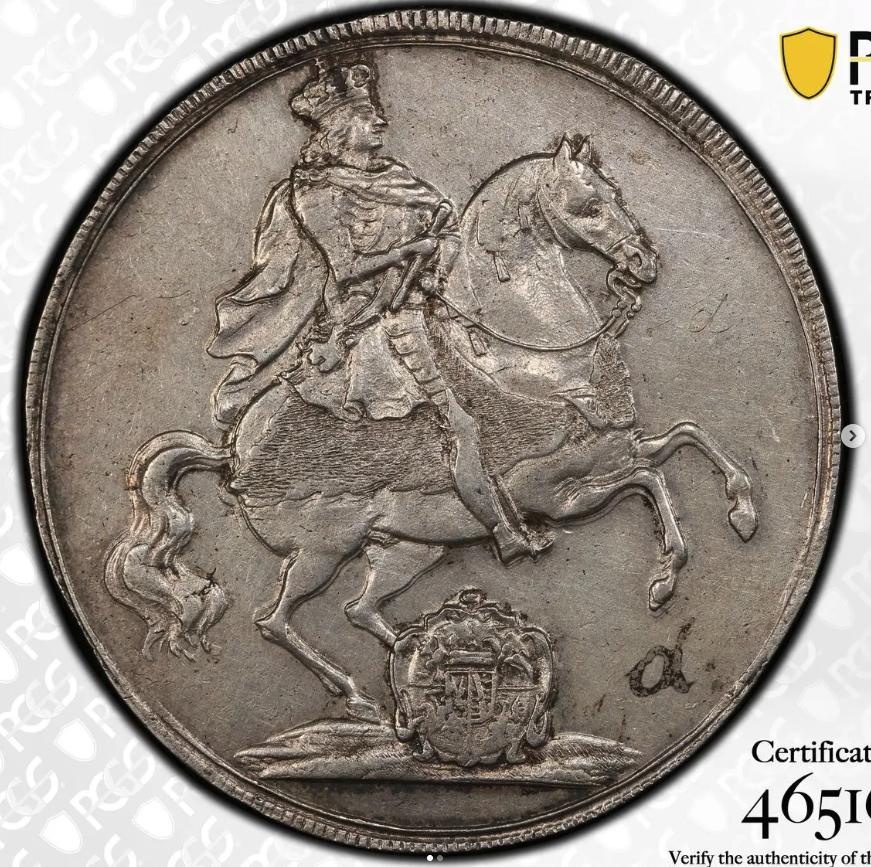
A Saxon Vicariat thaler struck during the brief 1711 Imperial interregnum, when Augustus the Strong governed the Empire as Imperial Vicar between the death of Joseph I and the election of Charles VI.
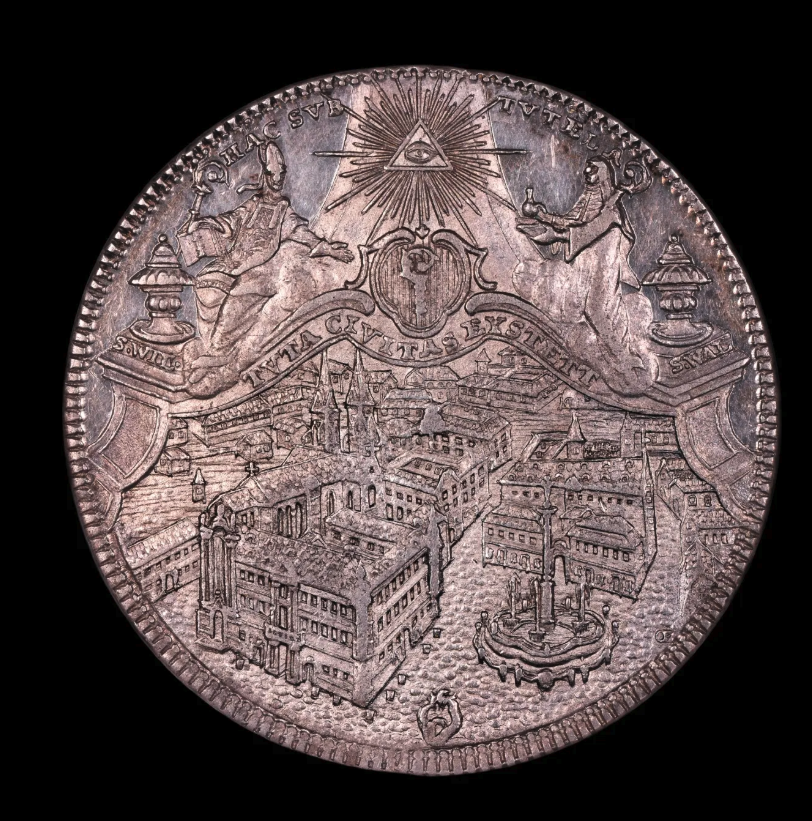
The dramatic 1781 Eichstätt Sede Vacante 'city-view' thaler - a baroque bird's-eye plan of the cathedral city under the All-Seeing Eye, struck during the vacancy of the prince-bishop's throne.
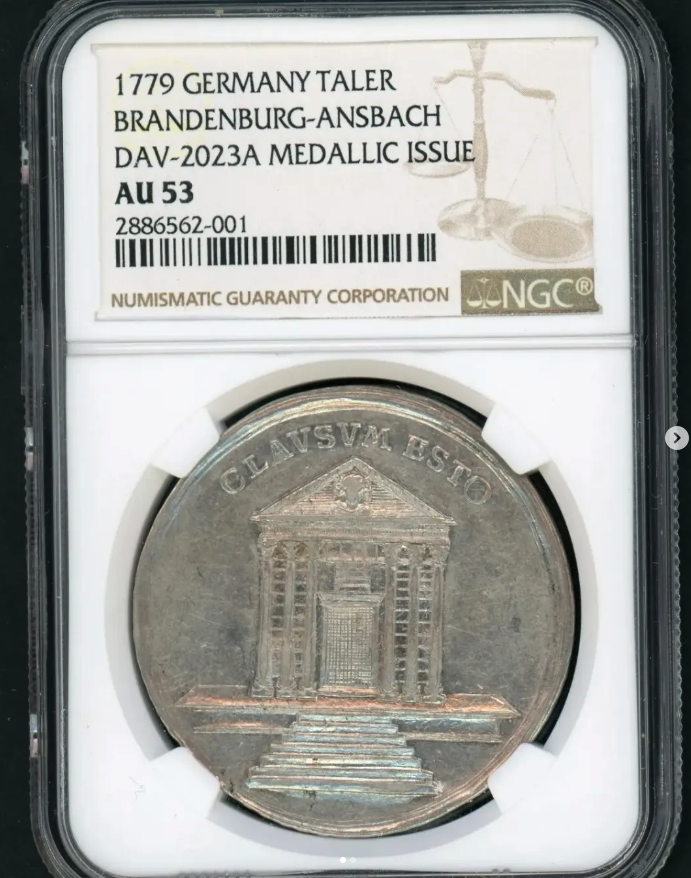
Brandenburg-Ansbach medallic thaler celebrating the Peace of Teschen - the closed Temple of Janus on the obverse, Prussia and Austria clasping hands over their joined arms on the reverse.
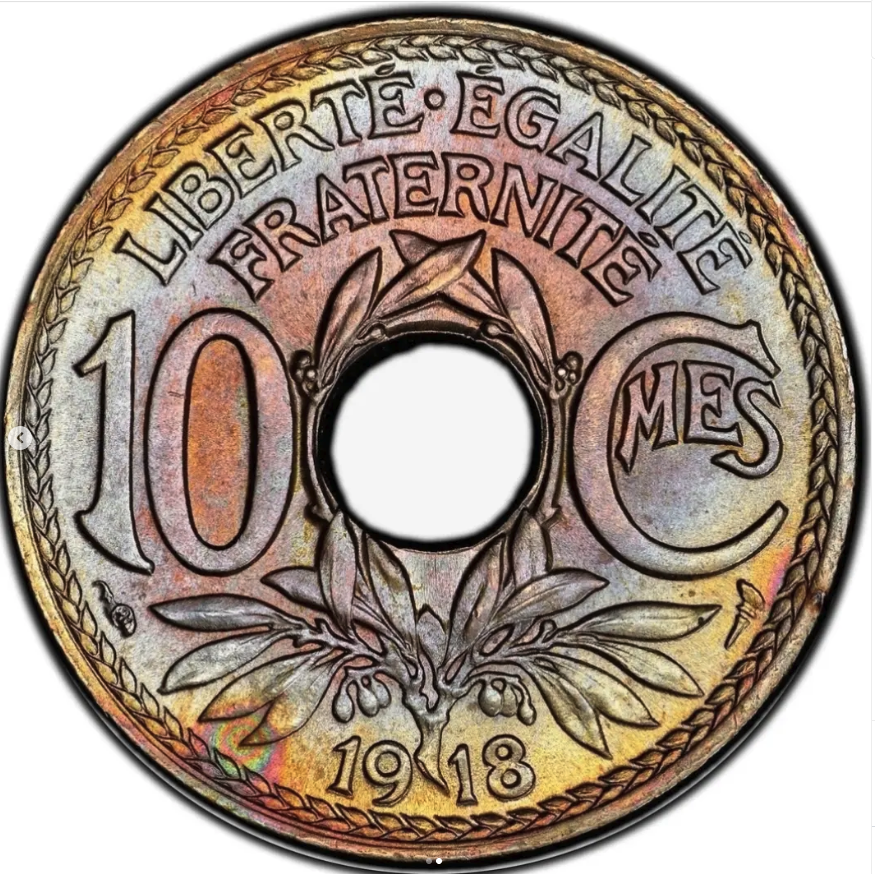
Finest-known 1918 Lindauer 10 centimes - and the finest of more than a billion struck across the entire 1917-1938 design, with full natural rainbow toning on both sides.
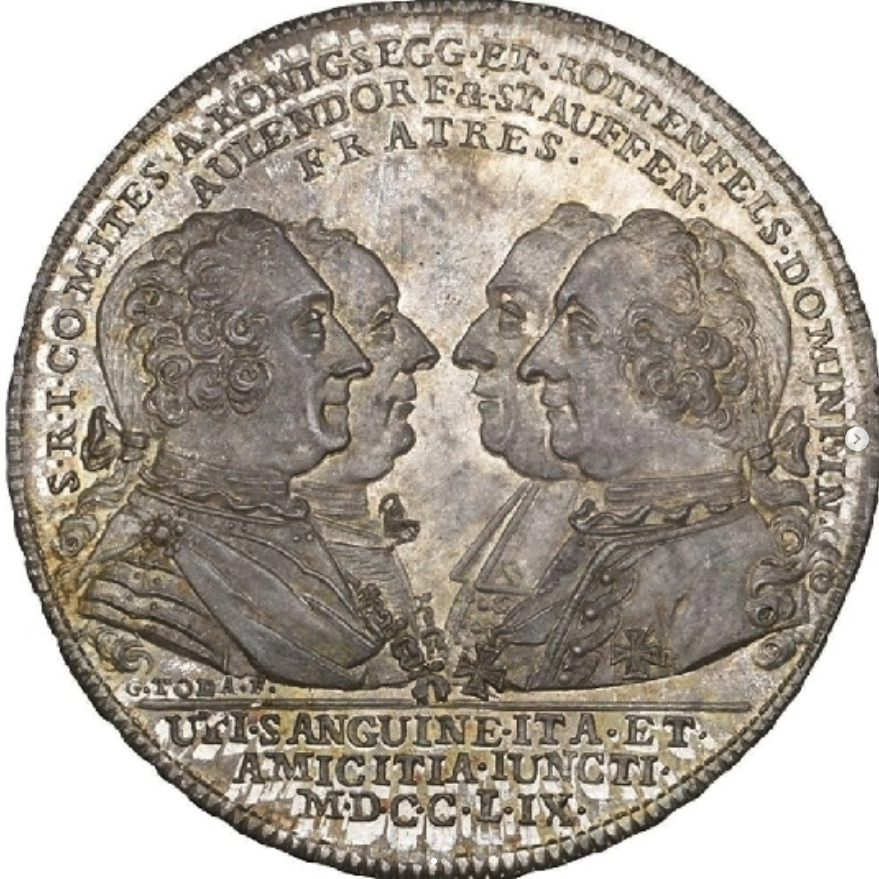
Magnificent 1759 'Four Brothers' thaler of the Counts of Königsegg-Rothenfels, ex collection of Franz Graf von Wolff-Metternich - the Kunstschutz officer who saved the Louvre's collections during WWII.
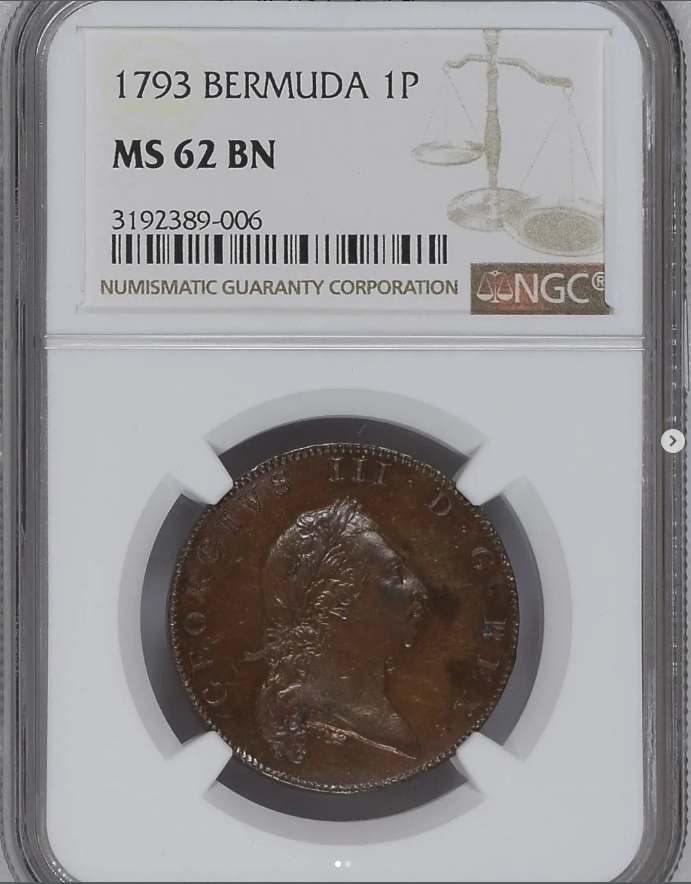
Lovely chocolate-brown Mint State example of the famous 1793 Bermuda 'Ship Penny' - the colony's only contemporary copper coinage, with just 72,000 pieces struck and almost all heavily circulated.
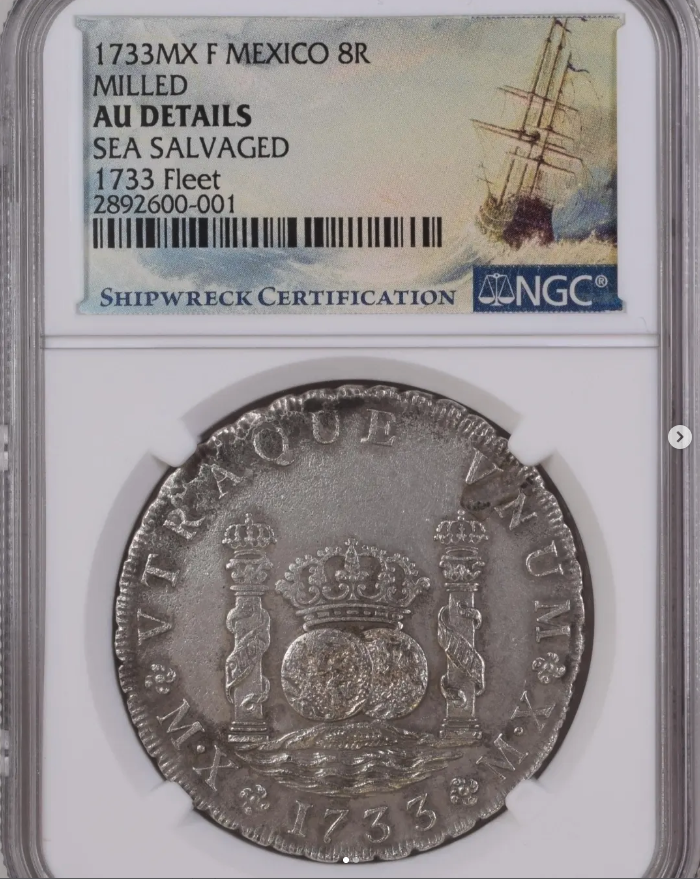
First-year Mexico City milled 'Pillar Dollar' with the rare MX mintmark error - sea-salvaged from the 1733 Spanish Plate Fleet hurricane wreck off the Florida Keys.
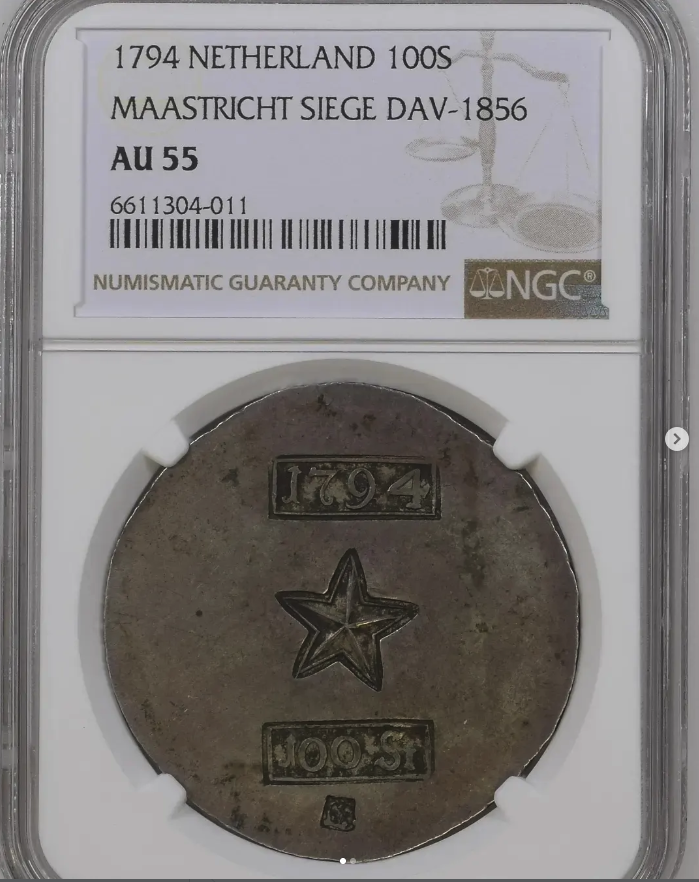
Uniface silver siege piece struck inside besieged Maastricht in 1794 from melted-down church plate and city treasures - Davenport 1856, NGC AU 55.
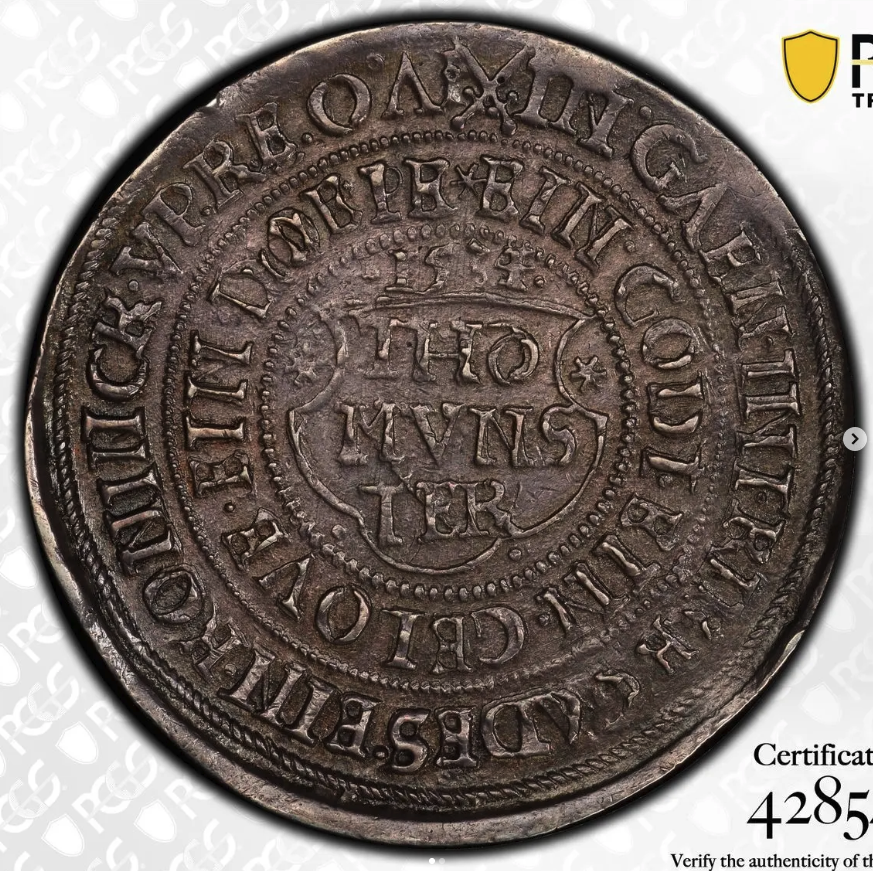
1640s restrike from the original 1534 dies of the Münster Anabaptist 'Kingdom of New Jerusalem' 2 thaler - one of the most notorious religious-radical issues in European numismatics.
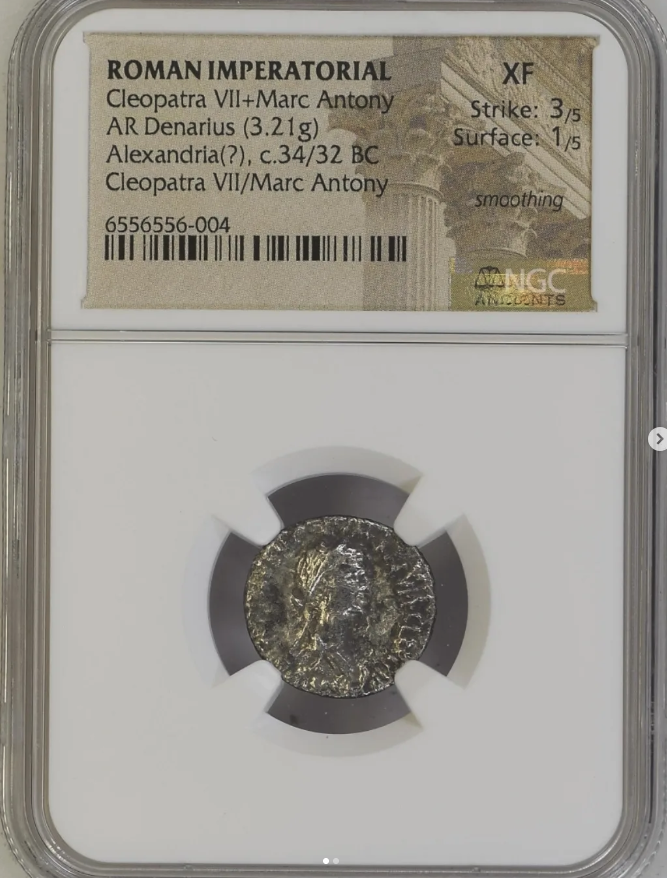
Joint silver denarius of Marc Antony and Cleopatra VII - the only Roman coin ever to portray a foreign queen as a co-equal ruler, struck for the Donations of Alexandria on the eve of the Actium war.
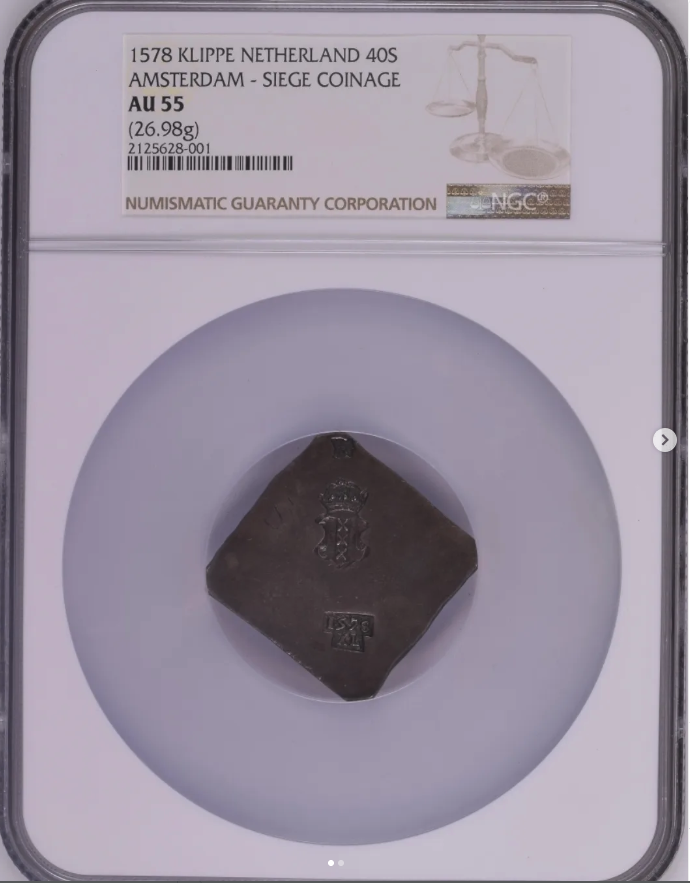
Crude uniface klippe siege piece struck inside Amsterdam in 1578 from the melted silver of the Nieuwe Kerk - finest certified by NGC, the second issue of the famous Amsterdam siege coinage.
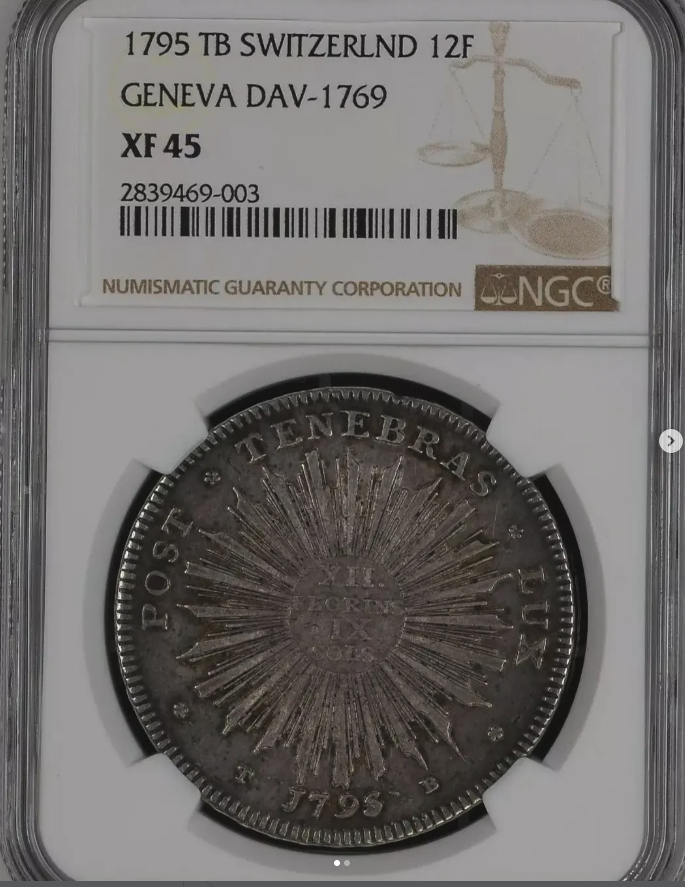
Genevan revolutionary thaler of 1795 (Davenport 1769) - the city's Calvinist motto POST TENEBRAS LUX over a radiant sun, dated 'Year IV of Equality.'
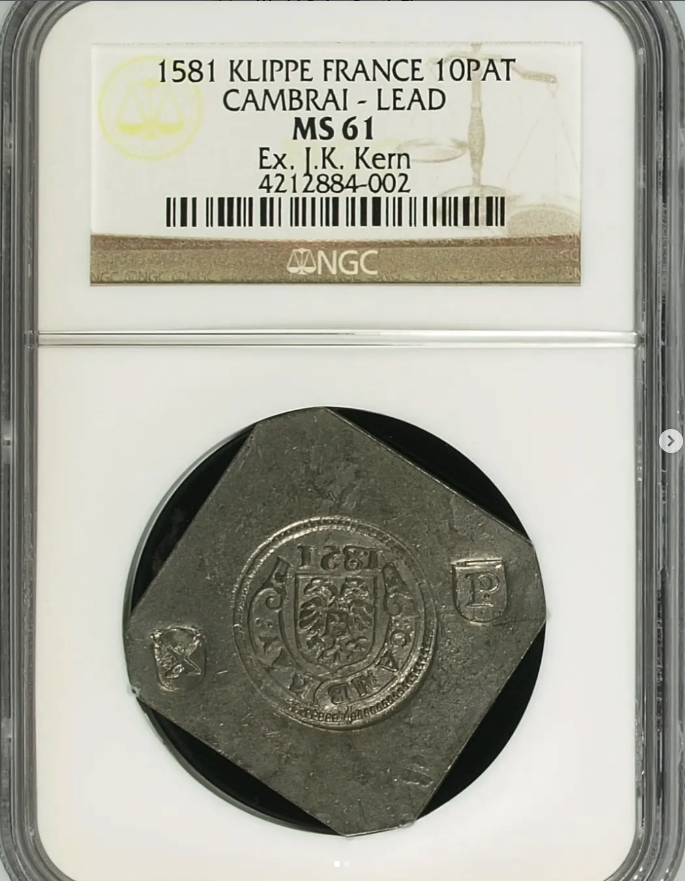
Lead emergency klippe struck inside besieged Cambrai in 1581 - ex Archer M. Huntington and Jonathan K. Kern collections, prior auction record CHF 1,200 (NGSA 2012) and USD 1,320 (CNG 2018).
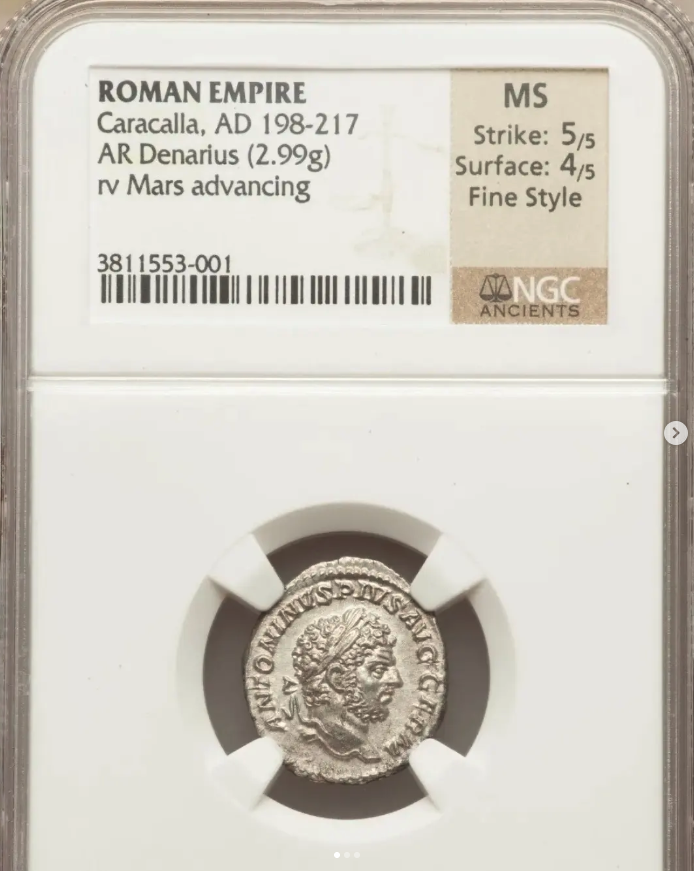
Mint State Fine Style denarius of Caracalla with the militant Mars-advancing reverse - the coinage of the emperor who murdered his brother in their mother's arms and granted Roman citizenship to every free man in the Empire.
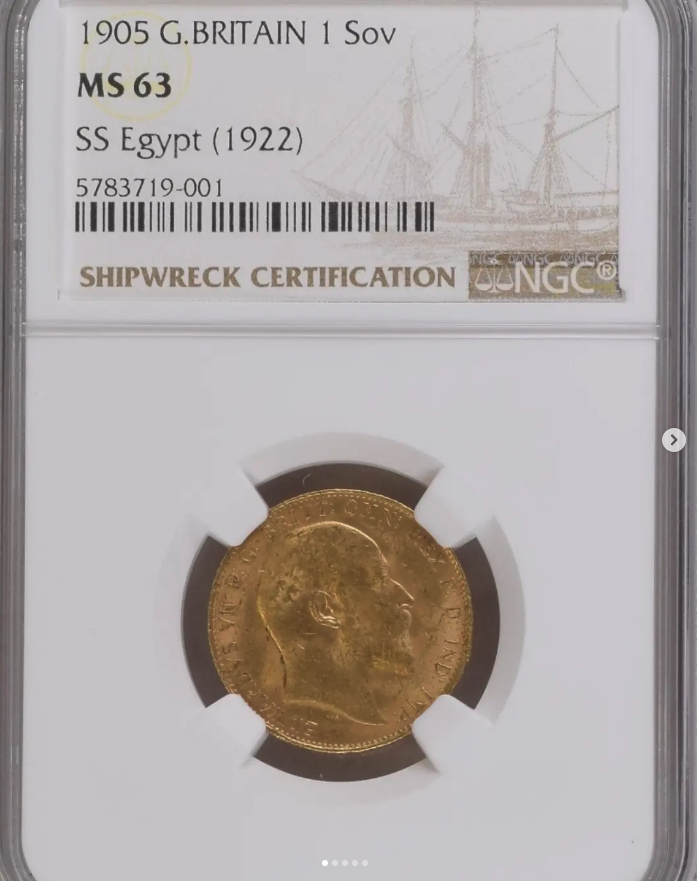
1905 Edward VII sovereign recovered from 70 fathoms off Ushant by the Italian salvage steamer Artiglio II - with the original Lloyd's of London presentation box and signed 1932 'Egypt Salvage' certificate from the Chairman of Lloyd's.
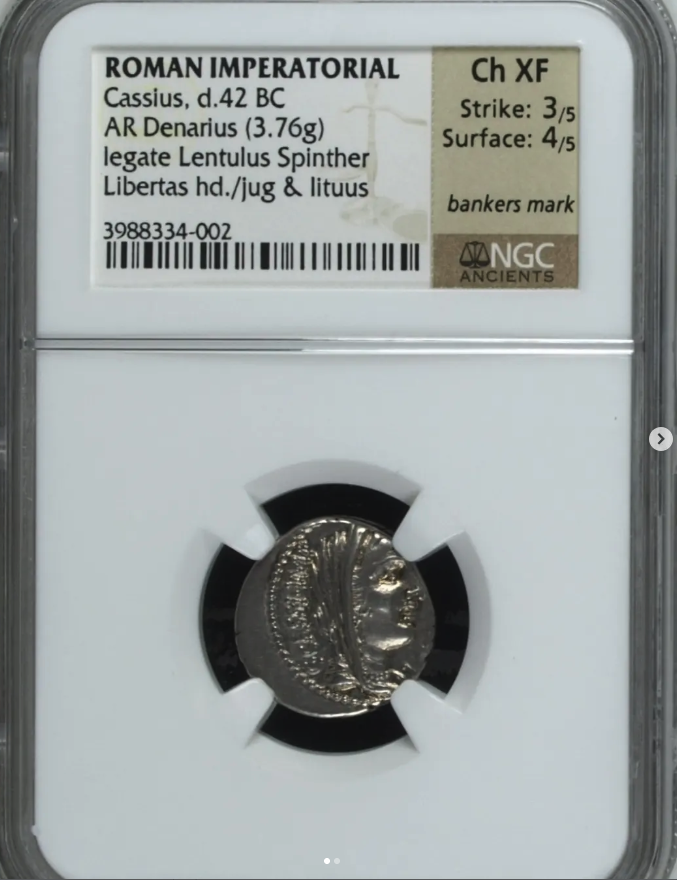
Struck in the East by Cassius - one of the principal assassins of Julius Caesar - in the months between his flight from Rome and his suicide at the First Battle of Philippi.
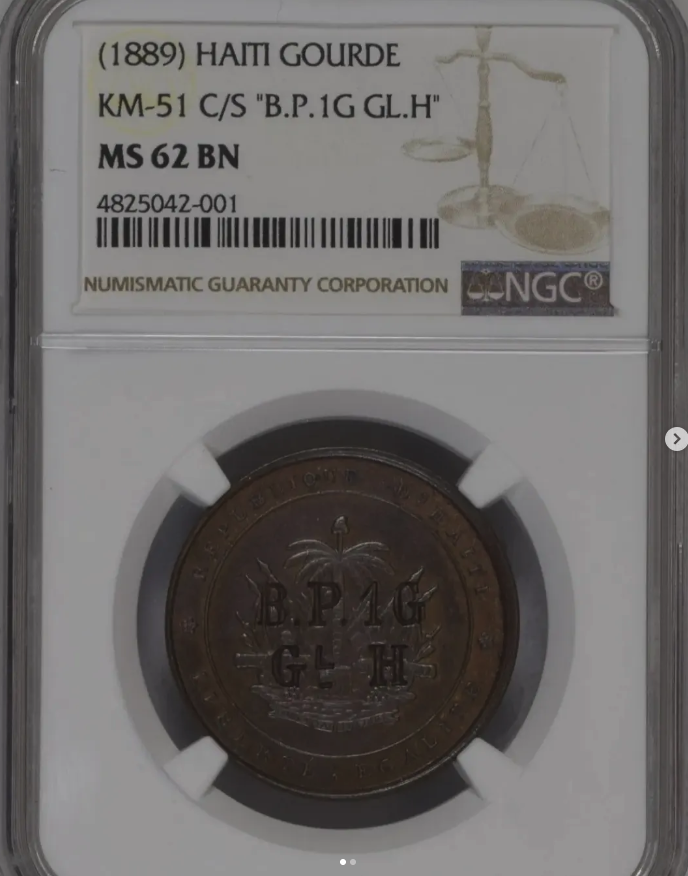
One of only ~10 known 'Bon Pour 1 Gourde / General Hippolyte' field-issue counterstamps - struck during the 1889 rebellion that brought Florvil Hippolyte to power and triggered the U.S. attempt to seize Môle-Saint-Nicolas.
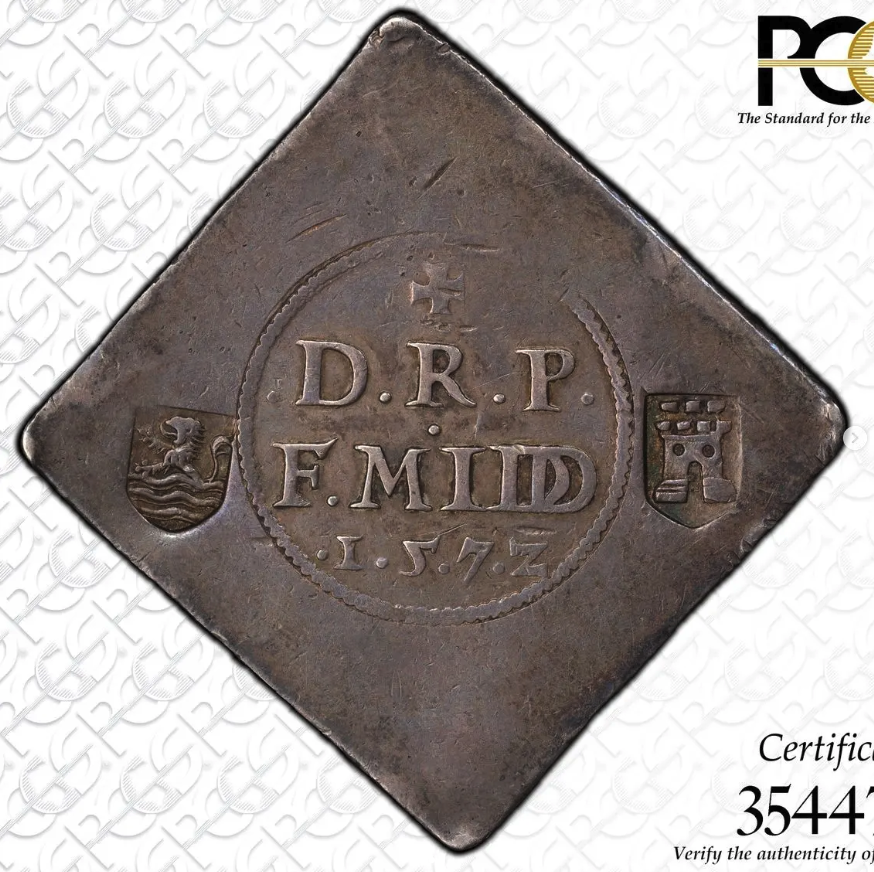
Diamond-shaped uniface siege klippe struck inside Spanish-held Middelburg in 1572 - dated 1572 with the arms of Zeeland and Middelburg flanking the cross-topped legend D.R.P. F.M.II.D. for Philip II. Ex Korchnak, the standard reference on siege coins.
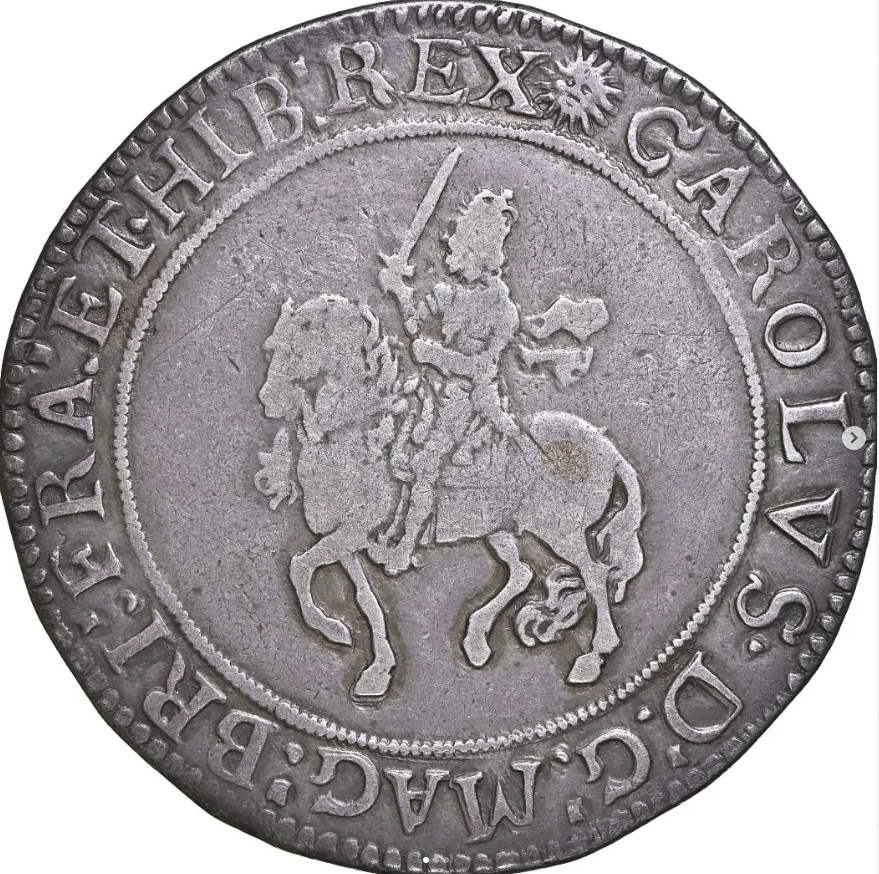
Equestrian crown of Charles I, struck at the Tower of London under Parliamentary control near the end of the First English Civil War - the king's portrait still on the silver of the Parliament that was about to put him on trial.
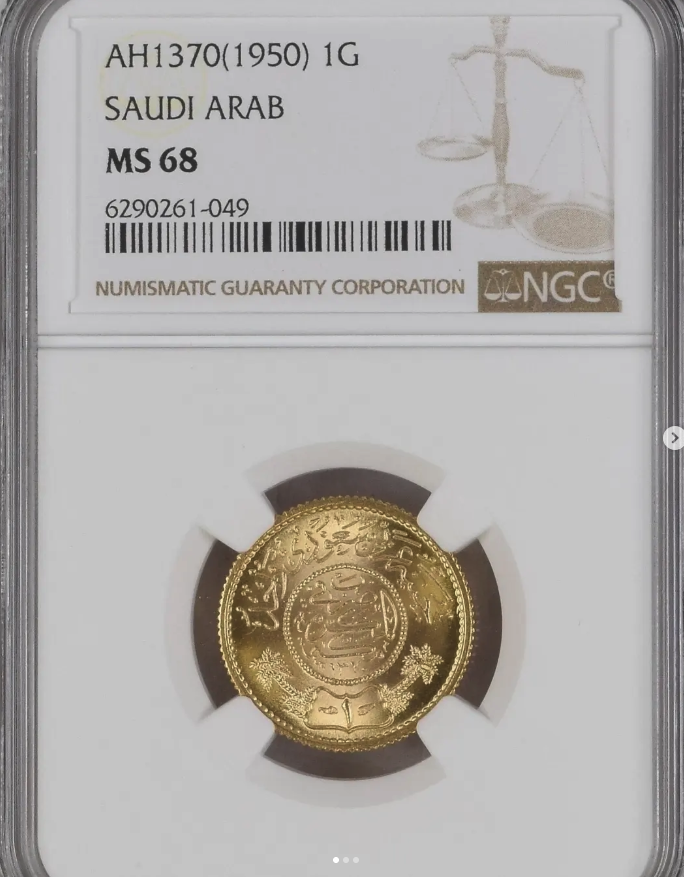
Top-pop AH 1370 (1950) Saudi gold guinea - tied finest known at NGC in MS 68, with none finer.
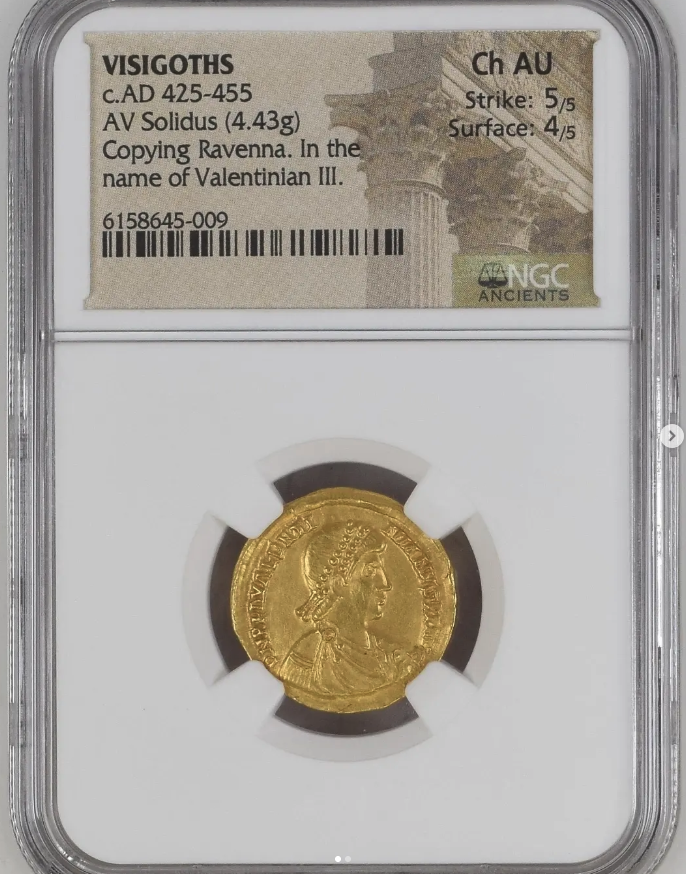
Visigothic gold solidus struck in the name of the Western Roman emperor Valentinian III - imitating the Ravenna mint during the years of Aetius, Attila, and the Catalaunian Plains.
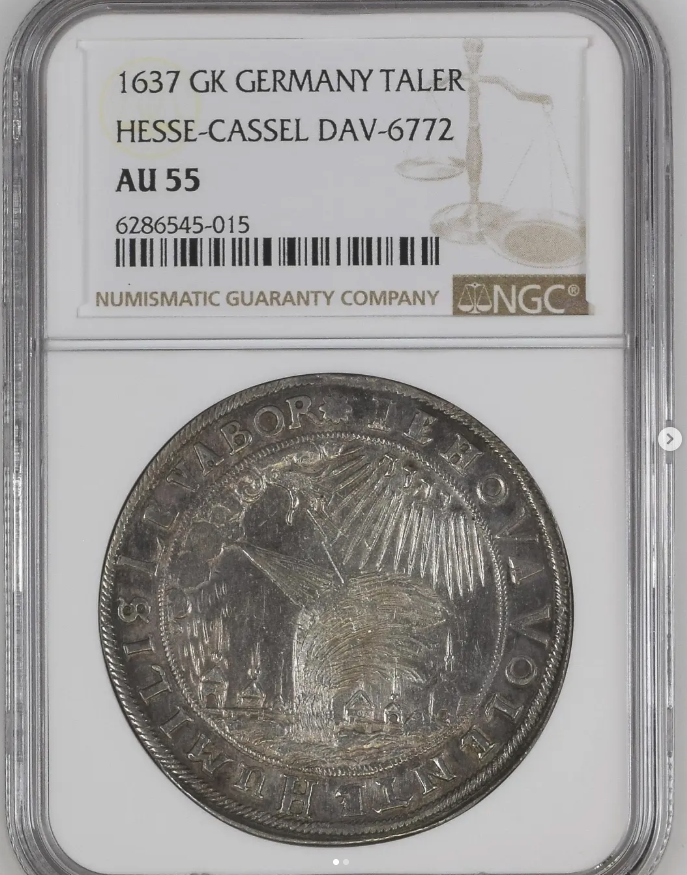
Wilhelm V's iconic 'Willow Tree in the Storm' thaler of 1637 - struck in exile to pay mercenaries to retake occupied Hesse-Cassel from the Imperial army. Davenport 6772, NGC AU 55, top pop.
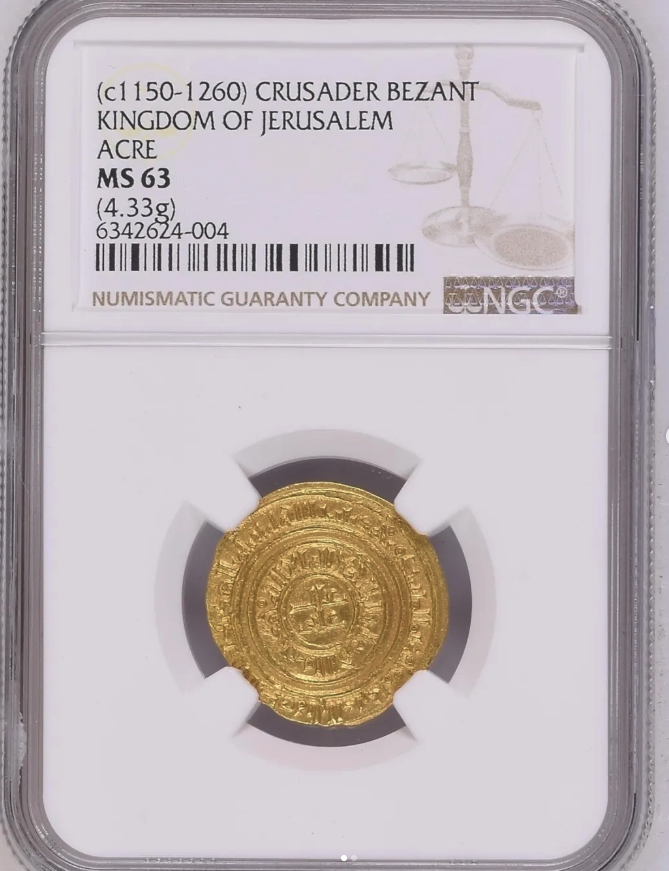
Crusader gold bezant struck at Acre in imitation of a Fatimid dinar - economic warfare against Saladin in the form of a debased gold coin with deliberately barely-legible Arabic.
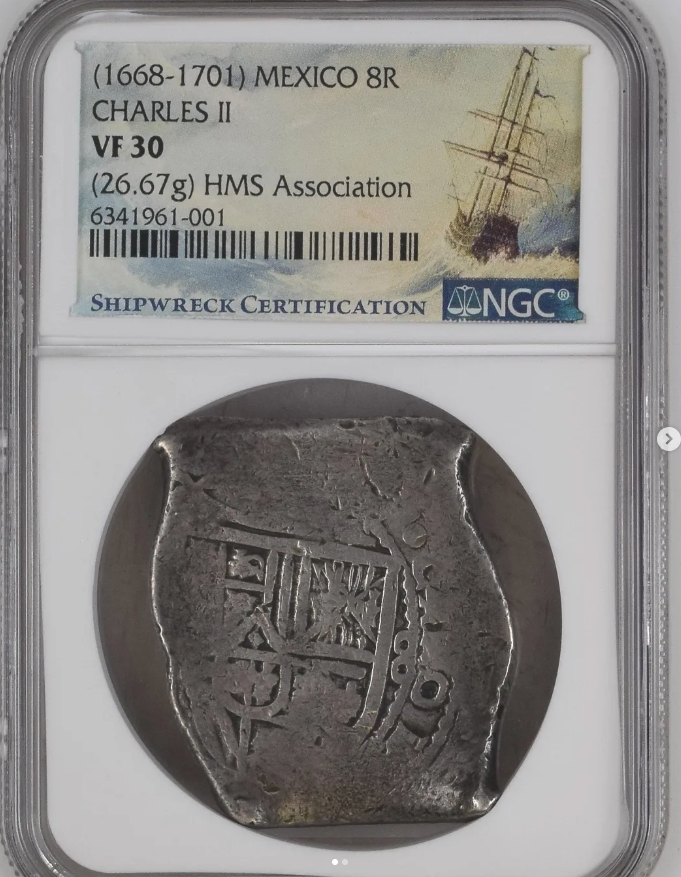
Mexico City 8-reales cob of Charles II of Spain, recovered from the wreck of HMS Association - the Royal Navy flagship lost with Admiral Sir Cloudesley Shovell and her entire crew of 800 in the Scilly Naval Disaster of 1707.
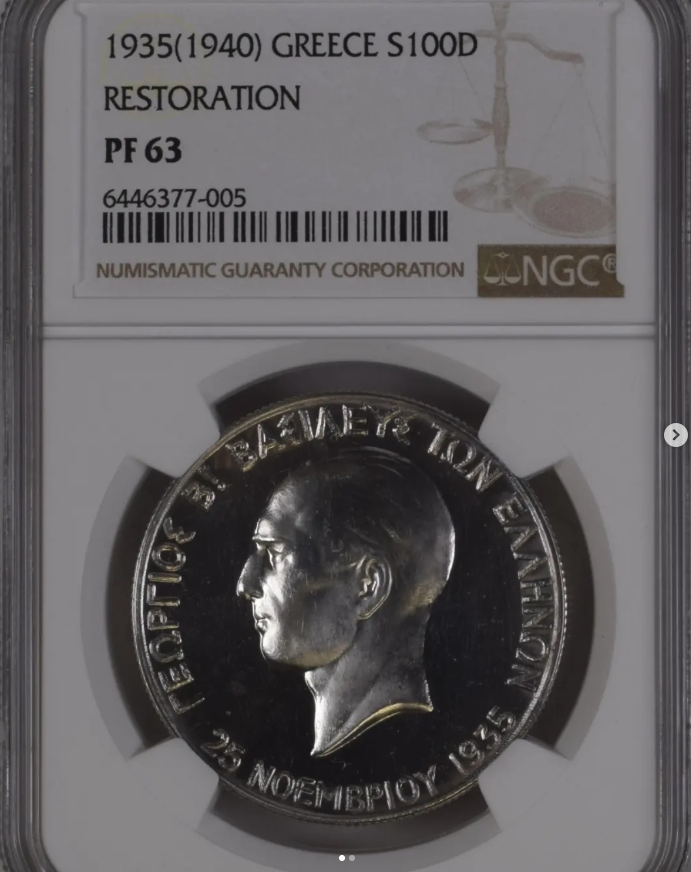
Mintage of just 500. The Greek 'restoration of the monarchy' commemorative - back-dated to 1935 but actually struck in 1940 for the fifth anniversary. NGC notes most examples are heavily hairlined; clean PF 63 examples bring strong premiums.
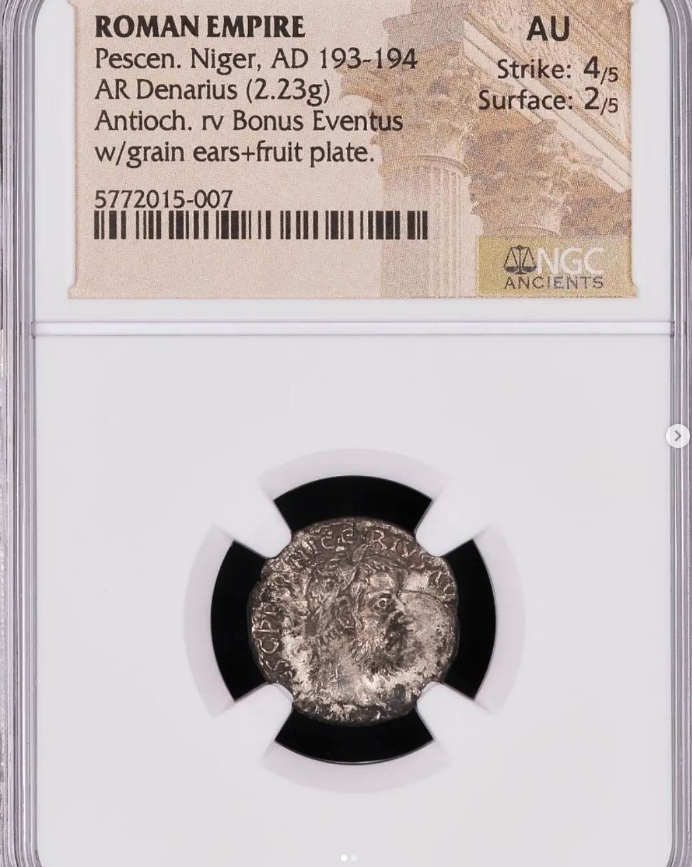
A scarce eastern denarius of Pescennius Niger - the Syrian usurper of the Year of the Five Emperors - struck at Antioch in 193-194 and graded NGC AU with a sharp Strike 4/5. Niger coinage is rare across the board: his entire 14-month reign was confined to the eastern provinces and most of his issues were melted by Severus after his defeat.
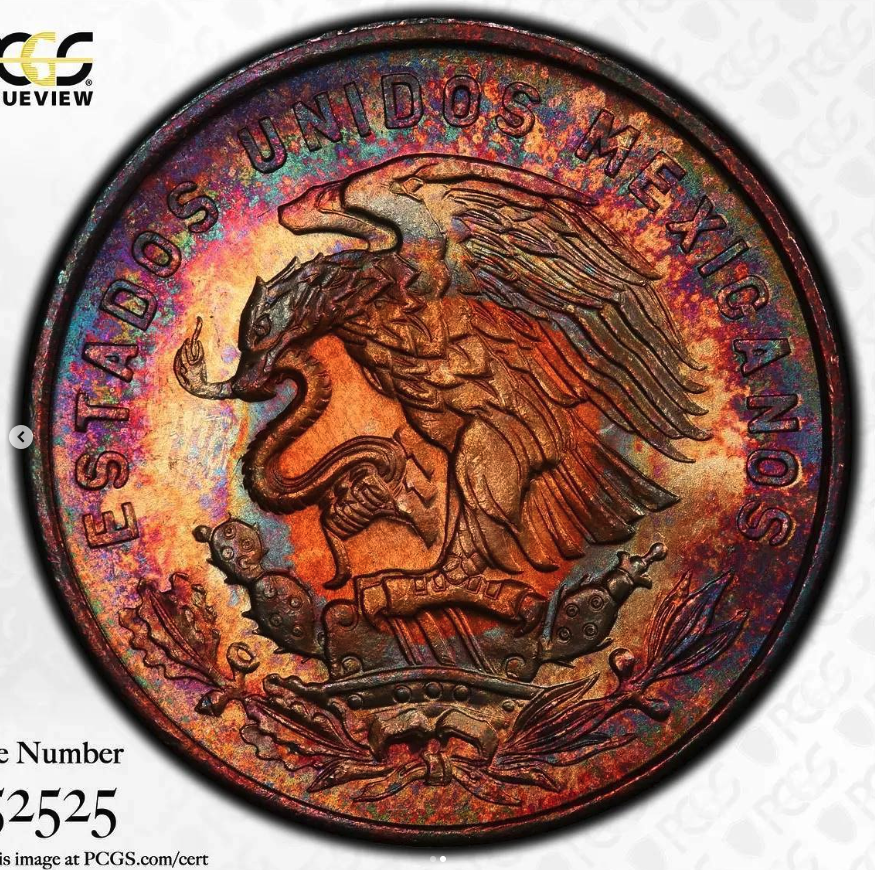
A monster-toned 1964 Mexico 20 centavos in PCGS MS-67 RB - electric magenta, cobalt, gold, and orange bullseye toning across both sides of one of Mexico's most iconic 20th-century designs: the Pyramid of the Sun at Teotihuacán framed by Popocatépetl and Iztaccíhuatl.
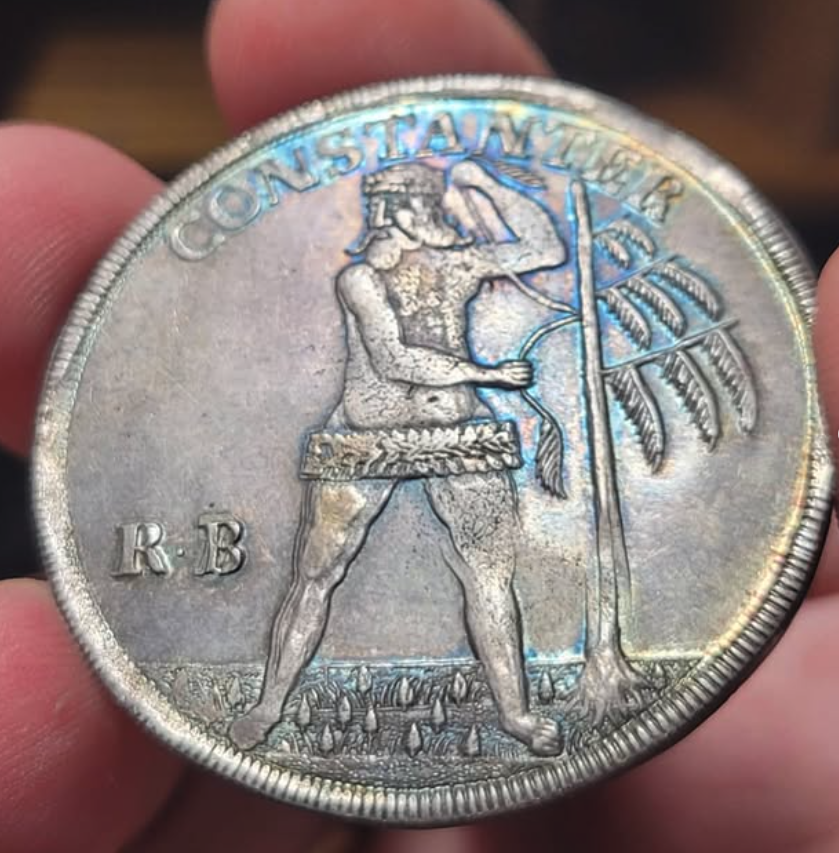
A 1708 Brunswick-Wolfenbüttel Wildman Thaler of Anton Ulrich - the iconic Harz silver type with the bearded forest giant striding through the trees, club replaced here by an uprooted fir, with the ducal motto CONSTANTER ('steadfastly'). Beautifully toned cabinet piece with full rainbow patina across both sides.
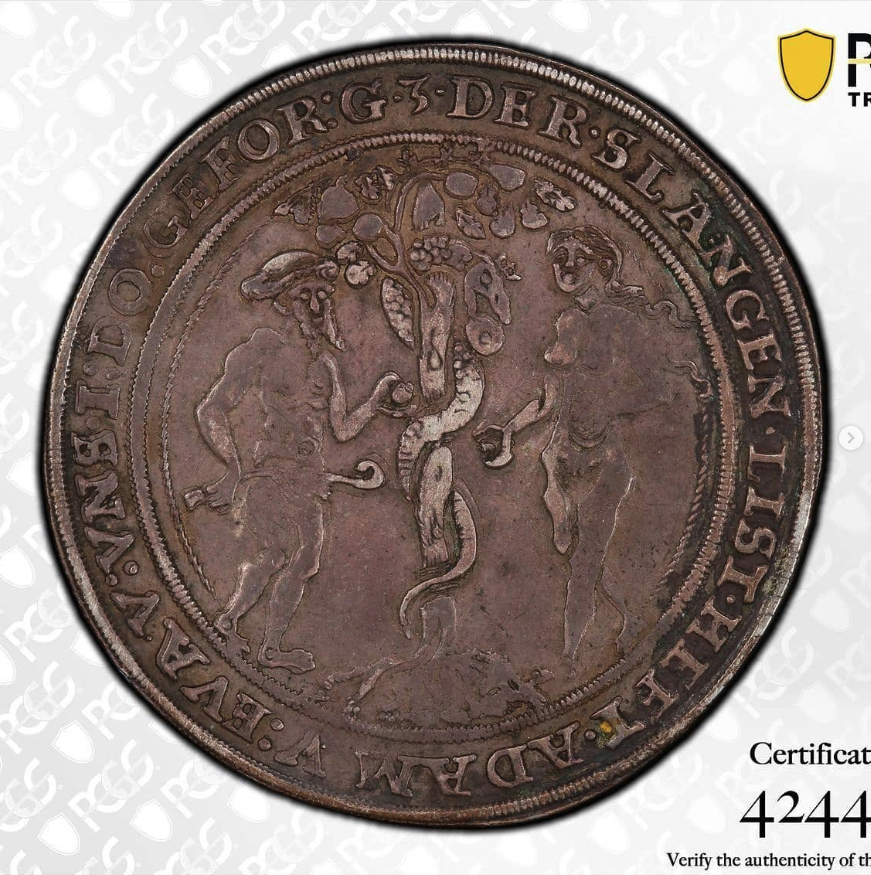
A 1/2 Schauthaler of Albertine Saxony (Katz-26) with the full Genesis cycle: Adam & Eve and the Serpent on the obverse, Jacob's Ladder with three angels on the reverse. PCGS XF-45 is a remarkable grade for an early-16th-century presentation piece - virtually all surviving Schauthalers come heavily worn, holed, or mounted.
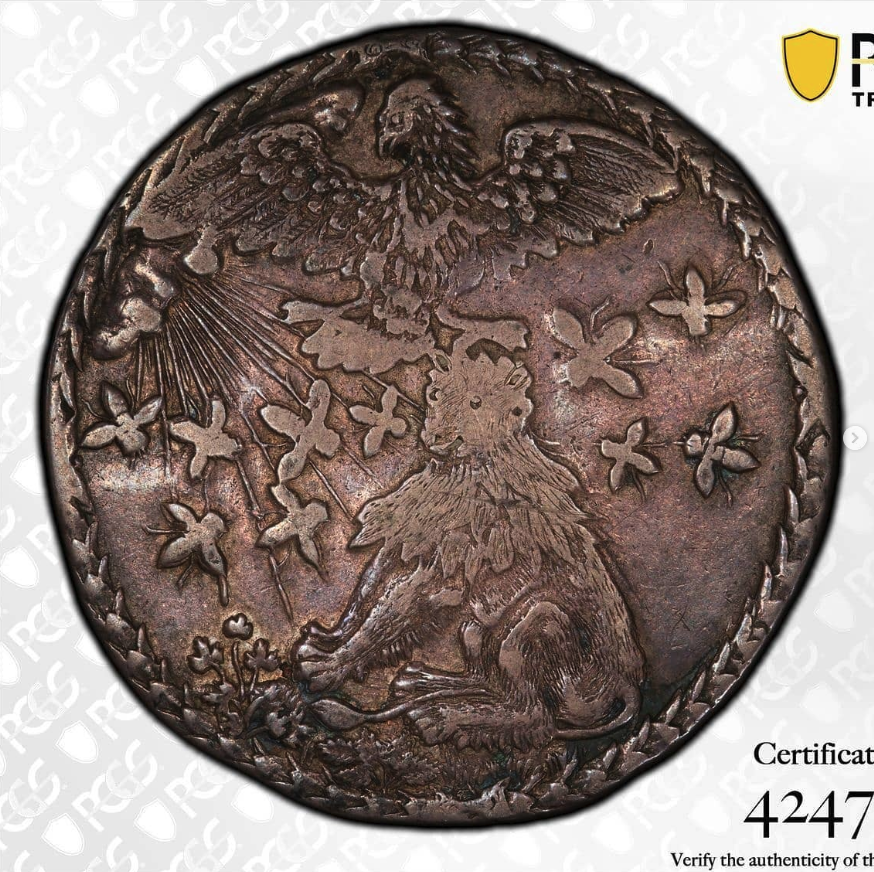
An iconic 1599 Brunswick-Wolfenbüttel 'Wasp Thaler' (Dav. 9092) - the Welf lion swarmed by ten wasps/mosquitoes representing the rebellious nobles, sheltered by the Imperial eagle of Rudolf II. One of the most famous and openly insulting propaganda coins of the entire 16th century. PCGS XF-40.
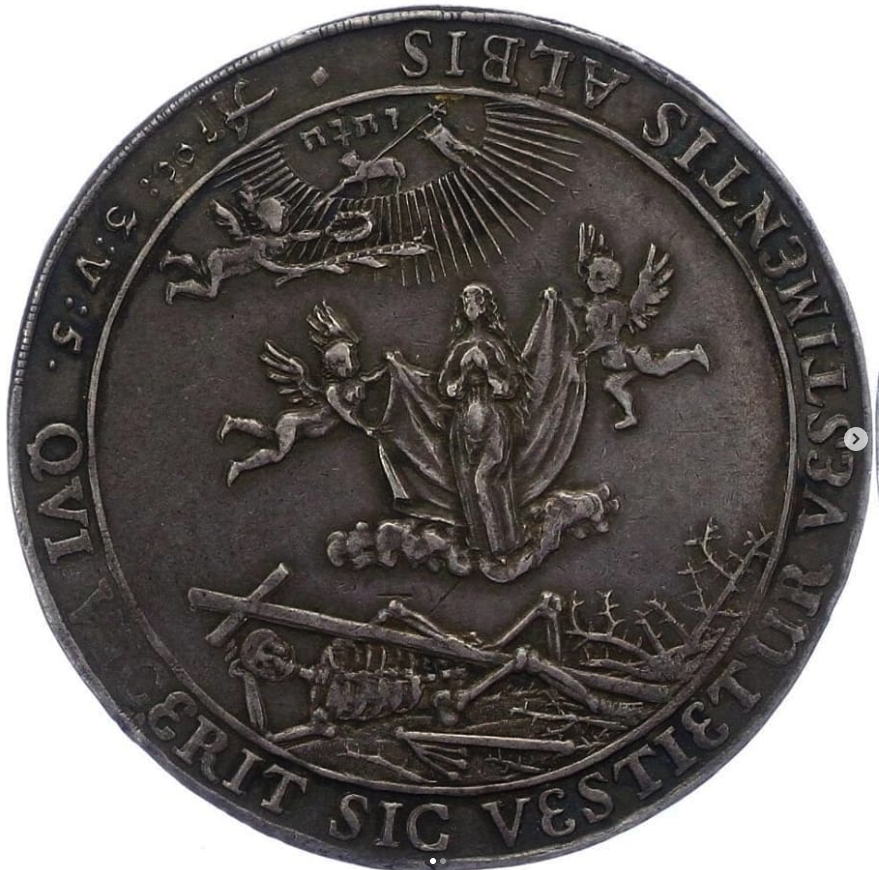
An unlisted-in-Davenport, misattributed-in-Krause Trauerthaler struck for the death of Duchess Sibylla Ursula of Schleswig-Holstein-Sonderburg-Glücksburg in 1671 - the silver memorial of one of the great women of early German Baroque literature, with the legend QUI SE GERIT SIC VESTIETUR VESTIMENTIS ALBIS ('he who conducts himself thus shall be clothed in white garments,' Revelation 3:5).
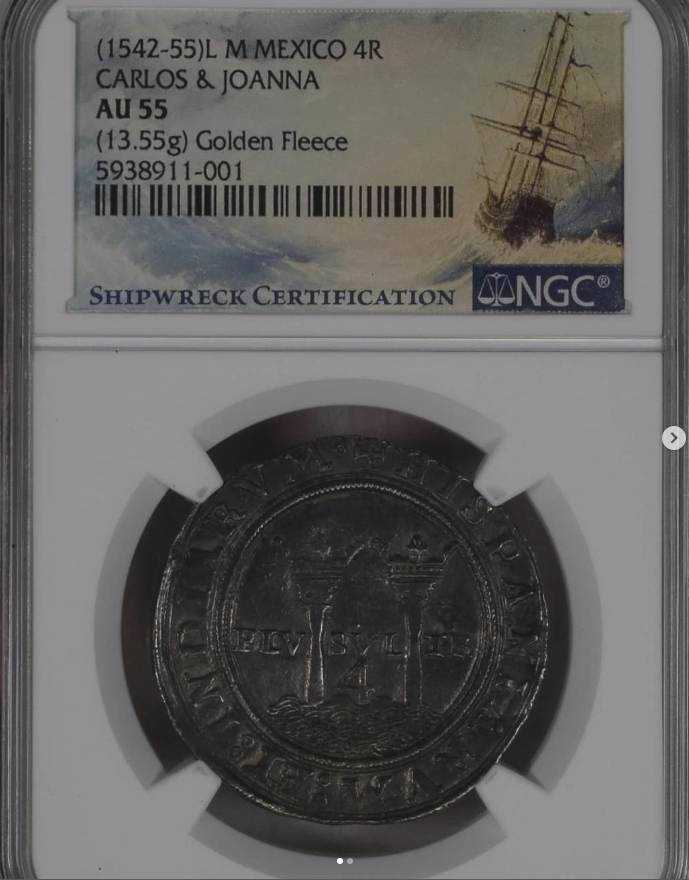
A virtually pristine Carlos & Juana 4 reales recovered from the Golden Fleece Shipwreck (sunk c. 1550) - somehow preserved without the saltwater corrosion that destroys nearly every coin from a 400-year submersion, almost certainly because it survived inside a sealed barrel or leather pouch on the wreck floor. NGC AU-55 with Shipwreck Certification.
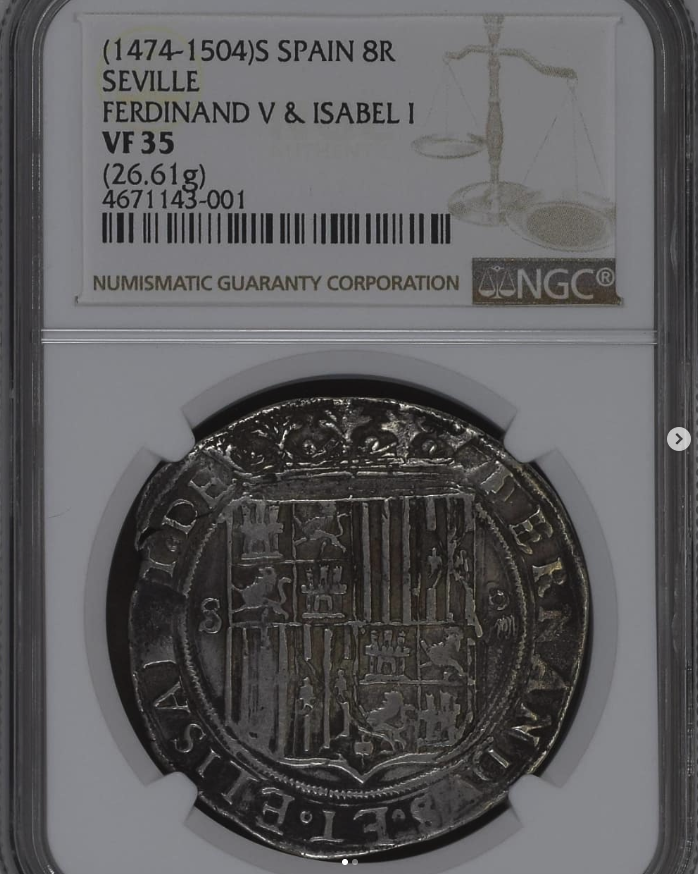
The first crown-size coin and the first 8 reales ever struck in Spain - the silver type that founded the entire Spanish-American 'piece of eight' economy. Issued under Ferdinand and Isabella's names but actually struck c. 1537-1566 under their Habsburg grandson Charles V and great-grandson Philip II for political legitimacy. NGC VF-35.
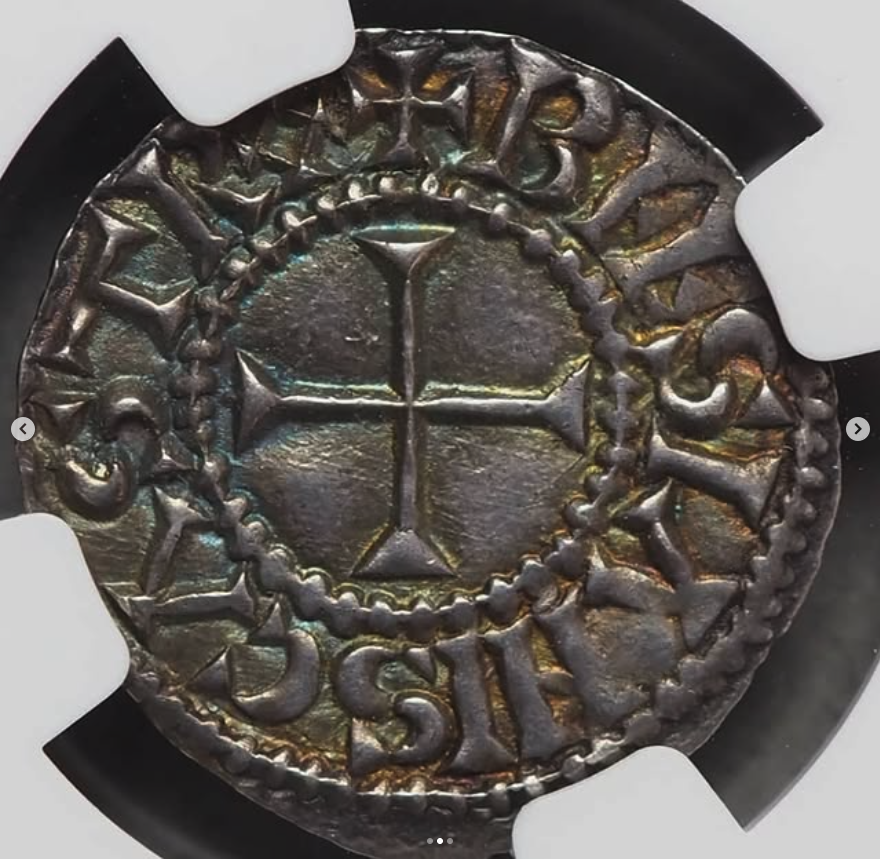
The finest known denier of King Odo of West Francia (r. 888-898) - the hero of the Siege of Paris and the first non-Carolingian elected king of the Franks. NGC MS-64 with subtle iridescent toning. Almost every surviving denier of this reign is heavily worn from circulation as Danegeld silver paid to the Vikings.
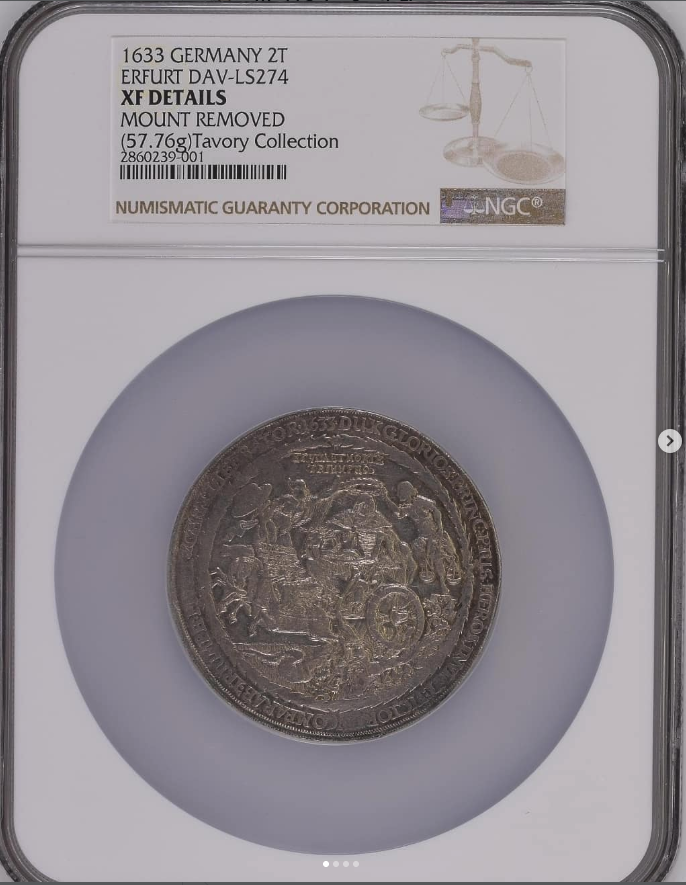
One of the legendary funeral coins of Gustavus Adolphus - struck at Wolgast in 1633 from melted-down royal silver as the dead king's body passed to the Baltic coast. Mintage of just 60 pieces. The coins were thrown from the Queen's carriage into the street and trampled in the chaos - 36 people are estimated to have died in the scramble. Tavory Collection. NGC XF Details.
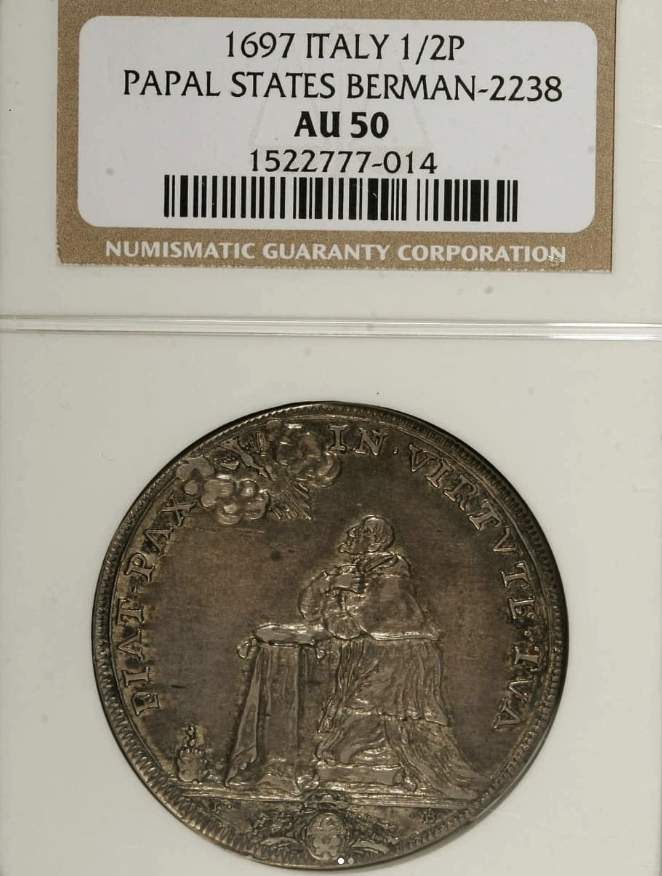
Rare two-year-type half piastre of Pope Innocent XII, dated Anno VII (1698 - the NGC label incorrectly reads 1697). Obverse shows the Pope kneeling in prayer before a draped column with the papal tiara set humbly on the ground, the radiant dove of the Holy Spirit descending in clouds - the visual statement of God's will choosing Innocent as His representative on Earth. NGC AU-50.
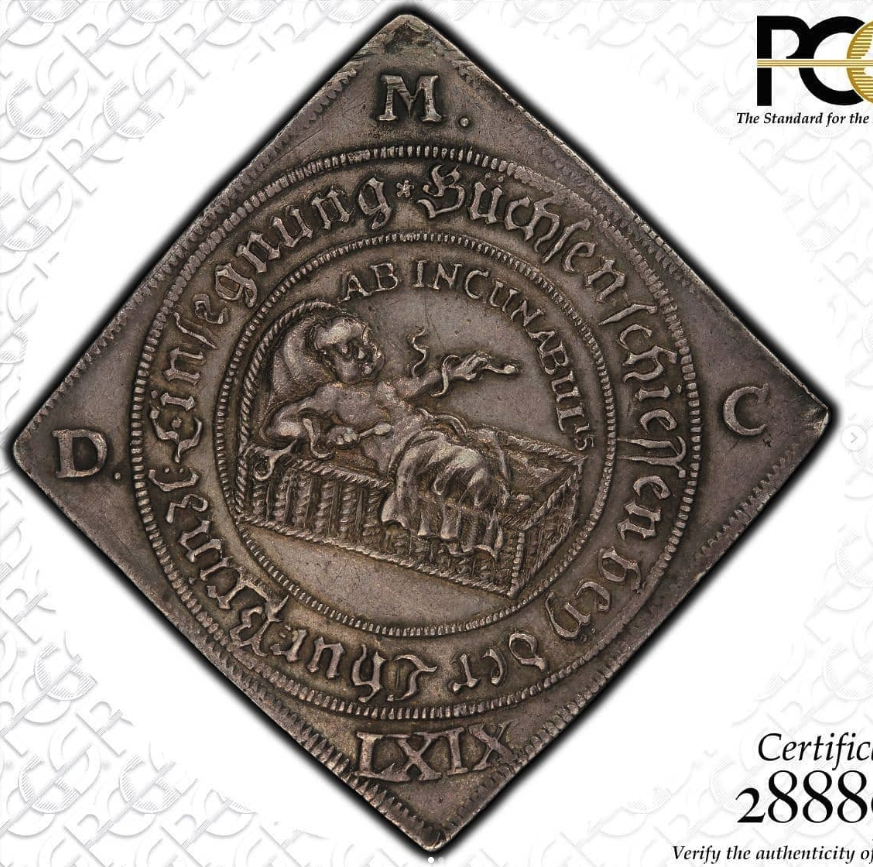
Extremely rare klippe-format birth thaler struck in 1669 to commemorate the baptism of the infant Johann Georg IV, future Elector of Saxony, who would die at 25 in one of the most lurid sequences of marital violence and smallpox in early-modern German history. PCGS AU-50.
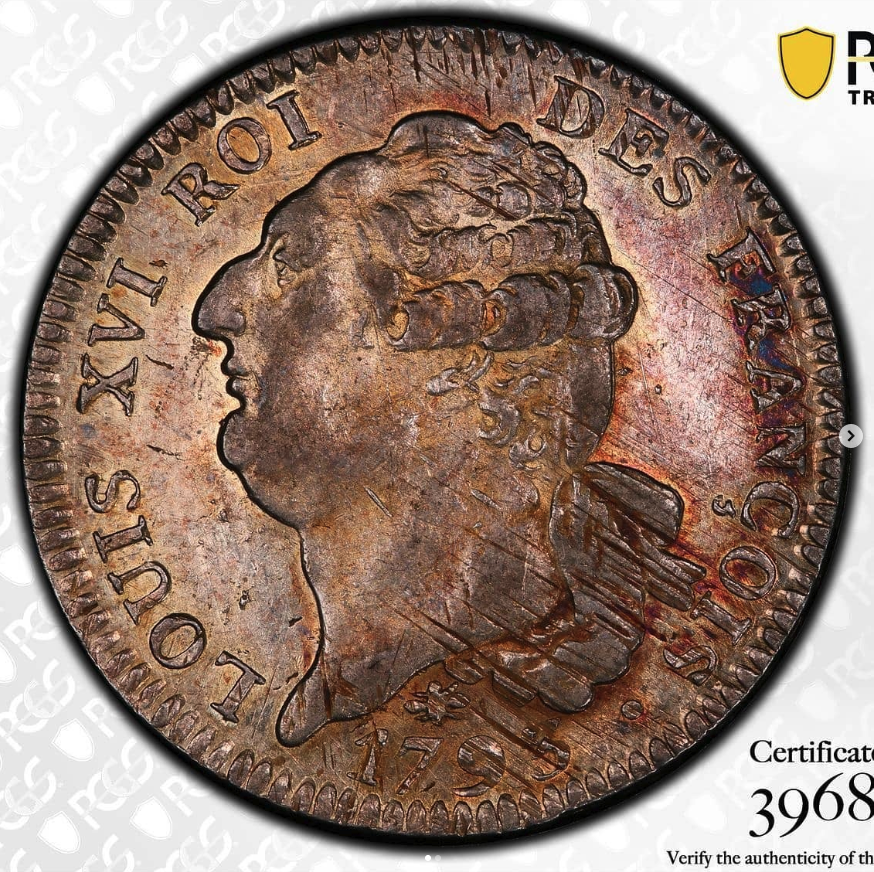
A 'Constitutional' écu of Louis XVI struck at the Lyon mint (mintmark D) in 1793 - after the King had already been deposed and executed - by Federalist rebels who had seized the mint during the August-October 1793 uprising against Robespierre. Possession of this coin during the Terror was a capital offence. PCGS AU-55 with bold rainbow toning.
![1643 AR Thaler (Glockenthaler / 'Bell Thaler') - Davenport-6375C - the seventh in the celebrated seven-type Bell Thaler series - obverse: crowned five-helmeted Brunswick arms / reverse: bell suspended from a wooden frame and rung by three hands emerging from clouds, view of the city of Wolfenbüttel in the distance, sun and tetragrammaton above, scroll inscribed NUPLC EX 9 ('Now after 9 [years]'), legend TANDEM PATIENTIA VICTRIX ('Patience is at last the Victor') with five-petaled flowers separating each word - obverse](/assets/1643-brunswick-wolfenbuttel-7th-bell-thaler-obverse-CgtdwRkj.jpg)
The seventh and final type of the celebrated Brunswick 'Bell Thaler' (Glockenthaler) series, struck by Duke Augustus the Younger to commemorate the lifting of nine years of Imperial occupation of his capital Wolfenbüttel on 19 September 1643. Three hands ring the bell of liberation; in the distance lies the freed city. The legend reads TANDEM PATIENTIA VICTRIX - 'Patience is at last the Victor.' NGC XF-45.
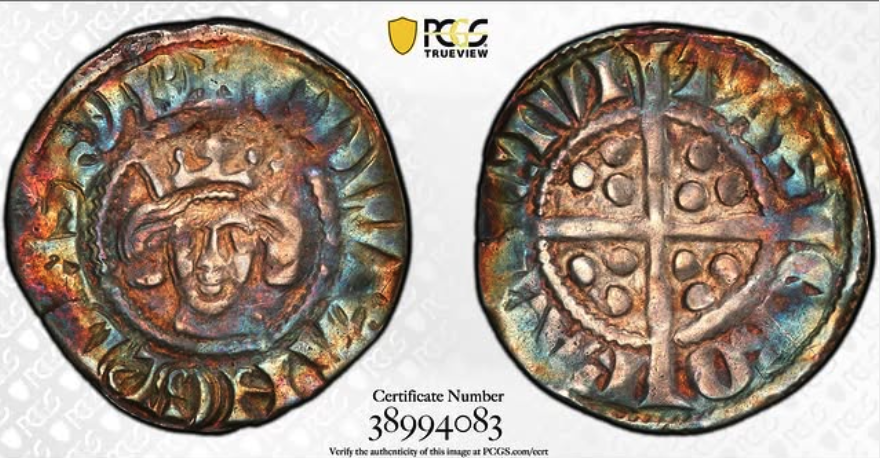
An Edward I York-mint long-cross penny with extraordinary full rainbow cabinet toning - blues, magentas and golds across both faces - of the kind almost never encountered on hammered medieval silver, which is normally found dark and circulated. PCGS XF-40, Spink-1429.
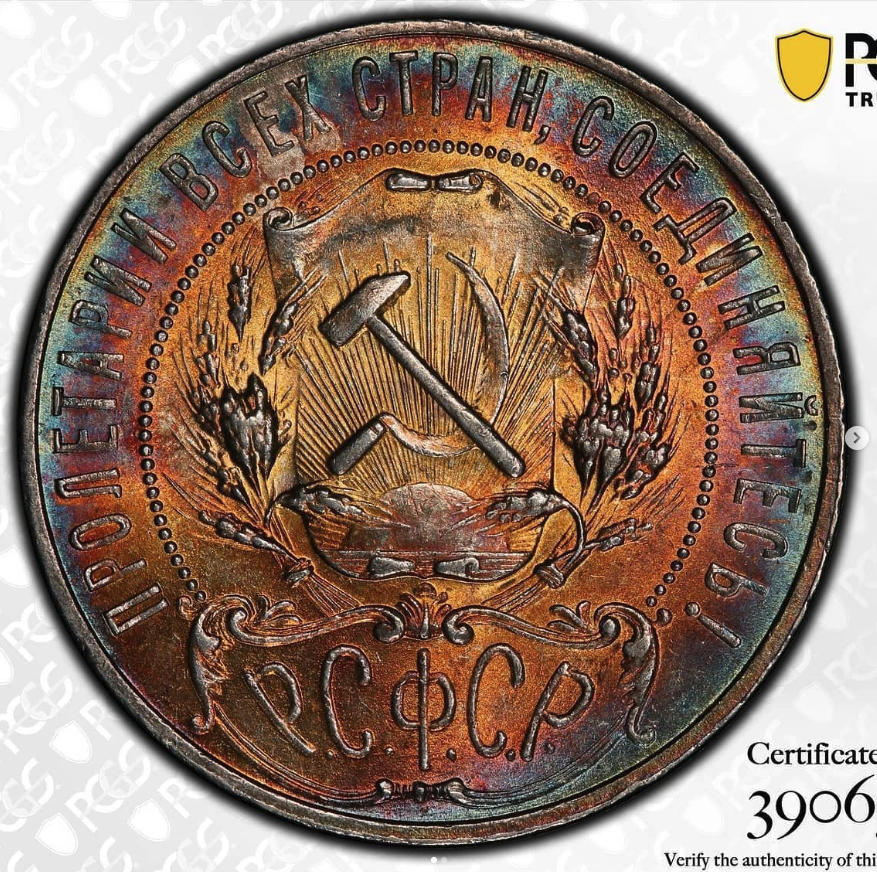
First-year-of-issue Soviet rouble, a two-year type (1921-1922) struck during the final year of the Russian Civil War. The first silver coinage of the new Bolshevik state, with the iconic hammer-and-sickle coat of arms and the 'Workers of all countries, unite!' legend. PCGS MS-62 with extraordinary full rainbow cabinet toning.