
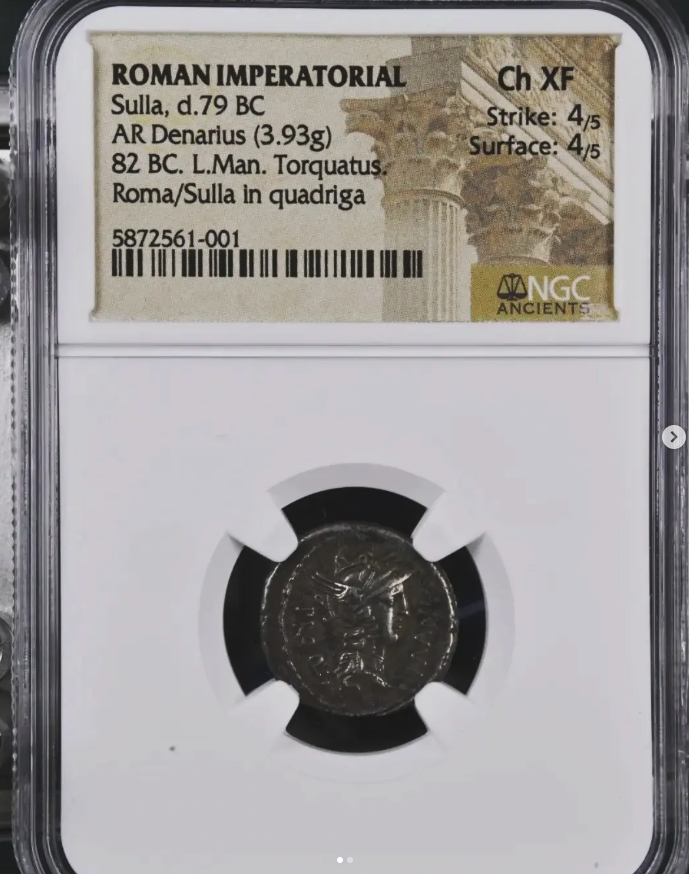
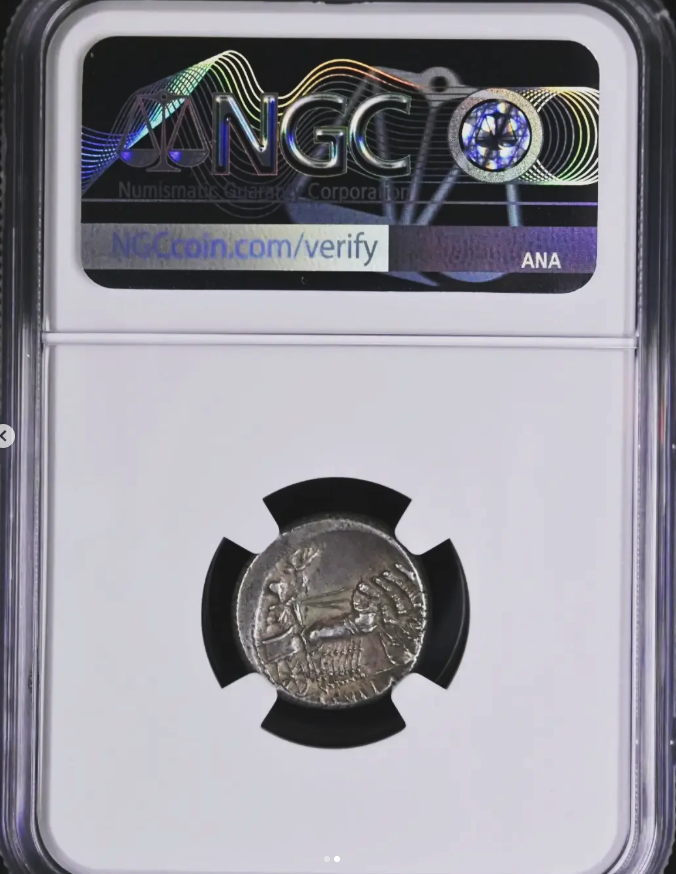
82 B.C. AR Denarius (3.93g)
An imperatorial denarius struck in Sulla's military mint as he marched on Rome - the first Roman coin to depict a living general in his triumphal chariot, the prototype for Caesar's coinage.
- Metal
- Silver
- Grade
- NGC Ancients Ch XF · Strike 4/5 · Surface 4/5
- Cert #
- 5872561-001
Full attribution & era
The history behind the coin.
Lucius Cornelius Sulla began his career as quaestor under the plebeian consul Gaius Marius in the Jugurthine War. In 107 B.C. it was Sulla who personally led the daring diplomatic mission that captured the Numidian king Jugurtha - but Marius took the credit, planting the seed of a rivalry that would tear the Roman Republic apart.
Marius rode that fame, plus victories over the Cimbri and Teutones (with Sulla again as his lieutenant), to an unprecedented five consecutive consulships. When the Social War broke out in 91 B.C. - the Italian allies of Rome rising in revolt over the denial of citizenship - Sulla was given command, crushed the rebels, and was personally awarded the Grass Crown, Rome's highest military decoration, for saving a legion in the field.
Sulla was elected consul in 88 B.C. and exiled Marius. While Sulla marched east to fight Mithridates VI of Pontus, who had massacred 80,000 Romans in the Asiatic Vespers, Marius seized the Senate and had Sulla declared a public enemy. Sulla's response broke the Republic: for the first time in history, a Roman general turned his legions on the city of Rome itself. He marched on Rome, killed Marius's supporters, and restored himself to the consulship. He then left for Greece - and Marius seized power again in 86 B.C. before dying of natural causes shortly after his seventh consulship.
Sulla remained in the East until 82 B.C., defeating Mithridates, then marched on Rome a second time. Marius's son and the Marian faction were destroyed at the Battle of the Colline Gates outside Rome's walls. Sulla had himself made dictator legibus faciendis et rei publicae constituendae causa - dictator without time limit - and unleashed the proscriptions: lists of names posted in the Forum, naming citizens whose lives and property were forfeit, whom anyone could legally kill on sight. Among those proscribed was a young Julius Caesar, whose aunt was Marius's wife and whose own wife was the daughter of Marius's co-consul; Caesar went into hiding and was pardoned only after a year of pleading by his family. Sulla resigned the dictatorship in 79 B.C. and died the same year, having tried - and failed - to set the Republic back on its old footing. His true legacy was the blueprint his march on Rome left for Caesar and Pompey a generation later.
This denarius is from that pivotal moment. It was struck in 82 B.C. by L. Manlius Torquatus, Sulla's proquaestor, in a military mint travelling with the army that marched on Rome - the legend on the reverse reads L · SVLLA · IM[perator] flanking Sulla in a triumphal quadriga, crowned by Victory flying overhead. The obverse shows a helmeted head of Roma with L · MANLI · PRO·Q (L. Manlius, Proquaestor) - making this one of the earliest Roman silver coins ever struck in the name of a living imperator rather than a magistrate or god. Catalogued as Crawford 367/3, it is the visual and political prototype for Caesar's coinage of 49-44 B.C.
NGC Ch XF with Strike 4/5 and Surface 4/5 is an excellent grade for this issue: full devices, original surfaces, no rough fields. A 3.93-gram, 2,100-year-old object from the moment the Roman Republic stopped being a republic.
- Crawford, Michael - Roman Republican Coinage (RRC 367/3).
- Sydenham - The Coinage of the Roman Republic (Syd. 757).
- Plutarch - Life of Sulla.
- Appian - The Civil Wars, Book I.
- Beard, Mary - SPQR (the Sullan crisis).
- NGC Cert #5872561-001.