
1759 Konventionstaler
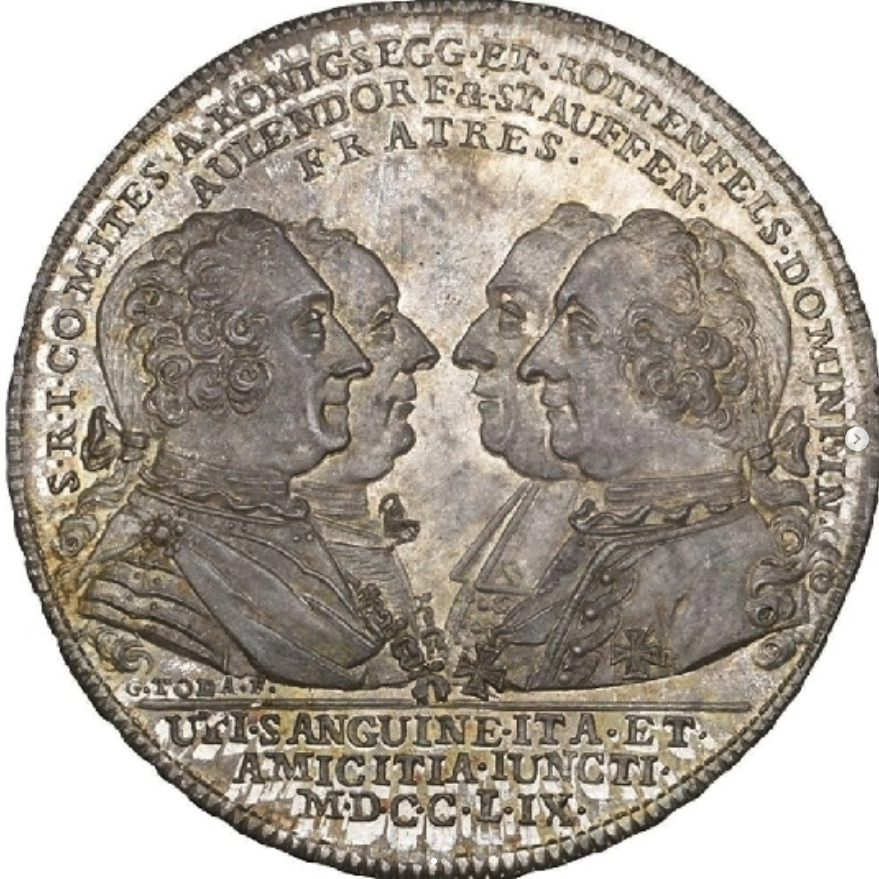
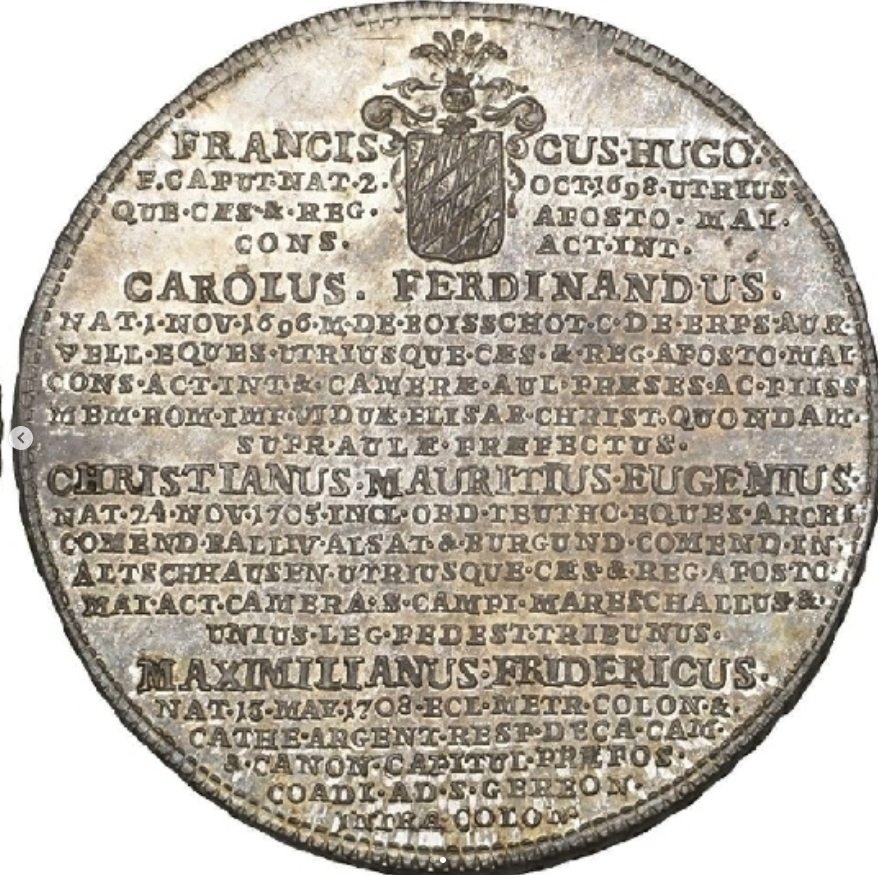
Magnificent 1759 'Four Brothers' thaler of the Counts of Königsegg-Rothenfels, ex collection of Franz Graf von Wolff-Metternich - the Kunstschutz officer who saved the Louvre's collections during WWII.
- Metal
- Silver
- Grade
- NGC MS 65+
Full attribution & era
The history behind the coin.
The Imperial County of Königsegg-Rothenfels was one of the small mediatized Reichsgrafschaften of the Holy Roman Empire, perched in Upper Swabia and holding direct vote in the Imperial Diet. On 15 October 1675, Emperor Leopold I granted the counts the privilege of striking their own coinage - a prerogative the family used sparingly across the next century, producing only a handful of issues, almost all of them designed as portrait medals on thaler flans.
The 1759 thaler is the masterpiece of the series. The obverse - signed by the Augsburg engraver G. Tobias - shows the four ruling Königsegg brothers facing one another in two confronted pairs of busts, their wigged heads rendered with sculptural baroque depth. The legend names them as Counts of the Holy Roman Empire of Königsegg and Rottenfels, lords of Aulendorf and Stauffeneck: S[ACRI] R[OMANI] I[MPERII] COMITES A KÖNIGSEGG ET ROTTENFELS AULENDORF & STAUFFEN[ECK] DOMIN[I] FRATRES. Below in the exergue runs the Latin couplet UTI SANGUINE ITA ET AMICITIA IUNCTI MDCCLIX - "joined as much by friendship as by blood, 1759."
The reverse is one of the most ambitious epigraphic compositions of any 18th-century German thaler: a 22-line inscription naming each of the four brothers in turn - Franciscus Hugo (born 2 October 1698), Carolus Ferdinand (born 1 November 1696), Christianus Mauritius Eugenius (born 24 November 1705), and Maximilianus Fridericus (born 13 May 1708) - and listing each man's full slate of imperial offices, ecclesiastical preferments, and military ranks beneath the family arms with the count's coronet and crest. The edge legend cites the 1675 minting privilege from Leopold I.
This particular example is graded NGC MS 65+ - extraordinary preservation for a 22-line inscription type, where every letter is legible and the high relief portraits retain full lustre. It is also a coin with a profound modern provenance: it comes from the cabinet of Franz Graf von Wolff-Metternich (1893-1978), art historian at the University of Bonn and one of the most quietly heroic figures of the Second World War. Appointed by the Wehrmacht in 1940 to head the Kunstschutz - the German "art protection" office in occupied France, intended by Hitler as the legal cover for the systematic looting of French collections - Wolff-Metternich instead used his authority to obstruct the looting at every turn, working covertly with Jacques Jaujard and the Louvre staff to keep France's national collections hidden in country châteaux. He was relieved of duty in 1942 for his refusal to cooperate. In 1952 President Charles de Gaulle awarded him the Légion d'Honneur in personal recognition of what he had done for French art.
This exact coin sold in the Morton & Eden auction of July 2022 for USD 10,102 including buyer's premium - a record reflecting both the extreme rarity of MS 65+ preservation on the type and the weight of the Wolff-Metternich provenance.
- Davenport - German Talers since 1500 (Königsegg-Rothenfels 1759).
- Ebner - Die Münzen und Medaillen des Hauses Königsegg.
- Morton & Eden, July 2022 - ex Franz Graf von Wolff-Metternich Collection (USD 10,102 inc. premium).
- NGC Cert MS 65+.