
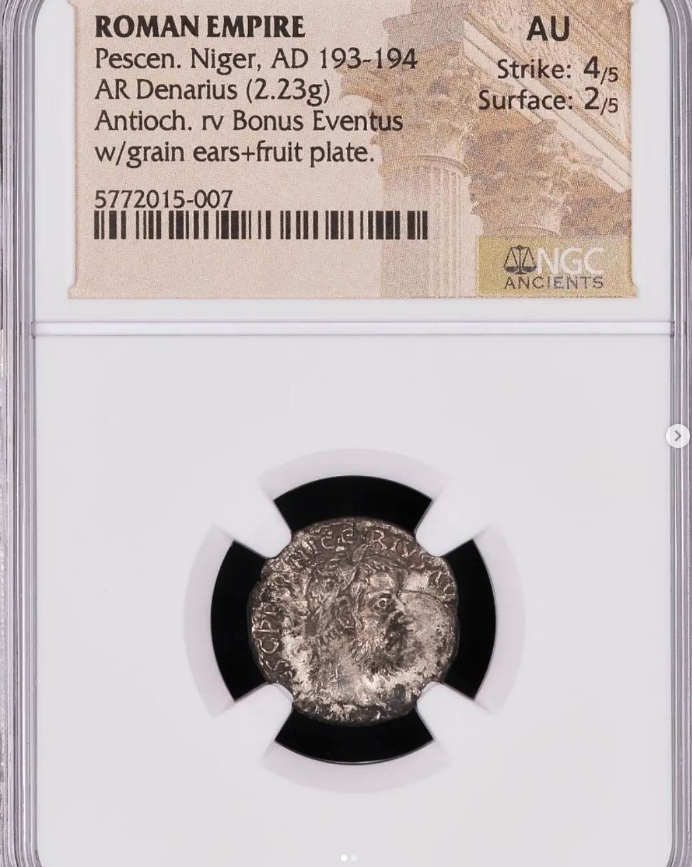
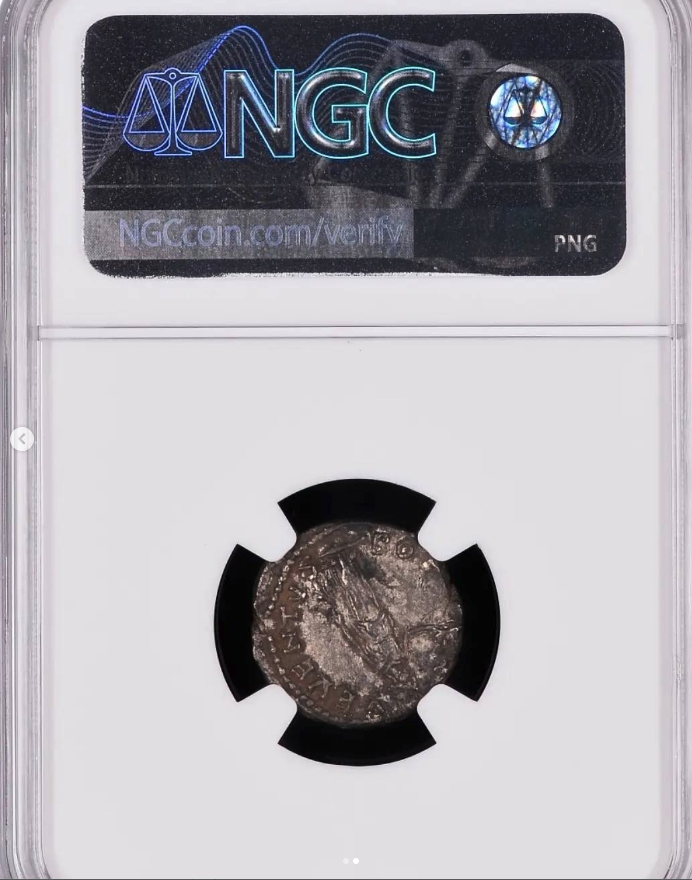
9 April A.D. 193 - May A.D. 194 AR Denarius (2.23g)
A scarce eastern denarius of Pescennius Niger - the Syrian usurper of the Year of the Five Emperors - struck at Antioch in 193-194 and graded NGC AU with a sharp Strike 4/5. Niger coinage is rare across the board: his entire 14-month reign was confined to the eastern provinces and most of his issues were melted by Severus after his defeat.
- Metal
- Silver
- Grade
- NGC Ancients AU · Strike 4/5 · Surface 2/5
- Cert #
- 5772015-007
Full attribution & era
The history behind the coin.
The Year of the Five Emperors was one of the darkest moments in Roman imperial history. When the Emperor Commodus was assassinated on New Year's Eve A.D. 192 - strangled in his bath by his wrestling partner Narcissus on the orders of his own mistress and praetorian prefect - it ended the Antonine dynasty and set off a mad scramble for the throne.
The respected senator and general Pertinax was hurried into the purple the next morning. Pertinax was notorious for being frugal and refused to pay the Praetorian Guard the donativum (the customary cash bribe) they had come to expect from each new emperor. Worse, he attempted to restore discipline and turn the Guard back into an actual military formation rather than the pampered political kingmakers they had become. On 28 March 193, after only 86 days on the throne, some 200 praetorians stormed the imperial palace and assassinated him. And so went the first emperor.
What followed was perhaps the most disgraceful episode in the entire history of the Empire: the Praetorian Guard literally auctioned off the throne from the walls of their camp. Two bidders competed - the wealthy senator Didius Julianus, and Pertinax's own father-in-law Sulpicianus, who was already inside the camp. Sulpicianus bid from within while Julianus, locked outside, had to shout his bids over the walls. Julianus eventually won at 25,000 sesterces per guardsman. When word reached the provinces that the Empire had been sold like a piece of furniture, three governors went into open revolt. Septimius Severus marched on Rome from Pannonia. After 66 days, Julianus was abandoned by everyone and executed in the palace by two of his own soldiers hoping for clemency from Severus. And so went the second emperor.
Three usurpers now claimed the purple: Severus himself, Clodius Albinus in Britain, and Pescennius Niger in the east. Severus bought off Albinus by promising to make him heir - a promise he had no intention of keeping (in 196-197 Severus would turn on Albinus and destroy him at Lugdunum after naming his own sons Caracalla and Geta as heirs). And so went the third emperor.
Pescennius Niger was the Governor of Syria and one of the most popular generals of his day. On 9 April 193 he was hailed as emperor by the legions at Antioch, and within weeks he controlled almost all of the eastern provinces - Syria, Egypt, the grain supply, and most of Asia Minor. Severus, however, moved with terrifying speed. In the autumn of 193 the two armies met at the Battle of Cyzicus in north-western Asia Minor, where Niger's forces were broken. A second crushing defeat followed at the Battle of Issus in the spring of 194 - on the same plain where Alexander the Great had defeated Darius III over 500 years earlier. Niger fled east, attempting to escape across the Euphrates to seek refuge with the Parthians, but he was overtaken and killed by Severus's cavalry. His head was sent back to Rome and paraded through the streets. And so went the fourth emperor.
In the end Septimius Severus stood alone - the fifth and last emperor of the year, founder of the Severan dynasty, the last great imperial dynasty before the Crisis of the Third Century tore the Empire apart from the 230s onward.
This denarius was struck at the Antioch mint during Niger's brief 14-month reign. The obverse legend reads IMP CAES C PESC NIGER IVST AVG and shows his laureate bust right; the reverse depicts Bonus Eventus ("Good Outcome / Successful Harvest") standing left, holding a plate of fruit and grain ears - traditional propaganda for an emperor promising prosperity and the secure delivery of the grain dole. The irony is acute: within months Severus's legions would seize the Egyptian grain supply that Niger had relied on, and within a year Niger himself would be a head on a spear. Surviving denarii of Pescennius Niger are scarce - his coinage circulated only briefly and only in the east, and Severus systematically melted Niger's silver after his victory. NGC AU with Strike 4/5 is an exceptional grade for the type.
- RIC IV (Pescennius Niger) 8 variant - Antioch mint, Bonus Eventus reverse with grain ears and fruit plate.
- BMCRE V (Pescennius Niger), Antioch issues.
- Cassius Dio - Roman History, Books 73-74 (Year of the Five Emperors, sale of the Empire by the Praetorians, defeat of Niger).
- Herodian - History of the Empire, Books 2-3.
- Historia Augusta - Lives of Pertinax, Didius Julianus, Pescennius Niger, and Septimius Severus.
- Anthony Birley - Septimius Severus: The African Emperor (rev. ed., Routledge).
- NGC Cert 5772015-007 - AU, Strike 4/5, Surface 2/5.