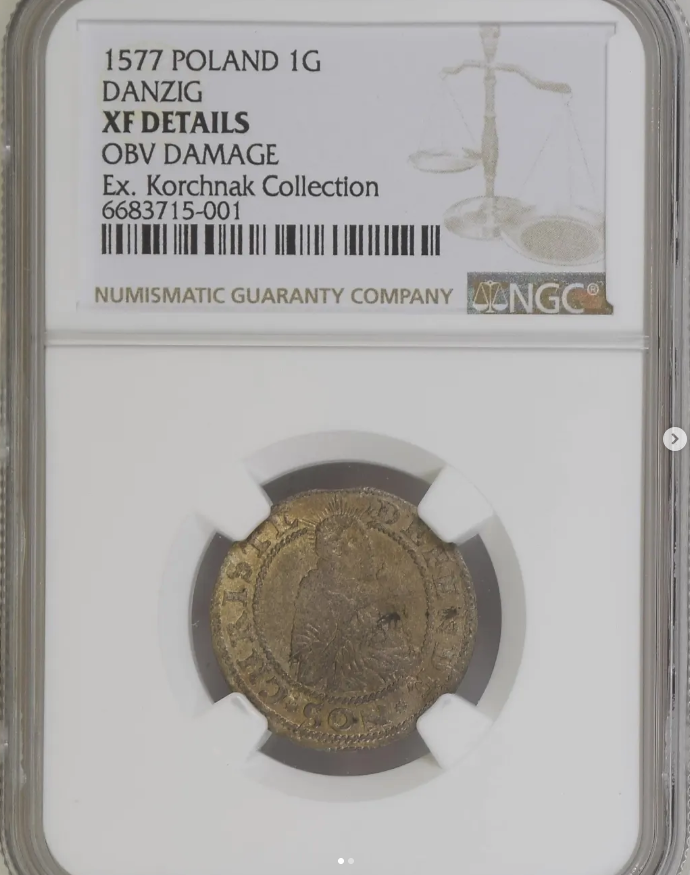
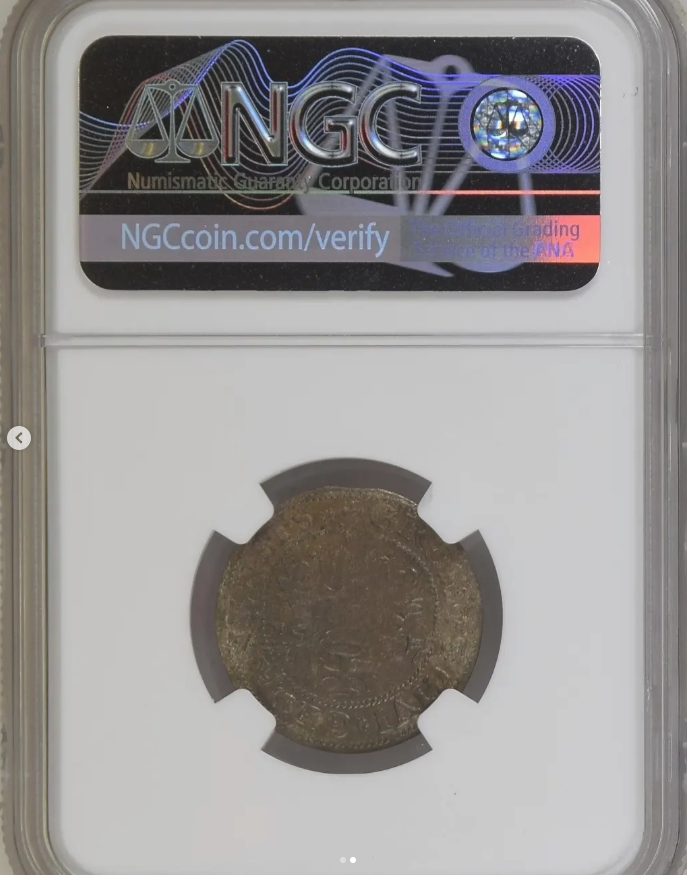
1577 Siege Groschen (1G)
A genuine emergency siege groschen struck inside Danzig during the 1577 siege - bearing the image of Christ to pay Scottish mercenaries - from the cabinet of Dr. Lawrence Korchnak, the standard author on world siege coinage.
- Metal
- Silver
- Grade
- NGC XF Details · Obv Damage
- Cert #
- 6683715-001
- Pedigree
- Ex. Dr. Lawrence Korchnak Collection (author of Siege Coins of the World 1453-1902)
Full attribution & era
The history behind the coin.
In 1574 King Henry of Valois, elected ruler of the Polish-Lithuanian Commonwealth, abandoned Poland to return to France and claim the French throne as Henry III after the death of his brother Charles IX. Poland-Lithuania was suddenly without a king, and the elective Diet of the szlachta convened to choose a successor. Two candidates emerged: Stephen Báthory, Prince of Transylvania, and the Holy Roman Emperor Maximilian II. The nobility elected Báthory - but the rich Hanseatic city of Danzig (Gdańsk), the wealthiest port on the Baltic, refused to recognize him and declared for Maximilian instead. The result was civil war.
In April 1577 the Scottish mercenary contingent hired by Danzig was crushed at the Battle of Lubieszów, and Báthory's army settled in to besiege the city itself. By July his cannons were in position above the walls, but a Danzig sortie destroyed most of the guns. In September a Danish fleet supporting Danzig attacked the Polish army from the sea and landed troops to break the siege. By December both sides were exhausted; a negotiated peace followed, in which Danzig pledged loyalty to Báthory and paid an indemnity of 200,000 zloty in exchange for confirmation of its civic privileges.
During the siege itself, Danzig struck emergency money from inside the walls to pay its mercenary garrison - including the Scottish troops. These siege groschen carry the image of Jesus Christ on the obverse, surrounded by an inscription naming Christ as protector, and the city arms or a defensive legend on the reverse. Issued under wartime conditions on irregular flans, with hand-cut dies and from whatever silver could be commandeered, surviving examples are scarce in any grade and almost never problem-free - they were meant to circulate hard and to feed soldiers, not to last for collectors.
This piece is graded NGC XF Details, with old obverse damage noted on the holder, and carries one of the most desirable provenances in siege-coin collecting: the cabinet of Dr. Lawrence Korchnak, author of the standard reference Siege Coins of the World 1453-1902. A Korchnak-pedigreed Danzig 1577 siege groschen is exactly the kind of piece that links the historical event, the academic literature, and the surviving coinage in a single object.
- Korchnak, Dr. Lawrence - Siege Coins of the World 1453-1902.
- Mailliet - Catalogue Descriptif des Monnaies Obsidionales et de Nécessité.
- Kopicki - Katalog Podstawowych Typów Monet i Banknotów Polski (Danzig 1577 emergency issues).
- NGC Cert #6683715-001.