
1868 Vereinsthaler (XXX Ein Pfund Fein)
Finest-certified PCGS MS-66 PL of a tiny-state Vereinsthaler - and a textbook case of the proof vs. prooflike debate that haunts pre-unification German coinage.
- Metal
- Silver
- Mint
- Berlin (A)
- Grade
- PCGS MS-66 PL · Prooflike - Finest Certified at PCGS
- Cert #
- 43905187
Full attribution & era
The history behind the coin.
The Principality of Reuss-Obergreiz was one of the smallest of the German states - a postage-stamp principality in Thuringia ruled, by tradition, by men named Heinrich and numbered consecutively. By 1868 the ruler was Heinrich XXII, and the Vereinsthaler standard ("XXX Ein Pfund Fein" - 30 to a pound of fine silver) was the common silver currency of the German Confederation in its final years before Bismarck's 1871 unification under Prussia.
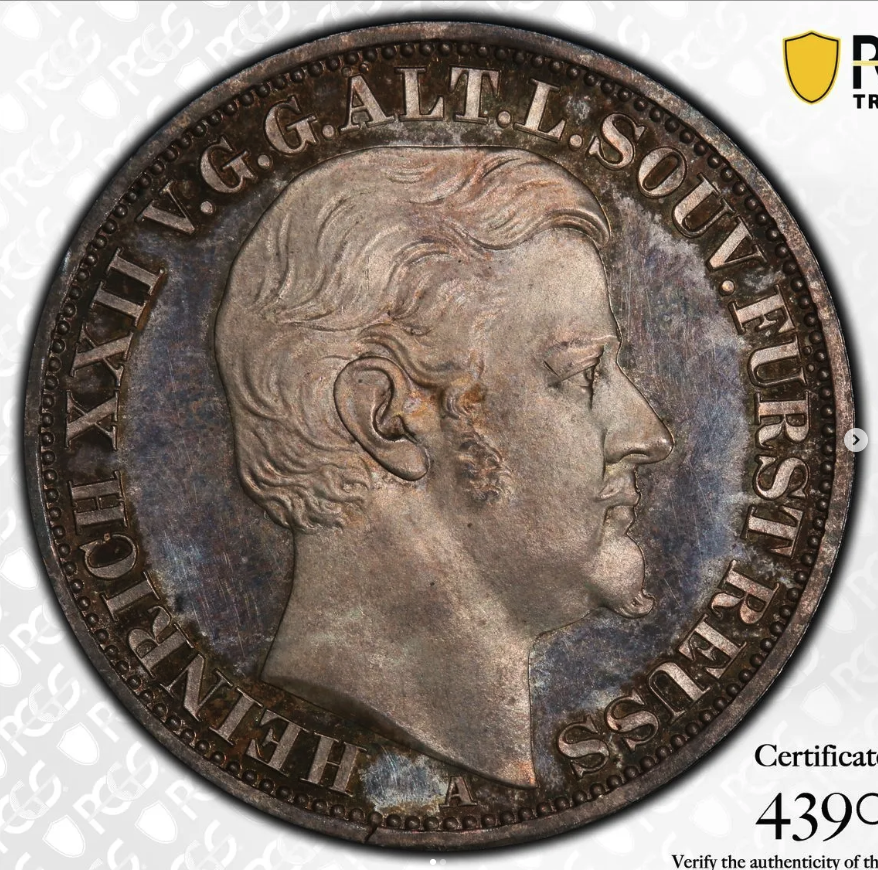
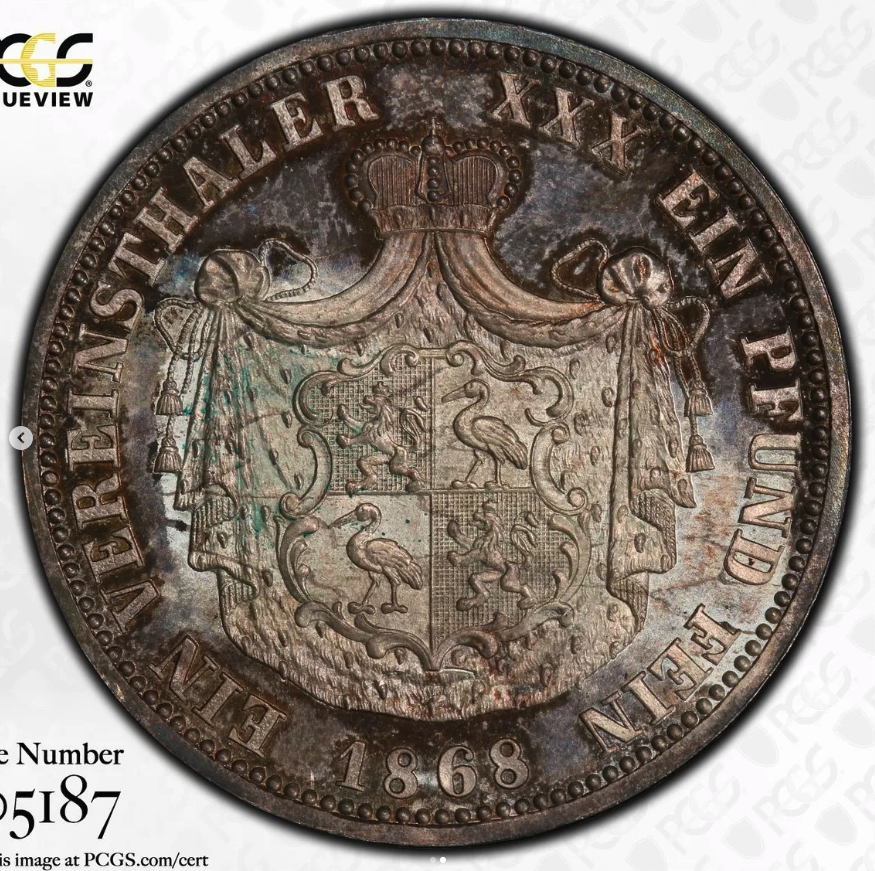
This piece, struck at the Berlin mint (A), is the finest example certified at PCGS - MS-66 PL. The obverse carries the bare-headed bust of Heinrich XXII with the legend HEINRICH XXII V.G.G. ALT. L. SOUV. FÜRST REUSS ("by the Grace of God, Senior Line Sovereign Prince of Reuss"); the reverse shows the crowned Reuss arms on a draped mantle, surrounded by VEREINSTHALER · XXX EIN PFUND FEIN · 1868.
The coin sits squarely on the line of an old numismatic argument: is it a proof, or only "prooflike"? Small German states before unification routinely used a single pair of dies first to strike a handful of true presentation pieces - mirror fields, frosted devices, for the prince's own cabinet, for visiting dignitaries, for diplomatic gifts - and then used those very same dies to strike circulation Vereinsthalers until they wore out. The first strikes are unmistakably proof; the last strikes are unmistakably business; somewhere in between the line is genuinely undefined.
There is no objective "correct" answer to where proof striking ends and mint state begins on these issues - it is one of the legitimately subjective calls in numismatics. Personally I would call this coin a Proof with a Cameo designation; PCGS has called it Prooflike. Either way, MS-66 PL is the top of the population, and the deeply mirrored fields with frosted, cameo-like portrait speak for themselves.
- Krause-Mishler - Standard Catalog of German Coins (KM-117 / AKS-25 / Thun-292).
- Davenport - German Talers Since 1800 (Dav-800).
- Jaeger - Die Deutschen Münzen seit 1871 (predecessor catalogue, Reuss-Obergreiz section).
- PCGS Cert #43905187 - Finest Certified at PCGS in MS-66 PL.