
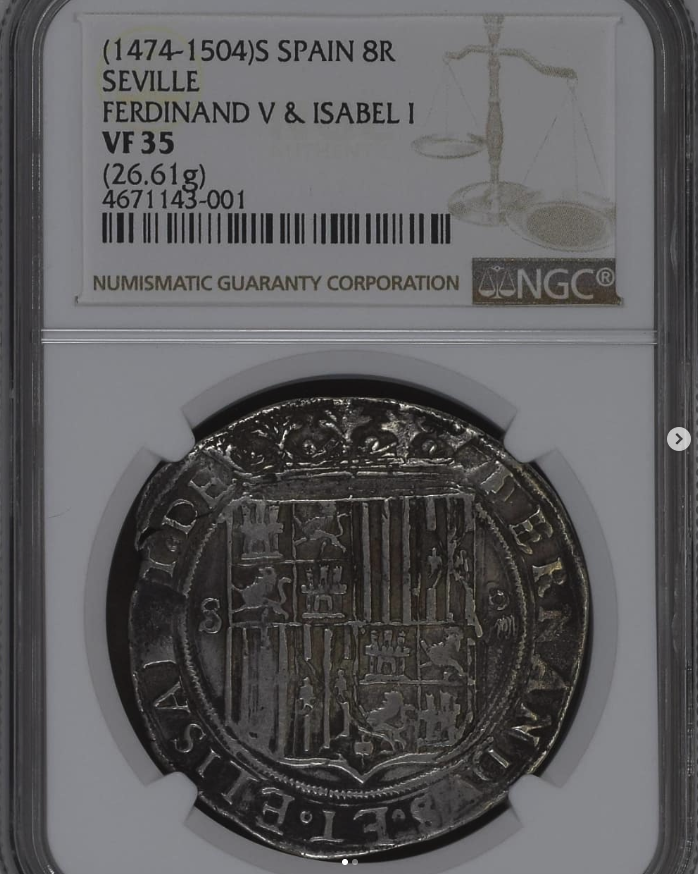
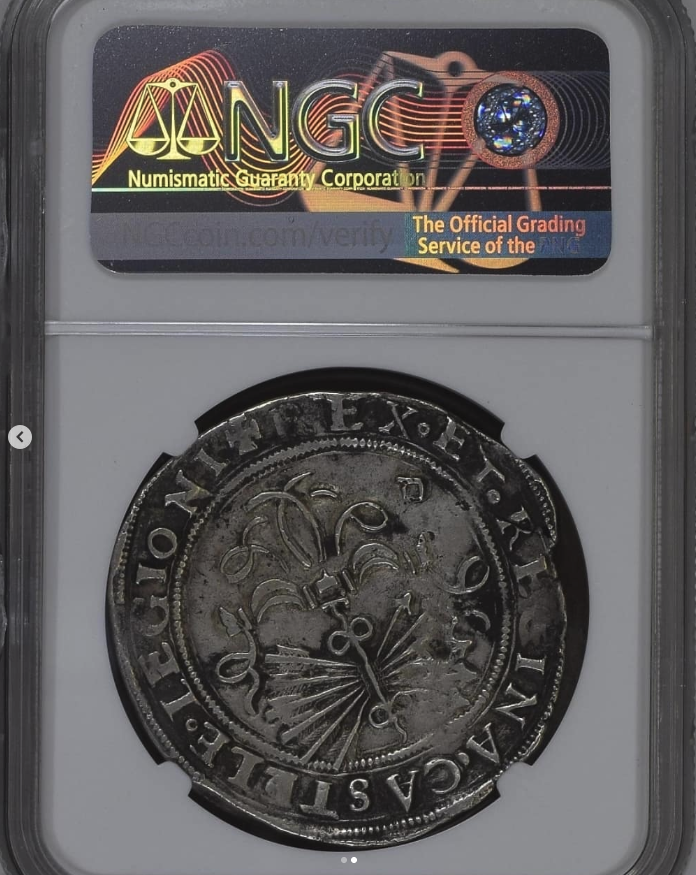
Dated 1474-1504, struck posthumously c. 1537-1566 AR 8 Reales (26.61g)
The first crown-size coin and the first 8 reales ever struck in Spain - the silver type that founded the entire Spanish-American 'piece of eight' economy. Issued under Ferdinand and Isabella's names but actually struck c. 1537-1566 under their Habsburg grandson Charles V and great-grandson Philip II for political legitimacy. NGC VF-35.
- Metal
- Silver
- Grade
- NGC VF-35
- Cert #
- 4671143-001
Full attribution & era
The history behind the coin.
This is the type-coin that launched the world. The 8 reales of Ferdinand and Isabella - "los Reyes Católicos," the Catholic Monarchs whose marriage in 1469 united Castile and Aragon and whose 1492 funded Columbus, completed the Reconquista at Granada, and expelled the Jews from Spain - is the first crown-size silver coin ever struck in Spain and the direct ancestor of every "piece of eight" struck thereafter from Mexico to Manila to Potosí. It is, in a real sense, the founding coin of the modern world's first global currency.
But this coin is not what it appears to be. Although it is dated 1474-1504 (the regnal years of Ferdinand and Isabella) and bears their names, titles, and joined arms, the coin was not actually struck in their lifetime. It is now firmly established by Spanish numismatic scholarship that the entire series of "Ferdinand and Isabella" 8 reales is a posthumous issue - struck between roughly 1537 and 1566, more than thirty to sixty years after Isabella's death, by their Habsburg grandson Emperor Charles V (Carlos I of Spain, r. 1516-1556) and great-grandson Philip II (Felipe II, r. 1556-1598).
The reason was almost entirely political. Charles V was a foreigner in Spain in every meaningful sense - born in Ghent, raised in the Burgundian Netherlands, fluent in French and Flemish but barely able to speak Castilian when he arrived in 1517. His arrival had triggered the Comuneros revolt of 1520-1521, when the Castilian cities rose against what they regarded as a Flemish takeover of the Spanish crown. Even after the revolt was crushed, Castilian opinion remained suspicious of the Habsburg dynasty for a generation. Continuing to strike Spain's flagship silver coin in the names of Ferdinand and Isabella - the universally beloved Catholic Monarchs whose memory was already being mythologised - was a calculated act of legitimisation: the new Habsburg silver was visually and ideologically a continuation of the Catholic Monarchs' regime, not a foreign innovation. Charles's authorising decree was the Cédula of 18 November 1537, which permitted the Viceroy of New Spain to strike 8 reales for the colonies; Philip II's Pragmática of 23 November 1566 finally ended the practice and ordered all future Spanish silver to bear the reigning king's own name.
The obverse of this Seville-mint piece displays the great quartered arms of the Catholic Monarchs - Castile (the castle), León (the lion), Aragon (the pales), Sicily (the eagle), Granada (the pomegranate, added after the 1492 conquest) - beneath a single royal crown, with the legend FERNANDVS · ET · ELISABET · D[ei] G[ratia]. The reverse carries the famous "Yoke and Arrows" emblem of Ferdinand and Isabella - the Y for Ysabel beside her husband's bound sheaf of arrows, and the F for Fernando beside her ox-yoke (yugo) - the personal devices the two monarchs gave each other as marriage emblems, encircled by the legend REX · ET · REGINA · CASTILE · LEGIONIS - "King and Queen of Castile and León." The S in the left field of the obverse is the Seville mintmark.
This is one of the foundational silver coins of European numismatics. From this design, in nearly unbroken continuity, descend the Mexico City and Lima Carlos y Juana 8 reales of the 1530s-1570s, the cob 8 reales of Potosí and Mexico that flooded Europe and Asia with American silver from the 1570s through the 1730s, the milled "pillar dollars" of the 18th century, the Spanish-American 8 reales that circulated as legal tender in the United States until 1857, and ultimately the modern US dollar itself - whose name "dollar" is derived from "thaler" but whose silver weight standard was set directly to match the Spanish piece of eight.
- Cayon-2844 (Spain, Ferdinand and Isabella, 8 reales, Seville mint).
- Calicó 187 (Catalogo General de la Moneda Española, Ferdinand and Isabella 8 reales).
- NGC Cert 4671143-001 - VF-35.
- Tomás Dasí - Estudio de los Reales de a Ocho, vol. 1, p. 49 (definitive Spanish-language treatment of the posthumous striking).
- Calbetó de Grau - Compendio de las piezas de ocho reales, vol. 2, p. 552.
- Octavio Gil Farrés - Historia de la moneda española, pp. 236-237.
- Aloïss Heiss - Descripción general de las monedas hispano-cristianas, vol. 1, pp. 161-162.
- Louis Jordan - Studies on John Hull, the Mint and the Economics of Massachusetts Coinage (cited above on the posthumous striking).
- Cédula of Charles I, 18 November 1537 (authorising 8 reales striking in New Spain) and Pragmática of Philip II, 23 November 1566 (ending the use of Ferdinand and Isabella's names).