
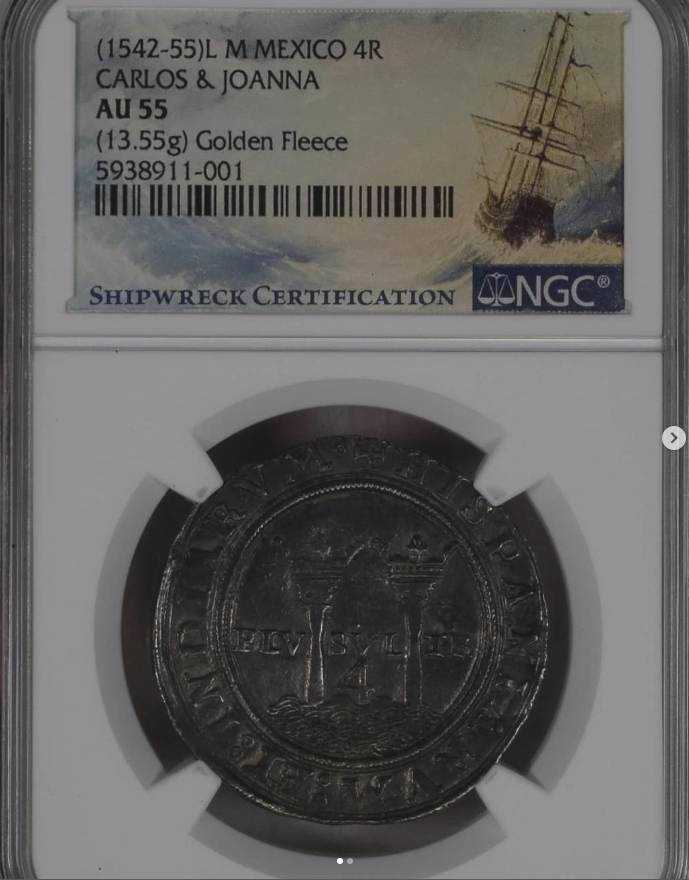
1542-1555 AR 4 Reales (13.55g)
A virtually pristine Carlos & Juana 4 reales recovered from the Golden Fleece Shipwreck (sunk c. 1550) - somehow preserved without the saltwater corrosion that destroys nearly every coin from a 400-year submersion, almost certainly because it survived inside a sealed barrel or leather pouch on the wreck floor. NGC AU-55 with Shipwreck Certification.
- Metal
- Silver
- Grade
- NGC AU-55 · Shipwreck Certification - Golden Fleece Wreck
- Cert #
- 5938911-001
Full attribution & era
The history behind the coin.
This is one of the very first coins ever struck in the Americas. The Mexico City Mint - the Casa de Moneda de México - was founded by royal decree in 1535, only fourteen years after Hernán Cortés finished destroying the Aztec Empire. It was the first mint in the New World, and the silver it struck was the first true coinage of the Western Hemisphere. The "Carlos y Juana" series ran from 1536 until about 1572 and was issued in the joint name of King Carlos I of Spain (better known to history as the Holy Roman Emperor Charles V) and his mother Queen Juana of Castile - "Juana la Loca," Joanna the Mad - who, despite being permanently confined at Tordesillas due to mental illness from 1509 until her death in 1555, remained the legal Queen of Castile and was named on every coin struck in her son's American mints throughout her lifetime.
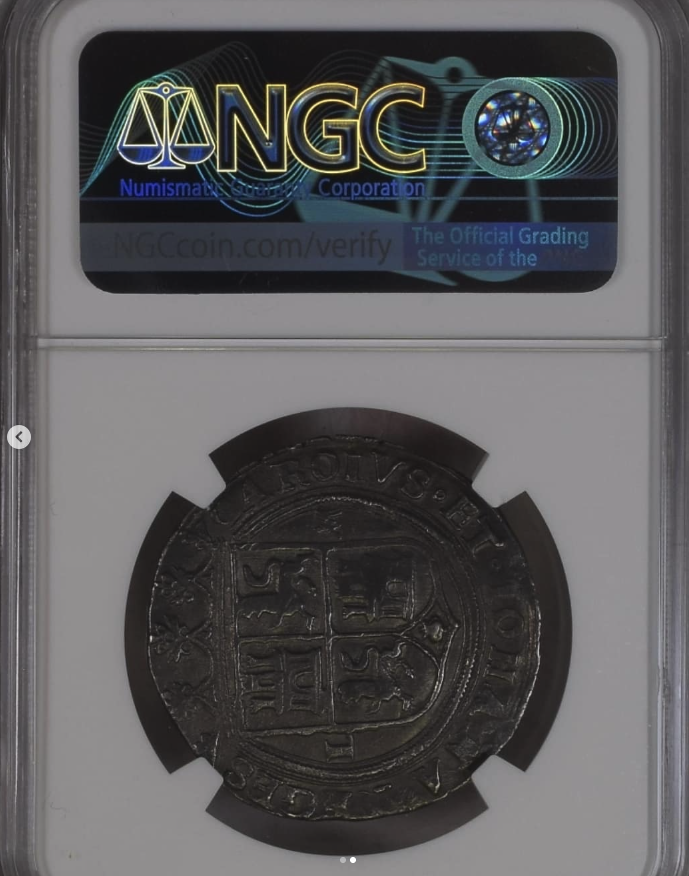
This 4 reales is a Nesmith Type 82a / Calicó 136 - the "Late Series" Mexico City Carlos y Juana 4R, with assayer's initial L (for Luis Rodríguez, mintmaster c. 1542-1555) at the left of the reverse and the Mexico City mintmark M at the right. The reverse shows the crowned Pillars of Hercules flanking the legend PLVS / VLTRA ("Further Beyond" - the personal motto of Charles V, declaring that the Strait of Gibraltar was no longer the limit of the known world) over waves, with the value 4 below. The obverse displays the crowned Habsburg-Castile-León quartered arms of Spain with the legend CAROLVS · ET · IOHANA · REGES around. These coins are entirely hand-hammered - the planchet was placed between two engraved dies and struck once with a sledgehammer. Strike weakness, off-centring, and partial flat spots are normal. A clean, sharp, well-centred 4-reales of this series is genuinely scarce.
The Golden Fleece Wreck takes its name from a royal Spanish hallmark - a stamp of the Order of the Golden Fleece (Toisón de Oro), the great Habsburg chivalric order of which Charles V was Sovereign - found on several of the gold "finger" bars (small ingots cast for transport) recovered from the site. The wreck has never been formally identified or its exact location publicly disclosed; the salvors have stated only that it was found in international waters in the northern Caribbean, and the cargo - a few thousand silver coins, a small parcel of gold finger bars, and almost no other recoverable structure - is consistent with a small dispatch ship of the late 1540s carrying a private parcel of New World silver back to Spain. Apart from a handful of extremely rare early Santo Domingo (Hispaniola) pieces, every coin from the Golden Fleece Wreck was a Mexico City Carlos y Juana silver. The wreck is dated to approximately 1550 by the latest assayer combinations present in the cargo.
What makes this particular coin remarkable even within the Golden Fleece group is its surface. The vast majority of coins recovered from any 16th-century Caribbean wreck show heavy chloride etching, salt-encrustation, and the characteristic dull grey "shipwreck patina" of long submersion in seawater. This piece shows almost none of that. The only credible explanation is that it spent the entire 400-year submersion sealed inside a wooden barrel or oiled leather pouch that remained watertight on the wreck floor - an exceedingly rare circumstance. The result is a Carlos y Juana 4R that grades NGC AU-55 with a clean, sharp strike and dark cabinet-style toning rather than seawater corrosion - functionally indistinguishable from a non-shipwreck Mexico City early-series 4 reales, but with the documented Golden Fleece pedigree on the NGC label.
- Nesmith Type 82a (Mexico City, Carlos y Juana, 4 reales, Late Series, assayer L, mintmark M).
- Calicó 136 (Carlos y Juana, Mexico, 4 reales, type 136).
- R. Nesmith - The Coinage of the First Mint of the Americas at Mexico City, 1536-1572 (American Numismatic Society, 1955).
- Daniel Frank Sedwick - Practical Book of Cobs (background on early Mexican silver and Caribbean wrecks).
- NGC Cert 5938911-001 - AU-55, Shipwreck Certification, 'Golden Fleece' wreck.
- Krause - Standard Catalog of Mexican Coins (early colonial Mexico, KM #18 / #19 series).