
1711 Imperial Vicariat Thaler
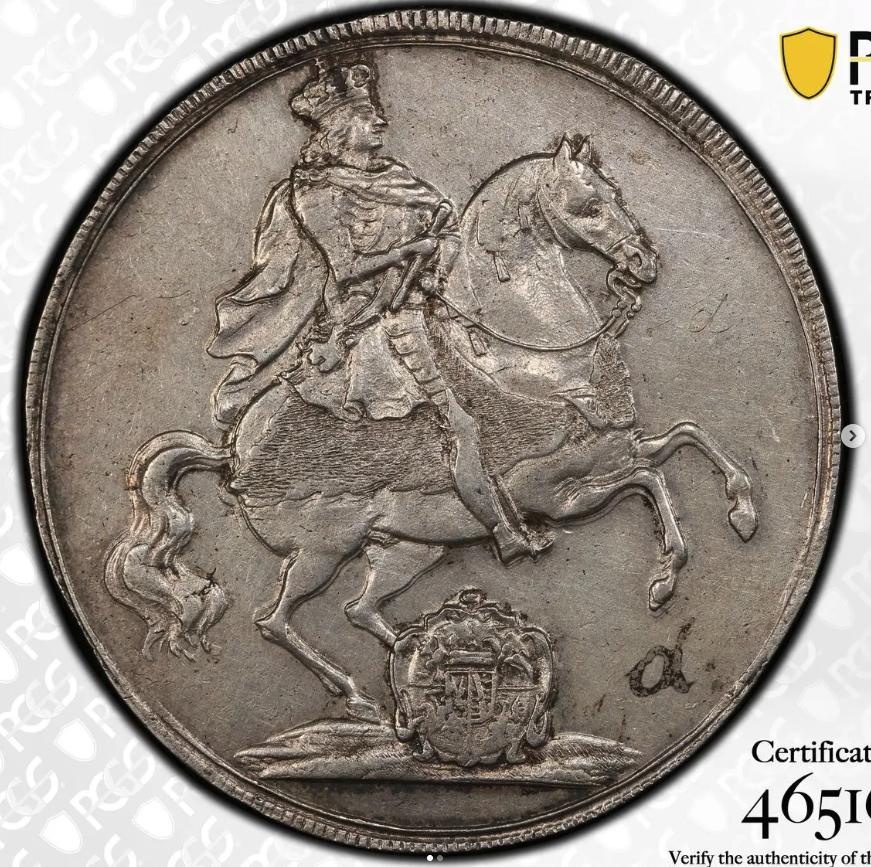
A Saxon Vicariat thaler struck during the brief 1711 Imperial interregnum, when Augustus the Strong governed the Empire as Imperial Vicar between the death of Joseph I and the election of Charles VI.
- Metal
- Silver
- Grade
- PCGS AU 55
Full attribution & era
The history behind the coin.
In the constitutional architecture of the Holy Roman Empire, an Imperial Vicar (Reichsvikar) was one of the great prince-electors charged with running the administration of the Empire during an interregnum - the period between the death of one emperor and the election of his successor. The Golden Bull of 1356 assigned this role in the Empire's Saxon-law lands to the Elector of Saxony.
When the Holy Roman Emperor Joseph I died unexpectedly of smallpox on 17 April 1711, the imperial throne stood vacant until his younger brother Charles - then in Spain prosecuting the War of the Spanish Succession as the Habsburg claimant to the Spanish crown - could be elected and crowned as Charles VI. Charles was elected on 12 October 1711 and the interregnum ended. For those few months, Frederick Augustus I of Saxony - better known to history as Augustus the Strong, the Saxon Elector and King of Poland - exercised the Vicariate over the Saxon-law portion of the Empire.
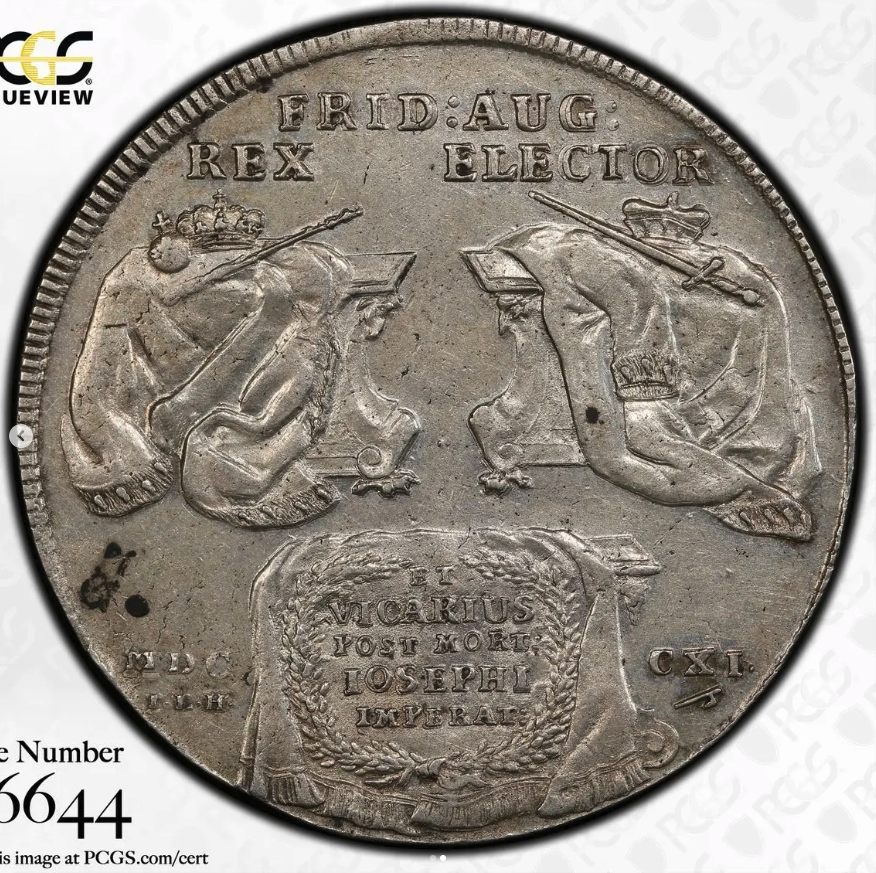
Saxon mints marked the occasion with a celebrated series of "Vicariatstaler". This is one of them. The obverse shows Augustus the Strong on horseback in full armor, crowned, with cloak streaming behind him, his horse rearing over a small crowned and mantled coat-of-arms - the classic baroque Reiterbild ("rider portrait") that Saxon engravers raised to a high art in the early 18th century. The reverse carries the legend FRID. AUG. REX ELECTOR ("Frederick Augustus, King and Elector"), a tableau of two crowned female figures - allegories of Saxony and Poland - kneeling and laying their crowns and scepters on a draped altar, and the cartouche-bound Latin inscription ET VICARIUS POST MORT[em] IOSEPHI IMPERAT[oris] ("and Vicar after the death of the Emperor Joseph") with the date MDCCXI flanking it.
PCGS AU 55 is a strong choice About Uncirculated grade for the type, with original surfaces and full design detail in the high-relief equestrian portrait. Vicariat thalers are among the most historically explicit coins of the Holy Roman Empire - struck only during the few months of an interregnum, with the constitutional event written in Latin onto the coin itself.
- Davenport - German Talers since 1500 (Vicariat issues, Saxony 1711).
- Schnee - Sächsische Taler (Vicariatstaler 1711).
- Slg. Merseburger / Slg. Sammlung der sächsischen Münzen.
- PCGS Cert (AU 55).