
1672 Silver Medal
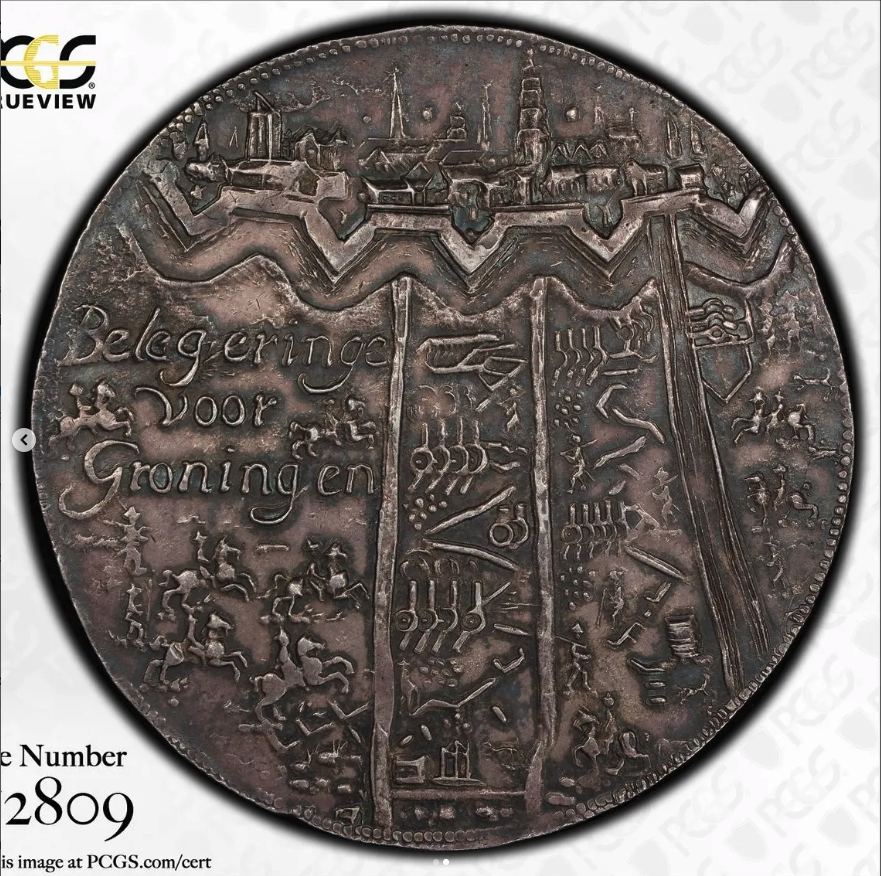
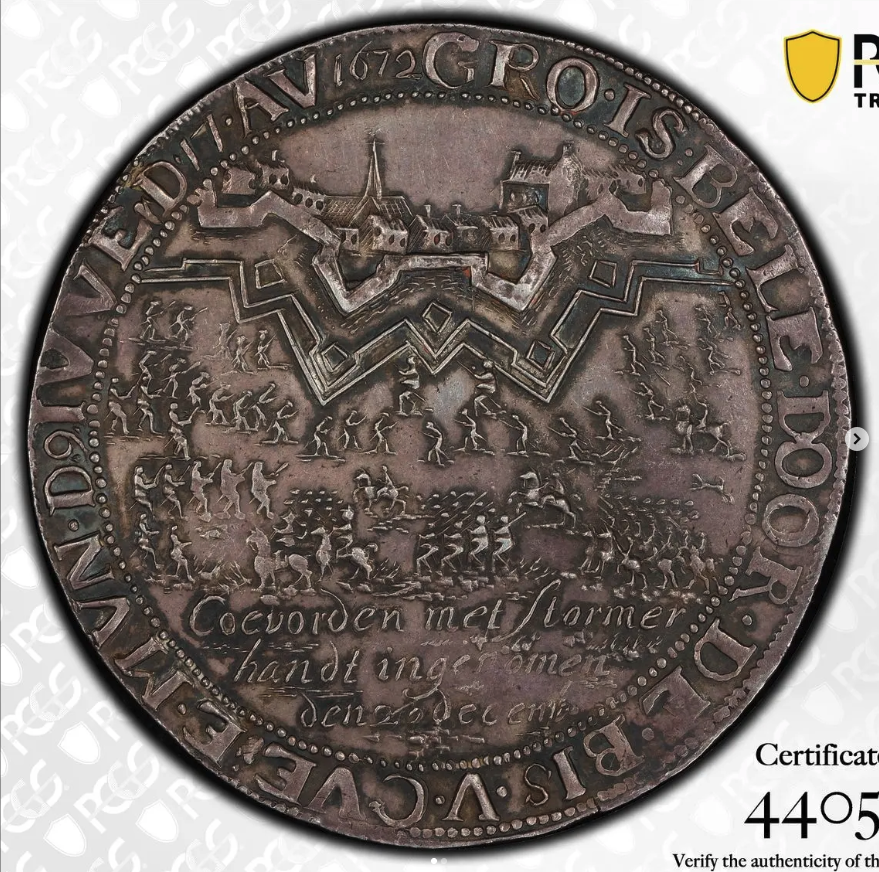
A magnificent narrative siege medal showing Groningen ringed by trenches, the Münster cavalry on the field, and the recapture of Coevorden - struck immediately after the city's deliverance on Groninger Ontzet (27 August 1672).
- Metal
- Silver
- Grade
- PCGS AU-58
- Cert #
- 44052809
Full attribution & era
The history behind the coin.
In 1672 the Dutch Republic was attacked simultaneously by France, England, the Bishopric of Münster, and the Archbishopric of Cologne - the year is remembered in Dutch as the Rampjaar, the "Disaster Year." In the north, the invader was Christoph Bernhard von Galen, the warrior Prince-Bishop of Münster, nicknamed Bommen Berend ("Bombing Bernard") for his enthusiastic and pioneering use of mortars in siege warfare. When Bommen Berend appeared outside Groningen on 17 July 1672 with a large army and a heavy artillery train, the city's prospects looked very dim.
In anticipation of the siege the city had broken the dikes and flooded the surrounding countryside, leaving only two reinforced bridges as approaches. Bishop Bernhard's troops attacked these bridges repeatedly and were repulsed each time by the defenders' ingenuity. In late July the city authorities, fearing fires from the bishop's mortar bombs, ordered every household to keep tubs of water out in the street, and assigned the Anabaptists - whose pacifist faith forbade them to take up arms - to firefighting duty. The bishop's demands for surrender were answered with sorties.
The Dutch high command, fearing the loss of the city, sent a relief force of 24 companies and 50,000 pounds of gunpowder to break in. On 26 August the Groningen garrison sortied out in force, met Bommen Berend's army in open battle, and routed it. The bishop lifted the siege on 27 August 1672 and retreated. The city of Groningen has celebrated Groninger Ontzet ("Groningen's Relief") on 28 August every year since.
The reverse of this medal carries a second scene: the Dutch recapture of the fortress town of Coevorden, which Bommen Berend had taken earlier in the campaign. The Dutch garrison stormed Coevorden in the night of 30 December 1672 in driving snow under the command of Carl Rabenhaupt - the legend reads COEVORDEN MET STORMER HANDT INGENOMEN DEN 30 DECEMB. ("Coevorden taken by storm 30 December") with the Münster troops shown fleeing the star-fort, all under the legend 1672 GROIS BELE DOOR DE BIS V CUEL EN MUNS [GED.] (Groningen besieged by the Bishops of Cologne and Münster).
The obverse legend BELEGERINGE VOOR GRONINGEN ("siege before Groningen") sits on the panoramic city view above the bishop's siege lines, with mortar batteries and cavalry rendered in extraordinary engraver's detail. PCGS AU-58 is a remarkable grade for a medal of this scale and complexity - a true narrative document of the only Dutch military success of the Rampjaar.
- van Loon - Histoire Métallique des Pays-Bas, Vol. III (Groningen siege medals, 1672).
- Israel, Jonathan - The Dutch Republic: Its Rise, Greatness, and Fall.
- Panhuysen, Luc - Rampjaar 1672 (definitive Dutch-language history).
- Boom, P.O. van der - De Belegering van Groningen 1672.
- PCGS Cert #44052809.