
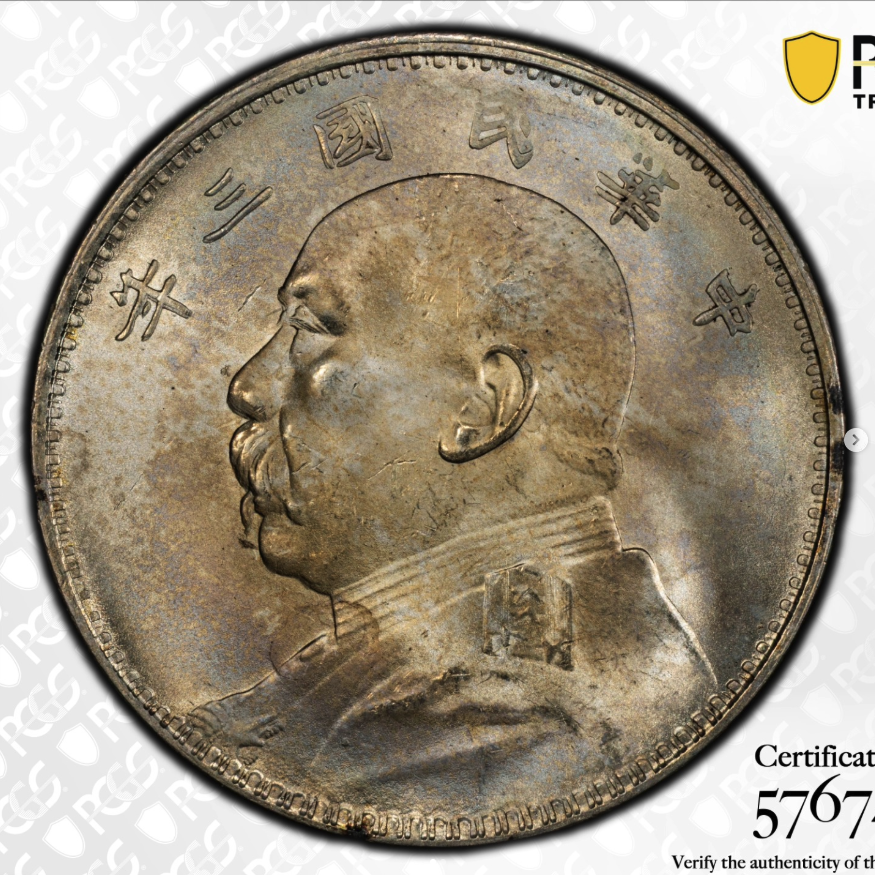
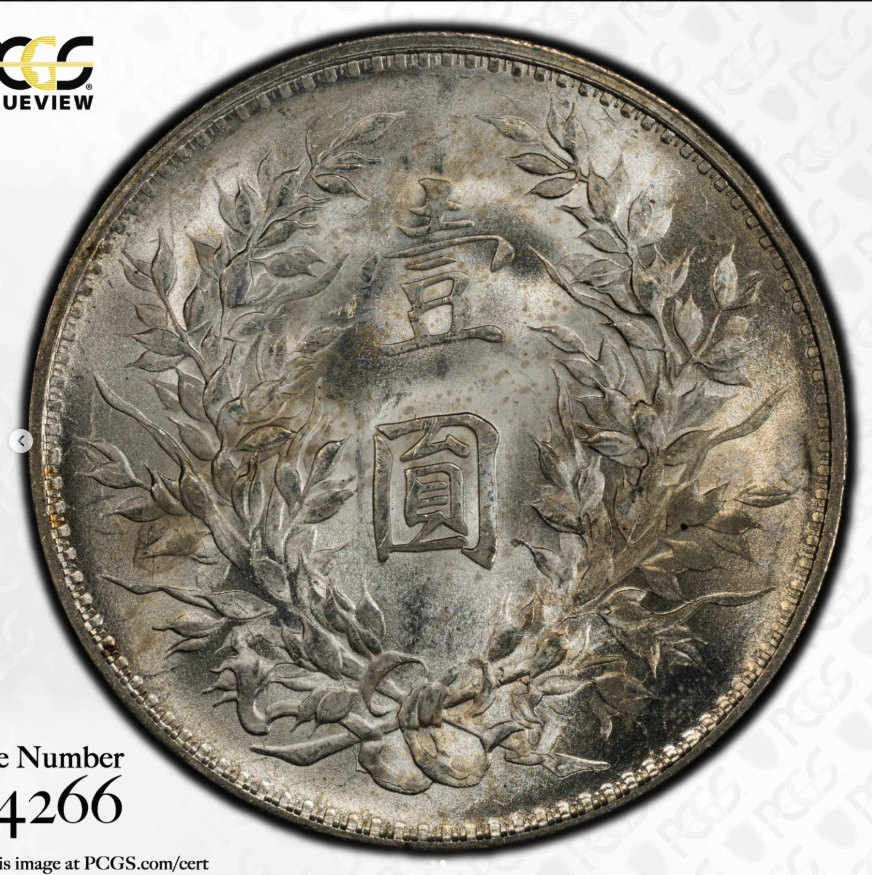
1914 (Year 3) Yuan Shih-kai "Fatman" Dollar
Year 3 Fatman Dollar with the dramatic Double Die Eyelid variety - a sharp MS-64 example of China's first unified Republic silver dollar.
- Metal
- Silver
- Grade
- PCGS MS-64 · Double Die Eyelid variety
Full attribution & era
The history behind the coin.
After the fall of the Qing Dynasty in 1911 and the end of more than two thousand years of imperial rule, the new Republic of China inherited a chaotic monetary system in which dozens of provincial mints struck their own silver dollars to wildly varying standards. In 1914, President Yuan Shih-kai - the former Qing general who had maneuvered himself into the presidency and would soon try (and fail) to crown himself emperor - introduced a new national silver dollar bearing his own portrait, intended as the first truly unified circulating coinage of the Republic.
Collectors immediately nicknamed the type the "Fatman Dollar" for Yuan's famously full-faced bust. The design is austere by Chinese standards: a left-facing military bust of Yuan with the legend "Year 3 of the Republic of China" above on the obverse, and a simple wreath surrounding the denomination "壹圓" (One Yuan) on the reverse - a deliberate break from the dragons of the imperial coinage.
This example is the dramatic Double Die Eyelid variety, where a misaligned die impression has doubled the lines around Yuan's eye - a well-documented mint error that is highly sought after by Fatman specialists. Combined with the PCGS MS-64 grade and beautiful original cabinet toning, this is a genuinely standout example of one of the most historically important Chinese coins of the 20th century.
Yuan himself died in 1916, just two years after this coin was struck, after his attempt to declare himself Emperor of China collapsed within months. The Fatman Dollar long outlived him, however, continuing to be struck into the 1920s and remaining one of the most widely collected Chinese coins in the world.
- L&M-63 (Lin Gwo Ming - Illustrated Catalogue of Chinese Gold and Silver Coins).
- Kann-645 (Eduard Kann - Illustrated Catalog of Chinese Coins).
- PCGS CoinFacts - 1914 (Yr. 3) China Yuan Shih-kai Dollar, Double Die Eyelid variety.