
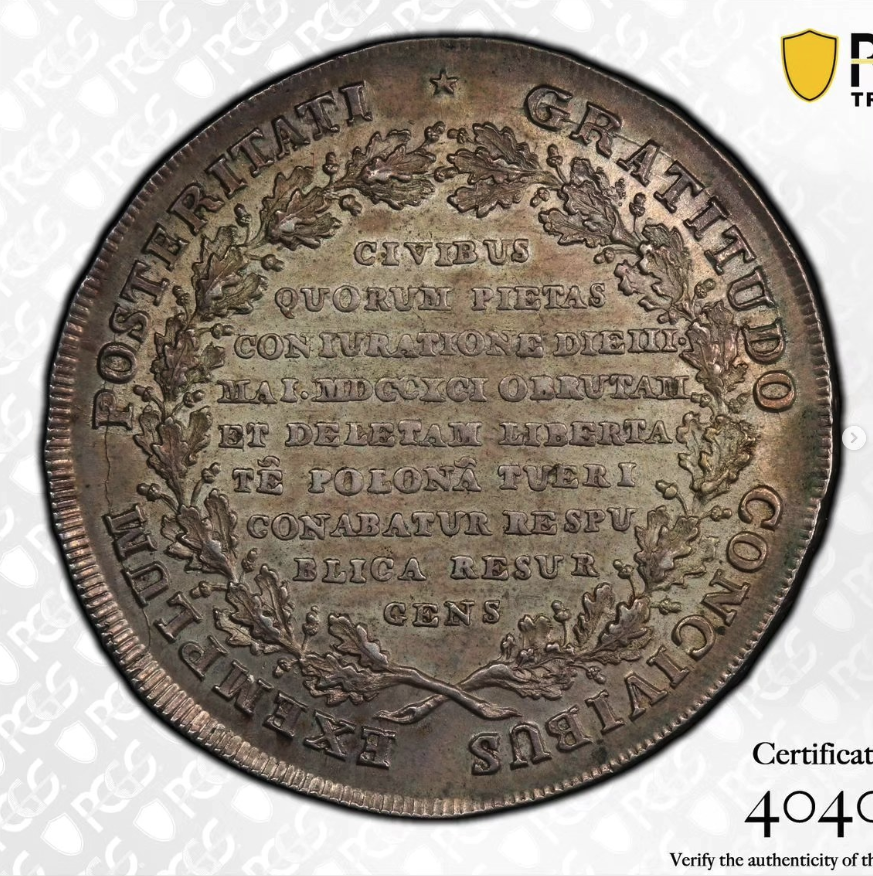
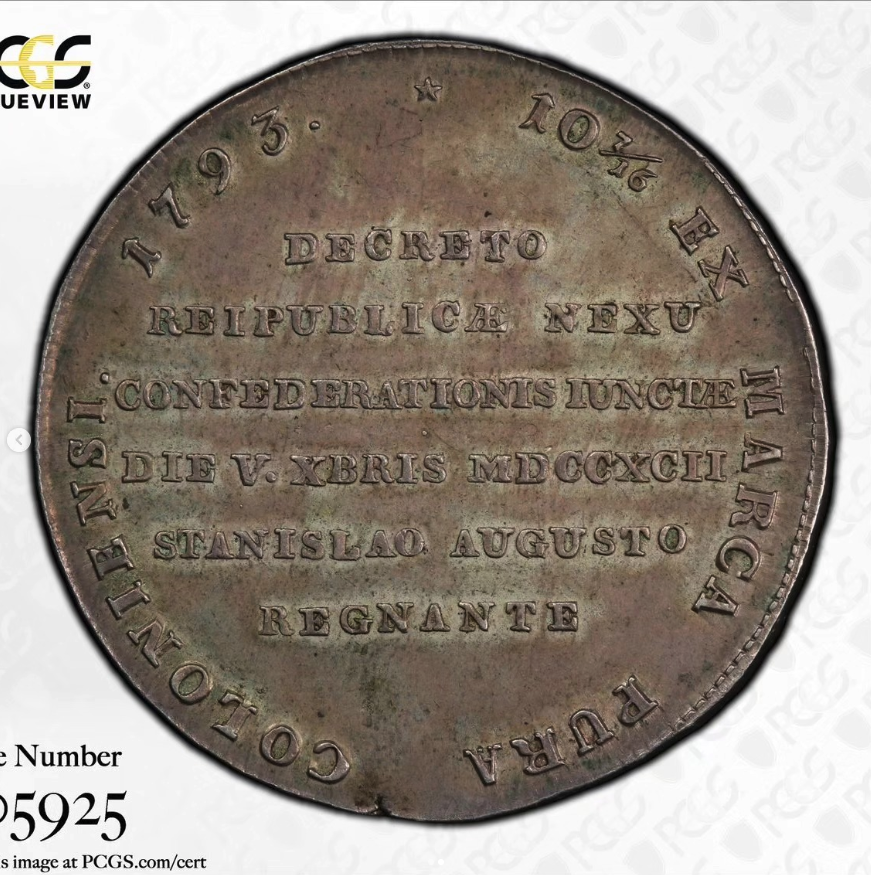
1793 Targowica Confederation Thaler
A deeply political thaler of the Russian-backed Targowica Confederation, struck in a tiny issue of about 1,699 pieces during the final dismemberment of Poland.
- Metal
- Silver
- Grade
- PCGS AU-58
Full attribution & era
The history behind the coin.
The Targowica Confederation was formed by conservative Polish magnates in opposition to the Constitution of 3 May 1791 - one of Europe's first modern written constitutions, and a last serious attempt to reform and preserve the failing Polish-Lithuanian Commonwealth. The confederates claimed they were defending noble liberty, but in practice they invited Russian intervention against their own state.
Russia eagerly backed the movement. In 1792 two Russian armies invaded Poland, crushed resistance, and forced King Stanisław August Poniatowski into the Confederation. The reformers were broken, the magnates of Targowica were eventually sidelined by their own patrons, and the Commonwealth lurched into the Second Partition in 1793. Within two more years, after the Kościuszko Uprising, Poland would be partitioned a final time and disappear from the map of Europe for more than a century.
This thaler was struck by the confederate regime in 1793 in an issue of only about 1,699 pieces. Rather than portraits or arms, both sides carry nothing but text - a perfect format for a coin whose entire purpose was political messaging and self-justification.
The obverse presents a wreath surrounding a long Latin inscription that can be paraphrased as a declaration of gratitude to the citizens whose piety, in the confederates' telling, would help overturn the "conspiracy" of 3 May 1791 and restore the liberty of Poland. The reverse records that, by decree of the united confederated republic issued on 5 December 1792 under the reign of Stanisław August, the piece was struck in 1793 to the standard noted in the surrounding inscription.
Today the coin is remembered less as a celebration than as a relic of national catastrophe - one of the clearest numismatic witnesses to the political collapse of the Polish-Lithuanian Commonwealth.
- Kamiński & Kurpiewski - Catalog of Polish Coins.
- Davies, Norman - God's Playground, Vol. I (on the May Constitution and partitions).
- PCGS certification for the illustrated AU-58 example.