
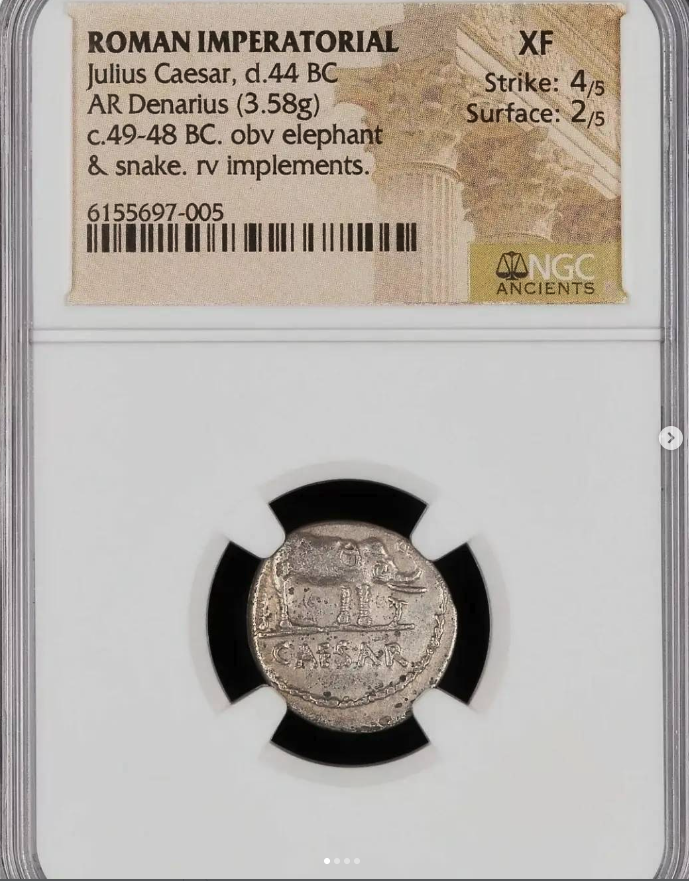
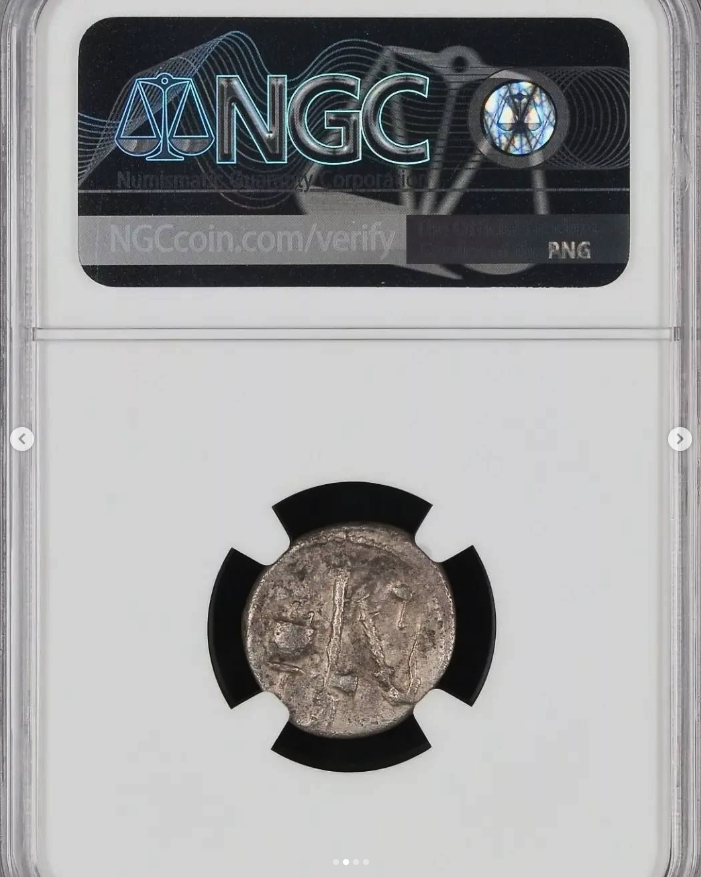
c. 49-48 B.C. AR Denarius (3.58g)
The most famous coin of the Roman Republic - struck by Caesar himself to pay the legions that crossed the Rubicon. The first Roman coin to put a living general's name on the obverse instead of the gods. A high-grade XF example with a sharp Strike 4/5.
- Metal
- Silver
- Grade
- NGC Ancients XF · Strike 4/5 · Surface 2/5
- Cert #
- 6155697-005
Full attribution & era
The history behind the coin.
Julius Caesar's family was old senatorial nobility, but they had lost prestige - his father never reached the consulship, the office that defined a Roman aristocrat's worth. Caesar would change that, and in changing it, end the Roman Republic.
In 60-59 B.C. Caesar struck a private deal with Pompey - Rome's most famous general - and Crassus, Rome's richest man. The First Triumvirate. With their backing Caesar bribed and bullied his way into the consulship, where he passed laws like land redistribution and debt relief that the Senate hated and the urban plebs adored. When his year as consul expired and his immunity from prosecution went with it, his allies engineered for him the proconsular governorship of Cisalpine Gaul, Illyricum, and Transalpine Gaul - giving him an army, a frontier, and a legal shield from the political enemies waiting in Rome.
Over the next nine years Caesar conquered most of modern France, won the double siege of Alesia against Vercingetorix, twice crossed the English Channel into Britain, and twice bridged the Rhine to terrify the Germanic tribes on the far bank. His self-published 'Commentarii de Bello Gallico' made him the most famous man in Rome. Pompey and the Senate were terrified of his power. When Crassus was destroyed by the Parthians at Carrhae in 53 B.C. - captured and, by tradition, executed by having molten gold poured down his throat - the triumvirate collapsed. The Senate sided with Pompey and ordered Caesar to lay down his command and return to Rome as a private citizen, where prosecution and exile were waiting.
In January of 49 B.C. Caesar instead crossed the Rubicon - the small river that marked the boundary between his province and Italy proper - with the 13th Legion at his back. To cross under arms was treason. "Alea iacta est," he is said to have remarked: the die is cast. As his army marched south through Italy toward Rome, Caesar set up a military mint travelling with the column. To pay the legions he struck this denarius. The reverse shows an elephant trampling a serpent or carnyx, with the single legend CAESAR in exergue - the obverse, the religious side, carries the implements of the pontifex maximus (the office Caesar held): the simpulum (ladle), aspergillum (sprinkler), securis (sacrificial axe), and apex (priestly cap). It was scandalous. For the first time in Roman history, a living general's name appeared as the principal legend on a Roman silver coin in place of a god, a personification, or a long-dead ancestor. Catalogued as Crawford 443/1, it is the single most important coin of the Late Republic and the direct prototype for every Roman emperor's portrait coinage that followed.
Pompey fled Italy without offering battle. Caesar was acclaimed dictator by the people and pursued Pompey to Greece, where he destroyed him at Pharsalus in 48 B.C. Pompey ran for Egypt and was beheaded as he stepped onto an Egyptian beach by men hoping to curry Caesar's favor. Caesar arrived shortly after, was presented with Pompey's head, wept, and then enmeshed himself in the Alexandrian dynastic war on the side of Cleopatra VII. After more than a year in Egypt he returned to Rome, pardoned most of the senators who had fought against him, and accepted offices and honors that drifted closer and closer to monarchy. On the Ides of March, 15 March 44 B.C., a senatorial conspiracy led by Marcus Junius Brutus and Gaius Cassius Longinus stabbed him to death at the foot of Pompey's statue.
This particular denarius is a higher-grade XF example with Strike 4/5 - a notably sharp impression of the elephant in mid-stride and the CAESAR exergue with full lettering. Surface 2/5 reflects the honest circulation of a coin that physically passed through the hands of Caesar's legionaries. NGC Cert #6155697-005. A 3.58-gram silver record of the moment the Roman Republic stopped being a republic.
- Crawford, Michael - Roman Republican Coinage (RRC 443/1).
- Sydenham - The Coinage of the Roman Republic (Syd. 1006).
- Caesar - Commentarii de Bello Civili.
- Suetonius - Life of the Deified Julius.
- Goldsworthy, Adrian - Caesar: Life of a Colossus.
- NGC Cert #6155697-005.