
1671 AR Memorial Reichsthaler
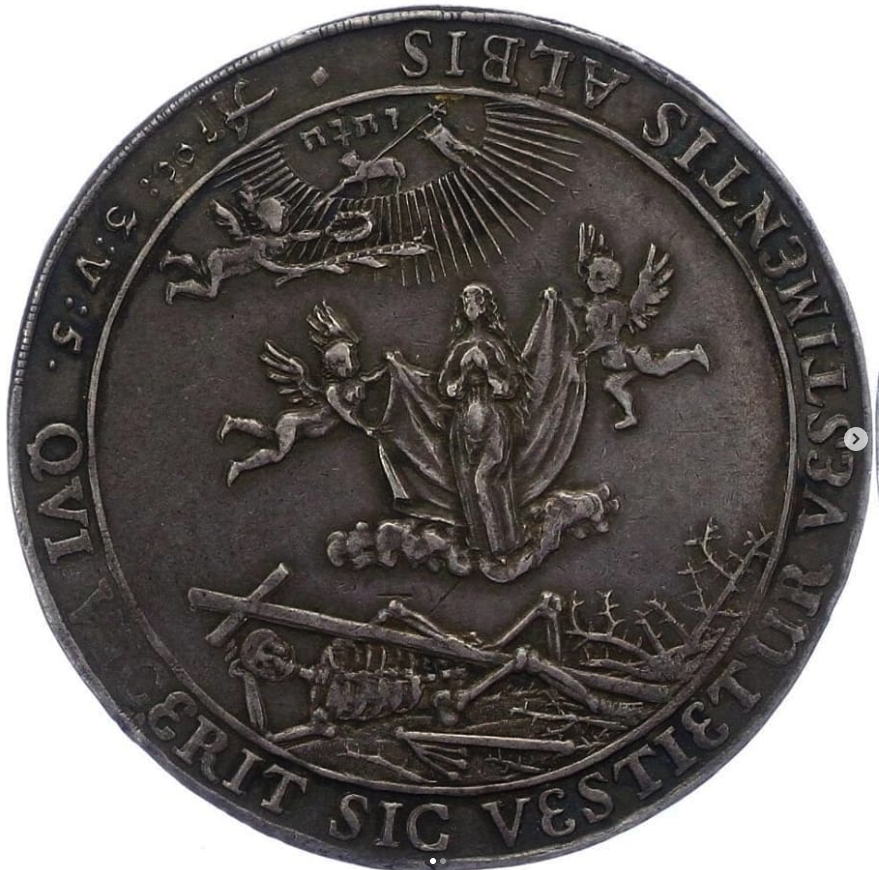
An unlisted-in-Davenport, misattributed-in-Krause Trauerthaler struck for the death of Duchess Sibylla Ursula of Schleswig-Holstein-Sonderburg-Glücksburg in 1671 - the silver memorial of one of the great women of early German Baroque literature, with the legend QUI SE GERIT SIC VESTIETUR VESTIMENTIS ALBIS ('he who conducts himself thus shall be clothed in white garments,' Revelation 3:5).
- Metal
- Silver
- Grade
- Raw
Full attribution & era
The history behind the coin.
Sibylla Ursula of Brunswick-Lüneburg-Wolfenbüttel (1629-1671) was, in her own lifetime, one of the founding women of German Baroque literature. The eldest daughter of Duke August the Younger of Brunswick-Wolfenbüttel - the polymath bibliophile whose library at Wolfenbüttel grew under his daughter's eyes into the largest in 17th-century Europe (today the Herzog August Bibliothek, where Leibniz would later serve as librarian) - she received an education unimaginable for almost any other woman of her generation. She wrote a five-act play, a substantial body of spiritual meditations, and translated the Spanish humanist Juan Luis Vives and the French novelist La Calprenède into German. Her greatest work, however, was the immense state-romance Aramena, die Syrische Prinzessin ("Aramena, the Syrian Princess") - a five-volume Baroque novel begun by Sibylla Ursula and completed and published after her death by her younger brother Anton Ulrich. Aramena became one of the central works of the entire German Baroque novel tradition.
In 1663, against her wishes and almost certainly against her happiness, Sibylla Ursula was married for purely dynastic reasons to Duke Christian of Schleswig-Holstein-Sonderburg-Glücksburg. By 1664 she had contracted syphilis - the surviving family correspondence makes the source clear, and she does not. The disease, then untreatable, ended her literary career and dominated the rest of her life. She bore four children, the last of whom died in infancy with her. On 12 December 1671, after a hard labour, Sibylla Ursula died of a combination of childbirth complications and tertiary syphilis. She was 42.
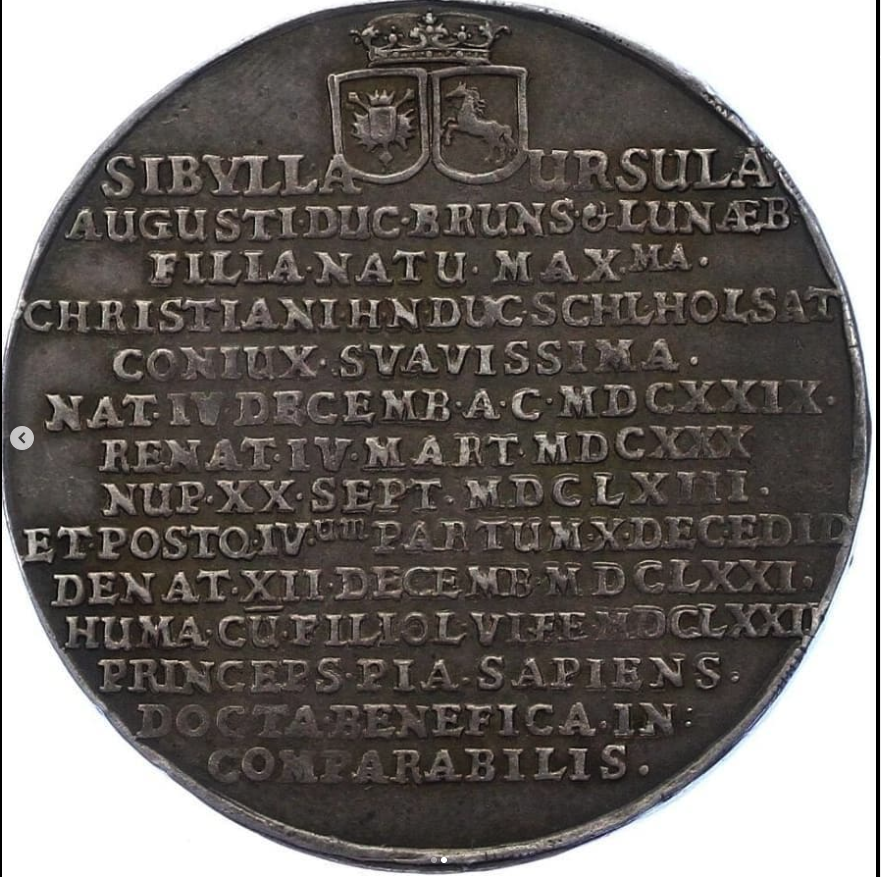
This Trauerthaler ("mourning thaler") was struck the following year by the Glücksburg court to mark her death. The obverse is one of the most striking Baroque death-allegories in German numismatics: at the upper edge, the Lamb of God carries the resurrection banner in a sunburst, with the Tetragrammaton יהוה ("YHWH") in Hebrew above it; in the centre, two flying angels lift the soul of the Duchess - depicted as a winged, partly draped figure standing on a cloud - upward to heaven; below, on the bare ground between blasted thorn bushes, her skeleton lies under the broken cross of mortality. The legend reads QUI SE GERIT SIC VESTIETUR VESTIMENTIS ALBIS - "He who conducts himself thus shall be clothed in white garments" - drawn from Revelation 3:5. The reverse carries the joined arms of her husband's Schleswig-Holstein-Glücksburg house and her father's Brunswick-Lüneburg house under a single ducal coronet, above a fourteen-line Latin inscription that sets out her full biography in dense lapidary script: born 4 December 1629, baptised 4 March 1630, married 20 September 1663, mother of four (one yet living at her death), died 12 December 1671, buried with her infant son in 1672 - PRINCEPS PIA SAPIENS DOCTA BENEFICA INCOMPARABILIS, "a princess pious, wise, learned, beneficent, incomparable."
The piece is unlisted in Davenport's German Talers and is misattributed in the Krause Standard Catalog of World Coins (typically catalogued under the wrong Holstein branch and wrong year). It survives in only a small handful of examples - Trauerthalers were struck in tiny numbers for distribution at the funeral and to family members of the German princely houses, never for circulation. As silver objects they are rare; as biographical objects, marking the death of a woman who was simultaneously a major Baroque novelist, a victim of dynastic marriage, and a victim of syphilis, they are unique.
- Davenport - German Talers 1500-1800: type unlisted (no Dav. number assigned).
- Krause - Standard Catalog of World Coins, 17th Century: misattributed entry under Schleswig-Holstein-Glücksburg.
- Lange - Sammlung Lange (Schleswig-Holstein medallic coinage), reference for the Christian / Sibylla Ursula memorial issues.
- Galen - Schleswig-Holsteinische Münzen und Medaillen, memorial thaler series for Christian of Glücksburg.
- Cornelia Niekus Moore - The Patterned Lives of Princesses (on Sibylla Ursula and her literary circle).
- Anton Ulrich von Braunschweig - Die Durchleuchtige Syrerin Aramena (1669-1673), preface acknowledging Sibylla Ursula's authorship of the original outline.
- Revelation 3:5 - source of the obverse legend QUI SE GERIT SIC VESTIETUR VESTIMENTIS ALBIS.