
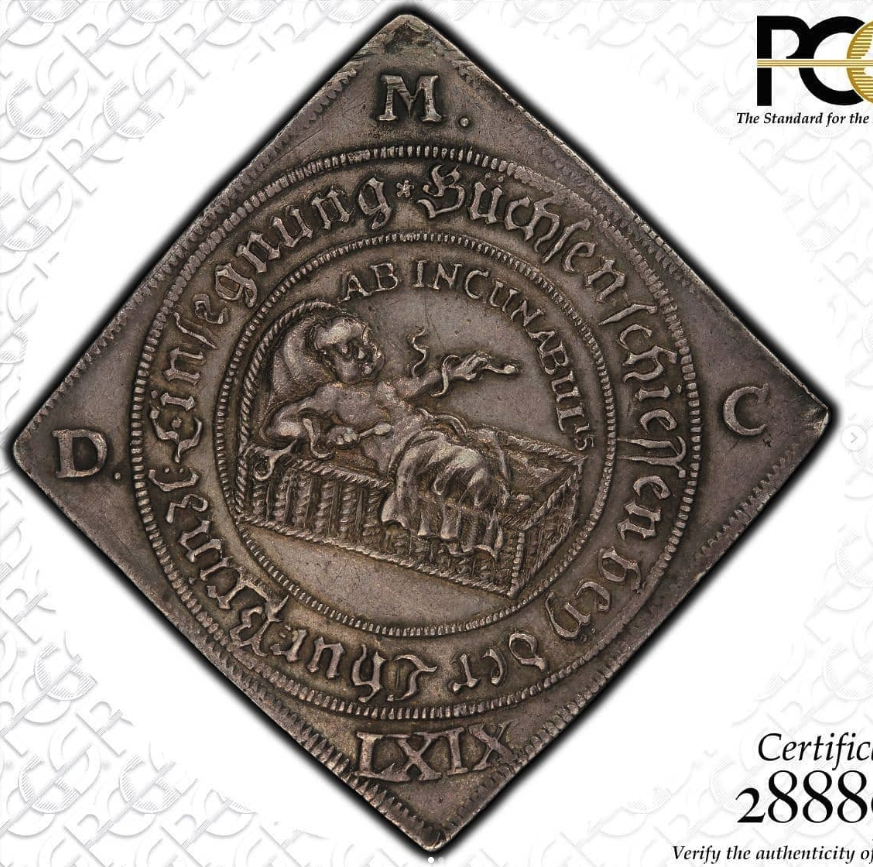
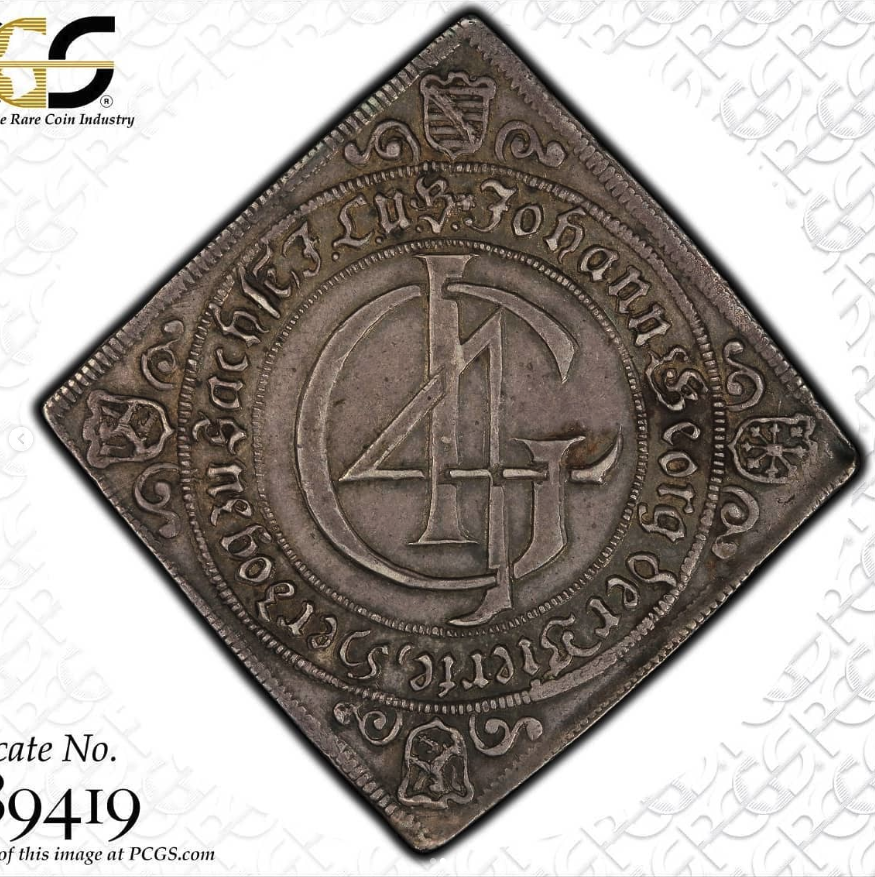
1669 AR Klippe Thaler (square / lozenge planchet)
Extremely rare klippe-format birth thaler struck in 1669 to commemorate the baptism of the infant Johann Georg IV, future Elector of Saxony, who would die at 25 in one of the most lurid sequences of marital violence and smallpox in early-modern German history. PCGS AU-50.
- Metal
- Silver
- Grade
- PCGS AU-50
- Cert #
- 28889419
Full attribution & era
The history behind the coin.
On 18 October 1668 a son was born to the heir-apparent of Saxony. His grandfather, Elector Johann Georg II, ordered the Dresden mint to strike a small commemorative issue marking the child's baptism in the form of a klippe - a thaler struck on a square planchet rotated to a lozenge, the traditional German format reserved for medallic and ceremonial coinage. The obverse shows the swaddled infant lying in a cradle, the Hand of God reaching down from a cloud with the Latin motto AB INCUNABULIS ("from the cradle"), framed by the German legend recording the baptismal blessing of the Saxon House. The reverse carries the child's crowned monogram and the date LXIX - 1669, the year of issue. The infant prince was named Johann Georg, the fourth of his name in the Wettin line.
What followed is among the most lurid stories in German princely history. Johann Georg IV succeeded his father as Elector on 12 September 1691, at the age of 22. His chief minister Hans Adam von Schöning - convinced that Saxony's future lay in a federation with Brandenburg-Prussia rather than continued subordination to the Habsburgs - persuaded the young Elector to withdraw all Saxon troops from the Imperial army during the war against Louis XIV. Holy Roman Emperor Leopold I responded by having Schöning kidnapped on Saxon soil and imprisoned at Spielberg fortress in Moravia. The young Elector, humiliated and outmaneuvered, never recovered diplomatic credibility.
His personal life was worse. Before his accession Johann Georg IV had fallen passionately in love with Magdalena Sibylla von Neidschütz, the beautiful mistress installed at the Saxon court - and unbeknownst to him, his own illegitimate half-sister, the natural daughter of his father Elector Johann Georg III. To break the relationship and force the production of legitimate heirs, his mother arranged his marriage in April 1692 to Princess Eleonore Erdmuthe of Saxe-Eisenach. Johann Georg openly defied the marriage. He installed Magdalena Sibylla at his side as the first formally acknowledged Maîtresse-en-titre of any German court, ennobled her as Reichsgräfin von Rochlitz, and confined his wife to the Hofe palace.
Determined to be free to marry Magdalena Sibylla, the Elector eventually attempted to murder his wife with a sword. His brother Friedrich August - the future August the Strong of Saxony and Poland - threw himself between them and caught the blade in his bare hand, suffering permanent injury but saving the Electress's life. The marriage was never consummated, and Eleonore Erdmuthe survived in fearful retirement.
Then, in spring 1694, Magdalena Sibylla contracted smallpox. The Elector refused to leave her bedside and shared her sickbed in defiance of every medical warning of the day. She died on 4 April 1694. Twenty-three days later, on 27 April 1694, Johann Georg IV - the swaddled infant on the obverse of this very coin - was dead of the same disease, aged 25. He was succeeded by the brother whose hand he had crippled: August the Strong.
The klippe of 1669 is consequently a rare and tragic object: the birth-coin of an Elector whose biography would become a byword in late-seventeenth-century Europe for scandal, uxoricide, and the lethal consequences of an obsessive love affair. Davenport records the type as 7632. Surviving examples are extremely scarce. Recent auction comparables: an XF-Details example brought $1,086 in Heritage in 2013; an AU-58 example brought $3,819 in Stack's Bowers the same year. The present example - PCGS AU-50, cert 28889419 - sits between them in grade and is among the finest known of the type.
- Davenport - German Talers 1500-1900, no. 7632 (Saxony klippe thaler 1669, birth/baptism of Johann Georg IV).
- Schnee - Die sächsischen Münzen des Hauses Wettin (Saxon coinage of the House of Wettin).
- PCGS Cert 28889419 - AU-50.
- Karl Czok - August der Starke und Kursachsen (background on Johann Georg IV's reign and his brother's succession).
- Heritage Auctions, 2013 - XF-Details example, $1,086 hammer.
- Stack's Bowers, 2013 - AU-58 example, $3,819 hammer.
- Hellmut Kretzschmar - Geschichte des sächsischen Hofes (the Magdalena Sibylla von Neidschütz affair and the attempted murder of the Electress).