
1581 Silver triangular victory medal
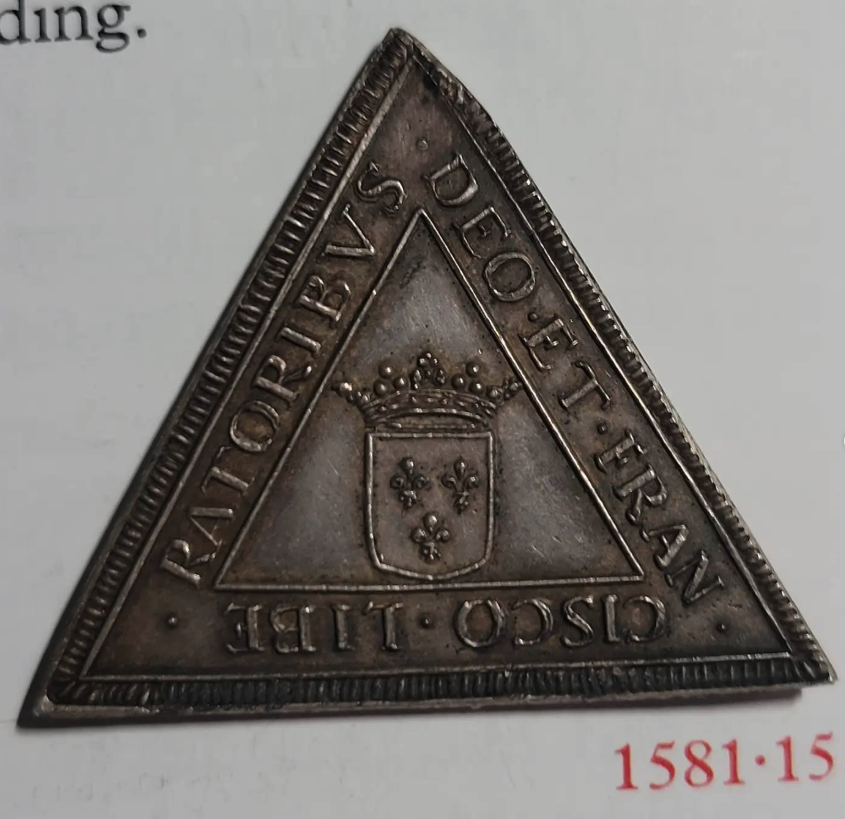
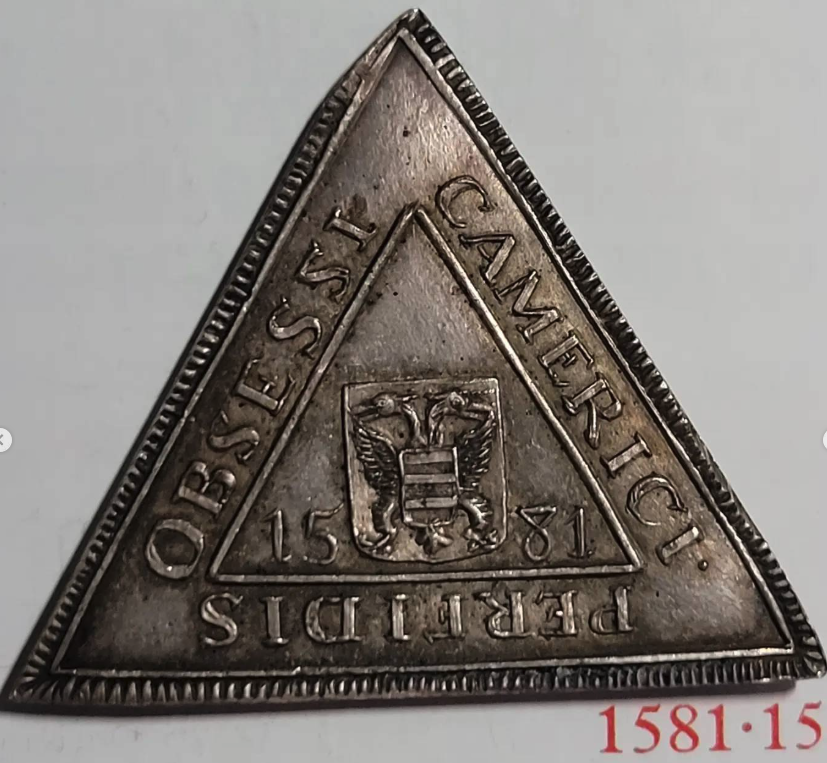
An extraordinarily rare triangular silver largesse medal physically thrown to the crowd of Cambrai on 18 August 1581 to celebrate the lifting of the Spanish siege. Pedigreed to Dr. Lawrence Korochnak (author of 'Siege Coins of the World 1453-1902') and accompanied by its original 1800s collector's tag. Comparable examples have made $12,000 at CNG and €5,000 at Künker.
- Metal
- Silver
- Grade
- Raw - Comes with original 19th-century collector's tag (1581·15)
Full attribution & era
The history behind the coin.
In the summer of 1581, while Alessandro Farnese, Duke of Parma, was leading the Spanish Army of Flanders against the rebellious United Provinces of the Netherlands, news reached him that the Kingdom of France - through its prince François, Duke of Anjou and Alençon, the youngest son of Henri II and Catherine de' Medici - had formally joined the war on the side of the Dutch rebels and had accepted sovereignty over the Low Countries. Acting fast, Parma turned his army around and marched on the city of Cambrai (Cambray) on the French-Spanish frontier - the most logical staging point for any French invasion of the Spanish Netherlands.
Parma laid siege to Cambrai in mid-1581 and, with characteristic skill, captured the entire surrounding countryside, isolating the city completely. The blockade was tight enough that food prices inside the walls collapsed into hyperinflation. Gerard van Loon, the great 18th-century historian of the medals of the Low Countries, records the prices that summer: 'the people were eating the meat of horses, dogs, cats, and rats; the price of a cow rose to 300 Guilders, a sheep 50 Guilders; for a pound of butter 24 Stuivers was paid, for an egg 2 Stuivers, and for an ounce of salt 8 Stuivers.' For context, the average peasant's wage at the time was about 6.5 Guilders per week, and 36 Stuivers made one Guilder. A pound of butter therefore cost roughly a tenth of a peasant's weekly income.
The city refused to surrender. Anjou was assembling a relief army of 10,000 infantry and 4,000 cavalry, and on 16 August 1581 he arrived in front of Parma's lines and offered open battle. Parma, recognizing that he was significantly outnumbered and that his troops were exhausted from the siegeworks, prudently broke camp and withdrew rather than risk destruction in the field. The siege of Cambrai was lifted without a single great battle.
Anjou entered Cambrai the next day, 17 August, to a hero's welcome. He swore solemn oaths in both the Cathedral and the Hôtel de Ville to uphold the ancient liberties and rights of the citizens of Cambrai. It is on this latter occasion in the Hôtel de Ville, according to van Loon, that 'after a fanfare of trumpets, a good number of gold and silver triangular medals were thrown amongst the crowd.' These were the medals that became known to numismatists as the Cambrai Largesse Medals - distributed by being physically tossed into the assembled citizenry as the formal act of largesse marking the city's deliverance. Robert (Cambrai 1-7) catalogues seven distinct types, some struck only in silver, some only in gold, and others in both metals.
This piece is one of those silver triangular medals, the second of seven types catalogued by Robert. The obverse, within a triangular beaded border, carries the crowned arms of the City of Cambrai (the three fleurs-de-lis on a shield) with the legend DEO ET FRAN[CISCO] LIBERATORIBUS - 'To God and François the Liberators' (François being François, Duke of Anjou). The reverse, in a similar triangular frame, shows the imperial double-headed eagle and the city's shield with the date 15-81 split across the field, the legend OBSESSI · CAMERICI · PER · IDIS - 'Cambrai Besieged Until It Was Restored.'
These medals are extraordinarily rare survivors. Most of those thrown to the crowd in 1581 were simply spent, melted, or lost. Classical Numismatic Group sold a 'Choice EF, toned, with die breaks on obverse and reverse' example for $12,000 with buyer's premium in their Auction 108, Lot 1049, on 16 May 2018. Künker's Fall Auction 351-354, Lot 6065 carried a comparable piece with an estimate of €5,000 hammer (plus 23.5% buyer's premium). This particular piece comes from one of the great pedigrees in siege numismatics: it is ex Dr. Lawrence Korochnak, author of the standard reference 'Siege Coins of the World 1453-1902,' and is accompanied by its original 19th-century collector's tag (inventory number '1581·15') - a paper artifact in its own right that documents two centuries of careful private custody.
References: van Loon I p. 295; Tongerlo 110, pl. XXXVI 2; cf. Erbstein 6842; Robert, Cambrai 3.
- van Loon, Gerard - Beschryving der Nederlandsche Historipenningen, Vol. I, p. 295.
- Tongerlo - 110, pl. XXXVI, 2.
- Erbstein - cf. 6842.
- Robert - Cambrai 3 (the standard catalogue of the seven Cambrai largesse types).
- Korochnak, Lawrence - Siege Coins of the World 1453-1902.
- CNG Auction 108, Lot 1049 (16 May 2018) - comparable, sold $12,000 w/ BP.
- Künker Fall Auction 351-354, Lot 6065 - comparable, est. €5,000 + 23.5%.
- Ex Dr. Lawrence Korochnak Collection · with original 19th-century collector's tag.