
1622 Pfaffenfeindtaler
Struck from the melted Holy Libori Shrine after Christian 'the Mad' looted Paderborn to pay his mercenaries - one of the most inflammatory anti-Catholic thalers ever issued.
- Metal
- Silver
Full attribution & era
The history behind the coin.
The Thirty Years' War was one of the bloodiest conflicts in European history. It began when the Catholic Habsburg Emperor Ferdinand II attempted to force the Protestant Kingdom of Bohemia back into Catholic conformity. The Bohemian nobles responded with the Second Defenestration of Prague, hurling the imperial representatives from a castle window and setting off a vast European war that, over its successive phases, drew in Austria, Spain, Bavaria, Savoy, and the Catholic League against Bohemia, the Palatinate, Denmark, the Dutch Republic, Sweden, and eventually France.
During the first two phases of the struggle - the Bohemian and Danish phases - the Protestant cause was fiercely supported by Duke Christian of Brunswick-Wolfenbüttel, better known as "Christian the Mad." To keep his mercenary army in the field, Christian turned to plunder. After capturing Paderborn in 1622, he looted the Catholic church treasures there, most famously melting down the great silver Holy Libori Shrine to create coinage for troop payment.
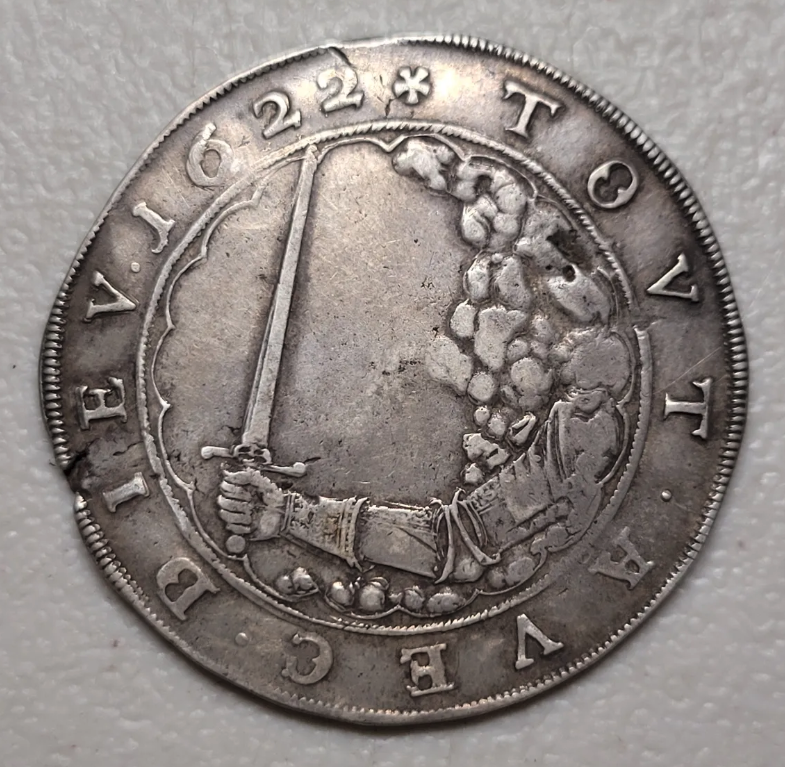
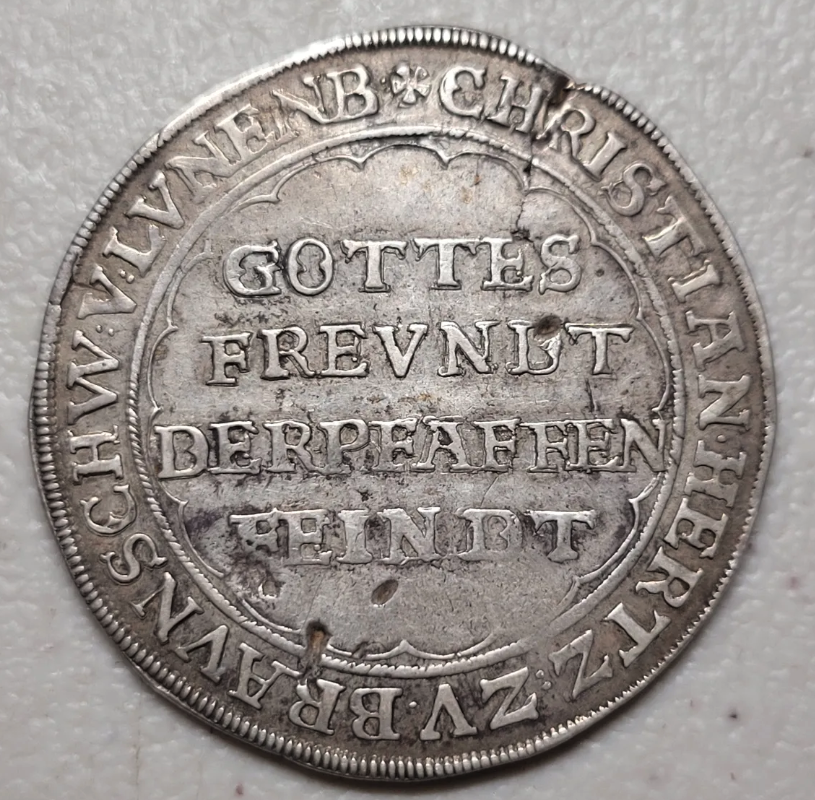
Those emergency war coins became the Pfaffenfeindtaler - the "Priest-Enemy Thaler," often paraphrased as the "Enemy of the Pope" thaler. The obverse shows Christian's right arm emerging from the clouds and brandishing a sword, surrounded by the French legend TOVT AVEC DIEV ("All with God") and the date 1622. The reverse bears the slogan GOTTES FREVNDT DER PFAFFEN FEINDT - "Friend of God, Enemy of the Priests" - a message deliberately crafted to insult and provoke the Catholic world.
The type caused outrage immediately, and contemporaries saw dark irony in what followed: later in 1622, at the Battle of Fleurus, Christian lost the very arm celebrated on the coin. Catholics regarded the mutilation as divine punishment. After the Peace of Westphalia in 1648 finally ended the war, Catholics reportedly melted down every Pfaffenfeindtaler they could recover and used the reclaimed silver to help recreate the Holy Libori Shrine that Christian had destroyed.
That history is why survivors are so compelling. This coin is not merely a thaler of wartime necessity - it is a surviving manifesto in silver from one of the most viciously confessional wars in European history.
- Davenport, John S. - German Talers 1600–1700 (Dav-6303 / Welter-1037).
- Whaley, Joachim - Germany and the Holy Roman Empire, Vol. 1.
- Künker and other auction references for Christian of Brunswick and the Paderborn 'Pfaffenfeindtaler' issues.