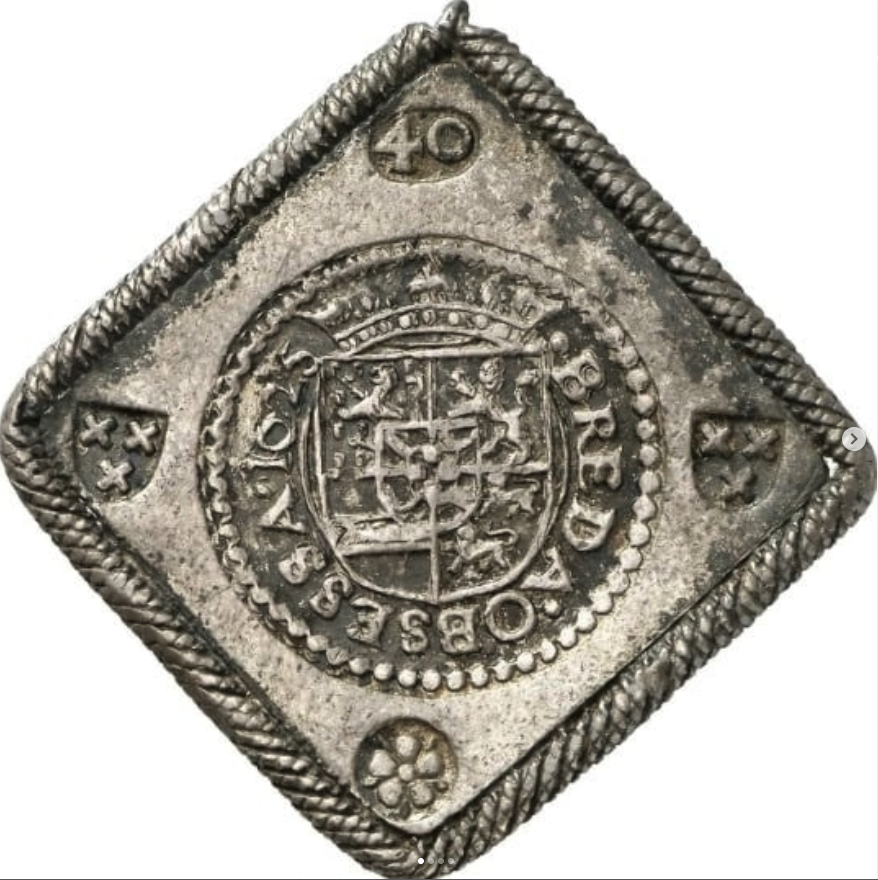
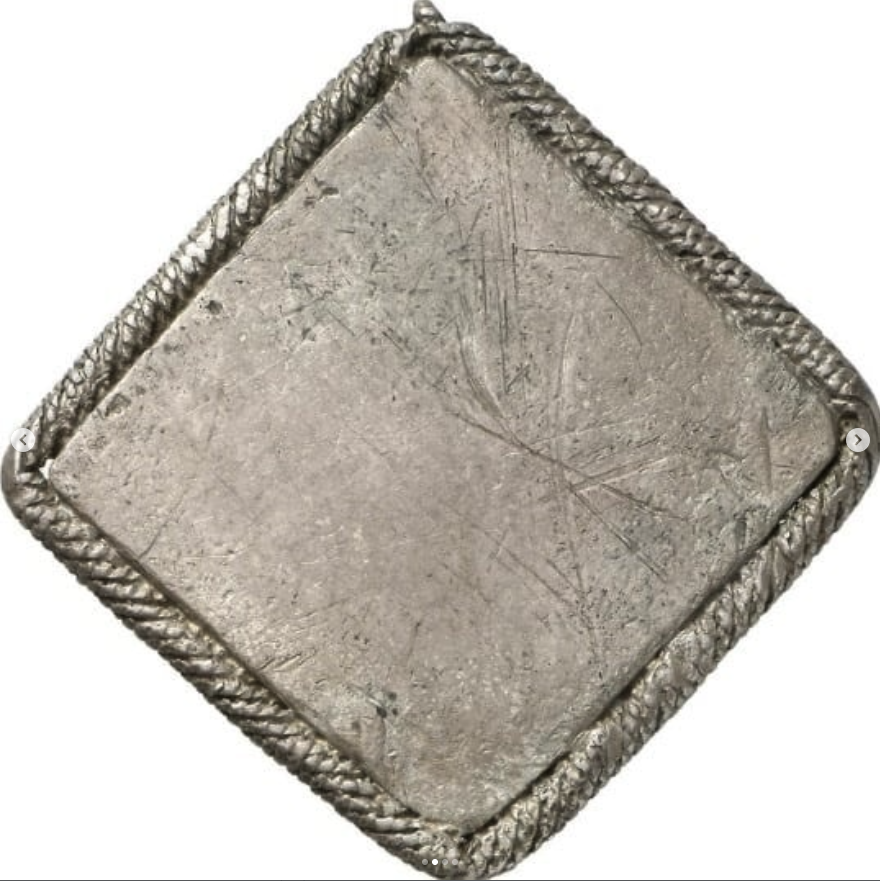
1625 40 Stuivers (lozenge-shaped siege piece struck from confiscated church silver)
A klippe siege piece struck from melted church plate inside starving Breda, captured by Spanish soldiers at the surrender and mounted in a contemporary bezel as a battlefield trophy. Pedigreed to the Archer Huntington Collection (no. 9356) and Dr. Lawrence Korochnak.
- Metal
- Silver
- Grade
- Raw - Mounted in contemporary 17th-century silver bezel
Full attribution & era
The history behind the coin.
On 27 August 1624 the Spanish general Ambrogio Spinola - the most respected commander of his generation - laid siege to the Dutch town of Breda as part of the renewed Eighty Years' War for Dutch Independence. With 24,500 Spanish soldiers Spinola encircled Maurice of Nassau, Prince of Orange and de facto ruler of the Dutch Republic, along with a garrison of roughly 7,000 defenders inside the walls.
From the first weeks the Spanish intercepted nearly every smuggling convoy. The defenders began to starve, and the price of what little food remained inside the town climbed past anything ordinary coin could pay. To remedy the sudden shortage of currency, Maurice of Nassau authorized the seizure of the gold and silver plate of the city's churches, melted it down, and had it hammered into emergency siege coin to pay the garrison.
Desperate, the Dutch defenders opened the surrounding dikes and tried to flood the besiegers out. The flooding bred plague and fevers in the marshes around Breda, and the Spanish camp suffered terribly - but Maurice of Nassau himself fell sick from the same diseases and died on 23 April 1625, in the middle of the siege he was trying to relieve. By July 1625 a Dutch relief army of 5,000 was defeated in the field, and the starving, plague-ridden garrison surrendered with full honors of war on 5 June 1625. Spinola famously refused to allow his troops to humiliate the defeated Dutch commander Justin of Nassau as he handed over the keys to the city - the moment immortalized a few years later by Diego Velázquez in 'La rendición de Breda' ('Las Lanzas') in the Prado.
As was customary with siege coinage struck during an unsuccessful defense, the entire issue of Breda's silver klippe pieces was confiscated by the Spanish at the surrender and used to pay their own soldiers. Many - like this example - were mounted in contemporary bezels and worn by Spanish veterans as war trophies, physical proof that they had taken Breda. The diamond-shaped flan, struck from confiscated church silver, carries the crowned arms of Breda flanked by the date 1645… (in fact 1625, with the date in the legend), the value 40 above, and the legend BREDA · OBSESSA ("Breda besieged") around the central shield, with rosette ornaments at the corners and four-cross stops. The silver bezel that surrounds it - twisted-rope border with a soldered suspension loop at the top corner - is the original 17th-century mount put on by the Spanish soldier who carried it home from Flanders.
The pedigree on this piece is exceptional. It traces to the Archer M. Huntington Collection, no. 9356. Archer Huntington (1870-1955) was the philanthropist son of railroad magnate Collis P. Huntington and one of the greatest collectors of Spanish, European, and Latin American coins ever assembled. His collection, often described as one of the most significant in private hands, was donated to the American Numismatic Society and the Hispanic Society of America. After a long legal battle ending in 2012, the bulk of the cabinet was deaccessioned through Sotheby's in headline-grabbing sales. This particular Breda piece, for reasons that remain unclear, was instead consigned quietly to Numismatica Genevensis SA in Geneva, where it received little attention and sold for well under its true value. It was acquired there by Dr. Lawrence Korochnak - author of the standard reference 'Siege Coins of the World 1453-1902' - and we acquired it directly from him.
- Korochnak, Lawrence - Siege Coins of the World 1453-1902 (Breda 1625).
- Mailliet, Pierre - Catalogue descriptif des monnaies obsidionales et de nécessité.
- Israel, Jonathan - The Dutch Republic: Its Rise, Greatness, and Fall, 1477-1806.
- Parker, Geoffrey - The Army of Flanders and the Spanish Road, 1567-1659.
- Ex Archer M. Huntington Collection, no. 9356 (Hispanic Society of America / Numismatica Genevensis SA).
- Ex Dr. Lawrence Korochnak Collection.