
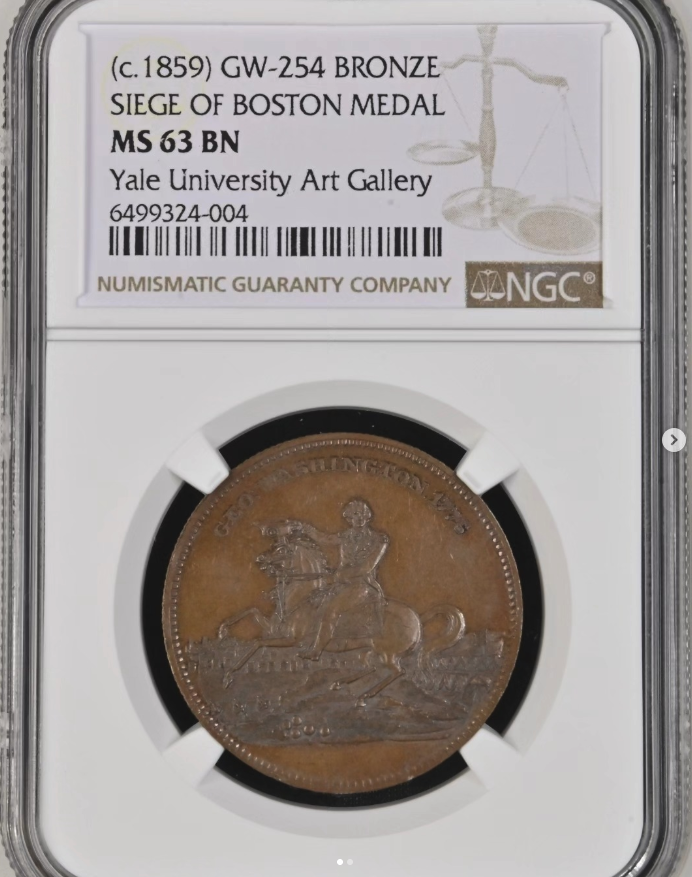
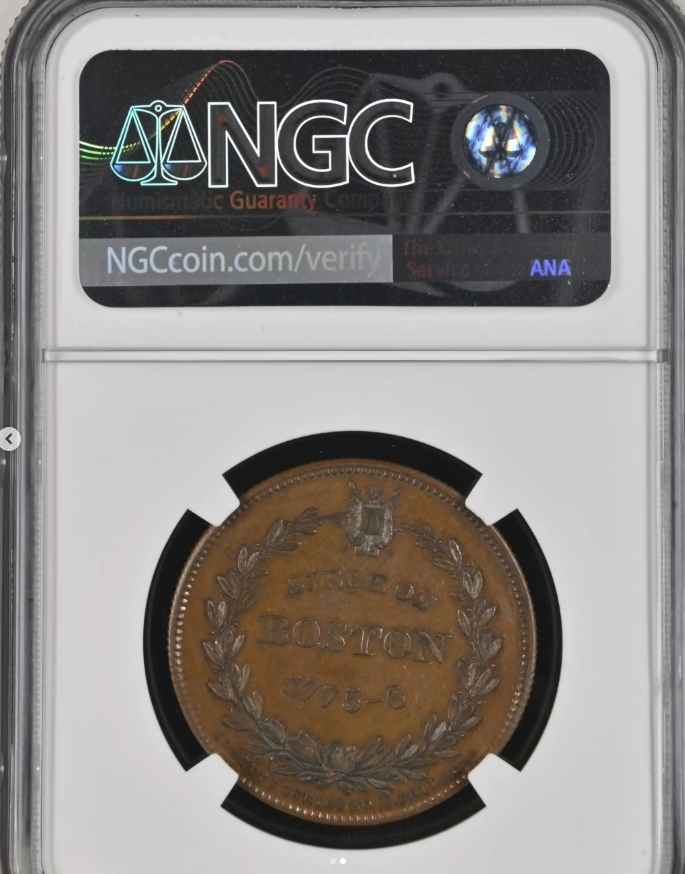
c. 1859 Siege of Boston Medal (GW-254, Bronze)
A Yale-pedigreed Washingtoniana medal commemorating the Siege of Boston (1775-1776), Washington's first great victory as Commander-in-Chief of the Continental Army.
- Metal
- Bronze
- Grade
- NGC MS-63 BN
- Cert #
- 6499324-004
- Pedigree
- Ex. Yale University Art Gallery
Full attribution & era
The history behind the coin.
The Siege of Boston began on 19 April 1775, the day after the Battles of Lexington and Concord, when the assembled Massachusetts militias blocked the only land route into Boston and bottled up the British garrison inside the town. The Continental Congress soon formalized those militias as the new Continental Army and appointed George Washington as Commander-in-Chief - and so the siege of Boston became, in effect, the first campaign of the Continental Army under Washington's personal command.
In June 1775 the British attacked the high ground north of the town, where the Americans were preparing to plant batteries. They took Bunker and Breed's Hills, but their casualties were so heavy that the tactical victory failed to break the American grip on land access to Boston. After Bunker Hill the campaign settled into a true siege - no large battles, only raids, skirmishes, and sniper fire across the lines, while the British in Boston suffered an increasingly serious shortage of food and supplies as smaller but more agile American forces harassed their seaborne and overland resupply.
In November 1775 Washington sent the young bookseller-turned-artilleryman Henry Knox on his famous "noble train of artillery" mission to drag the heavy guns recently captured at Fort Ticonderoga overland through the snows of New York and Massachusetts to Boston. By January 1776 Knox had delivered the cannon, and on the night of 4-5 March 1776 Washington's troops fortified Dorchester Heights, the high ground overlooking Boston Harbor. The position threatened to cut off the British seaborne lifeline entirely. Recognizing his position as indefensible, British General William Howe negotiated an unopposed evacuation and on 17 March 1776 withdrew his army by sea to Halifax, Nova Scotia. Boston was free, and Washington's reputation as a strategic commander was made.
This bronze medal, catalogued as GW-254 (Baker-50), is a 19th-century Washingtoniana commemorative struck circa 1859, the great age of American medallic patriotism. The obverse depicts George Washington on horseback, sword raised, charging across a battlefield with American troops behind him and the encircling legend GEO. WASHINGTON 1775. The reverse carries the inscription SIEGE OF BOSTON 1775-6 within a laurel wreath, surmounted by an eagle and shield - the standard 19th-century medallic vocabulary of American victory.
NGC MS-63 BN is a strong Mint State grade, with rich brown surfaces and the well-preserved fields and devices typical of an example carefully kept in an institutional cabinet. The Yale University Art Gallery pedigree gives the piece an additional layer of academic provenance - the Yale collection holds one of the great American historical medal cabinets in the country.
- Baker - Medallic Portraits of Washington (Baker-50 / GW-254).
- Rulau & Fuld - Medallic Portraits of Washington (2nd ed.).
- Yale University Art Gallery - Numismatic Collection.
- NGC Cert #6499324-004.