
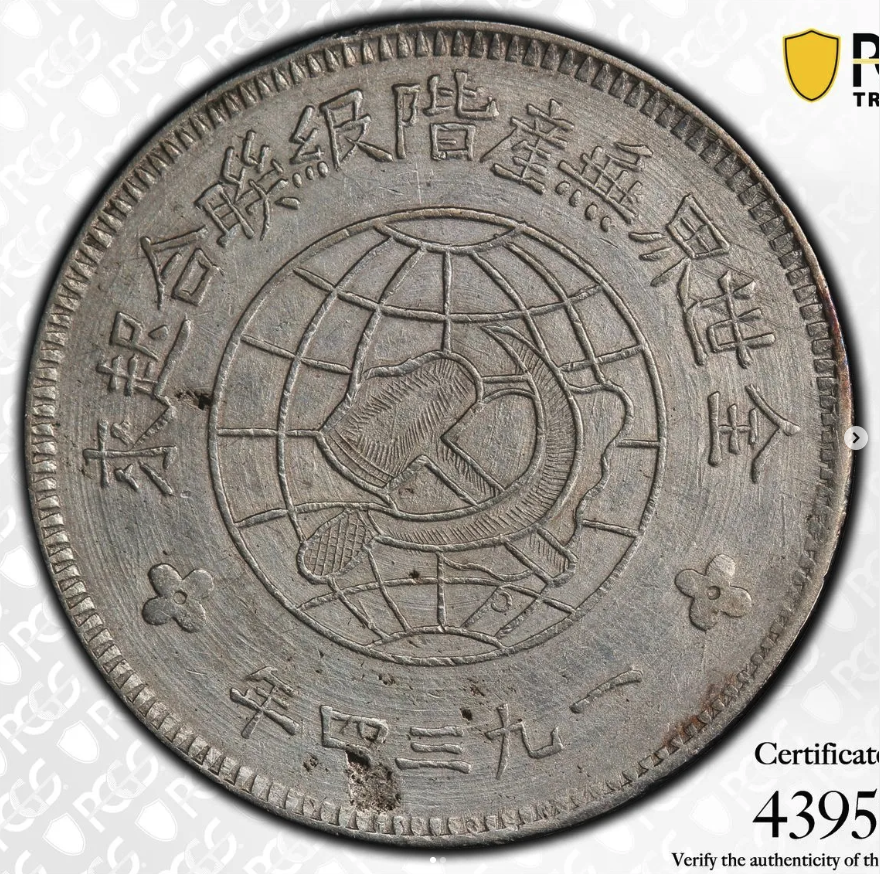
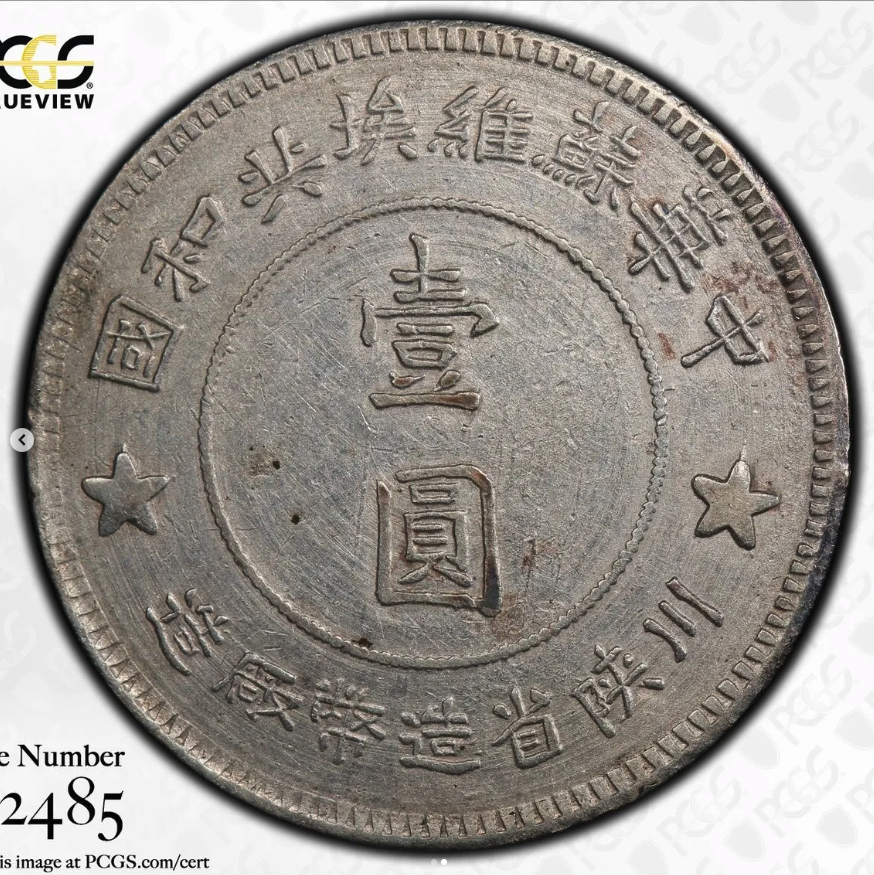
1934 Silver Dollar
A propaganda dollar struck in hand-cut dies by the Red Army during the Long March - banned on pain of death by the KMT, sold for $33,600 at Stack's Bowers Hong Kong.
- Metal
- Silver
- Mint
- Red Army Mint, Wangcang (Sichuan)
- Grade
- PCGS AU (Spot Removed)
- Cert #
- 43952485
Full attribution & era
The history behind the coin.
Between 1930 and 1934, Chiang Kai-shek and the Kuomintang launched five "Encirclement Campaigns" against the Chinese Communists in the First Chinese Civil War, in an attempt to destroy them outright. The Communists fought off the first four with classical guerrilla warfare, but in the fifth Chiang mustered 700,000 troops, built a ring of blockhouses, and slowly closed the noose around the Jiangxi Soviet.
The Chinese Communist Central Committee made the catastrophic decision to abandon guerrilla strategy and meet the Nationalists in regular positional warfare. The Red Army was nearly annihilated. In October 1934 the surviving 86,000 troops broke through the Nationalist lines at the Jiangxi-Fujian border and fled westward - the beginning of the Long March.
The first three months were a disaster. Constantly bombed by Chiang's air force and harried on the ground, the Red Army lost more than 75% of its men. By the time the survivors reached northern Shaanxi in October 1935 only about 8,000 of the original 86,000 remained - the rest killed in battle, lost to disease, or starved on the march. They linked up with a local Red Army contingent of 7,000 in Shaanxi and remained there throughout the Sino-Japanese War (1937-45).
It was during this Long March, in the brief Szechuan-Shaanxi Soviet base area, that this dollar was struck. The Red Army Mint at Wangcang produced these coins in 1934 from hand-cut dies, in tiny quantities, with crude planchets - they were as much an instrument of propaganda as of payment. The obverse carries 中華蘇維埃共和國 ("Chinese Soviet Republic"), 壹圓 ("One Dollar"), and the mint legend 川陝省造幣廠 ("Mint of Sichuan-Shaanxi Province"); the reverse shows the hammer and sickle laid across a globe, surrounded by 全世界無產階級聯合起來 - "Proletariats of the World, Unite!"
The KMT, predictably, banned the coins on pain of death; carrying one was a capital offense. After the Communist victory in the Second Chinese Civil War in 1949 these dollars - relics of the Party's lowest ebb - became powerful nostalgia objects. Surviving examples are extremely scarce, and demand from mainland Chinese collectors with disposable income has driven prices sharply higher. This PCGS AU example (Spot Removed) sold for $33,600 at Stack's Bowers Hong Kong.
- Krause-Mishler - Standard Catalog of World Coins (KM Y-513.4 / Kann-803).
- L&M (Lin & Ma) - Illustrated Catalog of Chinese Gold and Silver Coins.
- Stack's Bowers Hong Kong auction - realized $33,600.
- Salisbury, Harrison E. - The Long March: The Untold Story.
- PCGS Cert #43952485.