
c. 1528 Religious Thaler
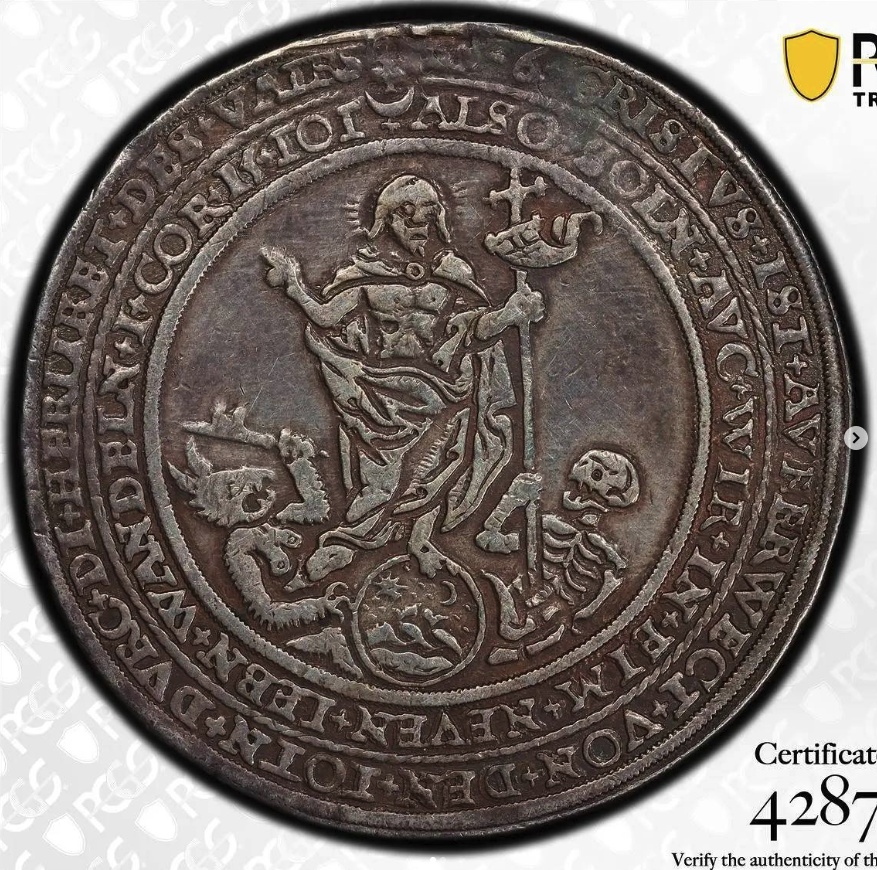
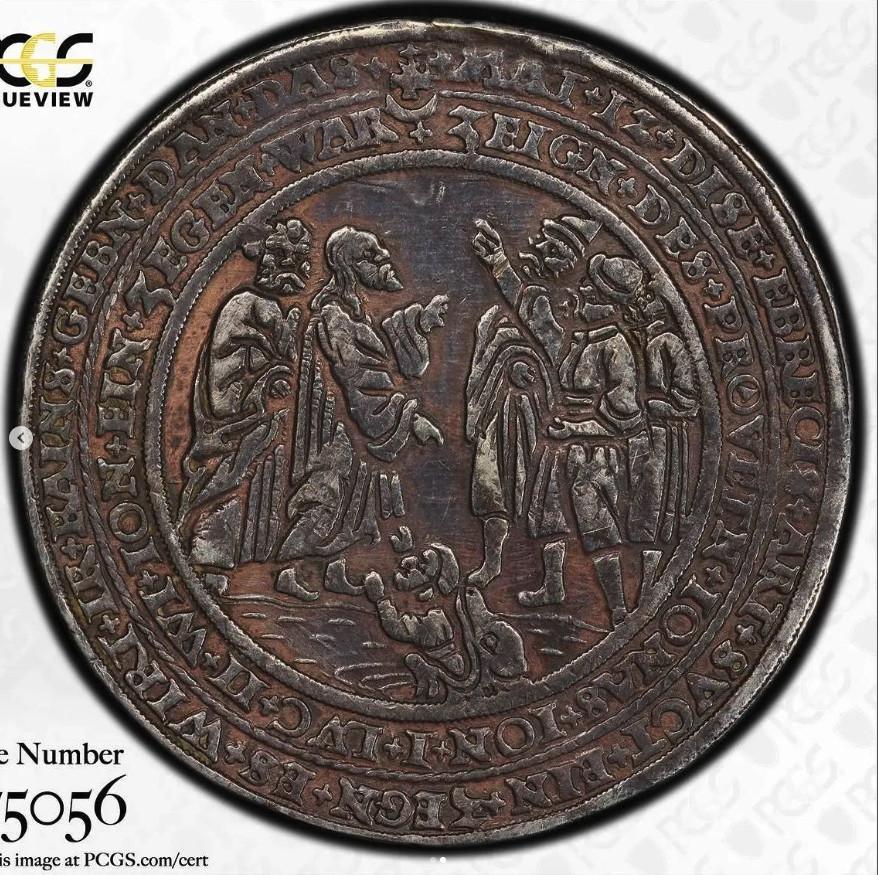
An early Joachimsthaler-style religious medallic Thaler from the Bohemian valley whose silver gave the world the word 'Dollar' - Christ trampling Death and the Devil on the obverse, the typological prefiguration of the Resurrection (Jonah cast into the sea) on the reverse.
- Metal
- Silver
- Grade
- PCGS XF Details - Tooled
- Cert #
- 42875056
Full attribution & era
The history behind the coin.
In 1516 Count Stephan Schlick of Bohemia discovered an extraordinarily rich vein of silver in a wooded valley on the Erzgebirge frontier between Bohemia and Saxony. The town that exploded out of the forest around the strike was named Sankt Joachimsthal (today Jáchymov in the Czech Republic) - 'St. Joachim's Valley.' The Counts Schlick obtained an imperial mint privilege from the Bohemian Diet in 1520 and began striking large silver coins of roughly 29 grams from their own ore. Within a generation the coins were so widely circulated and so trusted that the world simply called them 'Joachimsthaler' - shortened in everyday speech to 'Thaler.' That name traveled with the coin: through German into Dutch as 'daalder,' into Scandinavian 'daler,' and into English as 'dollar.' Every U.S. dollar in circulation today is, etymologically, a coin from this Bohemian silver valley.
The Joachimsthal mint also produced from the late 1520s onward a remarkable series of large religious medallic Thalers - oversized devotional pieces struck with biblical scenes on both sides, intended for presentation, gifting at weddings and christenings, and quiet personal devotion in the heated theological climate of the early Reformation (Luther had nailed his 95 Theses just nine years before this coin was struck, and Bohemia was already a hundred years post-Hussite). They are some of the most ambitious figural die-cutting of the entire 16th century.
The obverse of this piece shows the Resurrection of Christ in its theologically full Lutheran form: Christ risen from the tomb, holding the cross-staff with the resurrection banner, raising his right hand in blessing - and beneath his feet, ground into the dust, are the three traditional enemies he has just defeated. To the left, a roaring lion (sin); to the right, a grinning skeleton (death); under the orb of the world, a coiling serpent or dragon (Satan). The legend wrapping the rim quotes 1 Corinthians 15 - 'O Death, where is thy sting? O grave, where is thy victory?' - the great Pauline meditation on Christ as the firstfruits of those who have fallen asleep. This is the picture of John 11:25-26 made into silver: 'I am the resurrection and the life. He that believeth in me, though he were dead, yet shall he live.'
The reverse picks up the Old Testament typological prefiguration of the Resurrection - the story of Jonah, which Christ himself cited in Matthew 12:39-41 as the sign that pointed forward to his three days in the tomb. Jonah, called by God to preach repentance to Nineveh, fled instead by ship. God raised a great storm; the sailors, recognizing that Jonah's disobedience had caused it, cast him overboard. He was swallowed by a great fish, lay three days and three nights in its belly in prayer, and was vomited up alive on dry land. The reverse die shows the moment of being cast over the side: Jonah being lowered from the ship by the sailors, the great fish opening its jaws to receive him in the waves below, the legend quoting the German biblical text. The pairing is deliberate Lutheran typology - Jonah's three days in the fish are the type, Christ's three days in the tomb are the antitype.
PCGS graded this 'XF Details - Tooled,' meaning the engraver of the holder noted that an old hand at some point in its life worked on the surfaces with a tool to sharpen the imagery - a common 18th- or 19th-century practice on devotional pieces of this size to bring back the faces and the lettering. The underlying coin is a beautiful, sharply detailed example of one of the most theologically rich and historically important coin types of the entire Reformation - struck in the same valley, possibly from the same vein of silver, that gave the modern world its most-spoken word for money: the dollar.
- Doneberg, Donebauer & Donebauer-Slg. - Münzen der Grafen Schlick.
- Davenport, John S. - German Talers 1500-1600.
- MacKay, Pierre - 'Joachimsthaler and the Origin of the Dollar' (ANS).
- Whaley, Joachim - Germany and the Holy Roman Empire, Vol. I.
- PCGS Cert #42875056.