1668-1701 8 Reales cob (26.67g)
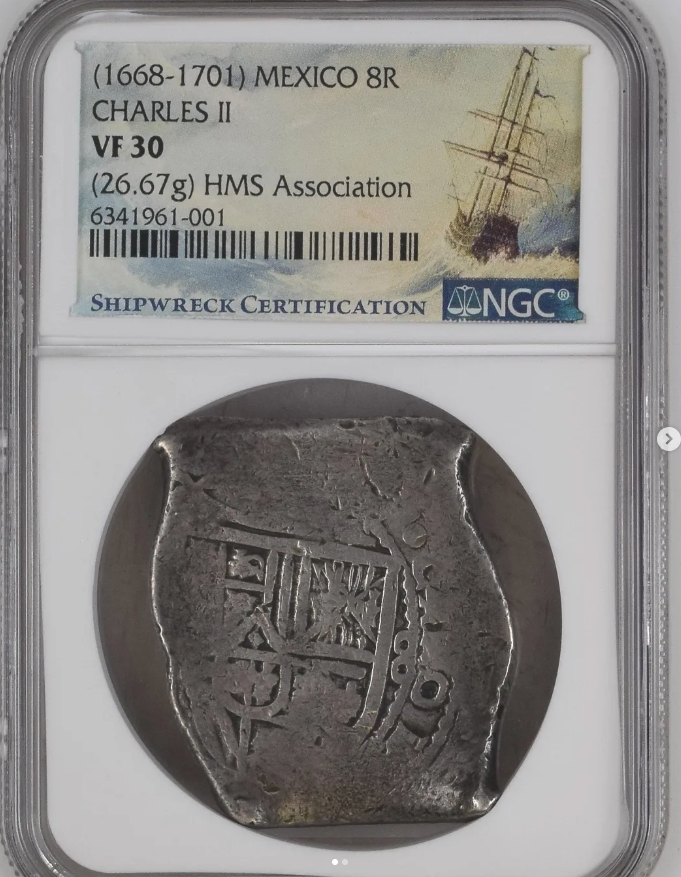
Mexico City 8-reales cob of Charles II of Spain, recovered from the wreck of HMS Association - the Royal Navy flagship lost with Admiral Sir Cloudesley Shovell and her entire crew of 800 in the Scilly Naval Disaster of 1707.
- Metal
- Silver
- Grade
- NGC VF 30 · Shipwreck Certification - HMS Association (1707)
- Cert #
- 6341961-001
Full attribution & era
The history behind the coin.
On the night of 22 October 1707, returning home to Portsmouth from the Toulon campaign of the War of the Spanish Succession, the Royal Navy second-rate ship-of-the-line HMS Association - flagship of the British Mediterranean Fleet under Rear-Admiral of the White Sir Cloudesley Shovell, captained by Edmund Loades - struck the Outer Gilstone Rock off the Isles of Scilly at about 8 P.M. and sank in three or four minutes with the loss of her entire complement of approximately 800 men. The watch on HMS St George saw her go down. In the same fog and the same navigational error three more ships of the squadron were lost the same night - HMS Eagle, HMS Romney, and the fireship HMS Firebrand - bringing the total death toll to roughly 1,400-2,000 sailors. The "Scilly Naval Disaster" of 1707 remains one of the worst single-night maritime catastrophes in British history.
The cause was a combination of bad weather and, more damningly, the crude state of contemporary navigation: the squadron simply did not know where it was. Longitude could not yet be determined reliably at sea. The disaster directly motivated the British Longitude Act of 1714, which offered the prize money that would eventually fund John Harrison's marine chronometers and revolutionise oceanic navigation.
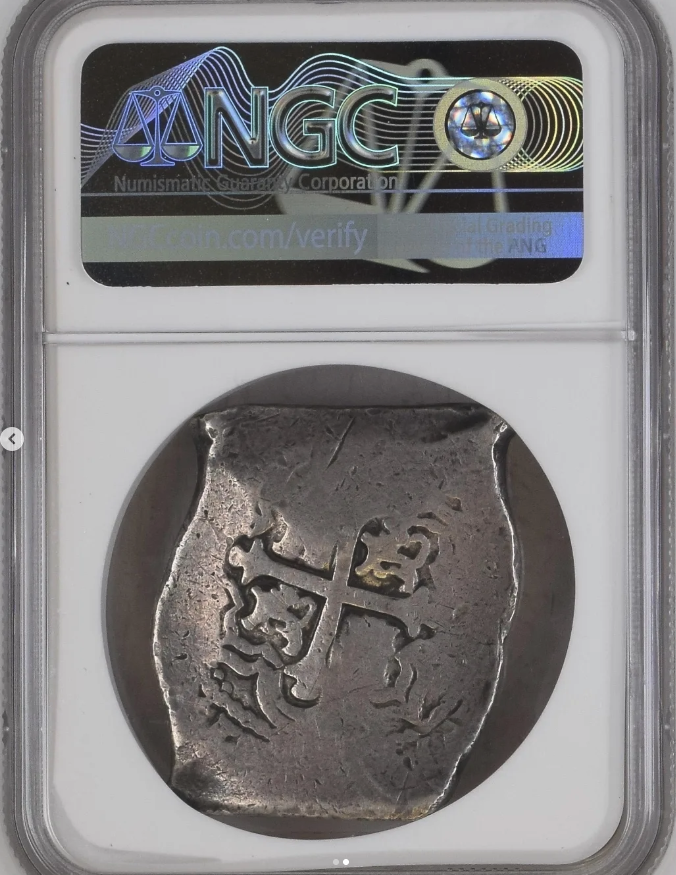
The wreck of the Association was rediscovered in 1967 by a Royal Navy diving team, and over the following years substantial portions of her cargo and pay-chest were recovered - including a quantity of Spanish colonial silver-cob 8 reales of Charles II of Spain ("El Hechizado," the Bewitched, 1665-1700), the same coins that funded the Mediterranean fleet via Spanish, Portuguese, and Mediterranean prize-money channels. This is one of those coins: a heavy 26.67-gram Mexico City 8-reales cob of Charles II, the obverse showing the typical pillars-and-tressure shield design of the period and the reverse the Habsburg crowned shield with the Castilian-Leonese quarters - both struck on the irregular, hand-cut "cob" planchet of the Mexico mint.
NGC has graded it VF 30 with the special "Shipwreck Certification - HMS Association (1707)" pedigree designation on the holder. The shield, the cross, and most of the legend are clearly readable on a heavy original silver flan with the soft grey patina and very slight surface granularity that authentic, conservatively conserved Association cobs carry. As a single physical object it is an artefact of two separate events at once: the regular flow of New World silver to Spain at the end of the 17th century, and the worst night the Royal Navy ever had off its own coast.
- KM-37, Calicó - Mexico 8 reales cob, Charles II, Mexico City mint, c. 1668-1701.
- Sotheby's / various - HMS Association salvage catalogues (1969 onwards) on the recovered Spanish silver.
- Cordingly, D. - Cochrane the Dauntless / general references on the Scilly Naval Disaster of 1707.
- Sobel, D. - Longitude - on the navigational background and the consequences of the Association loss.
- NGC Cert 6341961-001 - VF 30, Shipwreck Certification - HMS Association (1707).