
1709 8 Escudos Cob
A Lima cob 8 escudos of Philip V recovered from the 1715 Plate Fleet - one of the great Spanish treasure-fleet disasters and the wrecks that gave Florida's 'Treasure Coast' its name.
- Metal
- Gold
- Mint
- Lima (assayer M)
- Pedigree
- Ex. Daniel Frank Sedwick Treasure Auction 6, Lot 22 (Oct. 15-16, 2009) · Recovered from the 1715 Plate Fleet
Full attribution & era
The history behind the coin.
The Spanish 1715 Plate Fleet disaster was probably the greatest catastrophe ever to befall a Spanish treasure fleet, in terms of both casualties and lost wealth - reports speak of 14 million pesos lost (plus an equal or greater amount in contraband) and as many as 1,000 lives. In the classic Spanish pattern, it was a case of overloaded galleons departing too late and meeting a hurricane - but on a scale beyond anything that had come before.
The principal element of the convoy, the Nueva España (New Spain) Fleet, had gone to Veracruz to deliver mercury - essential for refining silver - to sell merchandise, and to load Mexican-minted bars and cobs. A series of complications kept the fleet in Veracruz for two full years before it could finally rendezvous in Havana with the ships of the Tierra Firme (Mainland) Fleet, which carried the Peruvian and Colombian treasure brought up from Panama and Cartagena. After still more delay in Havana, the combined twelve-ship convoy did not depart for Spain until 24 July 1715 - well into hurricane season.
The route home was supposed to be the routine one: up the Florida coast on the Gulf Stream, which gradually bends outward and across the Atlantic at about the latitude where the fleet was lost. On 30 July 1715, the convoy was overtaken by a hurricane and driven shoreward off the east coast of Florida. Some galleons sank in deep water, others broke up in the shallows, and others ran aground close to the beach. Hundreds of crew and passengers drowned; hundreds more improvised a survivors' camp on shore and sent a party north overland to St. Augustine for help. When word of the disaster eventually reached Havana, salvage ships were dispatched to the wrecks - and Spanish, English, and pirate salvors have been working the site, on and off, ever since. The stretch of beach from Sebastian Inlet to Fort Pierce is known to this day as Florida's "Treasure Coast" because of these wrecks.
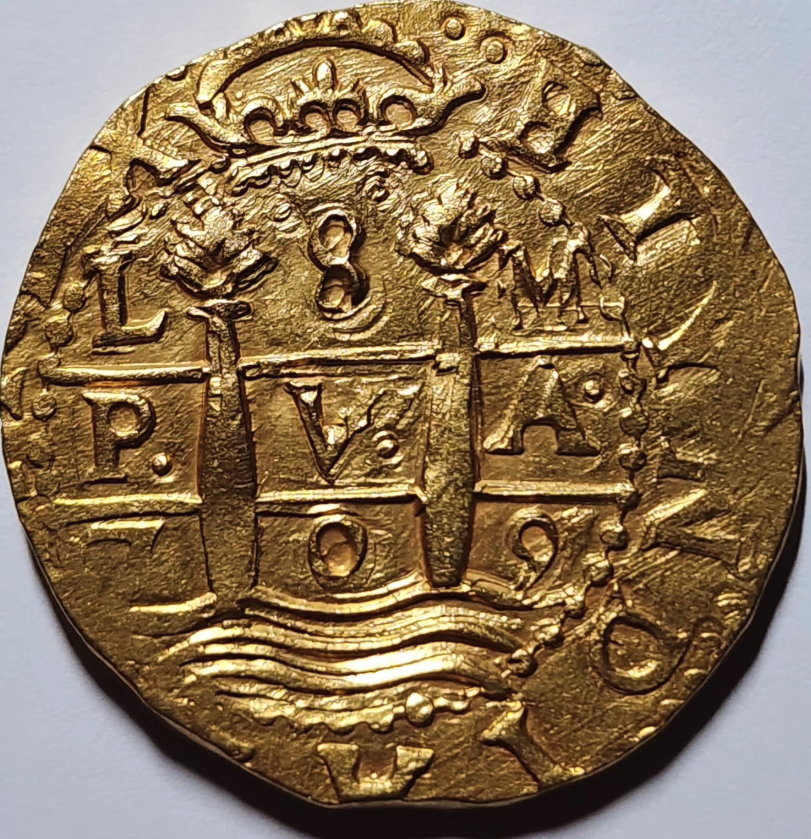
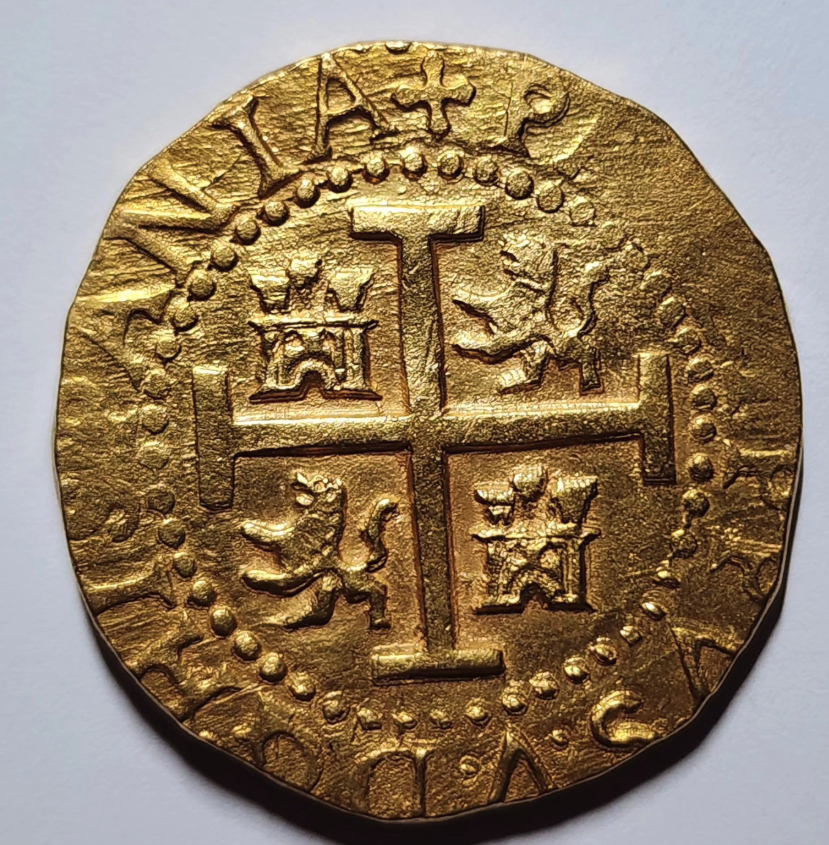
This coin is a Lima cob 8 escudos dated 1709, assayer M, struck under King Philip V of Spain - exactly the kind of South American gold loaded at Cartagena and Havana for the doomed return voyage. The obverse shows the crowned Pillars-and-Waves design characteristic of Lima gold cobs of this period: a stylized representation of the Pillars of Hercules rising from the sea, with the assayer's letter M, the denomination 8, the date 09 between the pillar bases, and the mintmark L (Lima) flanking the design. The reverse carries the Jerusalem Cross dividing the field into quadrants of castles and lions for Castile and León.
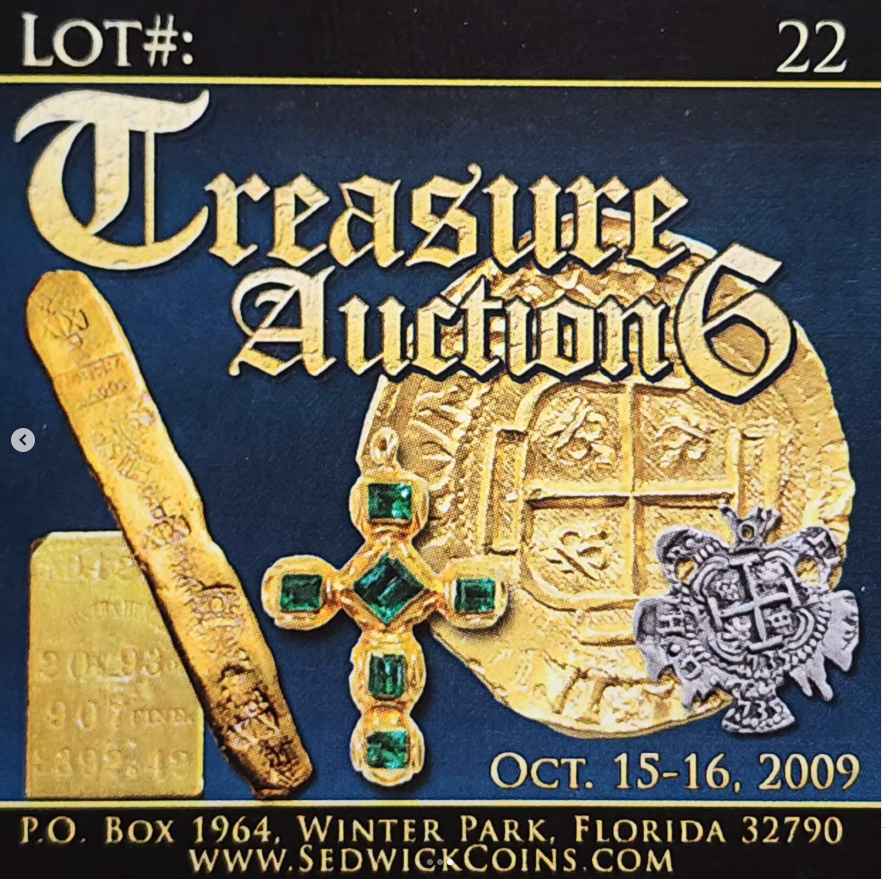
After more than three centuries on the seabed, this 8 escudos shows the soft golden surfaces and natural strike weakness typical of cob coinage, with strong central detail and the characteristic irregular cob flan. It was sold in Daniel Frank Sedwick's Treasure Auction 6 (15-16 October 2009) as Lot 22 - the auction-catalog plate is preserved here as the third image, documenting its formal appearance on the modern shipwreck-coin market.
- Daniel Frank Sedwick, LLC - Treasure Auction 6, Lot 22 (Oct. 15-16, 2009).
- Sedwick - The Practical Book of Cobs (4th ed.).
- Burgess & Clausen - Florida's Golden Galleons: The Search for the 1715 Spanish Treasure Fleet.