
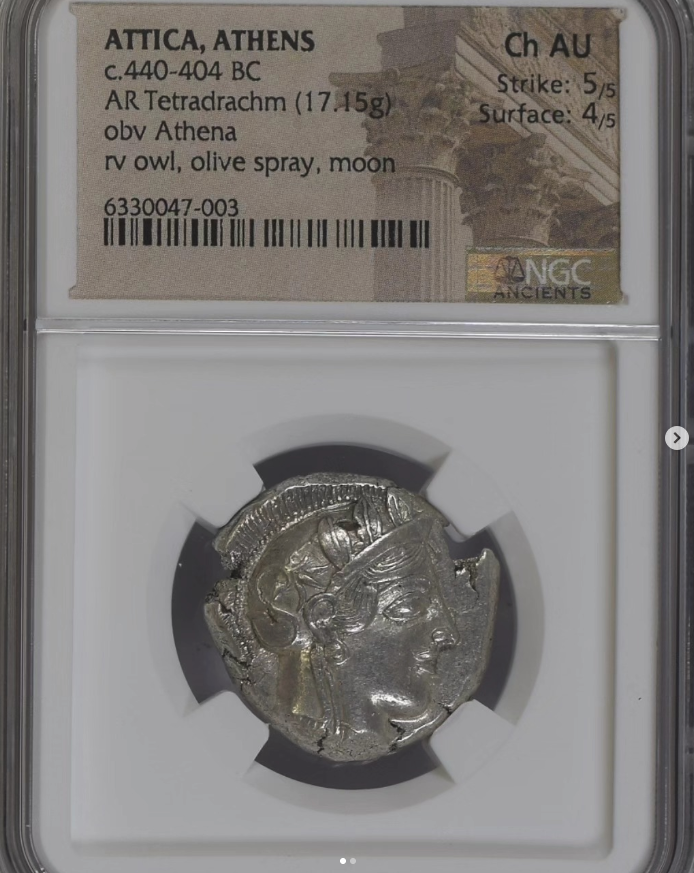
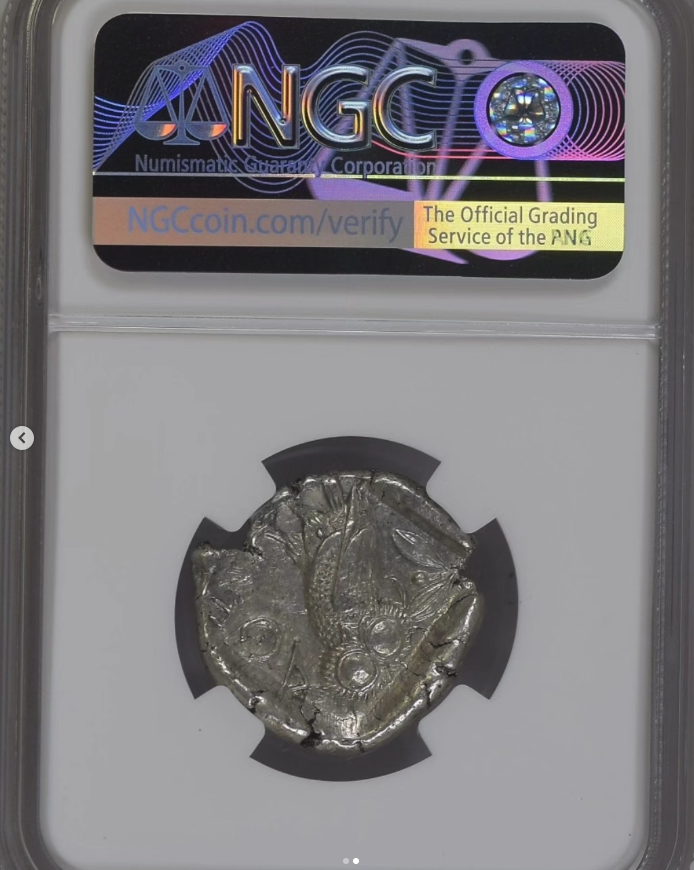
c. 440-404 BC AR Tetradrachm (17.15g)
The 'owl' of Athens - the first true international trade coin, struck from the silver of Laurion at the height of the Athenian Empire.
- Metal
- Silver
- Grade
- NGC Ch AU · Strike 5/5 · Surface 4/5
- Cert #
- 6330047-003
Full attribution & era
The history behind the coin.
The Athenian "owl" tetradrachm is one of the most important coins ever struck. Issued in massive quantity from the silver mines of Laurion in Attica from the late 6th century BC onward, the type became the de facto international currency of the eastern Mediterranean - hoarded from Egypt to Bactria and copied as far as Arabia and the Levant. The coins of this Classical "mass" series, struck c. 454-404 BC during and after the age of Pericles, financed the Parthenon, the Athenian fleet, and the long Peloponnesian War against Sparta.
The obverse shows the helmeted head of Athena, patron goddess of the city, facing right and wearing an Attic helmet decorated with olive leaves and a floral palmette. The reverse carries her sacred owl standing right with head facing the viewer, an olive spray and crescent moon behind, and the abbreviated ethnic AΘE ("of the Athenians") to the right - the whole within an incuse square. The olive spray and owl together encode the two great gifts of Athena to the city: the olive tree and wisdom.
This piece is a full-weight 17.15g tetradrachm with bold central detail on Athena's profile and a strong, well-centered reverse owl. NGC has graded it Choice AU with an exceptional 5/5 strike and 4/5 surfaces - a combination of preservation and eye appeal that places it firmly in the top tier of surviving Classical owls. After nearly 2,500 years, it remains exactly what it was meant to be: a portable monument to Athenian power, struck in the silver that built the Classical world.
- Kroll - The Greek Coins (Athenian Agora XXVI).
- Sear - Greek Coins and Their Values, Vol. 1 (no. 2526 ff.).
- NGC Ancients Cert #6330047-003.