
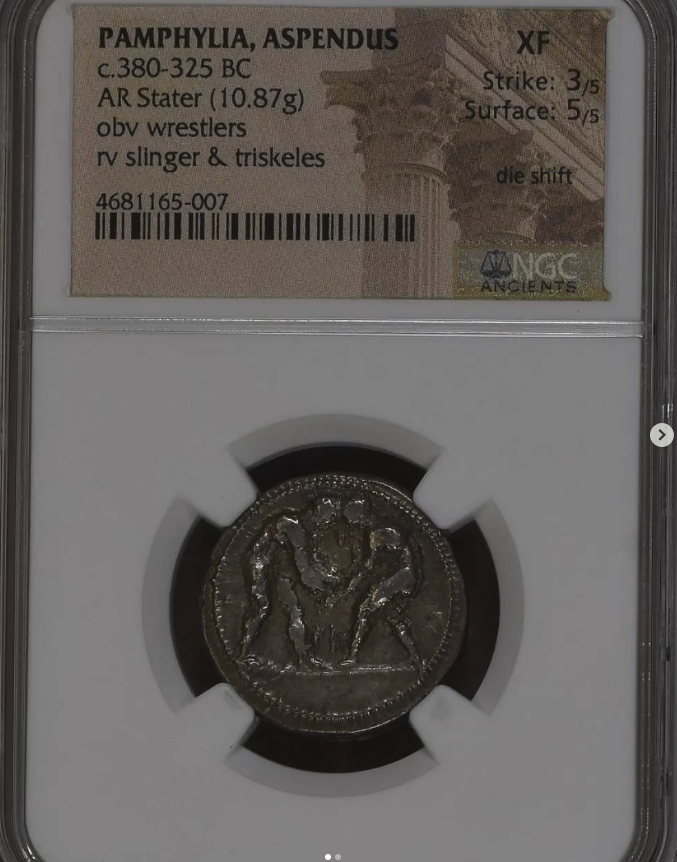
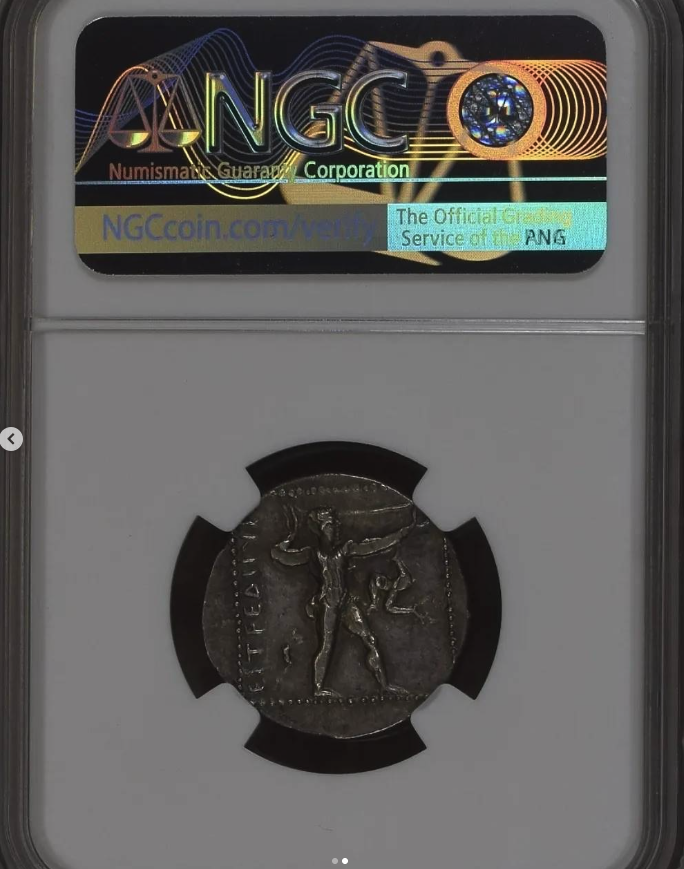
c. 380-325 B.C. AR Stater (10.87g)
One of the most iconic Greek silver coins ever struck - two wrestlers locked in a hold on the obverse, a slinger in mid-throw on the reverse, both alluding to the city's two great public spectacles. Surface 5/5 is exceptional for the type.
- Metal
- Silver
- Grade
- NGC Ancients XF · Strike 3/5 · Surface 5/5 · die shift
- Cert #
- 4681165-007
Full attribution & era
The history behind the coin.
Aspendus (modern Belkıs, near Antalya in southern Turkey) was a wealthy Pamphylian Greek city on the Eurymedon River, sitting on the trade route between the Aegean and the Levant. By the 5th and 4th centuries B.C. it was one of the richest cities of the southern coast of Asia Minor - rich enough to mint a massive series of fine silver staters in its own name, and famous enough across the Greek world that its coinage was hoarded from Sicily to Mesopotamia. The Roman theater that Marcus Aurelius later built at Aspendus still stands today as the best-preserved ancient theater in the Mediterranean - testimony to the wealth this city continued to enjoy long after the period of this coin.
The obverse shows two nude athletes locked in a wrestling hold, knees bent, arms gripping each other's necks and shoulders in the unmistakable stance of Greek pale (upright wrestling). The reverse shows a slinger - bearded, nude, leaning forward with his sling cocked back over his shoulder ready to release - with a triskeles (three running legs joined at the hip) as the field symbol and the Pamphylian-Greek city ethnic ESTFEDIIYS ('of the Estwediians,' the local form of 'Aspendian') around the rim. The two scenes together advertise the two things Aspendus was famous for in the Greek world: its athletic games (which featured wrestling prominently and were modelled on the panhellenic festivals of Olympia, Delphi, Nemea, and Isthmia) and its slinger mercenaries, who were prized across the Mediterranean for their accuracy and were exported as a major Aspendian commodity. Greek and Roman commanders specifically asked for Aspendian slingers when they were assembling armies; Xenophon mentions them in the Anabasis.
The triskeles on the reverse is one of the great mystery symbols of antiquity - it appears at Aspendus, on coins of Lycia just down the coast, and most famously on Sicilian Syracuse and on the modern flag of Sicily. Its meaning is debated, but at Aspendus it functions as the city badge: the same triskeles appears on every issue of this large stater series throughout the late 5th and 4th centuries B.C.
The historical setting of this coin is the late Classical period, between the Peace of Antalcidas of 387 B.C. (which formally returned the Greek cities of Asia Minor to Persian suzerainty) and the conquests of Alexander the Great, who passed through Pamphylia in 333 B.C. and famously demanded a massive contribution of horses and silver from Aspendus when the city tried to negotiate. Plutarch and Arrian both record Alexander's anger at Aspendus's bargaining - he doubled the demand and forced the citizens to surrender their leading men as hostages. Coins of exactly this type were the silver Alexander demanded.
NGC graded this stater XF with Strike 3/5 and an outstanding Surface 5/5 (the die shift noted in the slab is a minor minting flaw - the obverse die slipped slightly during the strike, doubling part of the wrestlers' outline, which is in fact diagnostic of an authentic ancient strike from the period). Surface 5/5 on a 2,400-year-old silver coin of this size is extraordinarily rare - it means there is no porosity, no encrustation, no scratches, no smoothing. A perfectly preserved silver record of Greek wrestling, Greek mercenary warfare, and one of the great trading cities of the Hellenistic Mediterranean.
- SNG France 3 (Pamphylie), 79-114 (the Aspendus stater series).
- SNG von Aulock 4555-4574.
- BMC Lycia, Pamphylia, and Pisidia, pp. 96-101 (Aspendus).
- Xenophon - Anabasis (Aspendian slinger mercenaries).
- Arrian - Anabasis of Alexander, I.27 (Alexander at Aspendus).
- Plutarch - Life of Alexander.
- NGC Cert #4681165-007.