
c. 1507-1540 AR 1/2 Schauthaler (presentation half-thaler)
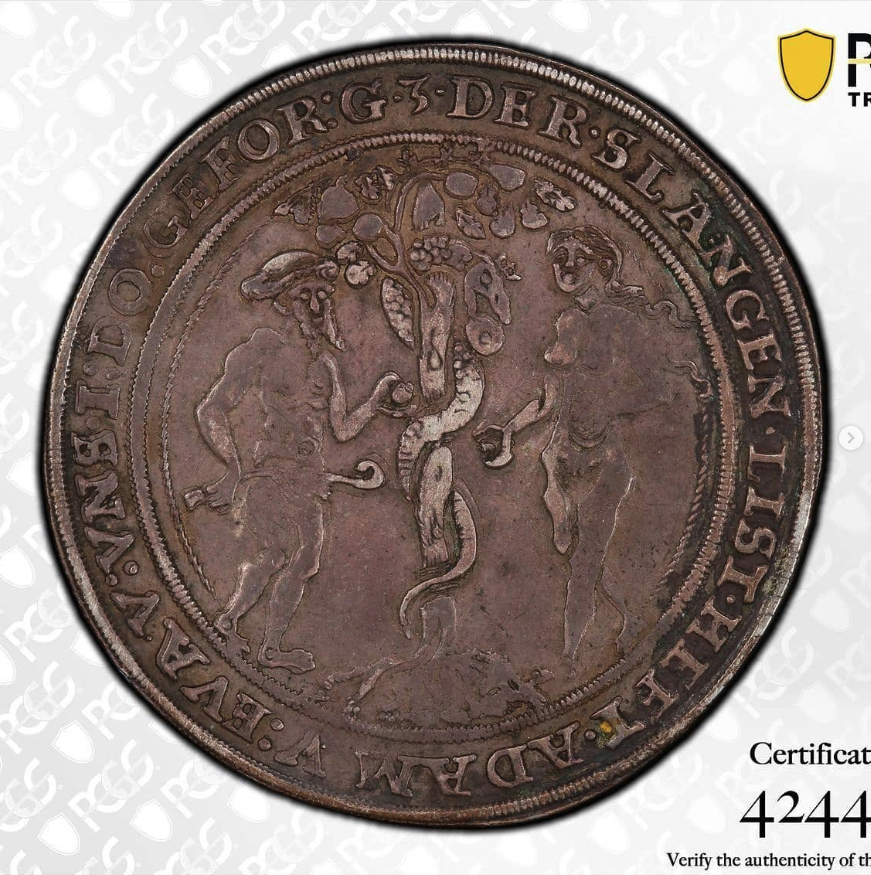
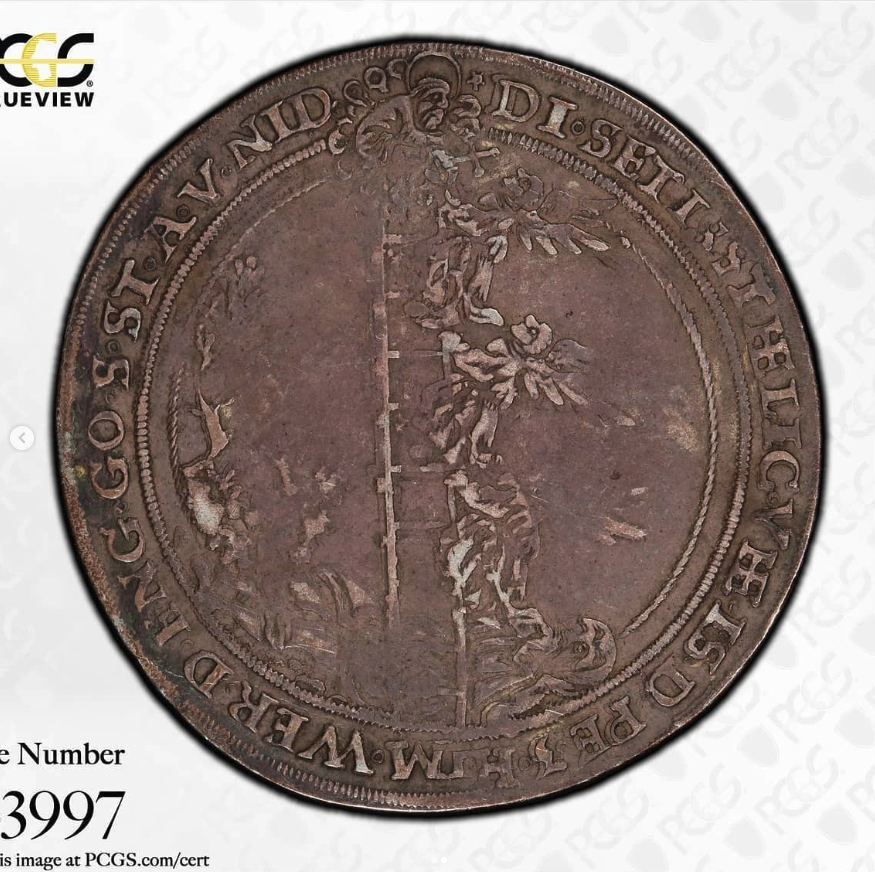
A 1/2 Schauthaler of Albertine Saxony (Katz-26) with the full Genesis cycle: Adam & Eve and the Serpent on the obverse, Jacob's Ladder with three angels on the reverse. PCGS XF-45 is a remarkable grade for an early-16th-century presentation piece - virtually all surviving Schauthalers come heavily worn, holed, or mounted.
- Metal
- Silver
- Grade
- PCGS XF-45
- Cert #
- 42443997
Full attribution & era
The history behind the coin.
The obverse depicts the moment of the Fall from Genesis 3:1-6: Adam stands to the left, Eve to the right, the serpent twined around the central trunk of the Tree of the Knowledge of Good and Evil with the apple offered toward Eve. The legend reads ADAM · V · EVA · V · IST · DO · GE · FOR · G · 3 · DER · SLANGEN · LIST · HEI - "Adam and Eve and what happened from Genesis 3, the cunning of the serpent." This is one of the earliest substantial coin / medallic depictions of the scene in German numismatics, and the figures are rendered in the High Renaissance style associated with Lucas Cranach the Elder, court painter to the Saxon Electors at Wittenberg, who painted the same subject repeatedly through these very years.
The reverse depicts Jacob's Ladder from Genesis 28:12: Jacob lies sleeping at the foot of a great ladder that rises to heaven; three winged angels climb the ladder; God the Father, in a sunburst, waits to greet them at the top. The legend - drawn from the Latin Vulgate - cites the dream and the divine promise.
Schauthalers ("show-thalers" - from German schauen, "to view / to display") occupy a peculiar grey zone in early-16th-century European numismatics. They were struck in Thaler size and weight, often by the same dies and mintmasters who produced regular currency Thalers, but their purpose was primarily commemorative or devotional - issued to mark coronations, marriages, religious holidays, and biblical themes. Whether they ever actually circulated as currency varies piece by piece. As a working rule, the more medallic and high-relief the design (typical of the great Salzburg and Habsburg pieces), the less likely it was to circulate; the more "coin-like" the design and surfaces, the more likely it was to pass at face. This Saxon piece sits squarely in the middle - it has the weight and design discipline of a circulating half-Thaler, and the wear pattern of the present example (PCGS XF-45) shows that at least this specimen genuinely passed through hands rather than living its life in a cabinet.
The series is attributed to the Albertine line of Saxony under Duke George the Bearded (1471-1539, reigned 1500-1539), the great Catholic adversary of his cousin Frederick the Wise's protection of Martin Luther. George's dukedom controlled the silver-rich Erzgebirge ("Ore Mountains") on what is now the Saxon-Bohemian border, including the new boom-towns of Annaberg (founded 1496) and Schneeberg, whose mines were producing more silver in this generation than any region of Europe outside Tyrol. It is no accident that the world's first true Thalers - the Joachimsthalers of neighbouring Bohemia - were struck just over the mountains in 1518-1520. The Saxon Schauthalers belong to that same explosive generation of early modern silver coinage. Reference: Katz 26; Tentzel I p. 48; Schnee 5.
PCGS XF-45 is a notably high grade for an early Saxon Schauthaler. Most surviving examples are heavily circulated, holed for suspension as religious medals, or have been mounted as jewellery. A clean, unmounted, sharply detailed example with original cabinet surfaces is genuinely scarce.
- Katz 26 (Saxony, half-Schauthaler, Adam & Eve / Jacob's Ladder).
- Schnee - Sächsische Taler, 5 (Saxon Schauthaler series, Albertine line).
- W. E. Tentzel - Saxonia Numismatica, vol. I, p. 48 (early documentation of the type).
- Davenport - German Talers (general reference for the Schauthaler classification).
- PCGS Cert 42443997 - XF-45 (TrueView).
- Genesis 3:1-6 (Fall of Man) and Genesis 28:12 (Jacob's Ladder) - the two scenes depicted.