
1599 AR Reichsthaler
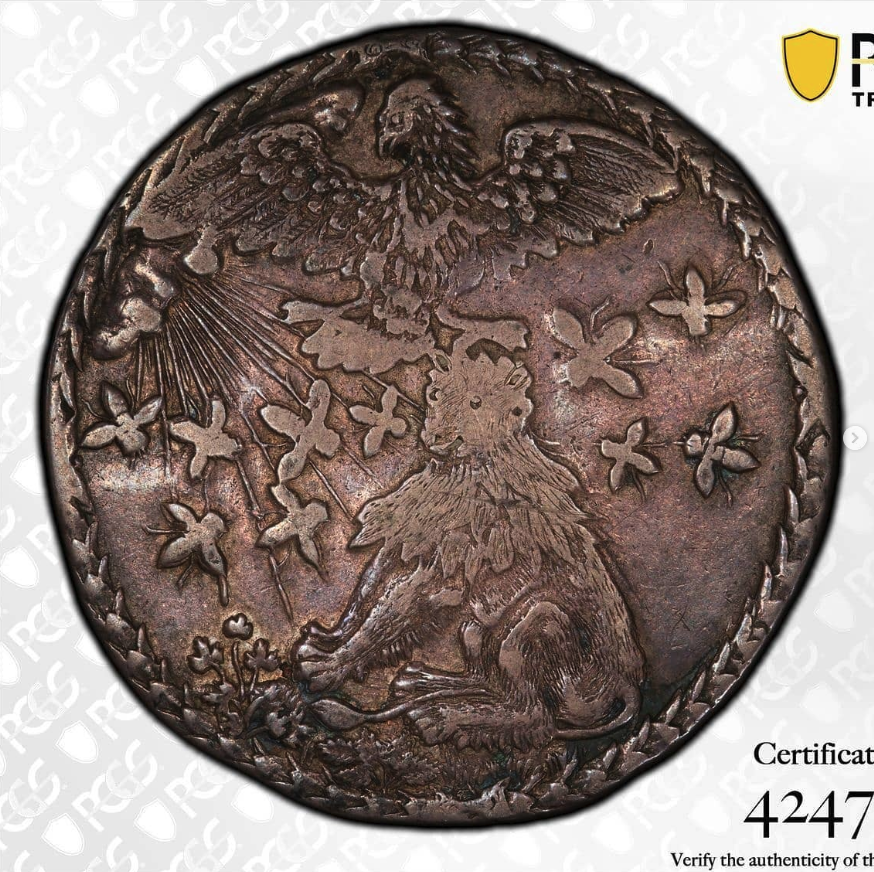
An iconic 1599 Brunswick-Wolfenbüttel 'Wasp Thaler' (Dav. 9092) - the Welf lion swarmed by ten wasps/mosquitoes representing the rebellious nobles, sheltered by the Imperial eagle of Rudolf II. One of the most famous and openly insulting propaganda coins of the entire 16th century. PCGS XF-40.
- Metal
- Silver
- Grade
- PCGS XF-40
- Cert #
- 42470630
Full attribution & era
The history behind the coin.
This is one of the most celebrated of all early modern German "satirical" coins. Heinrich Julius, Duke of Brunswick-Wolfenbüttel (1564-1613, reigned 1589-1613), was a brilliant and combative Renaissance prince - jurist, playwright (the first major author of original German drama), bishop of Halberstadt, courtier of Emperor Rudolf II in Prague, and the architect of one of the most aggressive programmes of legal modernisation in late-16th-century Germany. He attempted to replace the customary Saxon law (Sachsenspiegel) of his territory with codified Roman law, and to dissolve the traditional courts of the rural Lower Saxon nobility (the Landstände) - the very courts in which those nobles had served as hereditary judges. The nobles fought back ferociously: lawsuits, appeals to the Imperial courts, defamation campaigns, refusal of taxes. The dispute consumed the duchy for years.
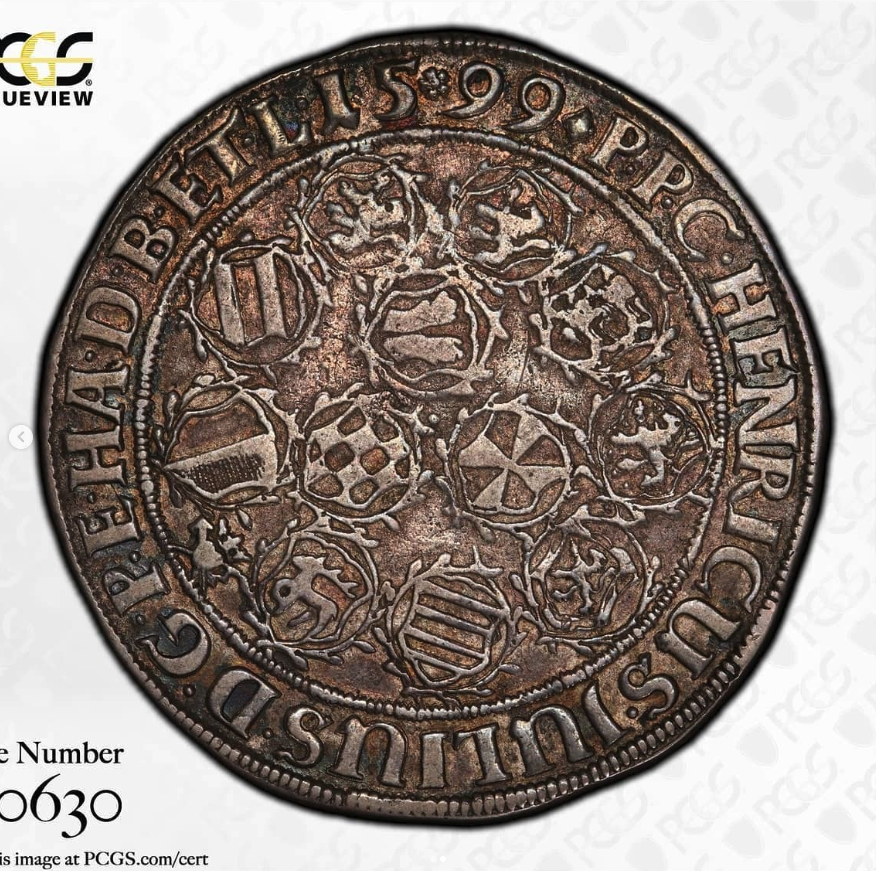
Heinrich Julius, denied a clean political victory, struck back in silver. From the late 1590s onward he authorised a remarkable series of "emblematic" Thalers - openly allegorical, openly insulting coins, struck in full Reichsthaler size from his own Harz silver, that mocked his noble enemies in symbolic language every literate German of the day could read at a glance. The 1599 Wasp Thaler is the most famous of them. The obverse shows the Welf lion (the Duke himself) seated calmly amid a swarm of ten wasps - or mosquitoes - that buzz and sting around his head and back. From the upper left, the sun shines; above the lion, the Imperial double-headed eagle of Rudolf II hovers with outstretched wings, signalling the Holy Roman Emperor's protection. The reverse displays the ten quartered shields of the Brunswick-Lüneburg territories around a central inescutcheon, encircled by the legend HENRICUS IULIUS D G E HA D BET L 1599 - "Heinrich Julius, by the Grace of God Bishop of Halberstadt, Duke of Brunswick and Lüneburg, 1599."
A surviving letter from the Wolfenbüttel State Archives, written by the Duke himself to his court painter Joachim Stolten, makes the symbolism explicit and surprisingly self-deprecating - the Duke insisted the insects were not threatening wasps but merely irritating mosquitoes:
"To our painter and dearly loyal Joachim Stolten - Dear faithful one, it is our gracious instruction that you should have our tailor make a rider's pennant of red damask of the same size as the other, and that you should paint upon it in gold, silver and colours a lion, so seated, and over him an eagle hovering, and the rays of the sun shining upon him, and several mosquitoes flying about his nose, in the same fashion as were stamped on the Thaler."
The Duke wanted his propaganda mounted on his own cavalry banner. Everyone in Lower Saxony understood the message immediately, and the nobles - exactly as intended - were furious. The Wasp Thaler is recorded as Davenport 9092 / Welter 645 / Knyphausen 5946. Surviving examples are scarce in any grade and the type is one of the most sought-after of the entire German emblematic-Thaler genre.
- Davenport - German Talers 1500-1600, Dav. 9092 (Brunswick-Wolfenbüttel, Heinrich Julius, Lion-and-Wasps Thaler 1599).
- Welter - Die Münzen der Welfen seit Heinrich dem Löwen, 645.
- Knyphausen 5946.
- PCGS Cert 42470630 - XF-40 (TrueView).
- Wolfenbüttel State Archives - letter from Heinrich Julius to court painter Joachim Stolten describing the lion-and-mosquitoes design.
- Wolfgang Steguweit - Geschichte der Münzstätte Goslar (Harz silver and the Welf mints).