
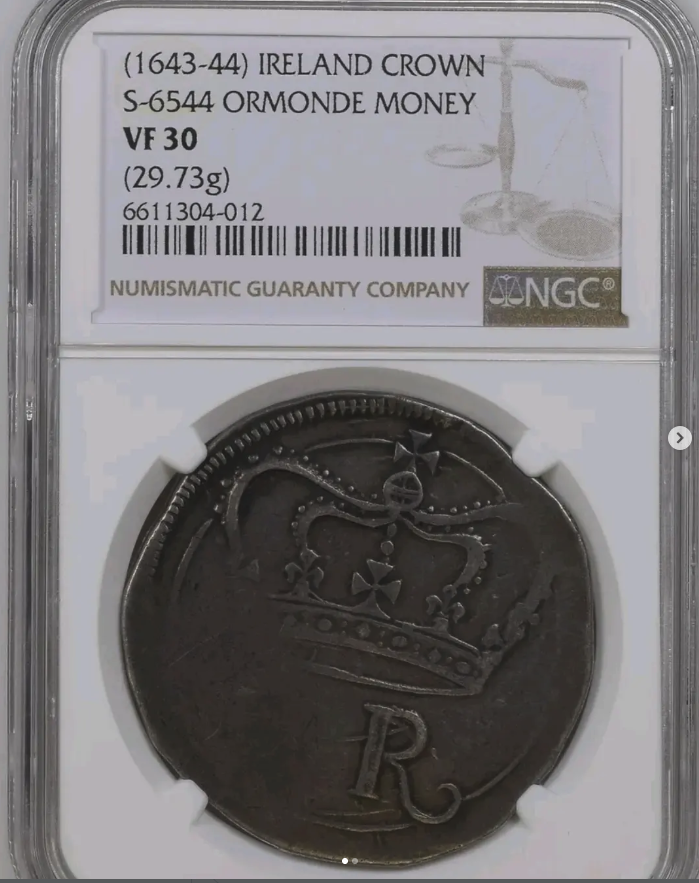
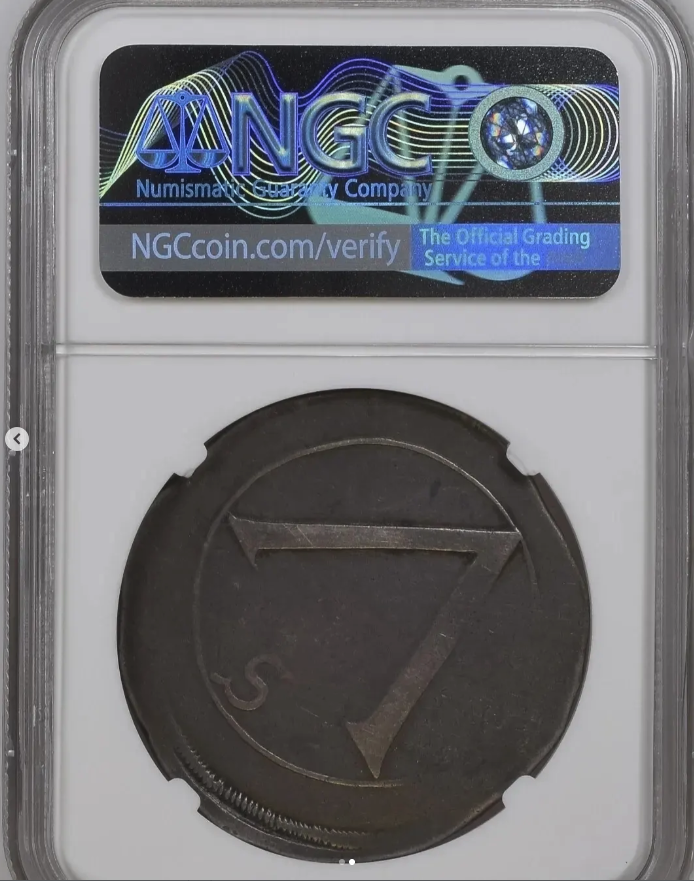
1643-1644 Crown
Crude, heavy emergency silver crown struck in Dublin under the Marquis of Ormonde during the 1643 Cessation - one of the great Royalist Civil War issues of Ireland.
- Metal
- Silver
- Grade
- NGC VF 30
- Cert #
- 6611304-012
Full attribution & era
The history behind the coin.
In 1641 the Catholic Irish Confederates rose against the English Crown's harsh anti-Catholic laws, declaring their rebellion in the name of King Charles I of England and Scotland. The timing could not have been worse for Charles, who was already locked in a multi-year confrontation with his Parliament over taxation, royal prerogative, and the religious policy of the Church of England. Charles was an Arminian - as ceremonially Catholic as a Protestant could be - while Parliament was led increasingly by Puritans hostile to images, ceremony, and royal absolutism. A Catholic Irish rebellion in Charles's name made Parliament deeply suspicious of the king's intentions.
When the question arose of who would command the army to be sent against the Irish rebels, Charles asserted royal prerogative. Parliament, fearing the army would instead be turned on its enemies in England, refused. On 4 January 1642 Charles personally entered the House of Commons with an armed escort to arrest five members he believed were leading the opposition - two of whom were actually pro-King but were driven into the opposition by his action. Parliament seized the London militia, Charles fled to Hampton Court, and the English Civil Wars began.
In Ireland, Charles entrusted the Royalist command to James Butler, Marquis of Ormonde. The Irish war became a stalemate of advance and counter-advance until September 1643, when Ormonde negotiated the "Cessation" - a one-year truce with the Catholic Confederates. During the truce the Confederate army held most of the countryside around Dublin, the Royalists held the city itself, and there was no money in the treasury to pay the Royalist garrison. Ormonde's administration responded by striking emergency silver from melted-down plate, hammered on roughly prepared flans without legends or portrait: just a crown over the royal cipher CR (Carolus Rex) on one side and the denomination on the other. These are the famous "Ormonde Money" issues.
This is the largest of the Ormonde denominations - the Crown, Spink-6544, weighing 29.73 grams. The obverse shows the simple but bold large crown above the engraved CR cipher; the reverse carries an enormous Roman V (5 shillings) with a small "s" beside it. NGC has graded this example VF 30 with full devices and the heavy, even gray surfaces these crude emergency strikings deserve when they survive in honest, problem-free condition.
In 1645 Charles secretly negotiated the Glamorgan Treaty with the Confederates, promising freedom of religion in Ireland in return for a Catholic army to invade England and Scotland and restore him to absolute power. When the treaty leaked, Charles was forced to repudiate it to save his political support in England - and the war in Ireland ground on, eventually to be ended only by Cromwell's brutal reconquest after Charles's execution in 1649. Ormonde Money is one of the most direct surviving artefacts of the Royalist effort in Ireland during those years.
- Spink - Coins of Scotland, Ireland & the Islands (Ormonde Money, S-6544).
- DNB - James Butler, 1st Duke of Ormonde.
- Seaby & Purvey - Coins of England and the United Kingdom (Civil War / Irish issues).
- NGC Cert #6611304-012.