
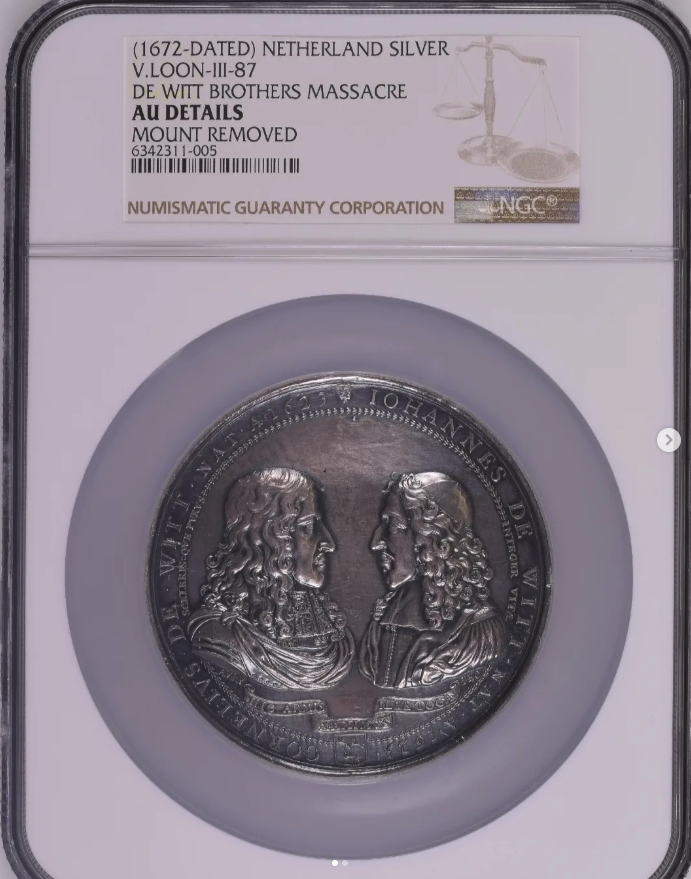
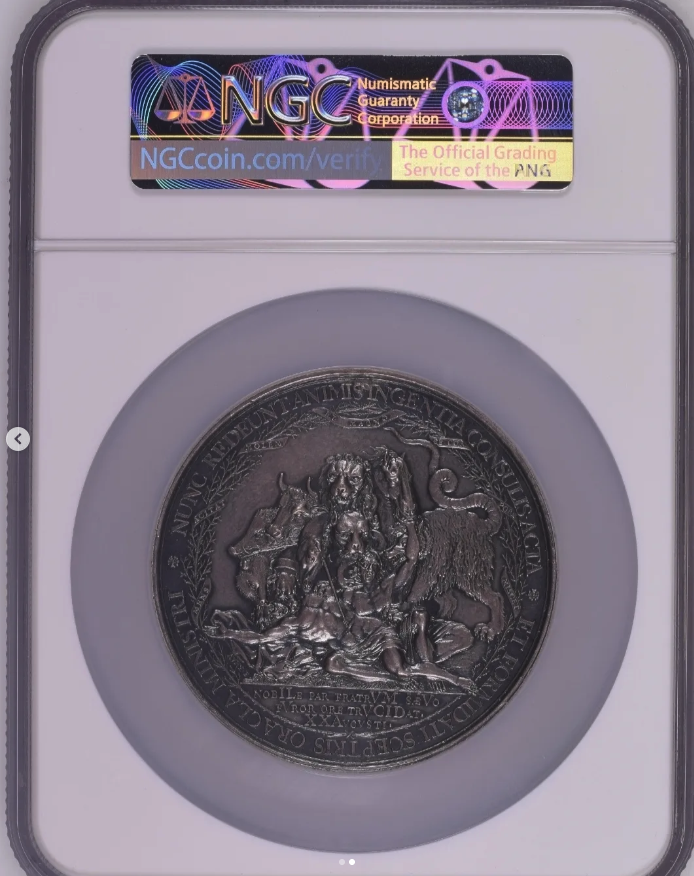
1672 Silver Medal, 72mm, 107g (van Loon III, p. 87, no. 1)
A massive 72mm silver medal struck in the year of the Rampjaar - the lynching, mutilation, and ritual cannibalism of the De Witt brothers by an Orangist mob in The Hague.
- Metal
- Silver
- Grade
- NGC AU Details · Mount Removed · De Witt Brothers Massacre
- Cert #
- 6342311-005
Full attribution & era
The history behind the coin.
In 1650 the Dutch Republic was left effectively leaderless. The young Stadtholder William II of Orange died of smallpox a week before his son (the future William III) was born, and the powerful province of Holland refused to appoint a new Stadtholder. The country was deeply divided between Statists - who wanted a loose federation of provinces run by the regent merchant class - and Orangists, who wanted a centralized state under the House of Orange.
The effective head of the Republic became Johan de Witt, the Grand Pensionary of Holland and a Statist. After defeating the English in the Second Anglo-Dutch War in 1665, De Witt used his popularity to push through the Eternal Edict (1667), in which Holland abolished the office of Stadtholder altogether - locking the House of Orange out of power.
Then came 1672 - the Rampjaar, the "Disaster Year." France, England, the Bishopric of Münster, and the Archbishopric of Cologne all invaded the Republic at once. The Dutch army collapsed; the country teetered on the edge of destruction. Popular fury turned on the Statists. Johan de Witt resigned the Grand Pensionary office. His brother Cornelis was arrested on a fabricated charge of plotting to assassinate William III and was tortured.
On 20 August 1672 (van Loon dates the medal 1672 by the event), Johan went to the Gevangenpoort prison in The Hague to collect his brother on his release. An Orangist militia held the regular guards back; an enraged mob seized both brothers, dragged them out into the street, and shot, stabbed, and beat them to death. The mob then strung up the corpses upside-down on a public scaffold, mutilated them, sold pieces of the bodies as souvenirs, and roasted and ate parts of them in an act of organized political cannibalism. It is one of the most shocking events in Dutch history.
This medal, by Christoffel Adolfi (van Loon III, p. 87, no. 1), was struck almost immediately to commemorate the brothers and to mourn the act. The obverse pairs the busts of Johannes (Johan) and Cornelis de Witt with their names in the legends. The reverse depicts an allegorical scene with the Latin legends NUNC REDEANT ANIMIS INGENTIA CONSUL[is] ACTA ("now let the consul's great deeds return to memory") and NOLITE PAR FRATRUM AVO PRO ORE TRUCIDATUM XX AUG[usti] ("the pair of brothers slaughtered for their words on 20 August"), with allegories of liberty, the lion of Holland, and the brothers' sacrifice. At 72mm and 107 grams of silver, this is a major presentation medal of the Dutch Golden Age.
The "Mount Removed" detail reflects that, like many large 17th-century silver medals, it was once worn or hung; the surfaces are otherwise full AU.
- van Loon - Histoire Métallique des Pays-Bas, Vol. III, p. 87, no. 1.
- Israel, Jonathan - The Dutch Republic: Its Rise, Greatness, and Fall.
- Rowen, H.H. - John de Witt: Grand Pensionary of Holland (definitive biography).
- Roorda, D.J. - Het Rampjaar 1672.
- NGC Cert #6342311-005.