
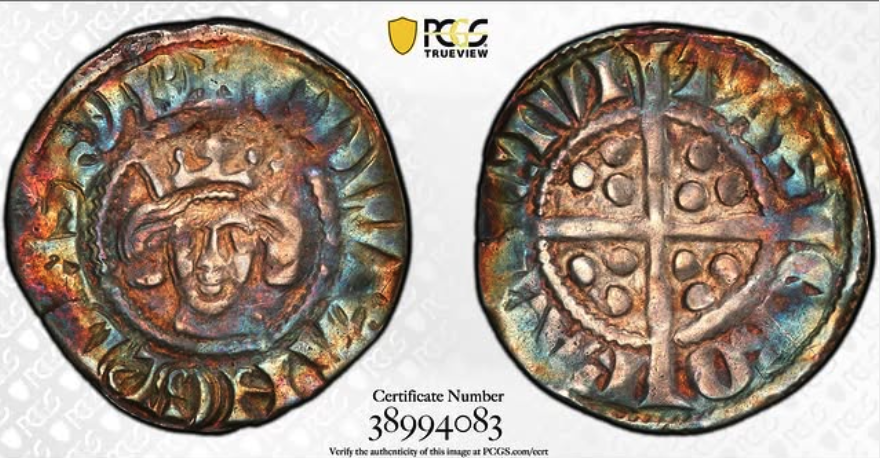
1279-1307 A.D. AR Long Cross Penny
An Edward I York-mint long-cross penny with extraordinary full rainbow cabinet toning - blues, magentas and golds across both faces - of the kind almost never encountered on hammered medieval silver, which is normally found dark and circulated. PCGS XF-40, Spink-1429.
- Metal
- Silver
- Grade
- PCGS XF-40
- Cert #
- 38994083
Full attribution & era
The history behind the coin.
Edward I succeeded his father Henry III in 1272 and inherited a debased and increasingly chaotic English coinage. The old voided long-cross pennies of Henry III had been struck for nearly thirty years, were heavily clipped, and were being pushed out of circulation by foreign sterlings and counterfeit imitations from the Low Countries. In 1279 Edward launched the great recoinage - one of the most ambitious monetary reforms of medieval Europe. The old pennies were called in en masse, melted down, and reissued in a new, sharper, and standardised design. The new penny carried a fully rendered crowned facing portrait of the king on the obverse and a continuous long cross across the entire reverse with three pellets in each quarter, struck on a slightly heavier and finer planchet. Spink catalogues this base type as S-1429.
The new design was so successful that it became the template for the English silver penny for the next two centuries: Edward II, Edward III, Richard II, and beyond all continued to strike pennies of essentially the same type, distinguishable only by minute differences in the king's name, lettering style, and crown shape. The York mint - one of the few provincial mints active throughout Edward's reign alongside London, Canterbury, Bristol, Lincoln, Newcastle, Durham and Berwick-upon-Tweed - signed its products CIVITAS EBORACI, the medieval Latin form of York's Roman name Eboracum.
Edward I's reign was defined as much by its coinage as by its wars: the conquest of Wales (completed with the death of Llywelyn ap Gruffudd in 1282 and the construction of the great Edwardian castles at Caernarfon, Conwy, and Harlech), the long Scottish wars against William Wallace and Robert the Bruce that earned him the epithet Malleus Scottorum - "the Hammer of the Scots" - and the expulsion of all Jews from England by the Edict of Expulsion in July 1290. Sterling silver pennies of this exact type paid the wages of the soldiers, the masons of the Welsh castles, and the agents of the Crown across all of those campaigns.
What makes the present coin remarkable is not its rarity - the type itself is moderately common - but its surface preservation. Hammered medieval silver, struck by hand on small irregular planchets and circulated for centuries before lying in soil for hundreds more, is almost always found dark, porous, or roughly cleaned. To find an Edward I penny that survived more than seven hundred years with this kind of full-spectrum iridescent rainbow cabinet toning - blues bleeding into magentas and golds across the entire surface, on both faces, completely undisturbed - is genuinely unusual. PCGS XF-40 with PCGS TrueView, cert 38994083.
- Spink - Standard Catalogue of British Coins, no. 1429 (Edward I, new coinage long cross penny, York mint).
- North - English Hammered Coinage, vol. 1 (Edward I-III pennies).
- PCGS Cert 38994083 - XF-40, TrueView image on PCGS.com/cert.
- Martin Allen - Mints and Money in Medieval England (Cambridge, 2012) - the great recoinage of 1279 and the York mint operations under Edward I.
- Marc Morris - A Great and Terrible King: Edward I and the Forging of Britain (2008) - background on the reign, the Welsh and Scottish wars, and the 1290 Edict of Expulsion.