
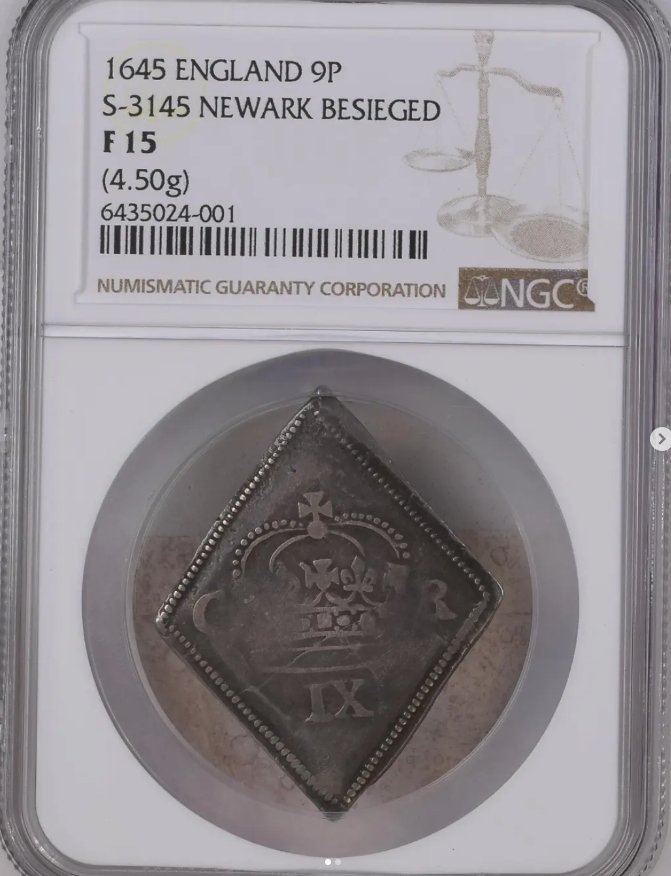
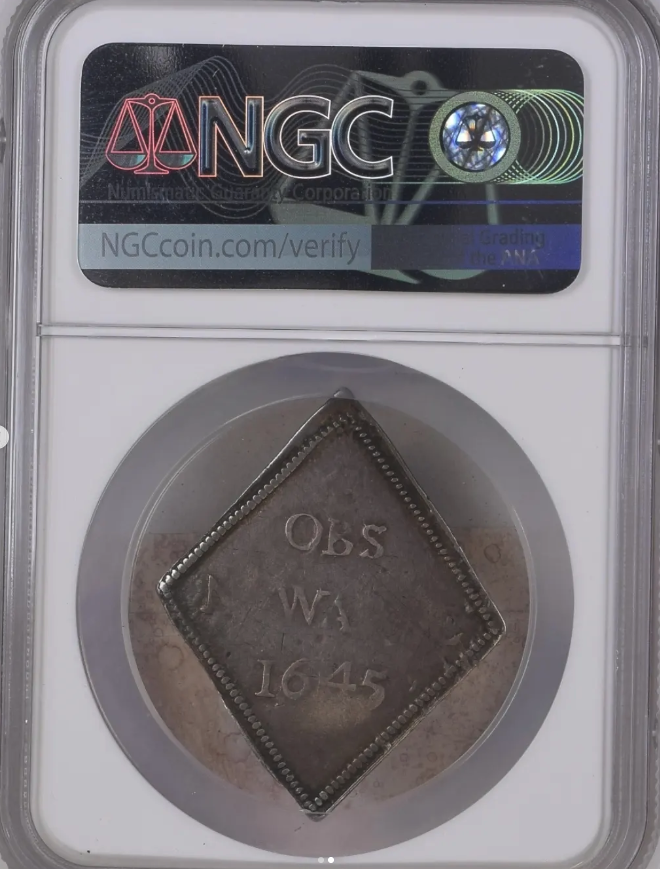
1645 (struck during the third and final siege, November 1645 - May 1646) Lozenge-shaped 9 Pence siege piece (4.50g)
A diamond-shaped emergency coin hammered out of the king's own silver plate inside a starving Royalist garrison - one of the last coins struck in Charles I's name before he was forced to surrender to the Scots and, eventually, to the executioner's block.
- Metal
- Silver
- Grade
- NGC F-15
- Cert #
- 6435024-001
Full attribution & era
The history behind the coin.
The English Civil Wars began in 1642 and were caused, at root, by King Charles I's refusal to accept compromise. Charles managed to push both of his kingdoms - England and Scotland - into rebellion against him, for entirely different reasons. The Scots rebelled when Charles tried to impose a new Anglican Book of Common Prayer on the Presbyterian Kirk. The English rebelled over a decade of personal rule without Parliament, ridiculous taxation loopholes (Ship Money), his attempt to personally arrest five Members of Parliament on the floor of the House of Commons, and his Laudian reformation of the Church of England toward more Catholic-style ceremony. All of this happened while a Catholic rebellion erupted in Ireland - and Parliament wrongly believed Charles himself was behind it.
Newark-on-Trent, on the road between London and the north, was a Royalist stronghold and was besieged three times during the wars. It is during the third and final siege that this coin was struck - melted from the silver plate of the king's table service and the garrison's officers, hammered into lozenge-shaped emergency money to pay soldiers who could no longer be paid in regular coin.
On 26 November 1645 a Scottish Covenanter army moved on Newark from the north, while Parliamentarian forces closed in from the south. The Royalist garrison defended the town aggressively. Through a brutal winter the Scots built up massive siege works manned by some 16,000 men. They dammed the River Devon so the town's grain mills stopped turning and the drinking water failed. Newark held out anyway. Survivors later wrote that food became so scarce they ate horses and dogs. Plague stalked the streets day after day, killing dozens at a time.
While Newark suffered, the war collapsed elsewhere. In April 1646 Parliament's New Model Army began the siege of the king's capital at Oxford. On 27 April Charles slipped out of Oxford in disguise, with his hair cropped and dressed as a servant, and rode hard for the Scottish camp outside Newark - hoping to play the Scots and Parliament off against each other. The Scots received him but refused to bargain. They forced his unconditional surrender, and on 8 May 1646 Charles ordered Newark itself to surrender. The siege ended after roughly six months.
Charles would later form the Solemn League and Covenant with the Scots and ignite the Second English Civil War, but Parliament defeated him again. His refusal to compromise and his willingness to invite foreign Scottish armies into England in his second war convinced Parliament that no peace was possible while he lived. On 30 January 1649 he was beheaded outside the Banqueting House in Whitehall.
This 9-pence is one of the four denominations (Half-Crown, Shilling, Ninepence, Sixpence) struck inside besieged Newark in 1645 and 1646, hammered between hand-cut iron dies into lozenge flans clipped from sheet plate. The obverse carries the royal crown over CR (Carolus Rex) flanking the value IX. The reverse reads OBS (obsessum, "besieged") · NEWARK · 1645. At 4.50 grams in NGC F-15 with full clear devices, both legends complete, and even the diamond beaded border intact, it is a remarkably honest survivor of the moment the Royalist cause ran out of money, food, and time.
- Spink - Coins of England and the United Kingdom, S-3145 (Newark Ninepence).
- Brooker, J.J. North - English Hammered Coinage, Volume II (Charles I siege issues).
- Besly, Edward - English Civil War Coin Hoards (British Museum).
- Wood, Andy - Newark and the Civil Wars.
- NGC Cert #6435024-001.