
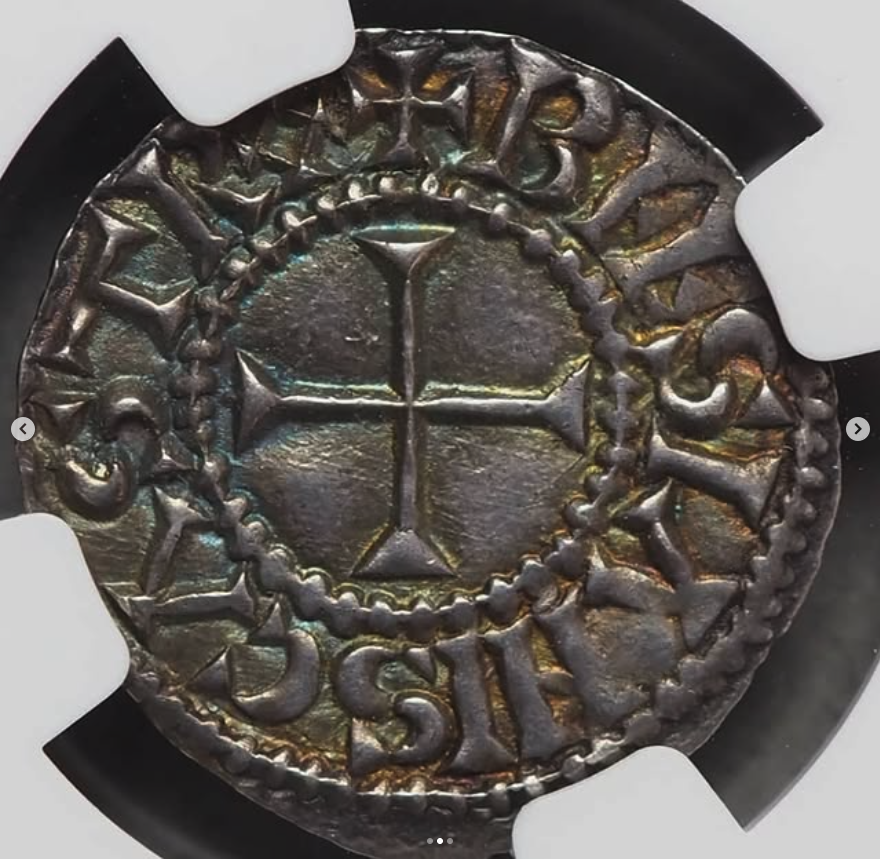
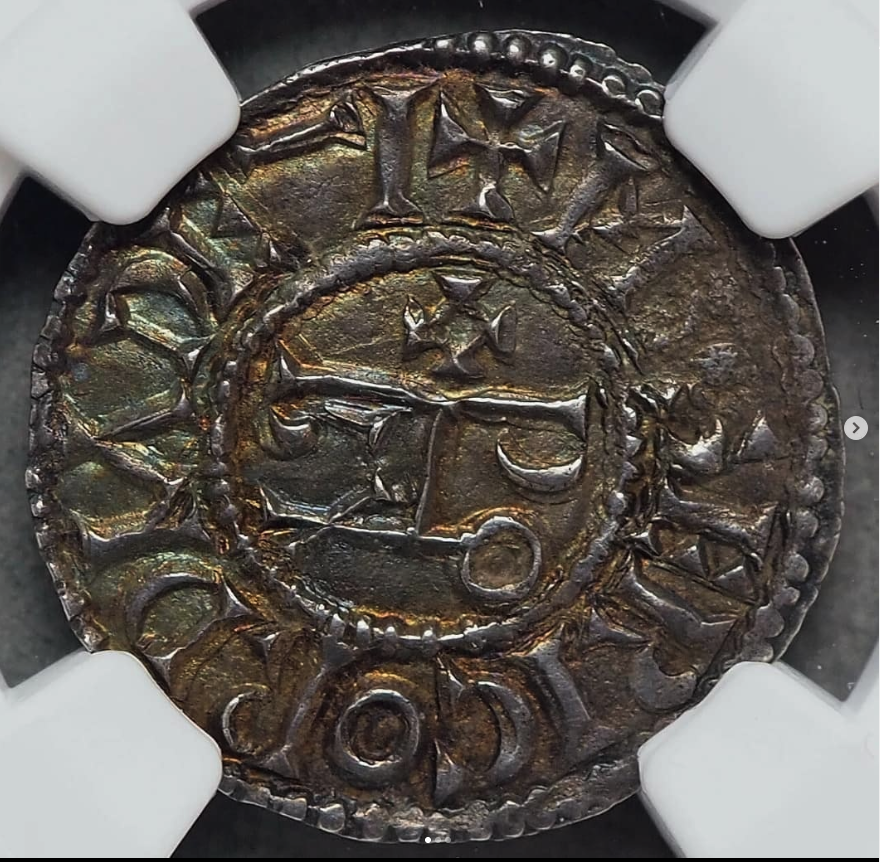
887-898 A.D. AR Denier (silver penny)
The finest known denier of King Odo of West Francia (r. 888-898) - the hero of the Siege of Paris and the first non-Carolingian elected king of the Franks. NGC MS-64 with subtle iridescent toning. Almost every surviving denier of this reign is heavily worn from circulation as Danegeld silver paid to the Vikings.
- Metal
- Silver
- Grade
- NGC MS-64 · Finest Known of Odo's reign
Full attribution & era
The history behind the coin.
On the night of 25 November 885, Odo (French: Eudes), Count of Paris, looked downriver and saw something almost unprecedented in Frankish history: a fleet of roughly 700 Viking longships sailing up the Seine, carrying an army that contemporary chroniclers numbered at as many as 30,000 men. The fleet was commanded, according to the Norse sagas, by Rollo "the Walker" (Hrólfr Ganger) - so called because he was so tall (well over six feet, perhaps approaching 6'7") that no horse in the army could carry him. Within days the fleet had encircled the small island-city of Paris, then a fortified bridge-and-island settlement of perhaps a few thousand inhabitants on the Île de la Cité.
Odo had roughly 200 fighting men. He held the city anyway. The Siege of Paris (November 885 to October 886) is one of the most extraordinary defensive actions of the early medieval West. Bishop Gozlin of Paris personally manned the walls, shooting Viking attackers with a bow and reportedly killing twelve more with a hand axe before he died of disease during the siege. The Frankish abbot Abbo of Saint-Germain-des-Prés, an eyewitness, wrote a Latin epic poem - the Bella Parisiacae Urbis - describing the year-long defence in detail: the burning siege towers rolled against the walls, the Viking attempts to dam the Seine with corpses, the Parisian women carrying boiling oil to the battlements. After ten months Emperor Charles III "the Fat" (Charles le Gros), nominal ruler of essentially the entire Carolingian world, finally arrived at the head of a relief army - and rather than fight, he paid the Vikings 700 pounds of silver in Danegeld to lift the siege and go ravage Burgundy instead. The cowardice of the bribe, set against the heroism of Odo's defence, broke whatever remained of Carolingian prestige in West Francia. Charles the Fat was deposed in 887 and dead by January 888.
The West Frankish nobility, refusing for the first time to elect a Carolingian, chose Odo as king on 29 February 888. He was crowned at Compiègne. His ten-year reign was a continuous war on two fronts - against repeated Viking raids that he personally beat off in the field, and against the Carolingian loyalists who eventually rallied around the boy-king Charles III "the Simple" (Charles le Simple, the posthumous son of Louis the Stammerer). Odo died in January 898 and Charles the Simple succeeded him. Odo's brother Robert would later be elected anti-king against Charles the Simple in 922, and Robert's grandson Hugh Capet would in 987 found the Capetian dynasty that ruled France in unbroken male-line descent until 1328 - meaning every Capetian, Valois, Bourbon, and Orléans king of France through Louis-Philippe in 1848 was a direct descendant of Odo's family, the Robertians.
This denier was struck at Blois - one of the principal mints of Odo's heartland on the Loire, the region from which his family drew its strength. The obverse carries a cross pattée within an inner circle with the legend +GRATIA D-I REX ("By the Grace of God, King") around. The reverse displays the famous ODDO monogram - the king's name compressed into a single ligatured device, with the cross-bar of the central D forming the cross-bar of the O on either side - within an inner circle, surrounded by the mint legend +BLESIANIS CASTRO ("the Castle of Blois"). The vast majority of Odo's deniers entered the Viking economy as Danegeld - paid in tribute, melted down in Scandinavia, lost in Norse hoards, or worn nearly smooth by hand-to-hand circulation through Frankish, English, and Norse territory. Almost every surviving example grades VF or worse and shows clipping, bending, or test-cutting from Viking metal-checks. NGC MS-64, with subtle iridescent toning and full mint detail on both the cross and the monogram, is genuinely the finest known of the entire reign.
- Roberts - The Silver Coins of Medieval France, Odo, Blois.
- Depeyrot - Le numéraire carolingien, Odo (888-898), Blois mint type.
- Morrison-Grunthal - Carolingian Coinage (American Numismatic Society), Odo of West Francia.
- NGC MS-64 - noted as finest known on the holder.
- Abbo of Saint-Germain-des-Prés - Bella Parisiacae Urbis (eyewitness Latin verse account of the Siege of Paris, 885-886).
- Annales Vedastini and Annales de Saint-Bertin - contemporary chronicles of Odo's reign.
- Janet L. Nelson - Charles the Bald and the West Frankish kingdom (background on the Robertian rise).