
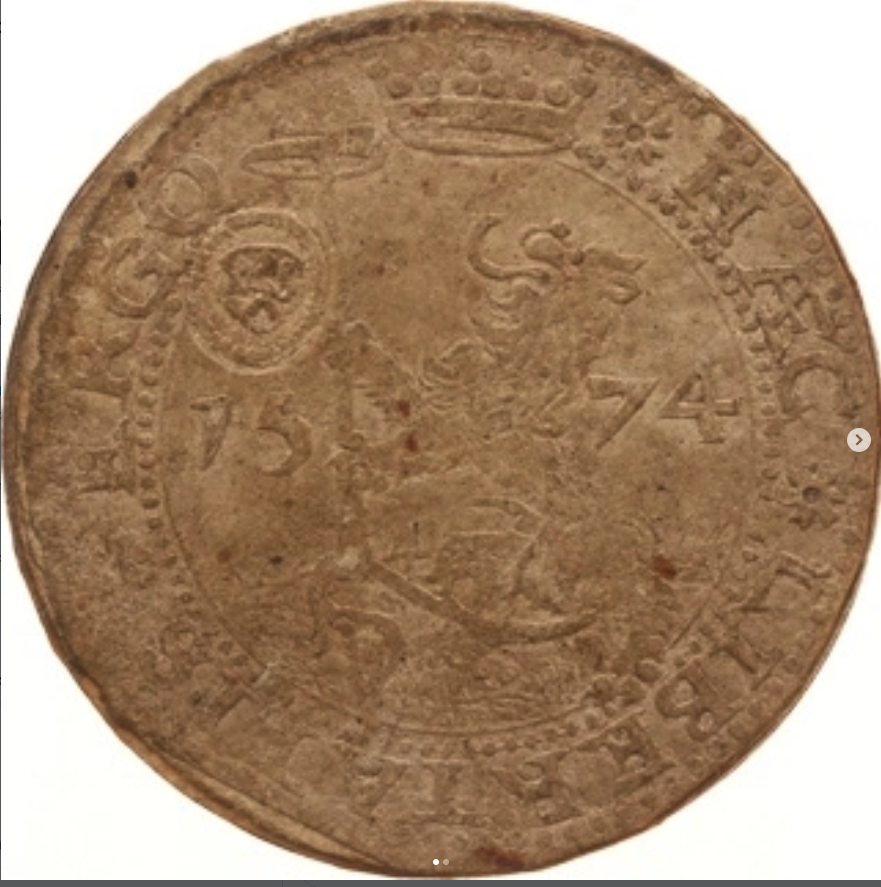
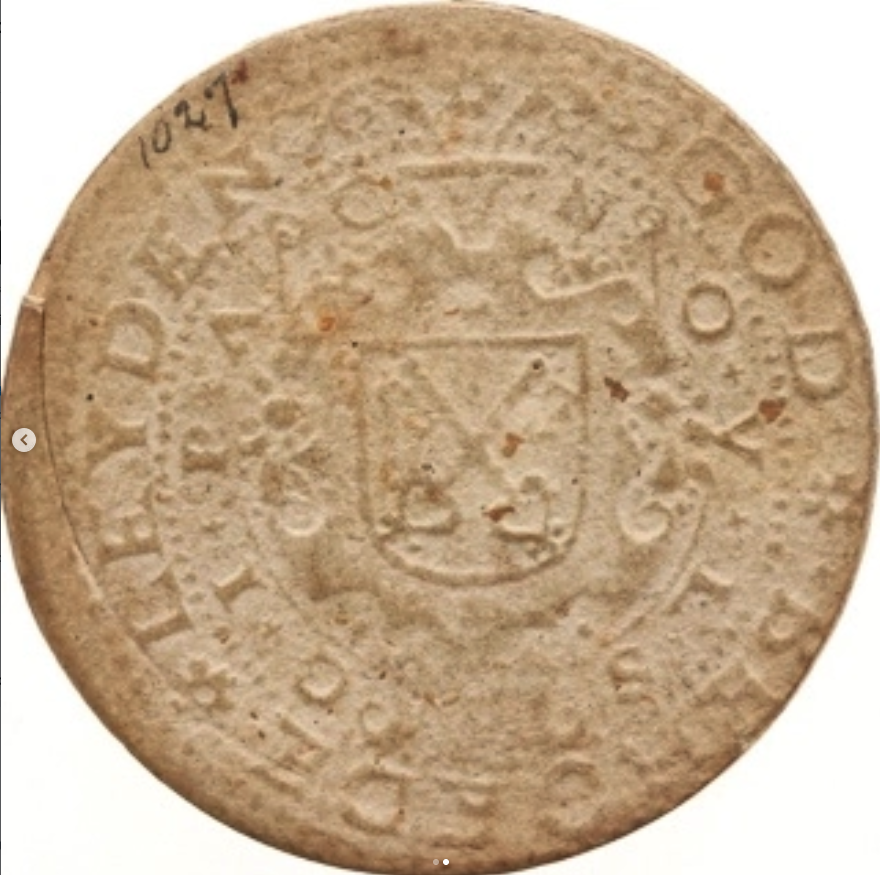
1574 (struck December 1573) Siege Gulden
One of the earliest paper coins in European history - struck from cut-up Catholic missal pages inside a starving city, then counterstamped to mark it as genuine after counterfeits flooded Leyden.
- Metal
- Other
- Grade
- Raw - Counterstamped (validated genuine)
Full attribution & era
The history behind the coin.
During the Eighty Years' War of Dutch Independence, the Spanish army under Don Federico de Toledo besieged the city of Leyden from October 1573 until 3 October 1574. When the Spanish arrived, the city was already short of food. In early 1574 William of Orange raised a 9,000-man relief army; it was crushed at Mookerheide on 26 May. The Spanish then smuggled letters into Leyden promising mercy to those who surrendered and death to those who fought - and it nearly worked. The citizens kept fighting only because Mayor Pieter van der Werff reminded them daily of the atrocities the Spanish had committed at the sack of Haarlem the year before.
The cost was horrific: roughly 6,000 Leydenaars died of plague and starvation; the survivors were reduced to eating horses, rats, and cakes of flour mixed with paper. William of Orange stayed in contact with the city by carrier pigeon. Seeing no other way to relieve it, he ordered the dikes of Holland broken, deliberately flooding his own province - "better a drowned land than a lost land." The Sea Beggars - Dutch privateers - rowed flat-bottomed boats inland through the rising water to harass the Spanish, but the flood at first was too shallow. Then, on the night of 1-2 October, a northwest gale piled the sea up over the broken dikes; the Beggars sailed into Leyden, and Don Federico abandoned the siege on 3 October 1574.
Inside the starving city, money had run out long before food. To pay soldiers and to keep some kind of currency in circulation, the city authorities took the missals and hymnals of Catholic Bibles from the churches and convents - their religious legitimacy already destroyed by the Reformation - and stripped them of their pages. The pages were given to a Leyden bookbinder named Jan Adriaensz, who pasted multiple sheets together into thick card, cut them into round planchets, and struck them with iron dies. The result was a true coin of paper: obverse with the city arms of Leyden in a shield with the legend GOD BEHOEDE LEYDEN ("God protect Leyden") and the date, reverse with the lion of Holland, the crown, and the legend HÆC LIBERTATIS ERGO ("This for the sake of liberty"), 1574.
The first paper Gulden were struck on 19 December 1573, even though the dies were dated 1574. Striking coins on paper before all base metals were exhausted is genuinely unusual; it speaks to a city pushed past every normal expedient. By 16 January 1574 the Leyden authorities had discovered numerous counterfeit paper Gulden in circulation; they ordered all genuine examples to be brought in and counterstamped to validate them, and demonetized the rest. By 21 March all paper coins were withdrawn and exchanged for new silver pieces. After the siege was lifted in October, paper coins were issued one more time - now as commemoratives of the city's deliverance, not as emergency money.
This piece is one of the genuine, counterstamped originals - a small disc of pasted Catholic missal paper that fed a starving city's economy for three months in the worst winter of the Dutch Revolt.
- Mailliet - Catalogue Descriptif des Monnaies Obsidionales et de Nécessité (Leyden 1574 issues).
- PW (Pieter Verkade) / Delmonte - Nederlandse Noodmunten.
- Brand - The Numismatic Chronicle (paper money of Leyden, 1573-74).
- Parker, Geoffrey - The Dutch Revolt.
- Old Leyden Civic Archives - paper Gulden authorization, 19 December 1573.