
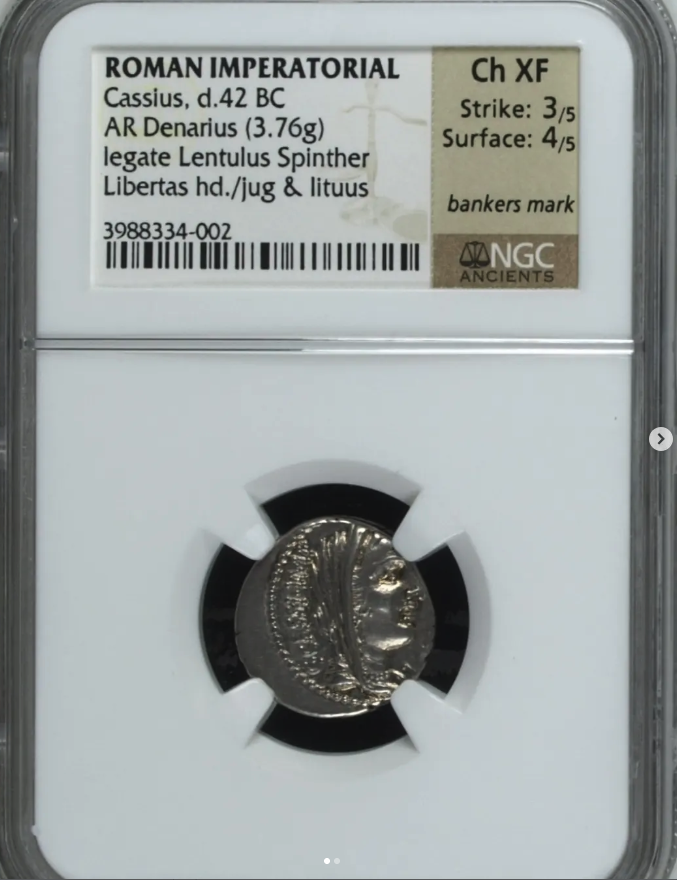
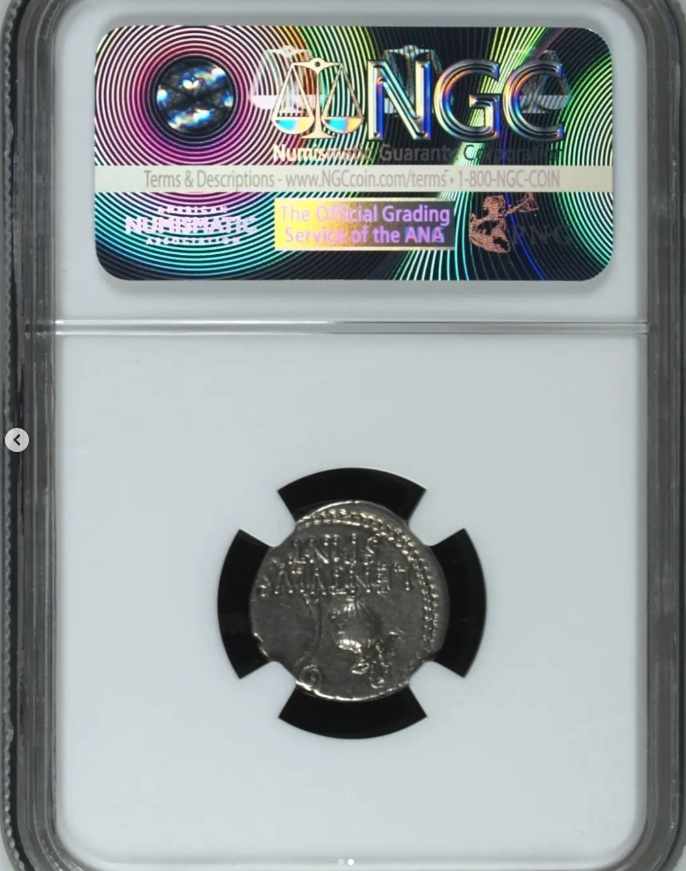
42 BC AR Denarius (3.76g, military mint moving with Cassius and Brutus, Smyrna)
Struck in the East by Cassius - one of the principal assassins of Julius Caesar - in the months between his flight from Rome and his suicide at the First Battle of Philippi.
- Metal
- Silver
- Grade
- NGC Ch XF · Strike 3/5 · Surface 4/5 · bankers' mark
- Cert #
- 3988334-002
Full attribution & era
The history behind the coin.
Gaius Cassius Longinus was already a war hero before he became an assassin. He had survived Crassus's catastrophic Parthian campaign of 53-51 BC, salvaging the remnants of the Roman army after Carrhae and successfully defending the province of Syria against the Parthian counter-invasion. When the civil war between Caesar and Pompey broke out in 49 BC he sided with Pompey, was defeated, and accepted Caesar's clemency in 48 BC - serving the dictator loyally for the next four years.
By 44 BC it was clear to Cassius and to many in the Senate that Caesar had no intention of stepping down as dictator perpetuo. On the Ides of March, Cassius was one of the first conspirators to plunge his dagger into Caesar at the foot of Pompey's statue. When the political reaction in Rome turned against the Liberators, Cassius fled east, returned to his old province of Syria, and seized command of the legions and fleet stationed there. In 42 BC he joined forces with Brutus and marched into Thrace to meet the Caesarian armies of Mark Antony and the young Octavian.
At the First Battle of Philippi in early October 42 BC, Cassius's wing of the army was driven from the field by Antony. From his position he could not see that on the other wing Brutus had simultaneously routed Octavian's troops and effectively saved the day. Believing all was lost, Cassius asked his freedman Pindarus to kill him with the same dagger he had used on Caesar. Brutus, when he found the body, called Cassius "the last of the Romans." Three weeks later, at the Second Battle of Philippi, Brutus was defeated in turn and took his own life.
This denarius was struck during the brief window between Cassius's flight from Rome and his death at Philippi - one of the so-called "Liberators' coinages" produced by the moving military mints that funded the Republican cause in the East. The obverse shows the veiled and diademed head of Libertas right with the legend C·CASSI·IMP - "Gaius Cassius, Imperator." The reverse shows a sacrificial jug (capis) and a lituus (the curved augural staff) with the legend LENTVLVS·SPINT, naming Publius Cornelius Lentulus Spinther, Cassius's legate and proquaestor, and pointedly advertising both their priestly office and their joint military command.
NGC Ancients has graded this Ch XF, Strike 3/5, Surface 4/5, with the bankers' mark on the reverse noted on the label - an authentic ancient test cut from a Roman or Eastern banker satisfying himself that the denarius was solid silver and not a plated fourrée. The portrait of Libertas is sharply struck on a full flan of good silver, and the political symbolism could hardly be more pointed: a coin issued in the name of the man who killed Caesar to defend the freedom of the Republic, with Liberty herself on the obverse and the priestly tools of legitimate Roman authority on the reverse - struck in the very year, and almost certainly the very months, before Philippi ended the Republic for good.
- Crawford - Roman Republican Coinage 500/3 (Cassius / Lentulus Spinther denarius, military mint moving with Cassius, 43-42 BC).
- Sydenham - The Coinage of the Roman Republic 1305.
- Sear - The History and Coinage of the Roman Imperators 220.
- Plutarch, Life of Brutus and Life of Caesar - on Cassius, the Ides of March, and Philippi.
- Appian, Civil Wars, Book IV - on the Liberators' campaign in the East and the battles of Philippi.
- NGC Ancients Cert 3988334-002 - Ch XF, Strike 3/5, Surface 4/5, bankers' mark.