
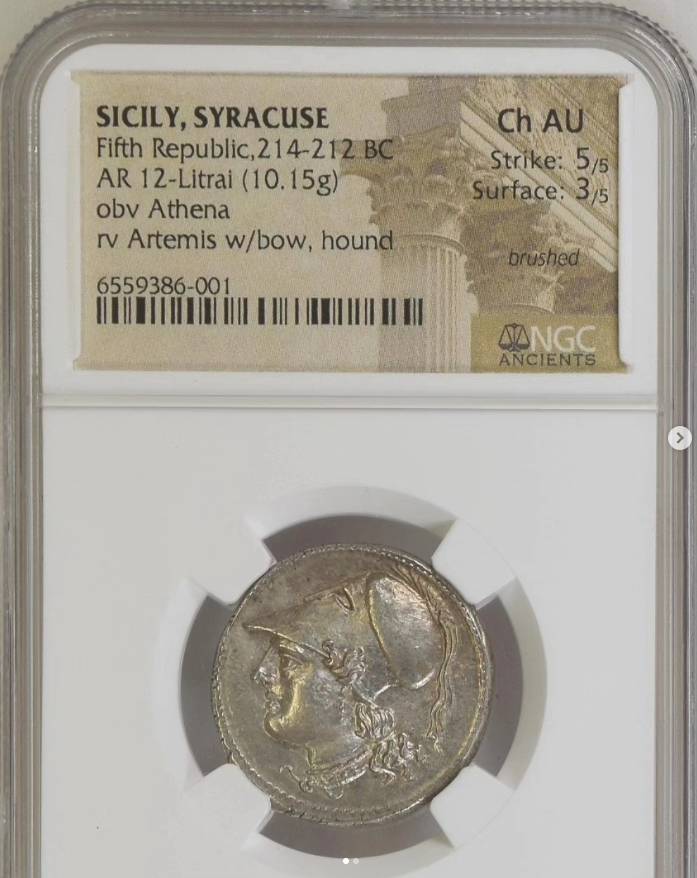
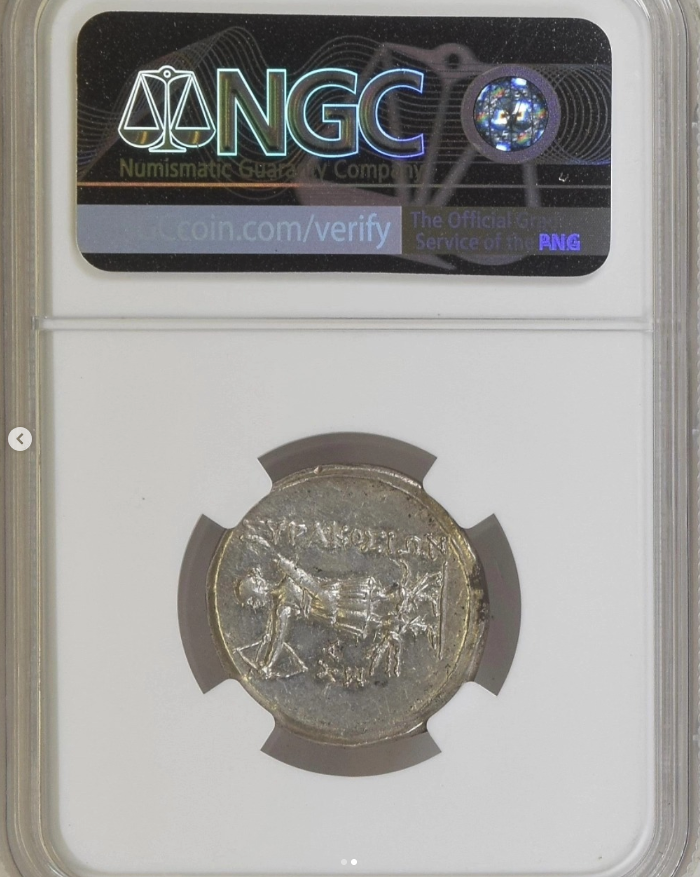
214-212 BC AR 12 Litrai (10.15g)
A large silver 12 litrai of the short-lived Fifth Republic of Syracuse, struck during the Roman siege immortalized by Archimedes' war machines.
- Metal
- Silver
- Grade
- NGC Ch AU · Strike 5/5, Surface 3/5, brushed
- Cert #
- 6559386-001
Full attribution & era
The history behind the coin.
In 215 BC, during the Second Punic War, the long-reigning pro-Roman king of Syracuse, Hieron II, died and was succeeded by his 15-year-old grandson Hieronymus. The young king was easily swayed into abandoning Rome and allying with Hannibal and Carthage. His debauchery and political incompetence made him deeply unpopular, and after only 13 months on the throne he was assassinated.
Even after Hieronymus' death, the new leadership of Syracuse - now reorganized as a democratic republic (the so-called Fifth Republic) - chose to continue the alliance with Carthage. Rome answered by sending an army under the consul Marcus Claudius Marcellus, who landed on Sicily and laid siege to the city.
Aiding the defenders was the great mathematician and engineer Archimedes, whose ingenious war machines became legendary. His defenses included the famous "Claw of Archimedes" - a massive crane-and-hook that could lift Roman ships out of the water and capsize them - heavy ballistas hurling stones, and the much-debated "burning mirrors" said to focus sunlight onto enemy hulls. For nearly two years the siege devolved into a stalemate: Rome could not breach the walls, but refused to lift the blockade.
In 212 BC, a small Roman party slipped into the city under cover of darkness during the festival of Artemis, when the defenders were distracted by celebrations. They threw open the gates and Marcellus' army poured in. Despite explicit orders that Archimedes be taken alive, the old mathematician was killed - according to tradition, while still working on a geometric problem in the dust. The garrison retreated to the inner citadel and held out for another eight months before a bribed defender betrayed it; the Romans then killed or enslaved everyone inside.
This 12 litrai was struck during exactly that brief, doomed Republican interlude, 214-212 BC. The obverse shows the head of Athena left, wearing a crested Attic helmet adorned with a Pegasos. The reverse depicts Artemis Soteira ("the Saviour") standing left, drawing her bow with a hunting hound at her feet, and the legend ΣΥΡΑΚΟΣΙΩΝ ("of the Syracusans") above. The choice of Artemis is no accident - she was the patron goddess whose festival the Romans exploited to enter the city, and on this coin she stands as protector of a republic about to fall.
NGC Ch AU with Strike 5/5 / Surface 3/5 (brushed) is a strong grade for this rare wartime issue. Athena's helmet, Artemis' figure, and the running hound all retain crisp definition - a tangible artifact of the last weeks of independent Greek Syracuse.
- Burnett - The Coinage of the Fifth Democracy at Syracuse (RIN 1983).
- BMC Sicily, Syracuse 631-636 (Athena / Artemis 12 litrai).
- Polybius, Histories VIII; Livy, Ab Urbe Condita XXIV-XXV; Plutarch, Life of Marcellus.
- NGC Cert #6559386-001.