
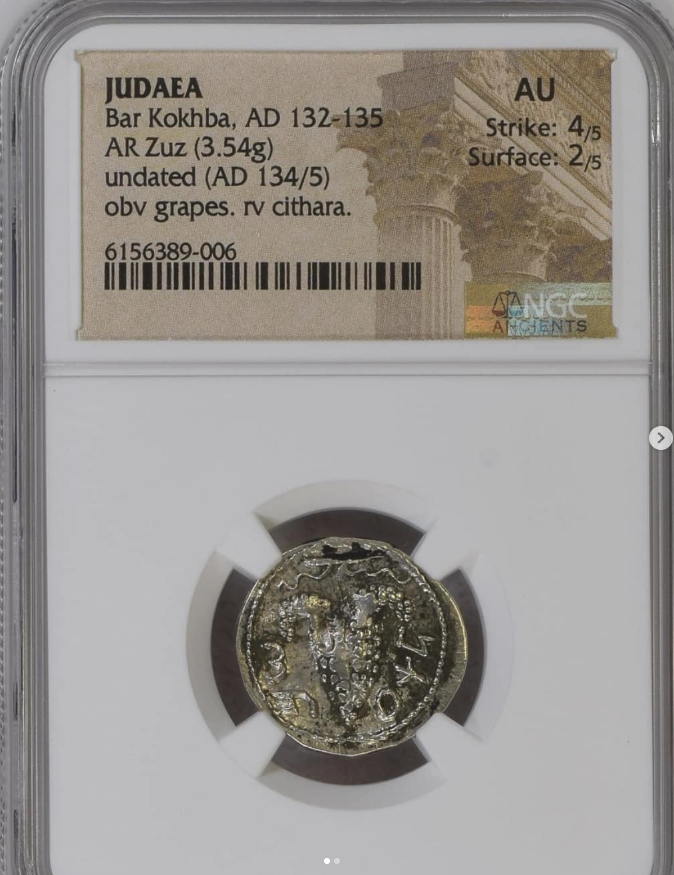
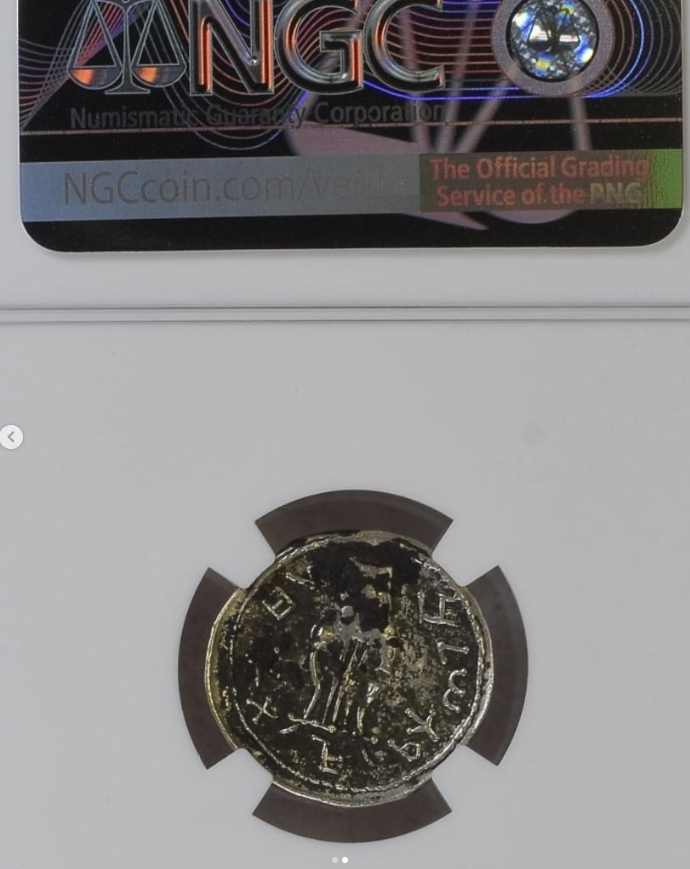
Year 3 of the Revolt (AD 134/5) AR Zuz (3.54g)
A silver zuz of Bar Kokhba - struck over a Roman denarius whose emperor's portrait the rebels deliberately defaced. The coins of a three-year independent Jewish state that bore the legend 'For the Freedom of Jerusalem' and named Bar Kokhba 'Prince of Israel' before Hadrian wiped Judaea from the map.
- Metal
- Silver
- Grade
- NGC Ancients AU · Strike 4/5 · Surface 2/5
- Cert #
- 6156389-006
Full attribution & era
The history behind the coin.
After the catastrophes of the First Jewish War (AD 66-73, ending in the destruction of the Second Temple) and the Kitos War (AD 115-117), the Roman province of Judaea was governed by a senatorial general and permanently garrisoned by two full Roman legions. Under the Emperor Hadrian, the Romans began increasingly restricting Jewish religious life: circumcision was banned (treated by Roman law as castration), and on the ruins of the Second Temple itself - the holiest site in Judaism, leveled by Titus in AD 70 - Hadrian ordered the construction of a temple to Jupiter Capitolinus and renamed Jerusalem itself 'Aelia Capitolina.' The provocation was deliberate, and the response was a third war.
In AD 132 Simon ben Kosiba - renamed 'Bar Kokhba' ('Son of the Star') by the great rabbi Akiva, who proclaimed him the Messiah - led an army that ancient and modern estimates place at somewhere between 200,000 and 400,000 Jewish fighters in revolt against Rome. Using guerrilla warfare from a network of underground tunnels and cisterns, Bar Kokhba's forces routed the resident Roman garrison and, within months, captured all of Judaea except the legionary fortress at Jerusalem itself. The Romans, even reinforced with four additional legions from neighboring provinces, fielded only about 80,000 soldiers, and they suffered several outright defeats in open battle. They were forced to abandon field warfare and resort to siege after siege, town by town - and even that was not working fast enough.
Hadrian recalled his best general, Sextus Julius Severus, the governor of Britannia, and gave him supreme command. Severus brought ten more legions with him - perhaps 120,000 additional soldiers - making the Roman force in Judaea one of the largest concentrations of Roman military power ever assembled in one province. Severus refused open battle and methodically reduced the rebellion fortress by fortress, massacring those who did not surrender immediately. By the summer of AD 135 only the rebel capital of Betar in the Judaean hills remained. When the legions breached the walls, no quarter was given. The Talmud records that the Romans 'went on killing until their horses were submerged in blood up to their nostrils.' Among the dead were the Ten Martyrs - the spiritual leaders of the revolt, including Rabbi Akiva, who was tortured to death with iron combs.
After Betar fell, the Roman army continued a campaign of systematic killing across Judaea, hunting down the surviving villages and tracking refugees through the caves of the Judaean Desert (where their bodies and possessions are still being found by archaeologists today). Cassius Dio gives a Roman casualty figure: 580,000 Jews killed in battle, 50 fortresses destroyed, 985 villages razed, plus uncounted dead from famine and disease. Hadrian then formally banned Jews from entering Jerusalem and erased the province's name from the map - 'Judaea' became 'Syria Palaestina,' a deliberate erasure intended to sever the Jewish people from their land. It worked: there would be no Jewish state in that territory again until 1948.
During the three years of the rebellion Bar Kokhba's administration struck its own coinage as an act of sovereignty. They had no foundry of their own, so the rebels seized circulating Roman silver and bronze - denarii, drachms, tetradrachms - and overstruck them with rebel dies. Where the host coin showed an emperor's portrait, the rebel die-cutters carefully chiseled the imperial face flat before re-striking. The new types are deliberately religious and political: the Jerusalem Temple facade, the lulav and etrog of Sukkot, vine leaves and grape clusters representing Israel, and the cithara - the lyre of King David - on the reverses of the silver zuzim. The Hebrew legends declare 'Simon, Prince of Israel,' 'For the Freedom of Jerusalem,' and (on this third-year issue) 'Year Three of the Freedom of Israel.' The use of paleo-Hebrew script rather than the Aramaic square script of the day was itself an archaizing political statement - a return to the script of the First Temple kings.
This zuz is from the third and final year of the revolt - struck while Severus's legions were already closing in. At 3.54g and graded NGC Ancients AU, it shows the bunch of grapes obverse with the legend 'Simon' in paleo-Hebrew, and the reverse cithara with 'For the Freedom of Jerusalem' - the slogan of a free Jewish state that, within months of this coin leaving the rebel mint, would be drowned in blood. Surface 2/5 is exactly what one expects from an overstrike on a Roman denarius hidden in a cave for two millennia. A 1,890-year-old silver coin from one of the great tragic moments of Jewish history.
- Mildenberg, Leo - The Coinage of the Bar Kokhba War (the standard reference).
- Hendin, David - Guide to Biblical Coins, 5th ed.
- Cassius Dio - Roman History, Book 69 (Hadrian and the Bar Kokhba War).
- Eshel, Hanan - The Bar Kokhba Revolt, in Cambridge History of Judaism Vol. 4.
- Schäfer, Peter - The Bar Kokhba War Reconsidered.
- NGC Cert #6156389-006.