
1708 AR Reichsthaler
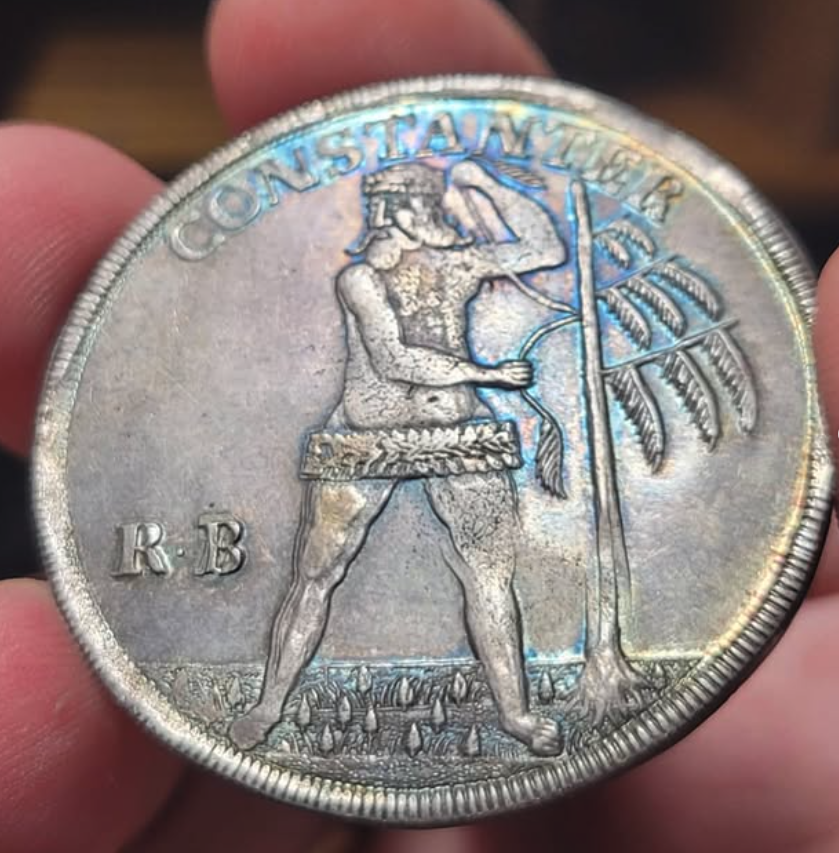
A 1708 Brunswick-Wolfenbüttel Wildman Thaler of Anton Ulrich - the iconic Harz silver type with the bearded forest giant striding through the trees, club replaced here by an uprooted fir, with the ducal motto CONSTANTER ('steadfastly'). Beautifully toned cabinet piece with full rainbow patina across both sides.
- Metal
- Silver
- Grade
- Raw
Full attribution & era
The history behind the coin.
The Wildman Thalers of Brunswick-Wolfenbüttel and Brunswick-Lüneburg are among the most instantly recognisable coins of early modern Germany. The Wild Man (German: Wilder Mann) is an ancient Germanic folkloric figure - a hairy, bearded forest giant from the deep woods - who became, by the late Middle Ages, the heraldic supporter of the House of Welf (Brunswick-Lüneburg). From the 1530s through the early 1800s the dukes of the Welf branches struck a continuous series of silver Thalers depicting the wildman striding through a forest of firs, club or uprooted tree in hand, with the ducal motto stamped overhead. The silver came from the family's most important asset: the great mining district of the Upper Harz Mountains and the Rammelsberg ore body at Goslar - the richest silver source in northern Germany for nearly 1,000 years - struck almost exclusively at the Welf mints of Zellerfeld and Clausthal high up in the Harz.
This piece was struck in 1708 at Zellerfeld for Anton Ulrich, Duke of Brunswick-Wolfenbüttel (1633-1714). Anton Ulrich is one of the more cultured figures of the late Baroque - a published novelist, librettist, builder of the magnificent Schloss Salzdahlum (the "Versailles of Lower Saxony"), patron of Leibniz, and the grandfather, through his granddaughter Elisabeth Christine, of the Habsburg empress Maria Theresa. He had ruled jointly with his elder brother Rudolf August from 1685, but in 1704 he became sole duke and immediately set about reasserting Wolfenbüttel's independence against the increasingly dominant Hanoverian (Brunswick-Lüneburg) cousins who would, in 1714, inherit the British throne as George I. The 1708 issue belongs squarely to the years of the War of the Spanish Succession, when Anton Ulrich's Hanoverian rivals were among the principal Allied commanders against Louis XIV.
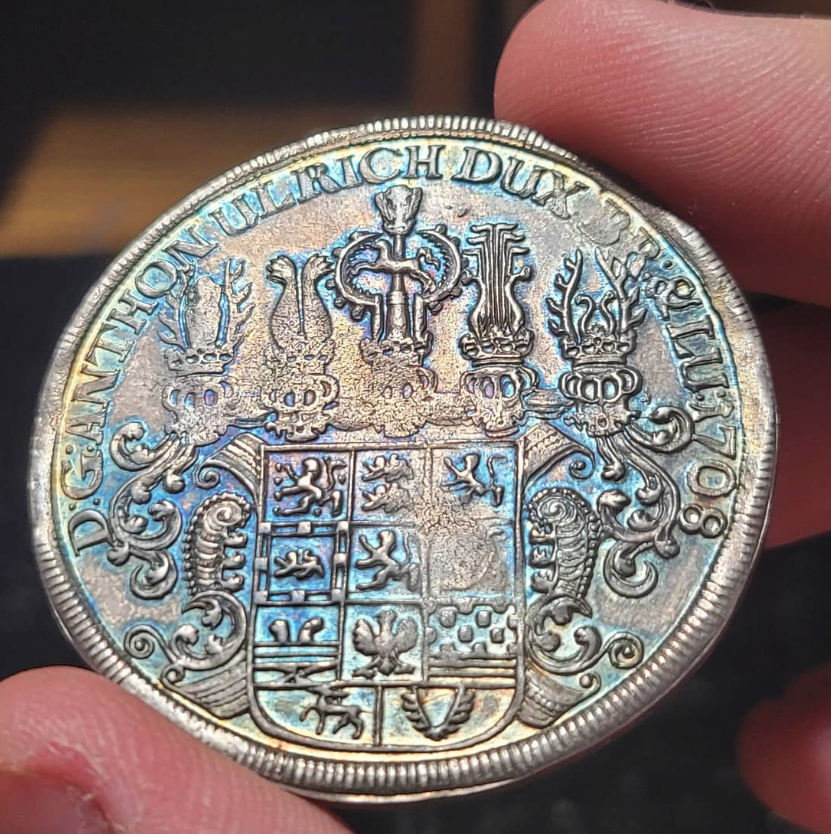
The obverse shows the bearded, near-naked wildman striding to the right through a stand of firs, his loins girt with a leafy garland, an uprooted fir tree shouldered like a banner. The motto CONSTANTER ("steadfastly" - the dynastic motto adopted by the Wolfenbüttel line) curves overhead. The mintmaster's initials R-B in the field stand for Rudolf Bornemann, mintmaster at Zellerfeld in the early 1700s. The reverse displays the elaborate quartered arms of Brunswick-Lüneburg surmounted by five crowned helms (Welf, Lüneburg, Brunswick, Eberstein, Diepholz), with the legend D · G · ANTHON · ULRICH · DUX · BR · ET · LU · 1708 - "By the Grace of God Anton Ulrich Duke of Brunswick and Lüneburg, 1708." Welter 2169; Davenport 2125.
The toning on this example is exceptional - long undisturbed cabinet storage has produced a full spectrum of cobalt-blue, rose, gold, and silver iridescence, hugging the high relief of both wildman and arms.
- Welter 2169 (Brunswick-Wolfenbüttel, Anton Ulrich, Reichsthaler 1708, Zellerfeld, R-B).
- Davenport - German Talers 1700-1800, Dav. 2125.
- KM-723 (Brunswick-Wolfenbüttel, Anton Ulrich Wildman type).
- K. Jaeger / Müseler - Hannoversche Münzgeschichte (Harz mining and the Welf mints of Zellerfeld and Clausthal).
- Brage bei der Wieden - Anton Ulrich, Herzog zu Braunschweig und Lüneburg-Wolfenbüttel (biographical context).