
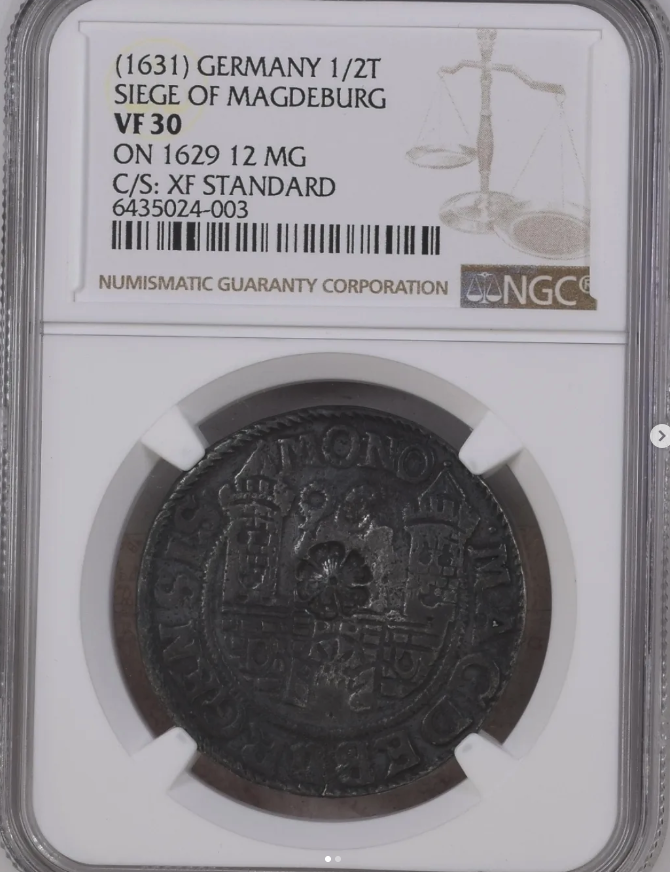
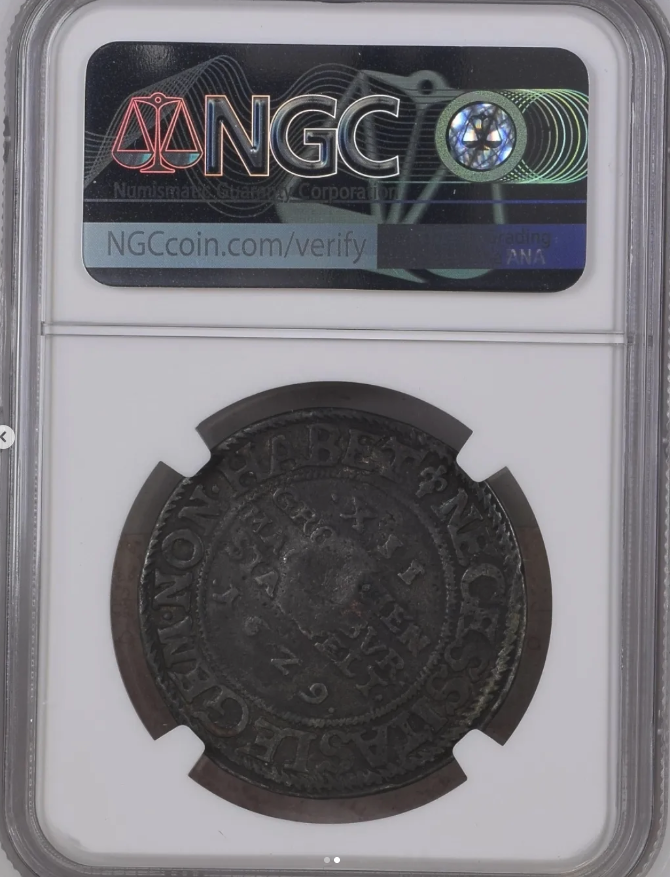
1631 (counterstamped on a 1629 host coin) 1/2 Thaler emergency counterstamp ('XF Standard' over a 1629 12 Mariengroschen of Magdeburg)
An emergency revaluation counterstamped onto an older Magdeburg coin during the siege - silver from a city that, weeks later, was annihilated. Of 25,000 inhabitants, only 5,000 survived.
- Metal
- Silver
- Grade
- NGC VF-30
- Cert #
- 6435024-003
Full attribution & era
The history behind the coin.
Since the Protestant Reformation, Magdeburg had been a safe haven for Lutherans - one of the largest, wealthiest, and most defiantly Protestant cities in the Holy Roman Empire. When the Thirty Years' War broke out, Protestant Magdeburg sided openly with King Gustavus Adolphus of Sweden against the Catholic Habsburg Emperor Ferdinand II. By the time Gustavus had begun making inroads in Pomerania, the Imperial general Count Johann Tserclaes von Tilly had already begun besieging the city - the siege opened on 20 March 1631.
After two months of constant bombardment with no signs of surrender, Tilly ordered his army of roughly 40,000 troops to storm the walls. Unbeknownst to him, Magdeburg's City Council had voted the day before to begin surrender negotiations. During the storming, the Swedish-appointed military commander Dietrich von Falkenberg was shot dead in the streets - and all hell broke loose.
There are written reports of Imperial attackers setting fire to individual houses to dislodge defenders, with the flames then spreading uncontrolled through the close-packed wooden city. By 10 a.m. on 20 May 1631 most of Magdeburg was on fire. Most of the victims of the siege did not die by the sword but suffocated or burned to death. The wind fanned the flames. In the end, 1,700 of the city's roughly 1,900 buildings were destroyed.
While Magdeburg burned, the Imperial soldiery lost all discipline. The army had not been paid in months, and they took out the deficit on the civilian population - demanding valuables from every household, raping women and children, torturing citizens to reveal hidden silver. Of 25,000 inhabitants only about 5,000 survived. Tilly finally ordered an end to the looting on 24 May, and a Catholic mass was celebrated in the ruined cathedral the next day. For fourteen days afterwards, charred bodies were dumped into the Elbe River.
The Imperial mercenary Peter Hagendorf, marching with the army, kept a journal. He wrote: "the streets were littered with naked corpses, with many women drowned headfirst in a beer barrel. Five or six waves of soldiers went to each house demanding all valuables, and when the poor citizenry had none they were raped, tortured, and slaughtered where they stood."
The atrocity is remembered by two names: Magdeburgs Opfer ("Magdeburg's Sacrifice") and the bitterly ironic Magdeburger Hochzeit - "Magdeburg Wedding." It became the most notorious massacre of the Thirty Years' War and one of the bloodiest siege-sacks in European history. The shock of Magdeburg drove dozens of Protestant princes who had been wavering into Gustavus Adolphus's arms; within sixteen months the Swedes destroyed Tilly's army at Breitenfeld and again at the Lech, where Tilly himself was mortally wounded.
This coin is a survivor from inside that catastrophe. The host is a 1629 12 Mariengroschen of Magdeburg, struck in the city's own mint two years before the siege - obverse with the Magdeburg city arms (the maiden in the gate-tower) and the legend MONETA · NOVA · ARGENTEA · MAGDEBURGENSIS, reverse with the imperial value tablet. During the 1631 siege, as the city ran out of bullion to strike fresh emergency coin, Magdeburg's mint took older silver in circulation and counterstamped it with the "XF Standard" punch revaluing it as a half-Thaler siege piece to pay the garrison. The counterstamp is clear on the obverse field. NGC VF-30 with a sharp, fully readable counterstamp on a fully attributable host - silver that physically passed through besieged Magdeburg in the weeks before the city was wiped from the map.
- Wilson, Peter H. - Europe's Tragedy: A History of the Thirty Years War.
- Medick, Hans & Marschke, Benjamin - Experiencing the Thirty Years War (Hagendorf diary).
- Friedrichs, Christopher - Urban Politics in Early Modern Europe.
- Helbig, Herbert - Die Belagerung und Zerstörung Magdeburgs 1631.
- NGC Cert #6435024-003.