
1779 Peace of Teschen Medallic Thaler (Davenport 2023A)
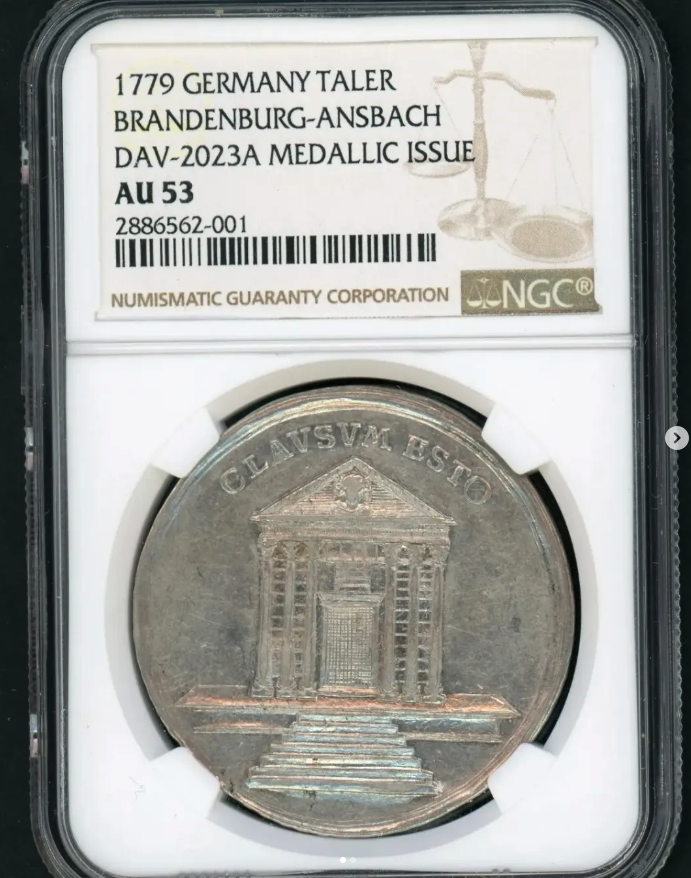
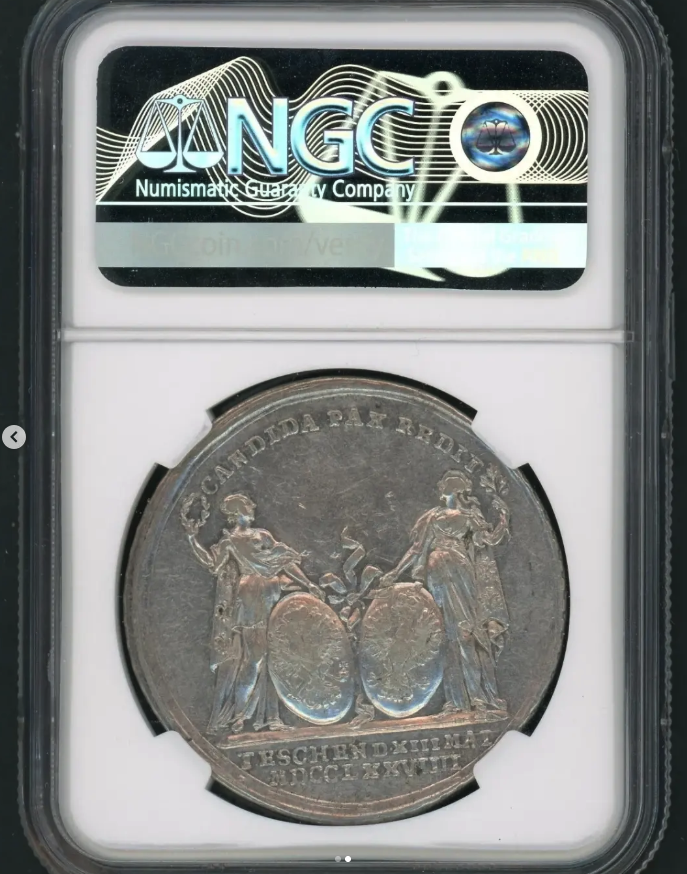
Brandenburg-Ansbach medallic thaler celebrating the Peace of Teschen - the closed Temple of Janus on the obverse, Prussia and Austria clasping hands over their joined arms on the reverse.
- Metal
- Silver
- Grade
- NGC AU 53
Full attribution & era
The history behind the coin.
The War of the Bavarian Succession (1778-1779) was the last great Habsburg-Hohenzollern confrontation of the 18th century. When the Wittelsbach Elector of Bavaria died without a direct heir, Emperor Joseph II of Austria moved to absorb large parts of Bavaria into the Habsburg lands. Frederick the Great of Prussia - unwilling to let Austria expand at the expense of the Reich's princely balance - mobilized against him. The campaign that followed was so dominated by foraging and so light on actual battle that the German soldiers nicknamed it the Kartoffelkrieg, the "Potato War."
Russian and French mediation brought the parties to the Silesian town of Teschen, and on 13 May 1779 the Treaty of Teschen ended the war: Austria received only the small Innviertel district, Bavaria's integrity was preserved, and the European balance held. To celebrate the peace, several German states struck commemorative medallic thalers - and the Brandenburg-Ansbach issue (Davenport 2023A) is one of the most beautifully conceived of them all.
The obverse shows the closed Temple of Janus, with the legend CLAVSVM ESTO - "Let it be closed." In Roman antiquity, the doors of the Temple of Janus in the Forum stood open in time of war and were ceremonially closed only when Rome was at peace on every frontier; under the Republic and Empire this happened only a handful of times across centuries. Putting CLAVSVM ESTO on a 1779 thaler was a deliberately classical, learned proclamation of peace.
The reverse carries the legend CANDIDA PAX REDIT - "Bright Peace returns" - around the standing personifications of Prussia and Austria, each holding olive and laurel branches and resting one hand on the joined oval shields bearing their respective arms. The exergue reads TESCHEN D[IE] XIII MAI MDCCLXXVIIII, dating the design precisely to the day the treaty was signed.
NGC AU 53 preserves the architectural detail of the temple - columns, pediment, and steps all sharp - along with the figural composition on the reverse, with only the gentlest cabinet wear on the highest points. Peace medals struck on thaler flans by the smaller German princely mints are a specialty of late-baroque numismatics, and this Brandenburg-Ansbach Davenport 2023A is among the iconic examples of the genre.
- Davenport - German Talers since 1500, no. 2023A (Brandenburg-Ansbach Peace of Teschen).
- Slg. Wilmersdörffer / Slg. Erlanger - Brandenburg-Ansbach.
- KM #305 / Krause Standard Catalog of World Coins.
- NGC Cert 2886562-001 (AU 53).