
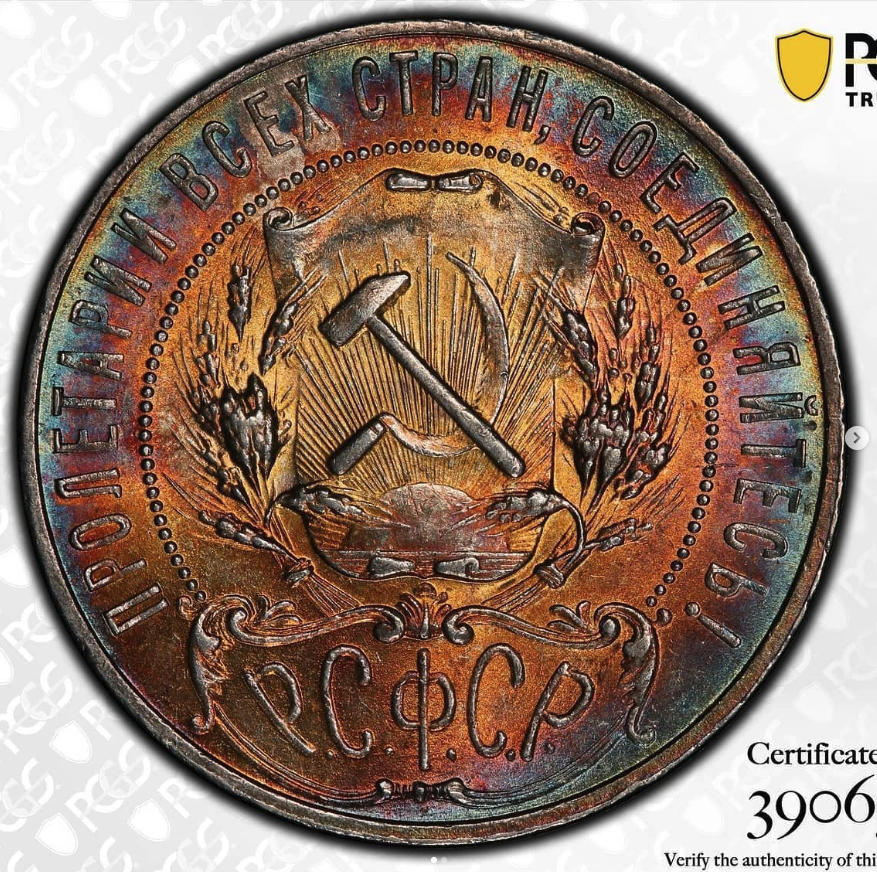
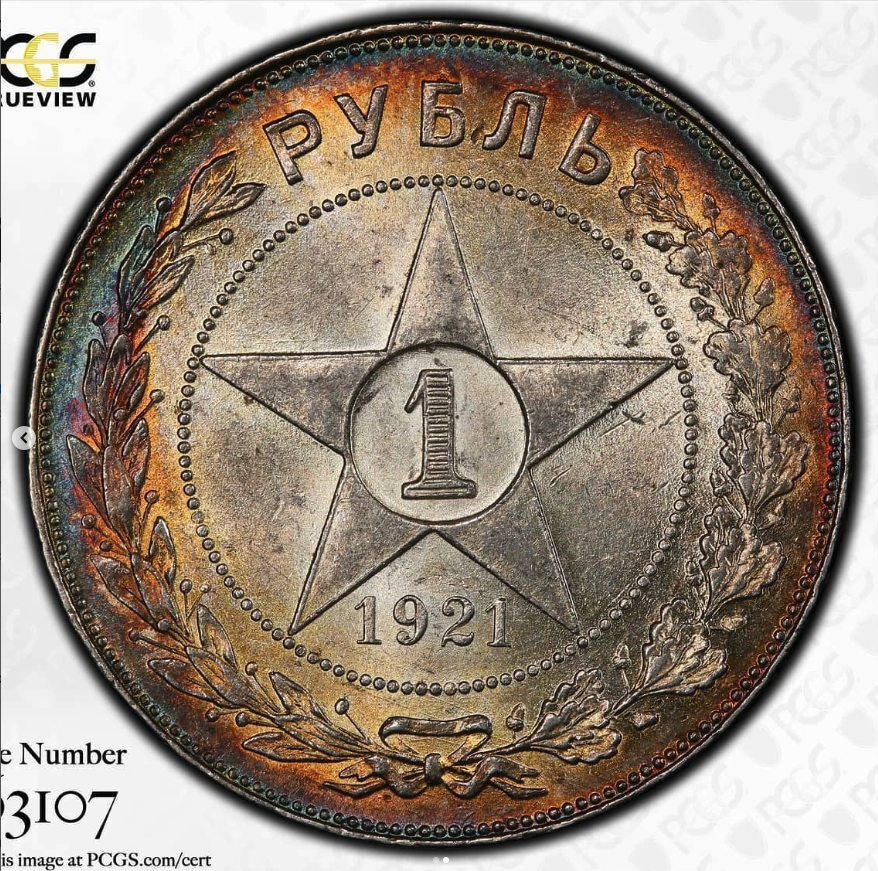
1921 AR Rouble (20g, .900 silver)
First-year-of-issue Soviet rouble, a two-year type (1921-1922) struck during the final year of the Russian Civil War. The first silver coinage of the new Bolshevik state, with the iconic hammer-and-sickle coat of arms and the 'Workers of all countries, unite!' legend. PCGS MS-62 with extraordinary full rainbow cabinet toning.
- Metal
- Silver
- Grade
- PCGS MS-62
Full attribution & era
The history behind the coin.
When the Bolsheviks seized power in October 1917 they inherited a currency in collapse. The Tsarist gold rouble had effectively ceased circulation in 1914, the Provisional Government had flooded the market with paper kerenki, and by 1920 the rouble had inflated to roughly one ten-thousandth of its 1914 value. Through the Russian Civil War (1918-1922) the Soviet government fought on multiple fronts simultaneously - against the White armies of Kolchak, Denikin, Yudenich and Wrangel, against Allied intervention forces (British, French, American, Japanese, Czech Legion), and against the Polish Republic in 1920 - while financing itself almost entirely through the printing press. Hyperinflation by 1921 was approaching German-1923 levels.
In late 1921, with the war effectively won and Lenin pivoting to the New Economic Policy (NEP) of limited market liberalization announced at the 10th Party Congress in March, the Soviet government took the first concrete step toward currency reform: it ordered the Petrograd mint - the same mint that had struck the silver of every Romanov tsar from Peter the Great onward - to begin striking silver coinage in the name of the new state. The 1921 rouble was the result. Struck on the same 20-gram, .900-fine silver standard as the late Imperial rouble (the Soviets used the existing dies, machinery and metal stocks of the old Imperial mint), the new coin was a deliberate statement that the Soviet government intended to return to a metallic currency.
The iconography is among the cleanest and most powerful of all early Soviet design. The obverse carries the very first version of the RSFSR coat of arms: the hammer (industrial proletariat) crossed with the sickle (peasant agriculture) on a rising-sun field, framed by a wreath of wheat and tied with a ribbon at the base reading Р·С·Ф·С·Р (Russian Soviet Federative Socialist Republic). The encircling legend - ПРОЛЕТАРИИ ВСЕХ СТРАН, СОЕДИНЯЙТЕСЬ! - is the closing line of the Communist Manifesto: "Workers of all countries, unite!" The reverse is dominated by a large five-pointed star with the denomination "1" in the central circle and the date 1921 beneath, surrounded by oak (strength) and laurel (victory) branches and the word РУБЛЬ above. The overall composition is a deliberate visual break from the Romanov double-headed eagle that had appeared on every previous Russian rouble for two centuries.
The 1921 rouble is the first year of a tightly limited two-year type (1921 and 1922 only). In 1923 the design was modified for the new chervonets-backed currency, and from 1924 onward all Soviet roubles bore the legend СССР - the USSR having been formally constituted on 30 December 1922. Surviving 1921 roubles in mint state are scarce; the Civil War context meant most circulated heavily and most of the silver was eventually withdrawn for melting in the great recoinages of the 1920s and 1930s. PCGS MS-62 with the kind of full-spectrum rainbow toning - magenta, electric blue, gold and amber - that is essentially never seen on Soviet silver of this era.
- Krause-Mishler - Standard Catalog of World Coins, Y#84 (RSFSR rouble 1921-1922).
- Fedorin - Soviet Coins 1921-1991, no. 1 (1921 rouble, first Soviet silver issue).
- Uzdenikov - Russian Coins 1700-1917 / Soviet Coins 1921-1991 (Petrograd mint operations under the new Soviet government).
- PCGS Cert lookup - PCGS.com/cert.
- Karl Marx and Friedrich Engels, Manifesto of the Communist Party (1848) - source of the obverse legend ПРОЛЕТАРИИ ВСЕХ СТРАН, СОЕДИНЯЙТЕСЬ!
- Orlando Figes - A People's Tragedy: The Russian Revolution 1891-1924 (1996) - background on the Civil War, hyperinflation and the introduction of the NEP.