
1613/2 Thaler with '1' Counterstamp
An overdated 1613/2 thaler of Archduke Maximilian III as Hochmeister of the Teutonic Order, struck at Hall in Tirol and later validated with a small '1' counterstamp.
- Metal
- Silver
- Grade
- NGC AU-50
Full attribution & era
The history behind the coin.
Archduke Maximilian III of Austria (1558-1618), brother of Emperor Rudolf II, served as Hochmeister (Grand Master) of the Teutonic Order from 1590 until his death. By the early 17th century, the Order had long lost its medieval territorial empire in Prussia and the Baltic, but it remained a powerful sovereign Catholic institution within the Holy Roman Empire, controlling commanderies (Balleien) scattered across German lands and drawing income from rich silver mines in Tirol.
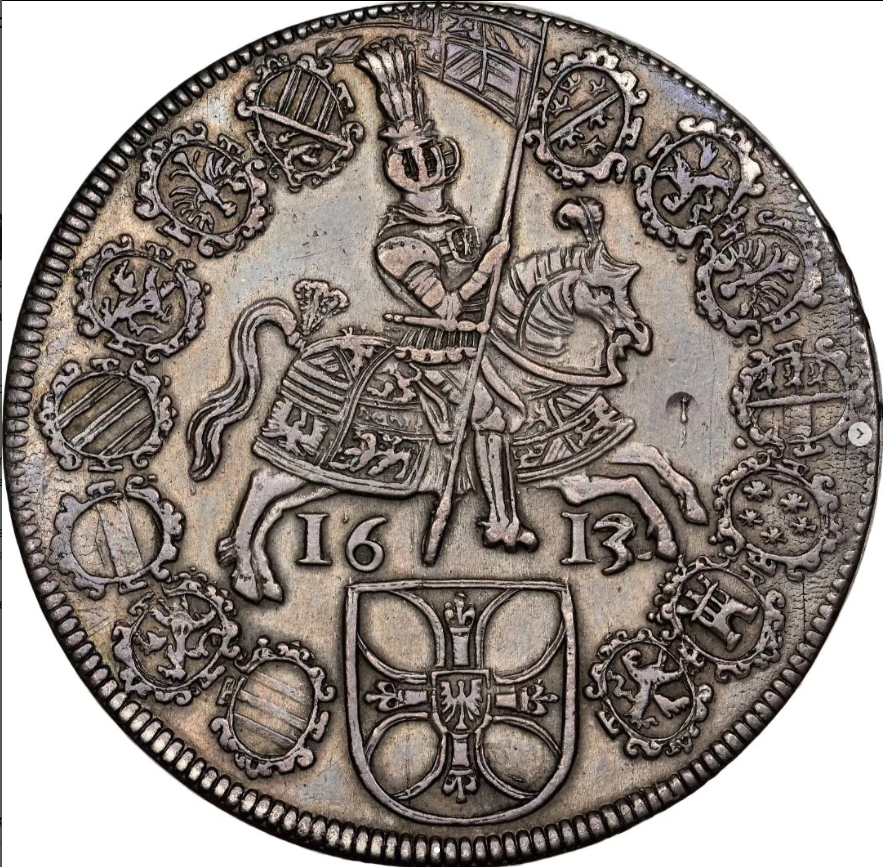
This thaler was struck in 1613 at the Hall in Tirol mint - one of the great silver mints of the Habsburg lands - with the date clearly recut from 1612, producing the well-known 1613/2 overdate variety. Some time after issue, the coin received a small punched "1" counterstamp, a contemporary validation mark of a kind sometimes applied to verify weight or fineness for continued circulation in a specific region.
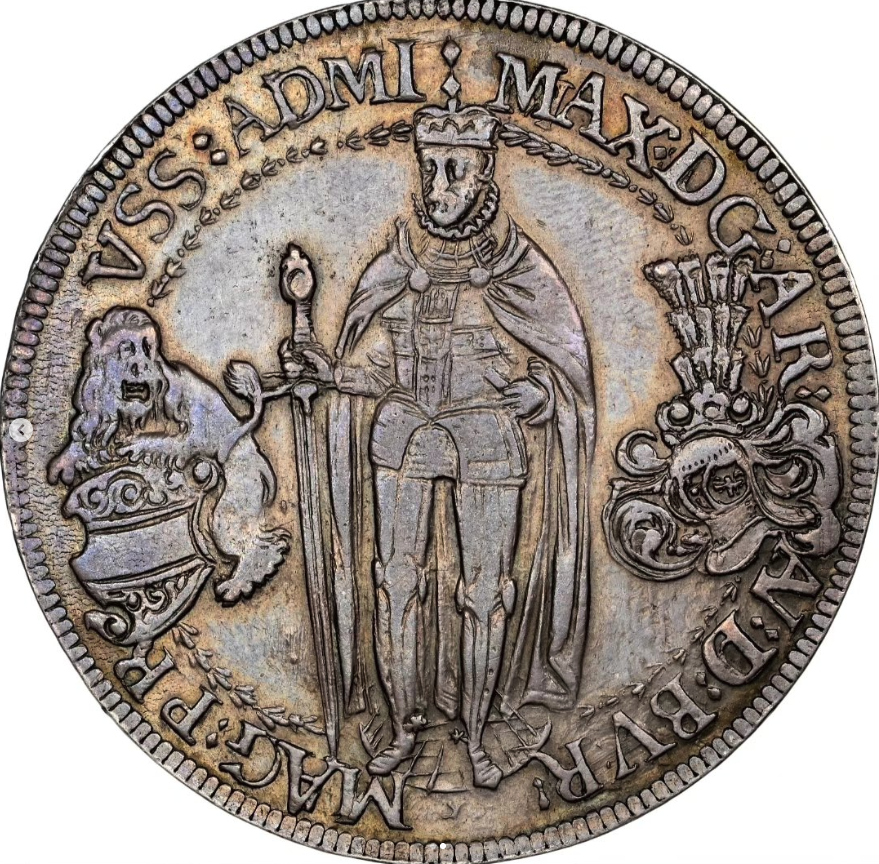
The obverse shows Maximilian standing in full regalia, crowned and robed as both Habsburg Archduke and Grand Master, holding a long sword. He is flanked by a helmeted lion crest on his right and an elaborate Teutonic-Habsburg armorial cartouche on his left. The Latin legend gives his full titulature: MAX[IMILIANUS] D[EI] G[RATIA] AR[CHIDUX] AVS[TRIAE] D[UX] B[URGUNDIAE] MAG[ISTER] PR[USSIAE] ADMI[NISTRATOR] - "Maximilian, by the Grace of God, Archduke of Austria, Duke of Burgundy, Master of Prussia, Administrator..." - referencing his role over the Order.
The reverse is one of the most striking compositions in Habsburg-Teutonic numismatics: Maximilian in full plate armor, plumed helmet down, mounted on a richly caparisoned charger and carrying a long lance, with the date 16-13 split across the field beneath the horse. The rider is encircled by the individual coats of arms of the twelve Ballei (provincial commanderies) of the Teutonic Order, each in its own ornate cartouche, with the central Teutonic shield directly below the horse.
NGC AU-50 is a strong grade for this large, deeply engraved type. The portrait, the equestrian Grand Master, and the ring of Ballei arms all retain crisp definition, and the small contemporary "1" counterstamp adds an extra layer of historical interest - quiet evidence that this coin once circulated and was deliberately re-validated by a 17th-century authority.
- Davenport, John S. - European Crowns 1600-1700.
- Prokisch, B. - Repertorium zur neuzeitlichen Münzprägung Europas (Hall in Tirol).
- Dudík - Des hohen Deutschen Ritterordens Münz-Sammlung (Vienna).