
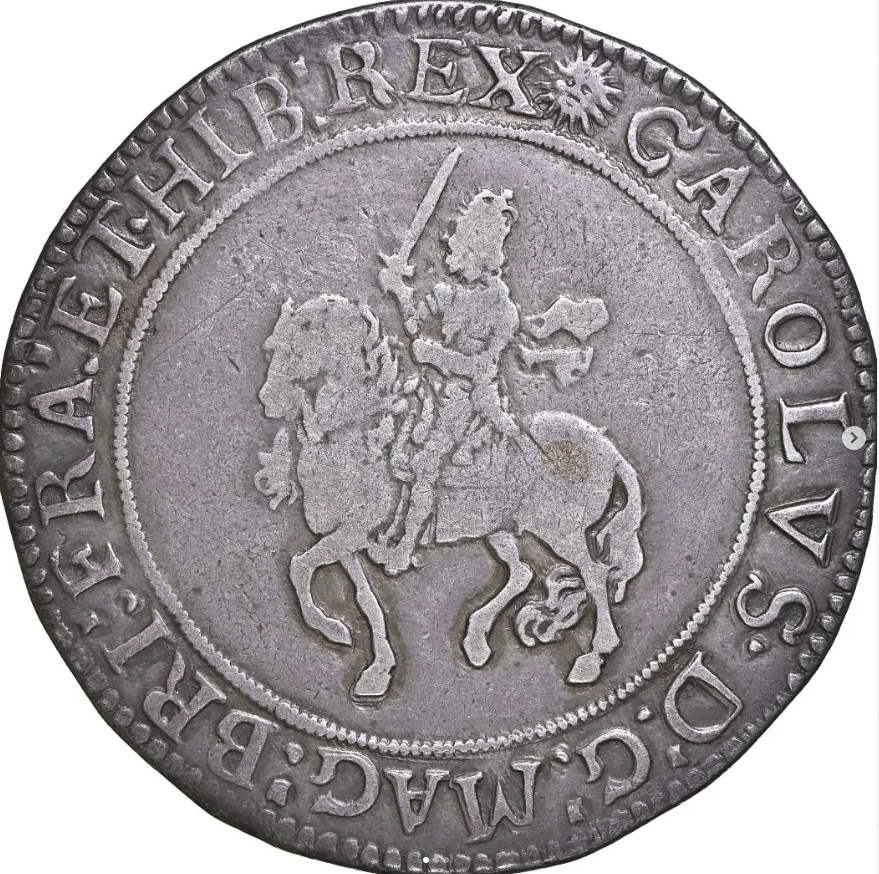
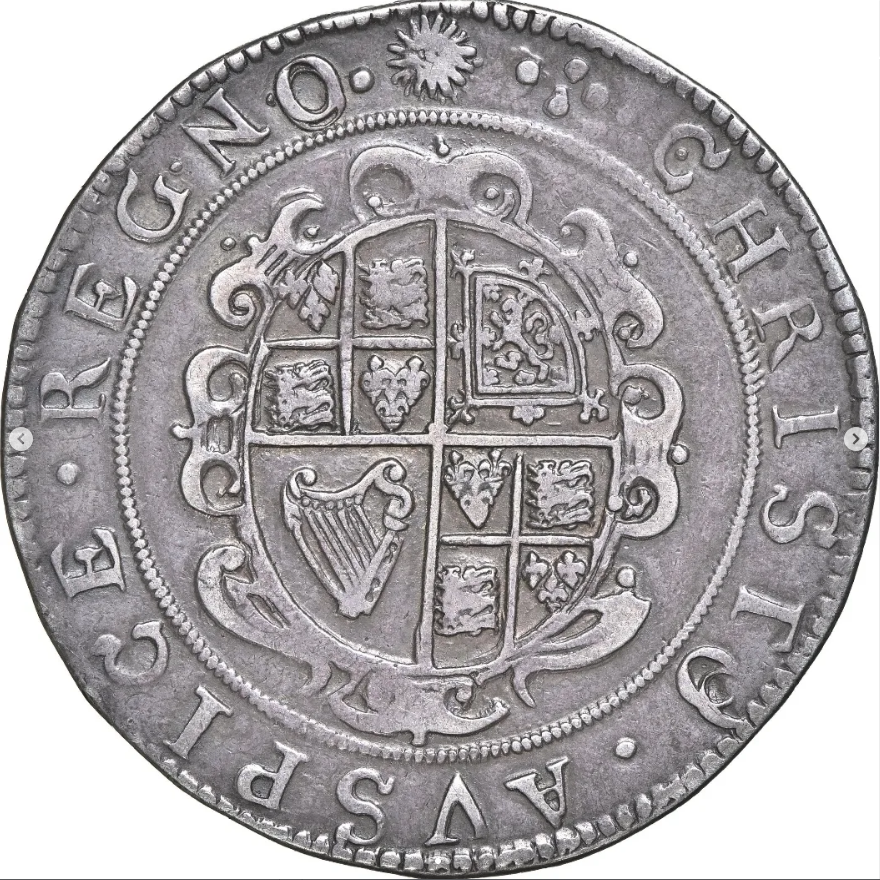
1645-1646 AR Crown
Equestrian crown of Charles I, struck at the Tower of London under Parliamentary control near the end of the First English Civil War - the king's portrait still on the silver of the Parliament that was about to put him on trial.
- Metal
- Silver
- Grade
- NGC VF 20
Full attribution & era
The history behind the coin.
Charles I came to the throne in 1625 already at odds with Parliament. When the Commons refused to grant him the customary lifetime grant of Tunnage and Poundage to fund the royal household, an enraged Charles dismissed Parliament in 1629 and refused to call another for eleven years - the so-called "Personal Rule."
Without Parliament, the only legal taxing authority in the kingdom, Charles improvised. The most notorious of the resulting expedients was Ship Money: a medieval levy under which coastal counties were obliged to provide the Crown with a warship (or its cash value) in time of national danger. Charles first extended Ship Money to all coastal counties in peacetime; the next year he extended it again to the inland counties. When John Hampden challenged it in court the bench split, but the principle was widely understood as illegal taxation by another name. The king also resorted to "Forced Loans" against the nobility - loans he had no intention of repaying. Five knights who refused to pay were imprisoned in the Tower without trial.
The final break came over religion. Charles and Archbishop William Laud were Arminian high-churchmen - technically Protestant but, in the eyes of their critics, dangerously close to Catholic ceremony. When they tried to impose a Laudian prayer book on the Presbyterian Kirk of Scotland in 1637, the Scots rose in the Bishops' Wars. Compounding the problem, Charles's queen, Henrietta Maria of France, was openly Catholic; and in October 1641 a major Catholic rebellion broke out in Ireland in the king's name, deepening Parliament's suspicion that Charles was secretly arming a popish counter-revolution.
Needing money for the war against the Scots, Charles recalled Parliament in April 1640. After three weeks of refusal to vote taxes until grievances were heard, he dissolved it - the Short Parliament. Forced back to the same well within months, he called what became the Long Parliament, which immediately impeached and (in May 1641) executed his chief minister, the Earl of Strafford. In January 1642 Charles tried to arrest five members of the Commons on the floor of the House itself - and failed, the birds having flown. Within weeks he had left London for Nottingham, where in August 1642 he raised the royal standard and the First English Civil War began.
This crown belongs to the very end of that war. By 1645-1646 the king's field armies had been broken at Naseby and Langport, and the Tower of London - and therefore the official royal mint inside it - had been in Parliamentary hands since the start of the war. The Tower mint nevertheless continued to strike coinage in the king's name and with the king's portrait, the same dies and types as before, only now under Parliament's authority and used to pay Parliament's New Model Army. The obverse shows Charles I on horseback, sword raised, with the legend CAROLVS·D·G·MAG·BRI·FRA·ET·HIB·REX ("Charles, by the grace of God, of Great Britain, France and Ireland King") and the sun mintmark dating it to the 1645-1646 issue. The reverse carries the crowned royal arms with CHRISTO AVSPICE REGNO ("I reign under the auspices of Christ").
NGC has graded this VF 20 - the equestrian portrait, the legend, and the quartered shield with England, Scotland, France, and Ireland are all clearly readable on a heavy original silver flan with the soft grey patina characteristic of an authentic mid-17th-century English Civil War crown. It is a remarkable physical artefact: the king's own coinage, struck for him at his own mint by the Parliament that within three years would put him on trial and behead him in front of his own banqueting house in January 1649.
- North - English Hammered Coinage, vol. II, 2316 (Charles I Tower crown, sun mintmark, 1645-46).
- Spink Standard Catalogue of British Coins (Charles I, Tower mint under Parliament, sun mm).
- C. V. Wedgwood - The King's War 1641-1647.
- Conrad Russell - The Causes of the English Civil War.
- NGC Cert - VF 20.