
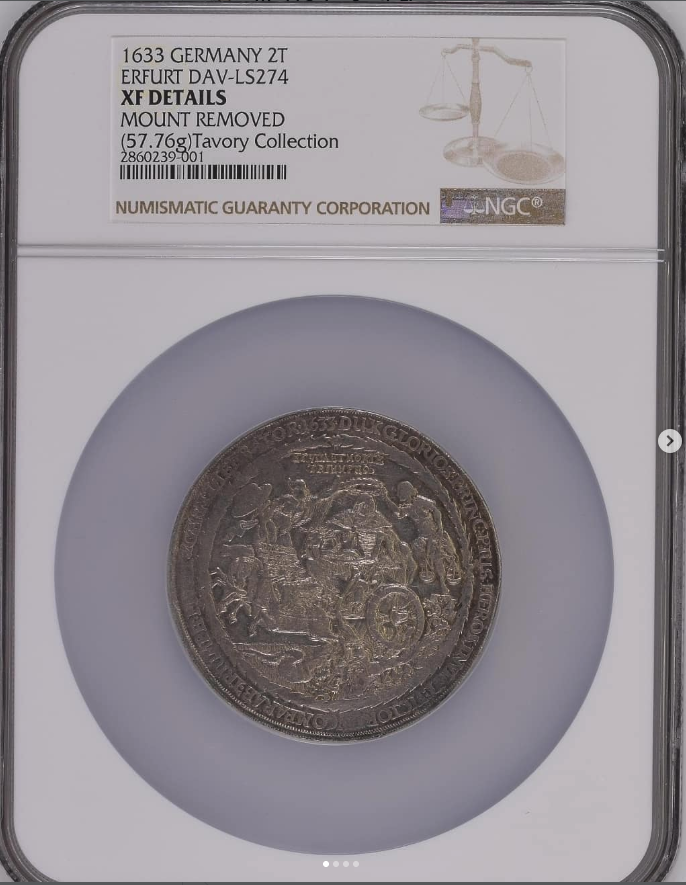
1633 AR 2 Thaler (57.76g)
One of the legendary funeral coins of Gustavus Adolphus - struck at Wolgast in 1633 from melted-down royal silver as the dead king's body passed to the Baltic coast. Mintage of just 60 pieces. The coins were thrown from the Queen's carriage into the street and trampled in the chaos - 36 people are estimated to have died in the scramble. Tavory Collection. NGC XF Details.
- Metal
- Silver
- Grade
- NGC XF Details · Mount Removed
- Cert #
- 2860239-001
- Pedigree
- Tavory Collection
Full attribution & era
The history behind the coin.
The Thirty Years' War (1618-1648) began with the Second Defenestration of Prague: in May 1618 Bohemian Protestant nobles threw the Catholic regents of the new Holy Roman Emperor Ferdinand II out of a third-storey window of Prague Castle into a pile of manure in the moat below. Within five years what had begun as a Bohemian religious rebellion had become a continental war engulfing nearly every state in Europe. By 1630 the Catholic Imperial side, under Wallenstein and Tilly, was on the verge of total victory. Sweden, under its 36-year-old warrior king Gustavus II Adolphus - the "Lion of the North," tactical innovator and defender of European Protestantism - intervened on the Protestant side in July 1630. Within two years Gustavus had reversed the entire war, defeated Tilly at Breitenfeld, and driven the Imperial armies back across Germany.
On 16 November 1632, at the Battle of Lützen near Leipzig, Gustavus personally led a cavalry charge through dense fog into the Imperial right wing. Separated from his bodyguard in the smoke, he was shot through the arm, then through the back, then finally killed with a pistol shot to the head. His body was stripped by Imperial soldiers and only recovered after the Swedish counter-attack retook the field. Sweden won the battle but lost the king.
The corpse was embalmed and began the long, slow funeral procession north toward the Baltic and home. It arrived at the Pomeranian port-city of Wolgast in January 1633 to await transport across the sea to Stockholm. To commemorate the moment, the city mint at Wolgast - briefly reopened for the occasion under Swedish-occupied authority and traditionally attributed in the Davenport reference to the Erfurt mint, hence "Erfurt Dav-LS-274" - struck a small series of memorial multiple-thalers and ducats from silver melted down from Queen Eleonora of Brandenburg's own washbasin and water-jug, brought along in the funeral train. Mint records survive: 16 four-ducats, 20 four-thalers, 40 three-thalers, 60 two-thalers, 120 single thalers, 240 half-thalers, and 700 quarter-thalers. The total quantity of silver involved was tiny by ordinary mint standards. The two-thaler module - the present coin - had a recorded mintage of just 60 pieces.
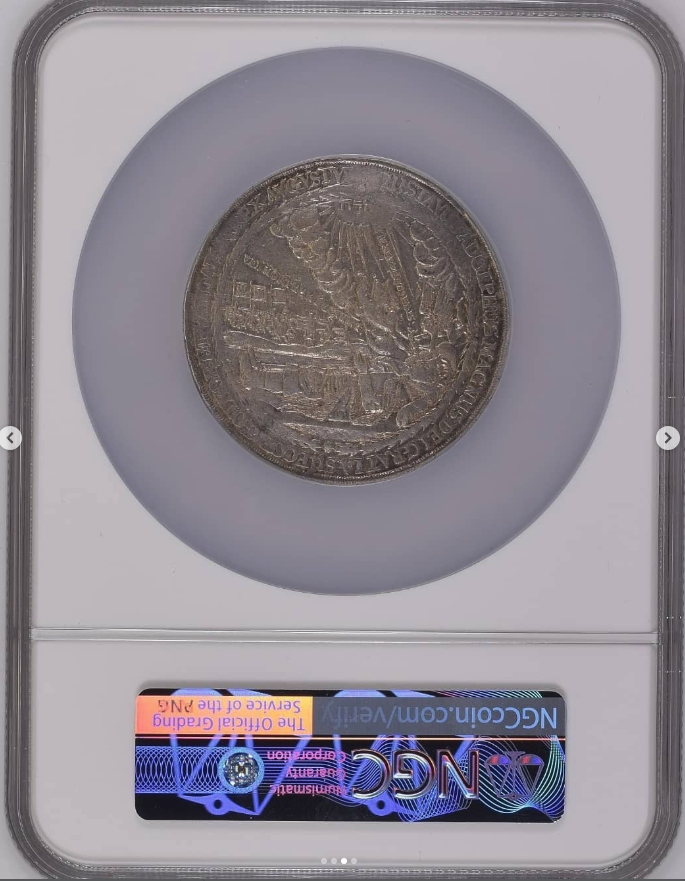
The propaganda is total. The obverse shows Gustavus Adolphus enthroned on the Roman Triumphal Chariot, drawn not by horses but by three winged Pegasi, crowned simultaneously by personifications of Religion (with cross and chalice) and Justice (with sword and scales), with the Latin motto ET VITA ET MORTE TRIUMPHO ("In Life and in Death I Triumph") above. The chariot wheels crush a fallen figure of the Devil holding the papal tiara - the Catholic Church and the Pope rendered as the Antichrist, in the most direct possible Lutheran iconography. The reverse depicts the body of the King in full ceremonial armour lying on the battlefield of Lützen at sunrise, his soul borne aloft by two angels toward the Hebrew Tetragrammaton יהוה ("YHWH") in glory above, with the legend EUGE SERVE FIDELIS ("Well done, faithful servant" - Matthew 25:21). In the middle distance, the Swedish army pursues and destroys the Catholic Imperialists, and below the scene runs the bitter motto VEL MORTUUM FUGIUNT - "They flee before him, even when he is dead."
What happened next is among the strangest stories in numismatic history. As the funeral procession moved through Wolgast, the freshly-struck silver coins were thrown by the handful from the windows of Queen Eleonora's carriage into the streets, in the old custom of largesse at a royal cortege - except that the silver value involved was, in 1633 terms, several lifetimes' wages thrown out at random into a packed crowd. Witnesses described the resulting chaos: the coins were trampled into the mud by the procession's own horses and carriages, fights broke out in the street, and contemporary chroniclers recorded that approximately 36 people were killed - crushed underfoot, trampled by carriage horses, or stabbed in the brawl - in the scramble for the king's silver. The combination of an absurdly tiny mintage, the fact that surviving examples were physically run over by carriage wheels in the moment of distribution, and the long centuries since, means the survival rate of the Wolgast funeral coinage is extremely low. Even the Davenport reference for the type was assigned only after extensive 20th-century scholarship sorted out the Erfurt-Wolgast attribution.
This example - 57.76g, NGC XF Details (Mount Removed, reflecting that at some point in its 390-year life it was set into a piece of jewellery), Tavory Collection - is one of perhaps a dozen surviving 2 Thalers from the recorded mintage of 60.
- Davenport - Large Size Silver Coins of the World, LS-274 (Wolgast / Erfurt funeral 2 Thaler of Gustavus Adolphus, 1633).
- Hildebrand - Sveriges och Svenska konungahusets minnespenningar (Swedish royal commemorative coinage, Gustavus Adolphus funeral series).
- Ahlström-Almer-Hemmingsson - Sveriges mynt 1521-1977 (the Wolgast funeral mintage figures: 16 / 20 / 40 / 60 / 120 / 240 / 700).
- NGC Cert 2860239-001 - XF Details, Mount Removed.
- Tavory Collection (provenance).
- Geoffrey Parker - The Thirty Years' War (rev. ed., Routledge) - background on Lützen and the Swedish phase.
- Michael Roberts - Gustavus Adolphus: A History of Sweden 1611-1632 - definitive English-language biography.
- Matthew 25:21 (EUGE SERVE FIDELIS, source of the reverse legend).