
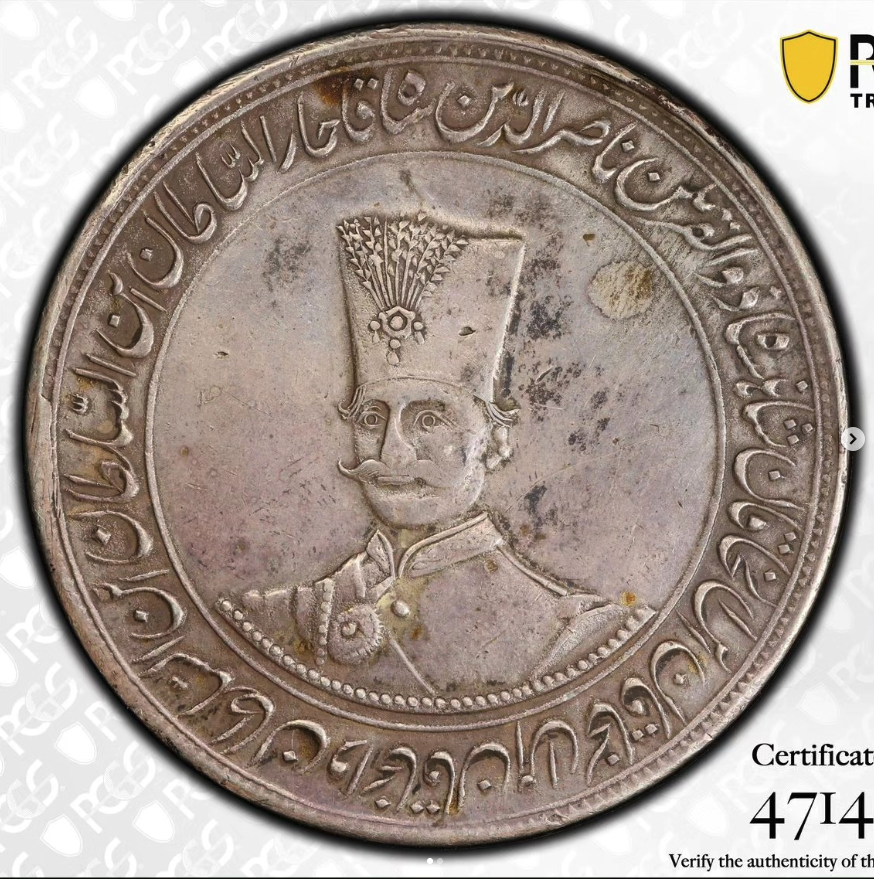
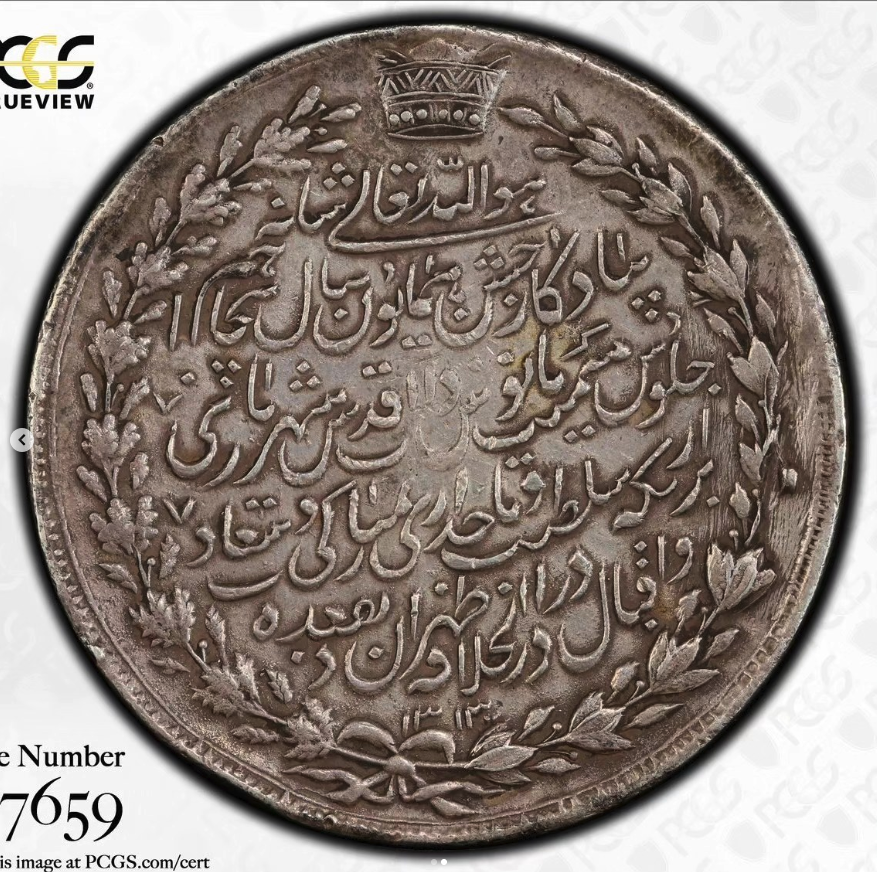
"1896" (restruck c. 1930) Toman (10,000 Dinars)
A massive 60mm jubilee toman struck only weeks before the Shah's assassination - this example a Belli Bank restrike from the 1930s.
- Metal
- Silver
- Grade
- PCGS XF Detail · Spot Removed
Full attribution & era
The history behind the coin.
Nasir al-Din Shah Qajar ruled Persia from 1848 until his assassination in 1896 - one of the longest reigns in Persian history. He was also one of the most disastrous. Throughout his reign, he sold off Persia's economic sovereignty piece by piece to foreign powers in exchange for personal enrichment, most infamously through the 1872 Reuter Concession (which gave a single British subject sweeping rights over Persian railways, mines, and banking) and the 1890 Tobacco Concession (which sparked nationwide protests and the Tobacco Boycott led by the Shi'a clergy). His incompetence and corruption united an unprecedented coalition of clergy, merchants, and intellectuals against the throne - a coalition that ultimately erupted in the Constitutional Revolution of 1906.
Nasir al-Din Shah was assassinated on 1 May 1896 at the Shah Abdol-Azim Shrine south of Tehran by Mirza Reza Kermani, a follower of the pan-Islamic reformer Jamal al-Din al-Afghani. He was shot at point-blank range with a rusty revolver - had he been wearing a slightly thicker coat, he might well have survived. Today in Iran his assassin is widely regarded as a national hero of the constitutional movement.
This enormous silver Toman (10,000 Dinars) - approximately 60mm in diameter and weighing 46 grams - was struck only a few weeks before the Shah's death, to commemorate the 50th anniversary of his accession. The obverse shows his uniformed bust in the tall Qajar kolah hat, surrounded by his full Persian titulature. The reverse carries a long Persian inscription within a wreath, dated to the 50th year of his reign and crowned at the top.
This particular example is one of a small number of restrikes produced from the original dies in the 1930s by the Bank Belli (Bank Melli Iran) for reasons that have never been fully explained - sometimes attributed to presentation use, sometimes to bank archival purposes. Either way, original or restrike, the type itself is a final monument to a regime that was about to come apart.
- KM-Y-A41 (Krause - Standard Catalog of World Coins).
- Album, Stephen - Checklist of Islamic Coins.
- Amanat, Abbas - Pivot of the Universe: Nasir al-Din Shah Qajar and the Iranian Monarchy, 1831-1896.