
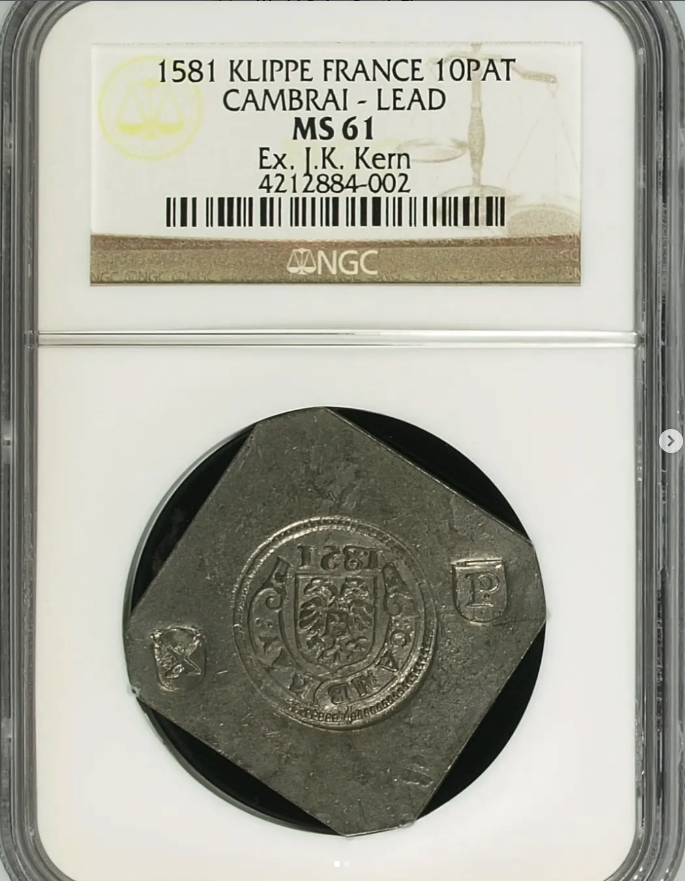
1581 Klippe 10 Patards
Lead emergency klippe struck inside besieged Cambrai in 1581 - ex Archer M. Huntington and Jonathan K. Kern collections, prior auction record CHF 1,200 (NGSA 2012) and USD 1,320 (CNG 2018).
- Metal
- Other
- Grade
- NGC MS 61
Full attribution & era
The history behind the coin.
In the summer of 1581, the Duke of Parma - Alessandro Farnese, Philip II's commander in the Spanish Netherlands - was campaigning in the rebel United Provinces when word reached him that France had openly entered the Eighty Years' War on the Dutch side. Acting with characteristic speed, Parma turned his army around and marched on Cambrai, the obvious staging ground for any French invasion of the Spanish Netherlands. He stripped the surrounding countryside, isolated the city, and settled in to starve it out.
Conditions inside the walls quickly became desperate. The numismatist and chronicler van Loon recorded that "the people were eating meat from horses, dogs, cats, and rats; the price of a cow rose to 300 guilders, a sheep 50 guilders; for a pound of butter 24 stuivers was paid, for an egg 2 stuivers, and for an ounce of salt 8 stuivers" - figures that, against an average peasant's wage of about 6.5 guilders a week (36 stuivers to the guilder), describe near-total economic collapse.
The city held out because help was on the way. The Duke of Anjou (François, brother of Henri III, here called by his alternate ducal title Duke of Alençon) was advancing with a relief army of 10,000 infantry and 4,000 cavalry. On 16 August 1581 Anjou's army formed up for battle outside Cambrai. Parma, recognising the disadvantage he was at, prudently withdrew, and the siege was lifted.
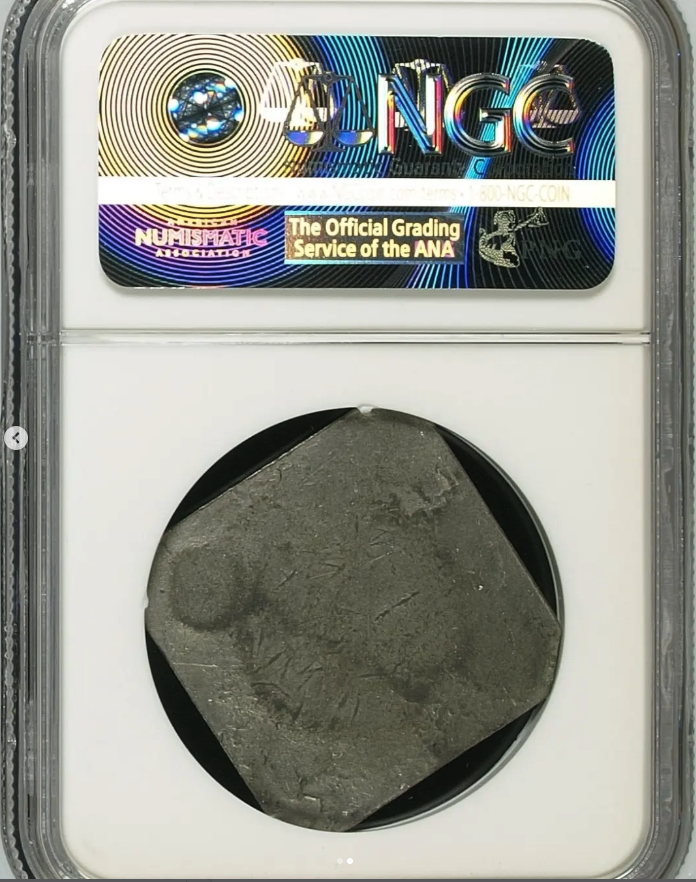
To pay troops and merchants during the blockade, the city authorised emergency money struck in the only metal available in quantity inside the walls: lead, stripped from roofs and water-pipes. This piece is one of those issues - a roughly cut lead klippe struck on a square flan with a single die. The obverse carries the Imperial double-headed eagle in a beaded circle with the date 1581 above and the city legend, flanked by two countermarks - a small shield with crossed bars at left and a stamped "P" at right - applied to validate the lead currency for circulation. The reverse is left blank as struck, the lead surface showing the soft pewter-grey patina of a four-and-a-half-century-old emergency strike.
NGC has graded this example MS 61 - an extraordinary preservation grade for a lead obsidional issue. The double-headed eagle and the date are sharp, both countermarks are crisp, and the flan retains its full original square geometry without the corrosion or breakage that destroys most surviving lead siege coins. The provenance is equally distinguished: the coin comes from the cabinet of Archer M. Huntington (1870-1955), founder of the Hispanic Society of America, and later from the celebrated holdings of Jonathan K. Kern. It sold uncertified in Numismatica Genevensis SA Auction 7, lot 577 (2012) for CHF 1,200 including premium, and again as this exact piece in CNG Auction 108, lot 1050 (2018) for USD 1,320 including premium. Documented in Dr. Lawrence Korchnak's "Siege Coins of the World, 1453-1902."
- Dr. Lawrence Korchnak - Siege Coins of the World, 1453-1902.
- Mailliet - Catalogue descriptif des monnaies obsidionales et de nécessité (Cambrai 1581).
- Numismatica Genevensis SA, Auction 7 (2012), lot 577 - CHF 1,200 inc. premium.
- CNG Auction 108 (2018), lot 1050 - USD 1,320 inc. premium.
- Ex Archer M. Huntington Collection / Ex Jonathan K. Kern Collection.
- NGC Cert 4212884-002 (MS 61).