
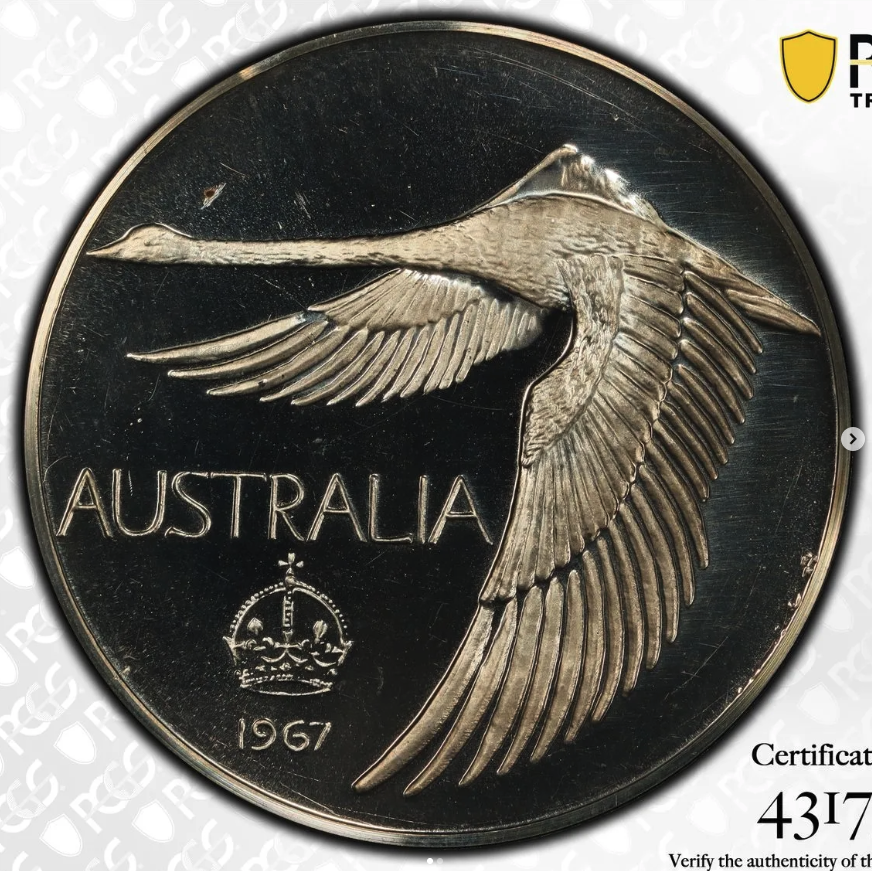
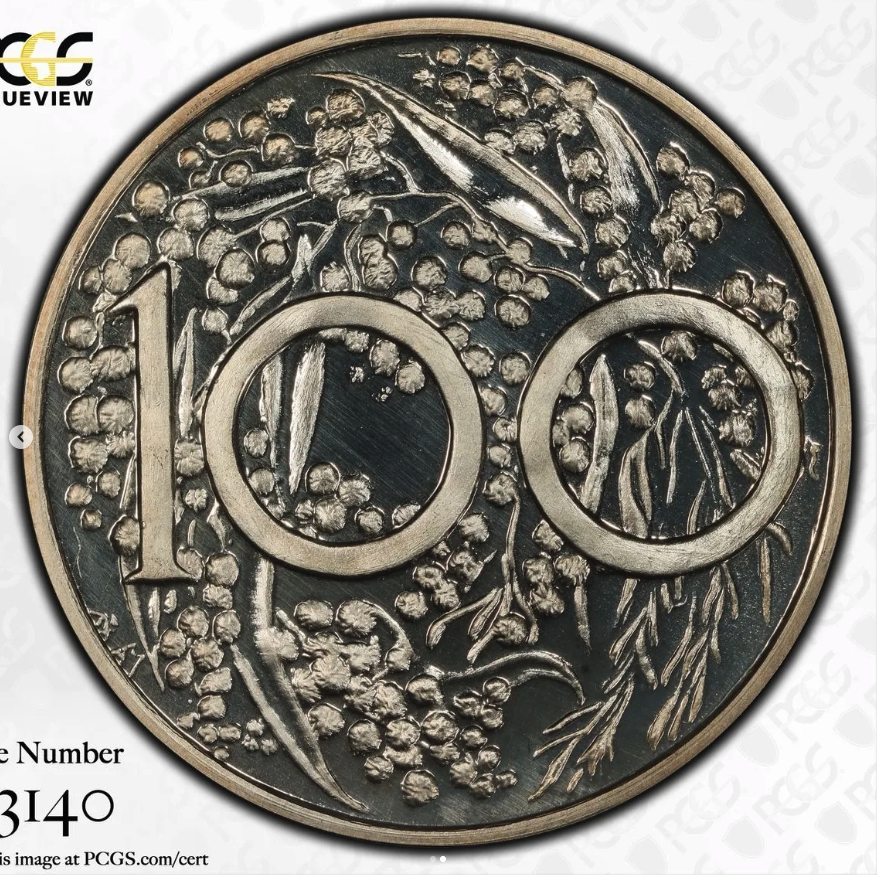
1967 Pattern Dollar (Andor Mészáros 'Swan' Crown)
A deep-cameo Proof example of the famous 1967 Mészáros 'flying swan' pattern dollar - struck by John Pinches of London in just 750 plain-edge proof pieces.
- Metal
- Silver
- Mint
- John Pinches, London
- Grade
- PCGS PR-67 DCAM
Full attribution & era
The history behind the coin.
In 1965, with Australia preparing to abandon the pound for a new decimal currency, the Australian Coin Review magazine launched an internationally contested design competition for an unofficial Australian decimal crown. The Hungarian-born Australian sculptor Andor Mészáros - one of the great medallic artists of the 20th century - submitted designs that were originally intended as the reverse of a twenty-cent coin (the swan in flight) and the reverse of a two-cent coin (the wattle-and-100 design). The official panel chose not to use them on the circulating series because it was seeking a unified Australian-fauna theme across all denominations rather than a set of individual artistic statements.
In 1967, the original designs were re-worked and combined onto a single pattern crown denominated as 100 cents (one dollar). The pieces were struck by John Pinches of London - one of the great private medallic mints - in three official versions: 1,500 silver specimens with a milled edge, 750 silver Proofs with a plain edge, and just 10 gold Proofs (also plain edge), with a single thick lead trial strike also recorded.
The obverse shows a magnificent black swan in full flight, wings spread, with AUSTRALIA, an imperial crown, and the date 1967 in the lower-left field - a pure piece of medallic sculpture rather than mass-coinage design. The reverse carries the denomination 100 within a dense composition of golden wattle - Australia's national flower - with Mészáros' AM monogram quietly placed in the lower field.
This piece is graded PCGS PR-67 Deep Cameo, the upper grade for the issue: deep mirrored fields with strong frosted relief on both the swan and the wattle composition. As the small-mintage plain-edge Proof variant, it is the most desirable of the silver versions, and a high-grade Deep Cameo example is exactly the way the Mészáros pattern dollar is meant to be appreciated - more sculpture than coin, and one of the finest pieces of 20th-century Australian medallic art.
- Renniks - Australian Coin and Banknote Values (Mészáros pattern dollar listings).
- Andrews - Australasian Tokens and Coins.
- John Pinches (London) - 1967 striking records for the Australian pattern dollar.
- PCGS Cert (PR-67 DCAM).