
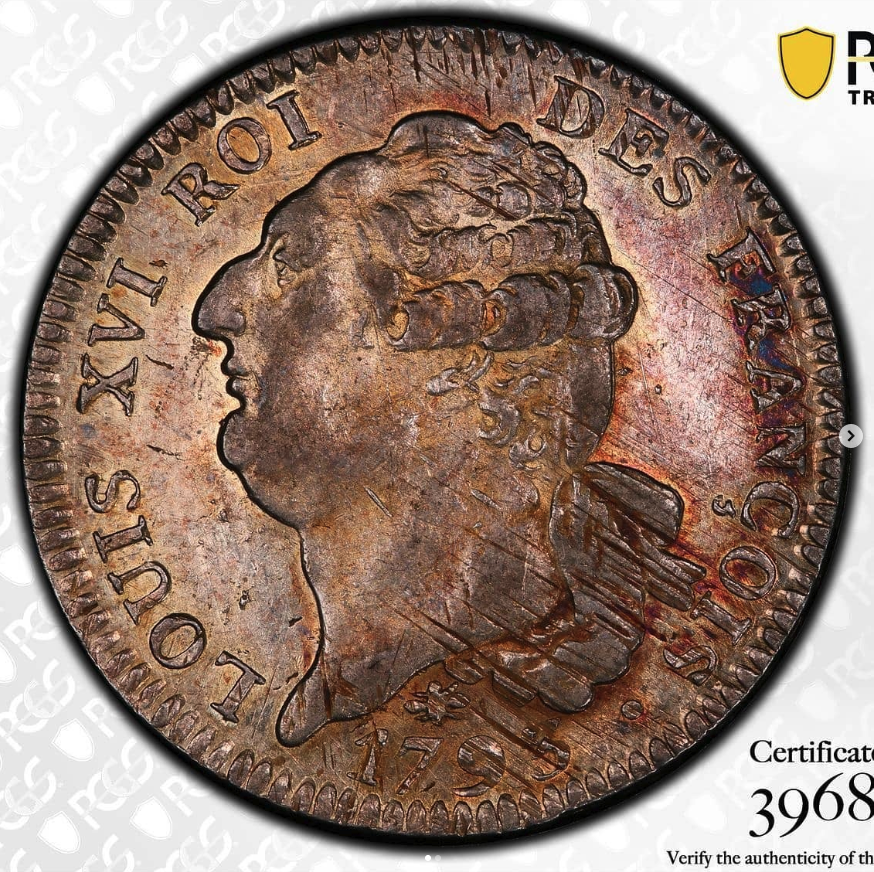
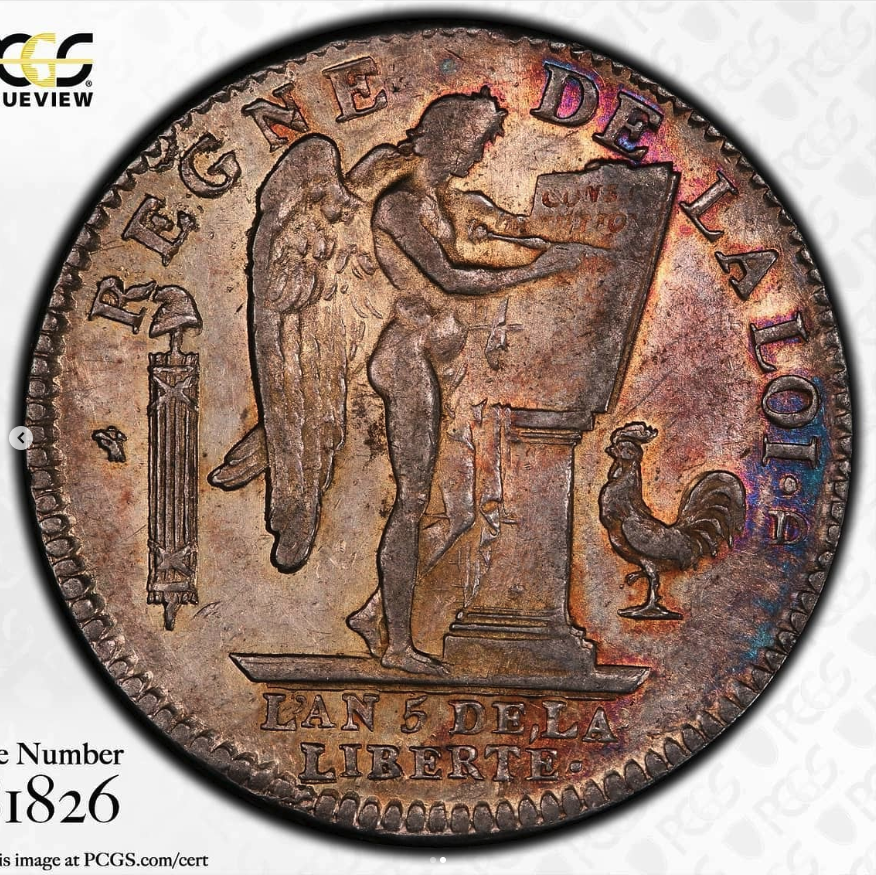
1793 (L'An 5 de la Liberté) AR Écu de 6 livres 'Constitutionnel' (29.4g)
A 'Constitutional' écu of Louis XVI struck at the Lyon mint (mintmark D) in 1793 - after the King had already been deposed and executed - by Federalist rebels who had seized the mint during the August-October 1793 uprising against Robespierre. Possession of this coin during the Terror was a capital offence. PCGS AU-55 with bold rainbow toning.
- Metal
- Silver
- Grade
- PCGS AU-55
- Cert #
- 39681826
Full attribution & era
The history behind the coin.
On 10 August 1792 a crowd of roughly 30,000 sans-culottes stormed the Tuileries Palace, massacred the Swiss Guard, and forced the Legislative Assembly to suspend Louis XVI. The Convention proclaimed the Republic on 22 September 1792. On 21 January 1793, after a one-day trial in which he was convicted of treason, Louis XVI was guillotined on the Place de la Révolution.
The constitutional écu - the design of 1791 showing Louis as a constitutional monarch on the obverse and the winged Génie of France inscribing the Constitution on the reverse, with the legend RÈGNE DE LA LOI ("Reign of the Law") - had been authorised under the short-lived 1791 Constitution. After the King's execution the Convention ordered the type replaced by a new Republican écu showing only Hercules, Liberty and Equality. But the Republic could not retool fast enough: there was a desperate shortage of crown-size silver coin, and most provincial mints simply continued to strike from the existing constitutional dies through 1793 even though the man on the obverse was already dead.
Lyon was uneasy from the beginning. France's second city, dominated by silk merchants and a relatively moderate municipal government, had voted overwhelmingly with the Girondins - the centre-left faction that had supported deposing the King but had opposed his execution. On 2 June 1793 Maximilien Robespierre and the Jacobins purged the Girondins from the Convention by force; the leading Girondin deputies were arrested and most were guillotined after a show trial in October. When the news reached Lyon in late summer the city rose. On 9 August 1793 Lyon declared itself in open rebellion against the Jacobin Convention, joined within weeks by Toulon, Marseille, and the Catholic peasant army of the Vendée. The combined uprising became known as the Federalist Revolt - the insurrection fédéraliste.
The Lyon rebels seized the city's mint. They deliberately destroyed the new Republican dies prepared for the Hercules écu and continued to strike the old constitutional écu of Louis XVI - the present coin - bearing the dead King's portrait, the date 1793, and the Lyon mintmark D. The act was simultaneously a practical response to the silver shortage and a deliberate political provocation: a counter-revolutionary coinage struck in defiance of the Convention, on legal-tender silver, with the face of the executed monarch.
Lyon held out for two months under siege by the Convention's army. The city surrendered on 9 October 1793. Edmond Dubois-Crancé and his successors on the Committee of Public Safety - Couthon, Collot d'Herbois and Fouché - carried out one of the most brutal reprisals of the entire Revolution. The Convention voted that Lyon should be physically destroyed and renamed Ville-Affranchie ("the Liberated Town"). Demolition crews began pulling down houses. Mass executions followed: standard guillotinings could not keep up with the volume of condemned, and on 4-8 December 1793 hundreds of Lyonnais rebels were tied together, lined up in open trenches in the Plaine des Brotteaux, and killed by direct cannon-fire at point-blank range, the survivors finished with sabres. Roughly 25 percent of all 17,000 official guillotine victims of the Reign of Terror were rebels from Lyon, and total Lyon casualties from the reprisals - guillotine, mitraillades, summary executions - are estimated at well over 10,000.
To be found in possession of this coin during the months that followed - or any monarchist symbol, weapon, or printed material - was effectively a death sentence. Survival rates of the 1793-D Lyon constitutional écu are correspondingly low, and a problem-free, well-toned example like this PCGS AU-55 with original deep iridescent rainbow toning is genuinely rare.
- Gadoury - Monnaies Royales Françaises 1610-1792, no. 55 (Écu Constitutionnel).
- Duplessy - Les Monnaies Françaises Royales, no. 1718.
- PCGS Cert 39681826 - AU-55.
- Donald Greer - The Incidence of the Terror during the French Revolution (1935) - statistical breakdown of the 17,000 guillotine victims.
- W. D. Edmonds - Jacobinism and the Revolt of Lyon, 1789-1793 (Oxford, 1990).
- Bill Edmonds / Paul Mansfield on the mitraillades of the Plaine des Brotteaux, December 1793.
- Simon Schama - Citizens: A Chronicle of the French Revolution (1989) - the Federalist Revolt and the destruction of Lyon.