
1572 Klippe Daalder
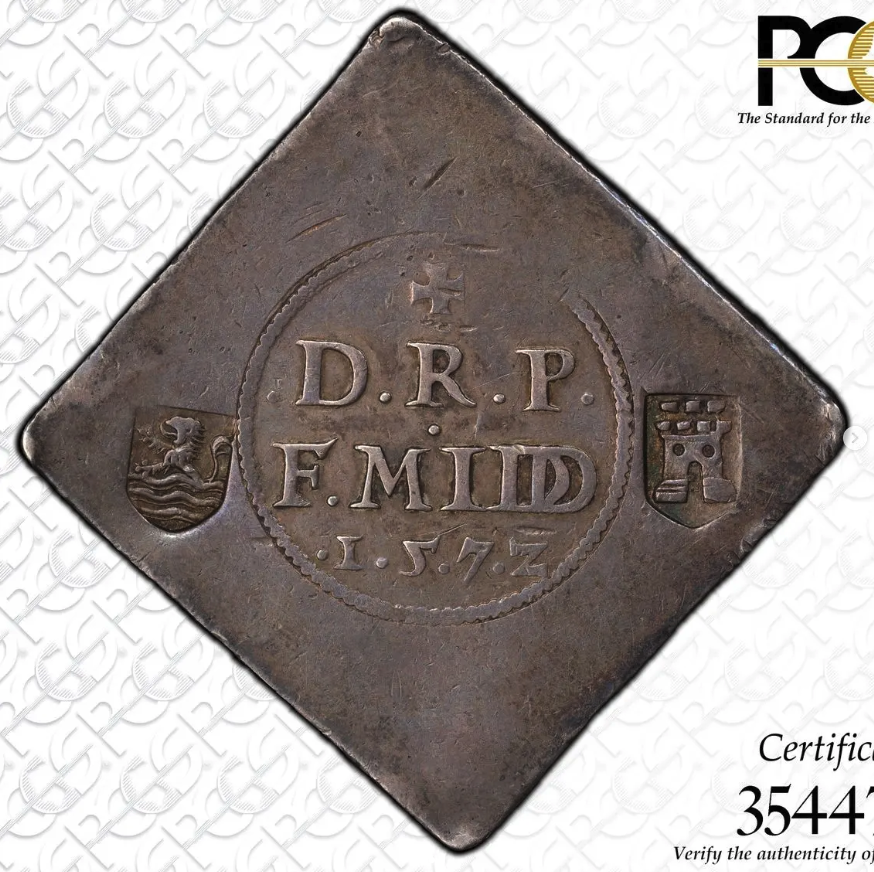
Diamond-shaped uniface siege klippe struck inside Spanish-held Middelburg in 1572 - dated 1572 with the arms of Zeeland and Middelburg flanking the cross-topped legend D.R.P. F.M.II.D. for Philip II. Ex Korchnak, the standard reference on siege coins.
- Metal
- Silver
- Grade
- PCGS XF 45
- Pedigree
- Ex Dr. Lawrence Korchnak, author of Siege Coins of the World, 1453-1902
Full attribution & era
The history behind the coin.
During the Eighty Years' War for Dutch independence, the Zeeland capital of Middelburg was one of the very few major cities to remain loyal to King Philip II of Spain. In February 1572 the rebel Dutch and their Sea Beggars allies opened the dikes around the city, deliberately flooding the surrounding countryside to cut off the resupply of the Spanish garrison and to contaminate the wells with brackish water. The Spanish responded by laying siege to the rebel-held city of Haarlem in Holland in an attempt to force the Dutch to lift the blockade of Middelburg.
When Haarlem finally fell in July 1573, the Spanish commander Don Fadrique de Toledo executed the surviving 1,800-man garrison by hanging or drowning, and offered the civilian population the choice between conversion to Catholicism and the sword. Spanish records put the resulting death toll at roughly 95 percent of those who had held out. The massacre at Haarlem, far from breaking the rebel will, only hardened the Sea Beggars' blockade of Middelburg. In early December 1572 the Spanish, now critically short of food and powder inside Middelburg, loaded twenty supply ships and tried to run the blockade. The Sea Beggars captured six of them, including the Spanish flag-captain. In direct retaliation for Haarlem, his severed head was catapulted over the Middelburg city walls.
By mid-1573 the Dutch had taken the dry island created by the flooding and were closing in on the walls themselves. In August 1573 the city expelled its old, sick, and pauper population - a standard but brutal early-modern siege measure - to stretch the remaining food. In March 1574, with Middelburg still holding but starving, the new Spanish governor Don Luis de Requesens organised one last great relief attempt: a fleet of nearly one hundred ships sent into the Scheldt estuary to break through to the city. In the opening engagement nine of the Spanish ships were taken and none reached Middelburg. In the second action the Sea Beggars deliberately allowed the Spanish admiral to grapple their flagship, then blew their own ship up - destroying both vessels in a shower of bodies and burning lumber and breaking the morale of the rest of the relief fleet. With no further hope of resupply, the Spanish garrison surrendered the city after a siege of more than two years.
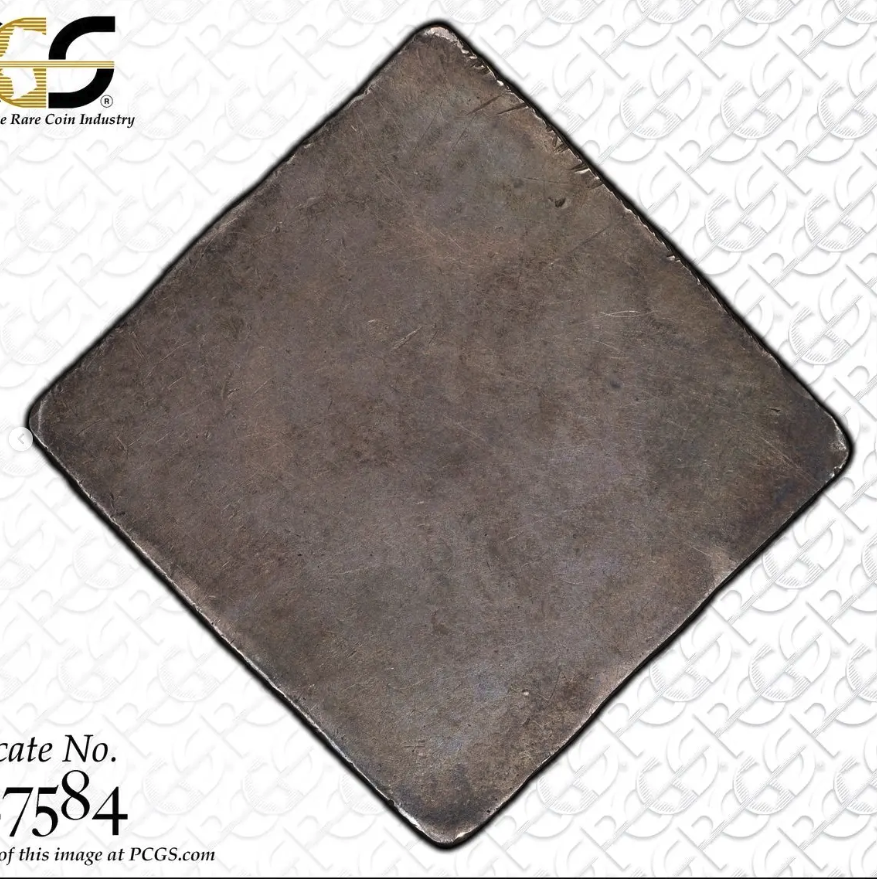
It is to the desperate middle of that siege that this coin belongs. Dated 1572 and struck inside Middelburg from the city's remaining silver, it is a typical Dutch obsidional klippe - a heavy diamond-shaped flan, struck only on one face, with the reverse left as the unfinished blank where the press struck the lead anvil. The obverse carries a cross above the abbreviated royal legend D·R·P· / F·M·II·D· (Dei gratia Rex Philippus Filius Maximiliani II Dux - "Philip, by the grace of God King, son of Maximilian II, Duke") and the date 1572, all enclosed by a beaded inner circle and flanked by the small heraldic shields of Zeeland (the lion rising from the waves) on the left and Middelburg (the castle gate) on the right. PCGS has graded this example XF 45 - the design fully readable on a heavy original silver flan with the deep grey patina and minor planchet wrinkling characteristic of authentic siege strikings.
The piece comes with the strongest provenance possible for a Netherlands obsidional: ex the collection of Dr. Lawrence Korchnak, author of Siege Coins of the World, 1453-1902, the standard modern reference on the entire field.
- Dr. Lawrence Korchnak - Siege Coins of the World, 1453-1902 (ex collection).
- Mailliet, P. - Catalogue descriptif des monnaies obsidionales et de nécessité (Middelburg, 1572).
- Delmonte - De Zilveren Benelux (Middelburg siege issues).
- Geoffrey Parker - The Dutch Revolt - on the sieges of Haarlem and Middelburg.
- PCGS Cert 35447584 - XF 45.