
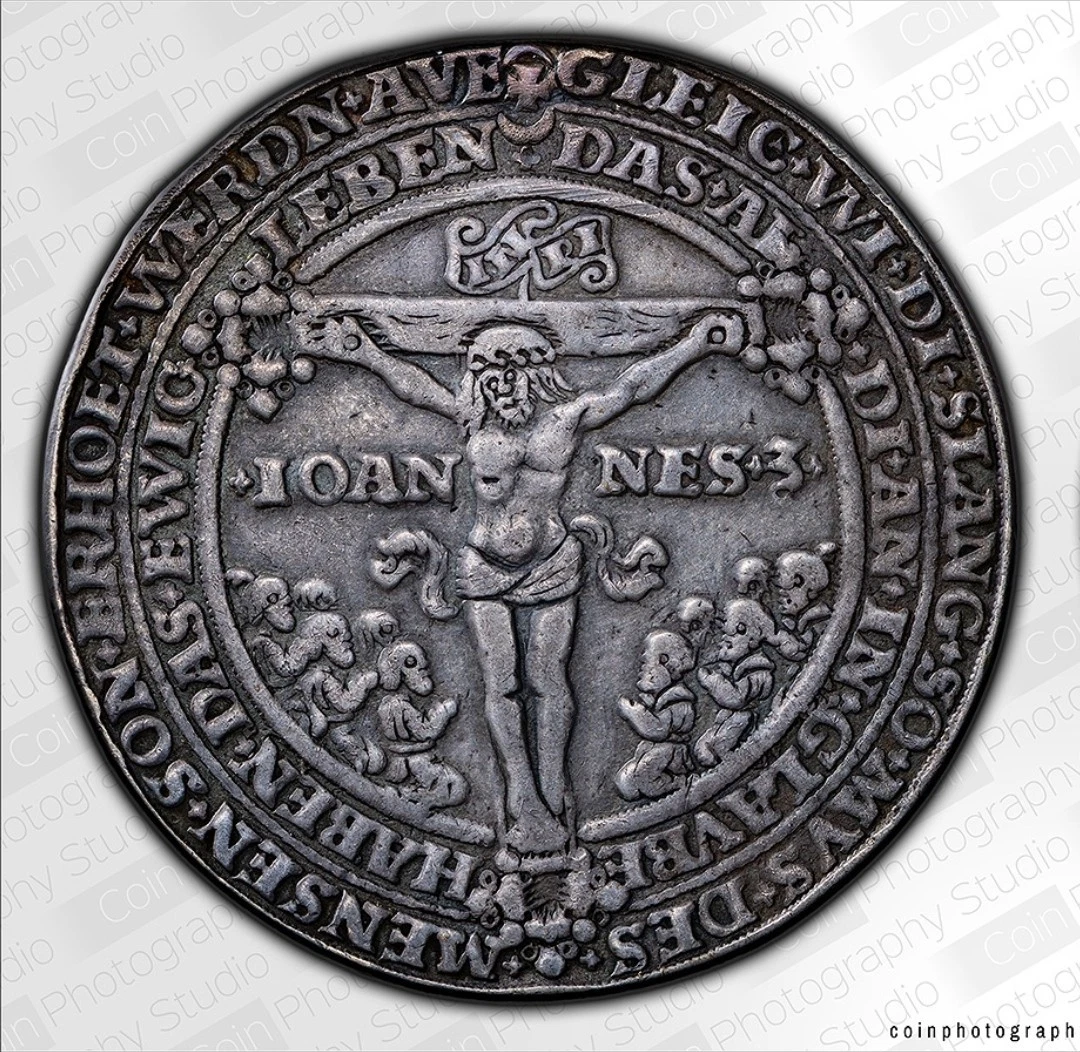
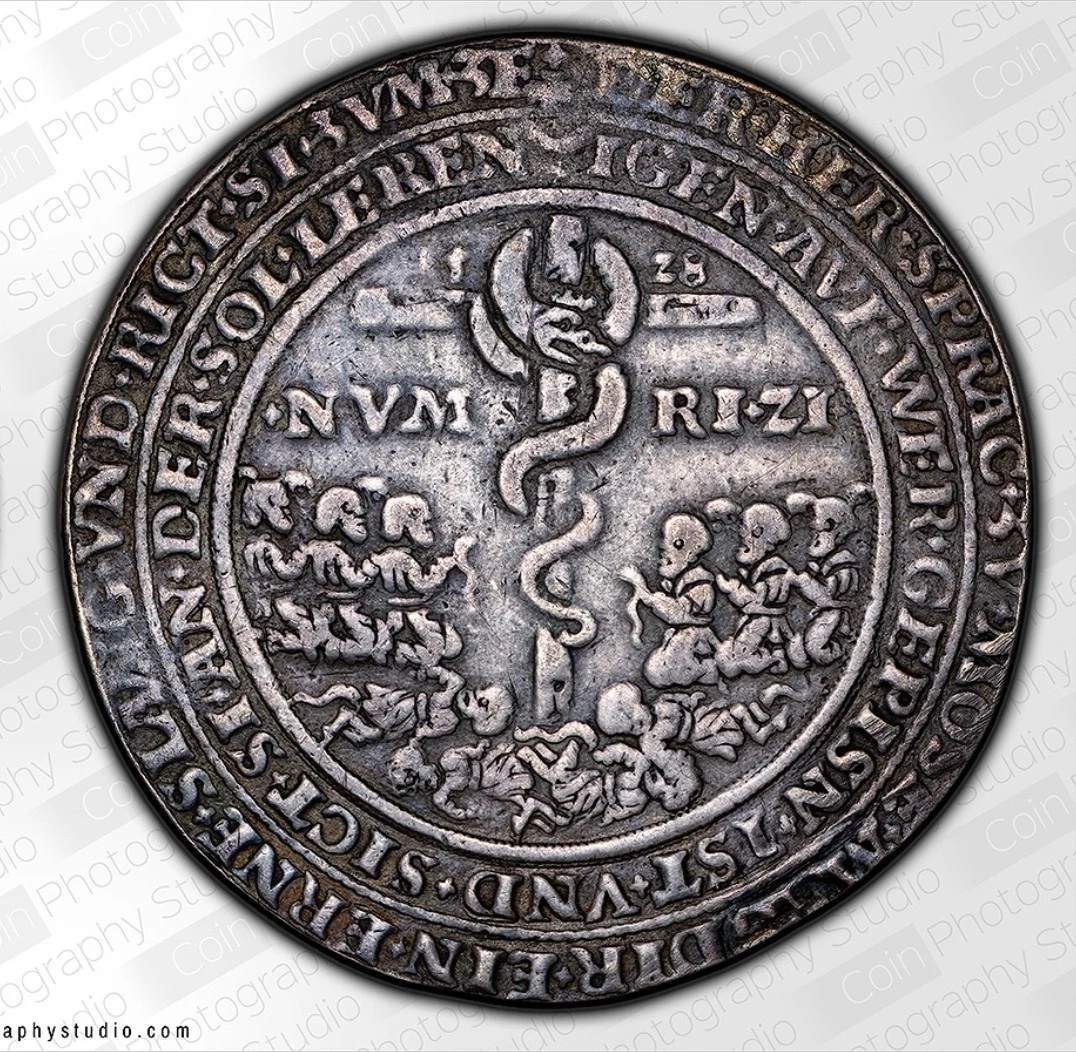
c. 1528 Religious Pesttaler (Pestilence Thaler)
The Joachimsthal 'Pesttaler' or Snake Thaler - a devotional plague medal pairing the Crucifixion with the Brazen Serpent of Moses (Numbers 21), the great Reformation typology of Christ as the cure for a dying world. Struck in the Bohemian valley that gave the world the word 'Dollar.'
- Metal
- Silver
- Grade
- Fine
Full attribution & era
The history behind the coin.
In 1516 Count Stephan Schlick of Bohemia discovered an extraordinarily rich vein of silver in a wooded valley on the Erzgebirge frontier between Bohemia and Saxony. The town that exploded out of the forest around the strike was named Sankt Joachimsthal (today Jáchymov in the Czech Republic) - 'St. Joachim's Valley.' The Counts Schlick obtained an imperial mint privilege from the Bohemian Diet in 1520 and began striking large silver coins of roughly 29 grams from their own ore. Within a generation the coins were so widely circulated and so trusted that the world simply called them 'Joachimsthaler' - shortened in everyday speech to 'Thaler.' That name traveled with the coin: through German into Dutch as 'daalder,' into Scandinavian 'daler,' and into English as 'dollar.' Every U.S. dollar in circulation today is, etymologically, a coin from this Bohemian silver valley.
The Joachimsthal mint also produced from the late 1520s onward a remarkable series of large religious medallic Thalers - oversized devotional pieces struck with biblical scenes on both sides, intended for presentation, gifting at weddings and christenings, and quiet personal devotion in the heated theological climate of the early Reformation (Luther had nailed his 95 Theses just nine years before this coin was struck, and Bohemia was already a hundred years post-Hussite). They are some of the most ambitious figural die-cutting of the entire 16th century.
This piece is the so-called Pesttaler - the Pestilence Thaler, or Snake Thaler - one of the most theologically loaded of the entire Joachimsthal devotional series. The obverse shows the Crucifixion: Christ on the cross, the inscription at his waist reading † IOAN NES 3, pointing the reader to the Gospel of John chapter 3 - 'For God so loved the world, that he gave his only begotten Son, that whosoever believeth in him should not perish, but have everlasting life.' The rim legend wraps the great Johannine typology in German: 'As Moses lifted up the serpent in the wilderness, even so must the Son of man be lifted up.' The kneeling worshippers at the foot of the cross are the faithful - those who look upon the crucified Christ and live.
The reverse delivers the Old Testament type that the obverse legend announces: the Brazen Serpent of Numbers 21. When the Israelites murmured against God in the wilderness, he sent fiery serpents among them, and many died. When they repented, God told Moses to make a serpent of bronze and set it on a pole - 'and it shall come to pass, that every one that is bitten, when he looketh upon it, shall live.' The reverse die shows the serpent coiled around the cross-shaped pole, the stricken Israelites lying on the ground around it, the inscription NVM RI 21 pointing the reader to the chapter, and the rim legend quoting the German of Moses' command. The pairing is pure Reformation typology - the Brazen Serpent lifted up in the wilderness is the type, Christ lifted up on the cross is the antitype, and to look on either in faith is to live.
The Pesttaler earned its name because these pieces were carried and given in times of plague - the serpent-on-a-pole was both the biblical cure and the contemporary apothecary's sign, and a coin that put that image into a sufferer's hand was a piece of silver theology, a tangible promise that the same God who healed the Israelites could heal the dying. Struck in the same valley, possibly from the same vein of silver, that gave the modern world its most-spoken word for money: the dollar.
- Doneberg, Donebauer & Donebauer-Slg. - Münzen der Grafen Schlick.
- Davenport, John S. - German Talers 1500-1600.
- MacKay, Pierre - 'Joachimsthaler and the Origin of the Dollar' (ANS).
- Whaley, Joachim - Germany and the Holy Roman Empire, Vol. I.
- Holy Bible - Numbers 21:8-9; John 3:14-15; John 3:16.